Custom Event Lanyards: Width, Print Method, and Attachment Choices
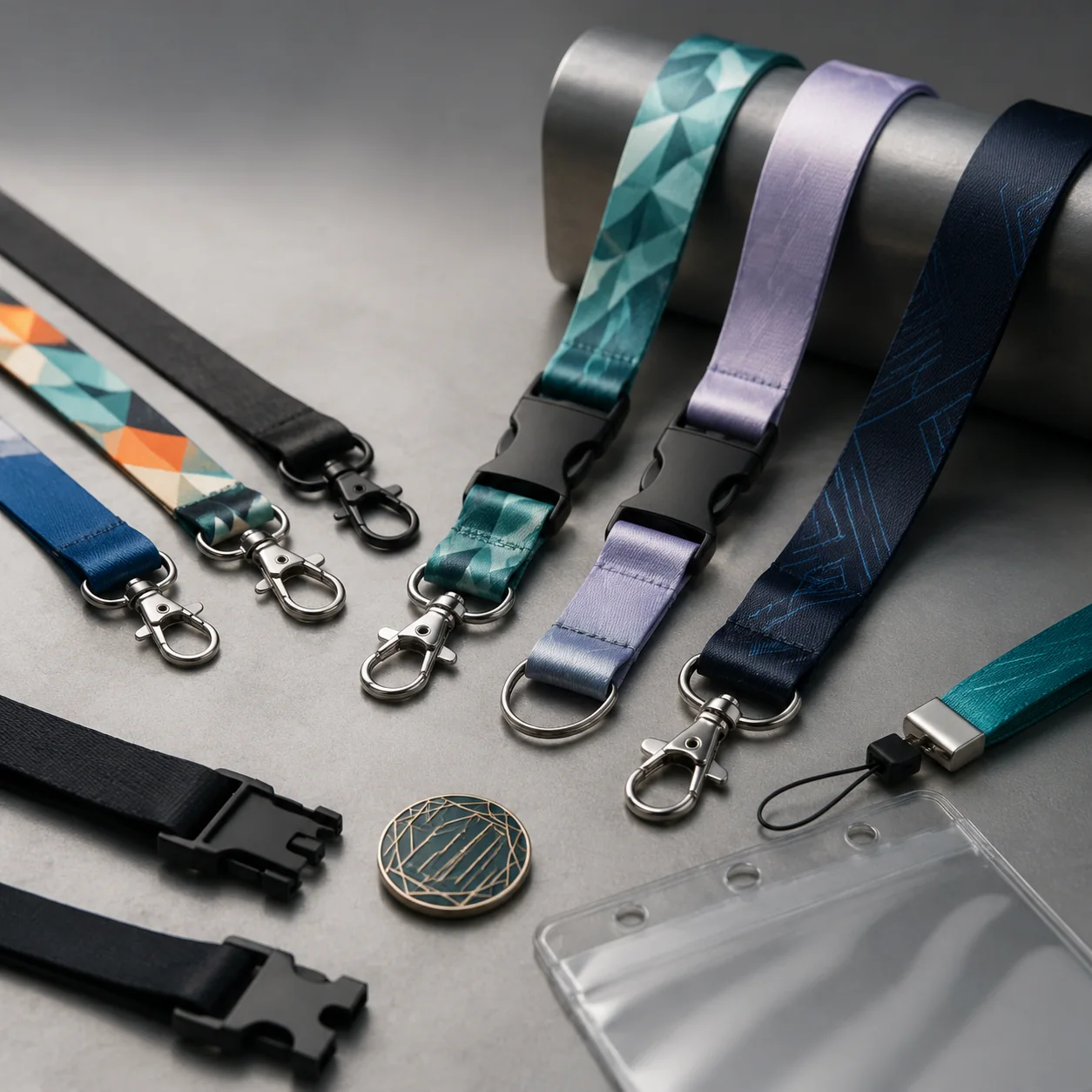
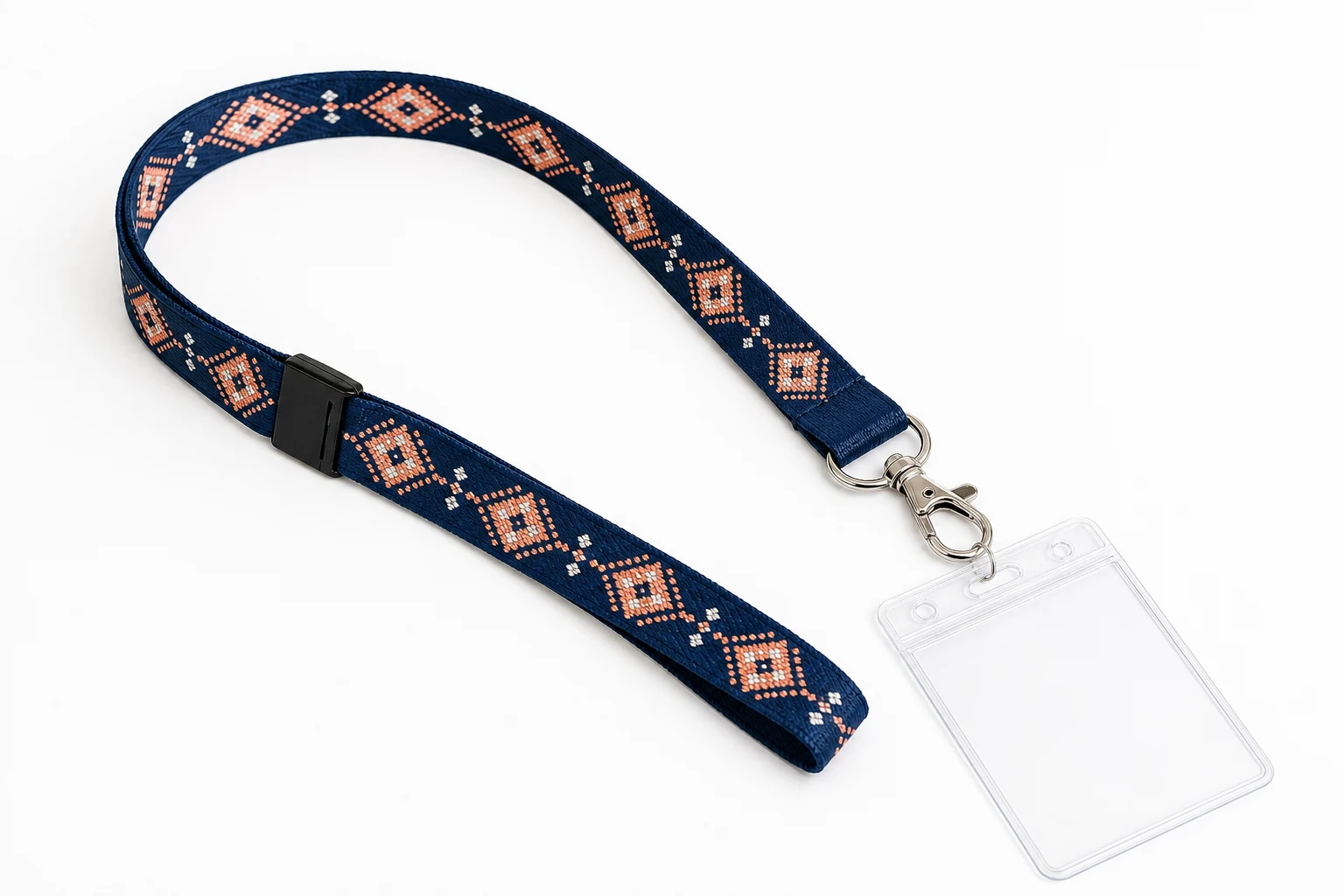
For a dependable event default, specify a 20mm polyester lanyard with a 900mm loop, silk-screen printing for a simple one-to-three-color identity, a swivel J-hook, and a breakaway safety buckle. Move to dye-sublimation when artwork needs full color, gradients, photos, or printing on both sides. Choose woven jacquard when a textured, non-peeling woven design matters more than full-color reproduction. Confirm the badge or holder connection with the exact attachment before bulk production, because the available product information lists attachment options but does not provide compatibility dimensions or load-test data.
Start With a Readable, Wearable Default
Conference credentials need to keep badges available for access control while making the event identity visible as attendees move through the venue. A practical starting specification from the available range is a 20mm polyester lanyard, listed as the standard width. Pair it with the standard 900mm loop, then choose the print method, attachment, and safety extras around the artwork and credential setup.
This event lanyard width and attachment guide is a specification framework, not a substitute for sample approval. The available facts establish widths of 10mm, 15mm, 20mm, and 25mm; polyester as the default material; and several printing and hardware options. They do not establish a universal comfort rating, badge compatibility chart, attachment strength value, packed quantity, or inspection standard. Procurement teams should identify those missing controls before releasing a bulk order.
For international buyers, a complete default reduces ambiguity across artwork, purchasing, event operations, and receiving teams. State the width in millimeters, material, print method, loop length, attachment, and every requested extra in the RFQ. A request for custom event lanyards described only as branded lanyards leaves too many functional choices open.
Choose Width From the Available 10mm to 25mm Range
Width is the first visual constraint because it defines the strap format available to approved artwork. The product range offers 10mm, 15mm, 20mm, and 25mm widths. The product lede identifies 15-25mm as the standard range, while the specification table identifies 20mm as standard. That makes 20mm the clearest default when the event has not already approved a strap size.
| Width option | Evidence-supported position | Buyer decision |
|---|---|---|
| 10mm | Listed width option | Use only when the approved artwork and event team accept the narrowest listed strap format. |
| 15mm | Within the listed standard 15-25mm range | Use when the event has approved a 15mm specification and the artwork has been reviewed at that width. |
| 20mm | Listed as the standard width | Use as the default RFQ width for a general event lanyard specification. |
| 25mm | Within the listed standard 15-25mm range | Use when the event has approved a 25mm strap and wants that wider listed format for its artwork. |
Do not treat width as a stand-alone readability guarantee. The supplied facts distinguish printing by color capability and finish, not by a promised minimum text size or logo-detail threshold. Submit the actual repeating artwork at the selected width and approve how it appears before bulk production. This is particularly important when small text, several brand colors, gradients, photographs, or artwork close to the strap edge are involved.
Specify loop length separately from width. The standard is a 900mm loop, and custom lengths are available. An RFQ that names only a 20mm lanyard does not confirm loop length. Record 900mm if that standard loop is acceptable, or state the required custom loop length explicitly.
Match Print Method to the Artwork
The print method determines which artwork can be represented using the offered lanyard constructions. Silk-screen printing is the economical option for flat spot colors on a polyester strap and is identified for one to three colors. Woven jacquard places the design into the strap and is described as a premium textured finish that does not peel. Dye-sublimation supports edge-to-edge full color on both sides and is intended for gradients, photos, and complex artwork.
| Print method | Supported artwork fit | Trade-off to capture in the RFQ |
|---|---|---|
| Silk-screen | Simple logos and text in 1-3 colors | Most economical option; specify the required spot colors and confirm polyester is the intended strap material. |
| Woven jacquard | Designs suited to a woven, textured finish | The design is woven into the strap and does not peel; it is not presented as a full-color photo or gradient method. |
| Dye-sublimation | Full-color, gradient, photo, and complex artwork | Supports edge-to-edge full color on both sides; provide final full-color artwork and confirm both-side printing in the order. |
A low unit price should not override the artwork requirement. The stated FOB range is $0.18-$1.20 per piece, but the available facts do not assign a price to an individual material, width, print method, attachment, or extra. Ask for a quote against one complete specification rather than assuming a price from a basic silk-screen polyester lanyard applies to a full-color, double-sided dye-sublimated lanyard with additional hardware.
The same discipline applies to both sides of the strap. The available product information specifically says dye-sublimation can print full color on both sides. For silk-screen and woven jacquard requests, state whether branding is required on one side or both and require the supplier to quote that exact construction. Do not infer double-sided print coverage from a product category name.
Set Material and Finish Expectations Clearly
Polyester is the default material. Other listed choices are nylon, tubular, woven, recycled rPET, and bamboo-fiber. These are material options, not interchangeable labels. The procurement document should name the selected material rather than using a broad instruction such as fabric lanyard. That removes uncertainty when price, artwork method, and sample approval are compared.
Material and print method should be specified together. Silk-screen printing is described on a polyester strap. Woven jacquard refers to a design woven into the strap. Dye-sublimation is the full-color method described as printing on both sides. When selecting recycled rPET, bamboo-fiber, nylon, tubular, or woven material, ask the supplier to restate the proposed material and print construction in the quotation and sample record. The supplied facts do not claim that every listed print method is available on every listed material.
- Name the material: polyester, nylon, tubular, woven, recycled rPET, or bamboo-fiber.
- State the selected width: 10mm, 15mm, 20mm, or 25mm.
- State whether the standard 900mm loop is accepted or a custom length is required.
- Name the print method and whether artwork is required on one side or both sides.
- Provide the approved artwork and required Pantone colors where applicable.
- Treat the requested finish as part of the production specification: flat silk-screen color, woven jacquard texture, or full-color dye-sublimation.
Specify the Attachment Around the Actual Credential
The listed attachment choices are swivel J-hook, lobster claw, bulldog clip, split ring, and no-twist hook. The selection should follow the credential component being issued, whether that is an ID-card holder, a badge reel, or another approved badge format. The product information lists ID-card holders and badge reels as available extras, but it does not state which hook is compatible with each holder, reel, or badge design.
Attachment selection therefore needs a physical confirmation step. Provide the exact credential holder, reel, card, or event badge design to the supplier, identify the attachment by name in the purchase specification, and request a sample of the final combination. A familiar hardware name alone does not prove that the components connect correctly.
| Component | Listed options | What the buyer must lock down |
|---|---|---|
| Attachment | Swivel J-hook, lobster claw, bulldog clip, split ring, no-twist hook | The exact hardware type and its fit with the approved credential component. |
| Badge handling extra | ID-card holder, badge reel | Whether a holder, reel, or neither is included in the quoted lanyard configuration. |
| Convenience extra | Detachable buckle, length adjuster | Whether either extra is required and where it must appear in the approved sample. |
Avoid mixing alternatives in the same line item. A specification such as hook or clip creates a choice the supplier must resolve. Instead, assign a single attachment to each SKU. If staff, visitors, VIPs, exhibitors, or different access groups need different badge setups, separate them into distinct line items with their own artwork, quantities, and attachments.
Use Breakaways and Extras as Functional Requirements
A breakaway safety buckle is the relevant option when the event wants the lanyard to release under a sudden pull. The supplied product narrative describes this feature as helping prevent neck injury and notes that breakaway safety is commonly specified for event and staff-ID orders. Request it explicitly; it is available on request rather than established as an automatic inclusion in every configuration.
A detachable buckle serves a different stated function: it lets the badge end be unclipped without removing the lanyard. Specify it when that detachability is an operational requirement, not as an equivalent to breakaway safety. A length adjuster, ID-card holder, and badge reel are separate extras and should each be marked included or not included.
- Specify a breakaway safety buckle when the order requires release under sudden pull.
- Specify a detachable buckle only when the badge end must be unclipped without removing the lanyard.
- State whether a length adjuster is included.
- State whether an ID-card holder is included.
- State whether a badge reel is included.
- Confirm the selected attachment and all extras together in the sample configuration.
Build QC Into Sample Approval and Receiving
The available product facts provide a sample lead time of 5-7 days and a bulk lead time of 10-18 days. Use the sample period to approve the actual complete configuration: width, material, 900mm or custom loop length, print method, artwork placement, attachment, breakaway request, detachable buckle request, and any holder or badge reel. An approved print sample alone does not verify the finished event credential setup.
Do not add unsupported quality requirements to an RFQ by assumption. The supplied facts do not provide an AQL level, print tolerance, hook load rating, breakaway release force, carton quantity, individual packaging format, or formal inspection procedure. If your organization needs any of those controls, define them in its own purchase terms and obtain written agreement. They should not be represented as included product specifications without confirmation.
At receiving, compare delivered goods with the approved sample and purchase order rather than a generic lanyard expectation. Verify the selected width from the listed range, loop length, material, print construction, attachment, and extras. Count the order against the approved quantity and separate any variation so the event team can determine whether it affects deployment.
Send a Complete Event Lanyard RFQ
The MOQ is 100 pieces per design. Plan quantities by design, not only by total event attendance. A conference needing separate staff, visitor, VIP, sponsor, or exhibitor designs may meet a total volume target while still needing each individual design to satisfy the 100-piece MOQ. The supplied lead times are 5-7 days for samples and 10-18 days for bulk production, so build sample review time into the event schedule.
For the next quotation, send the loop length, width, attachment, and Pantone colors along with the artwork. Add the material, print method, side coverage, breakaway requirement, detachable buckle requirement, length adjuster, ID-card holder, badge reel, quantity per design, and requested delivery terms. The supplied product information states that a quote can be provided within 12 hours when loop length, width, attachment, and Pantone colors are supplied. Request the sample first, approve the complete assembled configuration, and then release the bulk order.
Ready to get this made?
Send your sketch, target quantity and ship-date. Detailed quotation in 12 hours.