PVC Morale Patches: Relief Levels, Backing, and Detail Limits
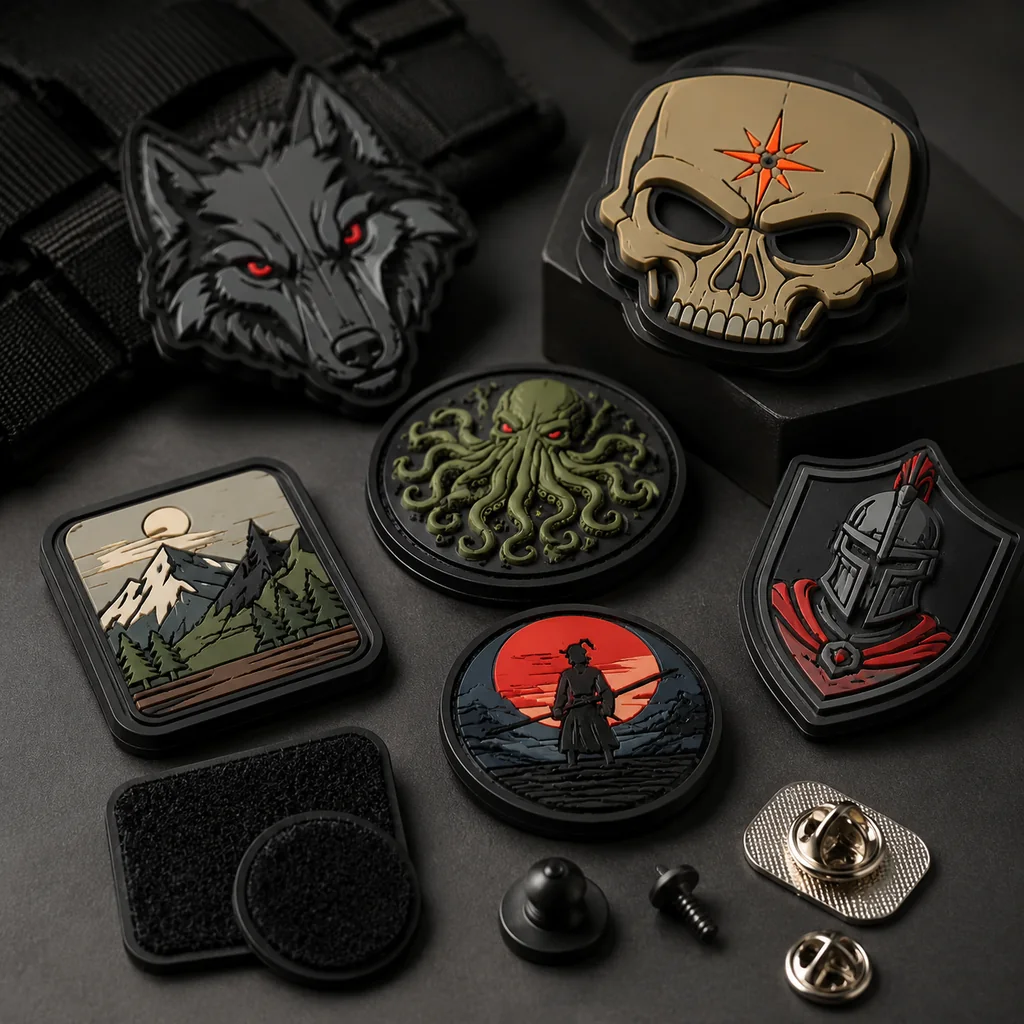
The supplied product facts do not state a standard PVC patch thickness or durometer, so buyers should not assume one universal millimeter or hardness value. For personalized morale patches, use PVC rubber when weather resistance, molded shape, and crisp 2D or 3D detail matter. Confirm finished thickness, material hardness, relief, border, and backing in the sample before bulk production.
How Thick Are PVC Patches?
Buyers asking how thick are PVC patches often want a quick way to compare suppliers. Thickness is useful only when it is tied to the complete construction, intended use, molded relief, and backing. The supplied product facts identify PVC rubber as a patch type suited to outdoor and tactical gear because it is waterproof, UV-stable, dishwasher-tough, and capable of crisp 2D or 3D molded detail. They do not provide one fixed PVC thickness.
The supplied facts also do not state a PVC durometer. Durometer measures material hardness, not thickness, and neither specification should be inferred from the patch category alone. A brand that needs a particular hand feel, flexibility, or resistance to deformation should request the supplier's finished thickness and hardness specification during quoting.
For procurement, the practical question is not whether a patch is simply thick. It is whether the finished PVC construction supports the artwork, relief treatment, gear surface, and intended exposure. Use PVC where shape and weather resistance matter, then confirm the quote-specific construction in a pre-production sample.
When PVC Is the Right Patch Type
PVC rubber is one option within a custom patch program, rather than the default answer for every design. The supplied facts describe embroidered patches as the workhorse for traditional thread-based patch programs. Woven patches use thinner threads and resolve finer detail and small text that embroidery can blur. Dye-sublimated patches are the supported choice for photographic full color, gradients, and complex artwork that thread cannot reproduce.
PVC serves a different purpose: molded dimensional detail and weather-resistant performance for outdoor and tactical applications. It is especially relevant for personalized morale patches when the design needs a defined shape, clear color areas, and a 2D or 3D molded appearance.
| Patch type | Best fit from supplied facts | Key buyer consideration |
|---|---|---|
| PVC rubber | Outdoor and tactical gear, waterproof and UV-stable use, crisp 2D or 3D molded detail | Confirm finished thickness, hardness, relief, and color feasibility in the sample |
| Embroidered | Uniforms, workwear, caps, jackets, bags, club vests, and youth group patches | Small text may blur compared with woven construction |
| Woven | Fine detail and small text that embroidery would not resolve cleanly | Does not provide PVC's molded dimensional appearance |
| Printed or dye-sublimated | Photographic full color, gradients, and complex artwork | Does not provide PVC's raised molded appearance |
| Chenille or leather | Programs requiring those specific patch styles | Choose for the intended visual direction and application |
Relief, Detail, and Color Limits
For PVC morale patches, molded relief is the main production discussion. The supplied facts support crisp 2D or 3D molded detail. Before sampling, define whether the artwork needs 2D relief with distinct molded levels, a more sculpted 3D effect, or a combination the supplier confirms is feasible.
PVC is generally the better match for bold icons, separated lettering, clear color areas, and a distinct outer shape. Designs that rely on very small typography, fine internal lines, or soft photographic transitions should be evaluated against woven or dye-sublimated construction. Woven patches are specifically supported for fine detail and small text, while dye-sublimation is supported for photographic color, gradients, and complex artwork.
- Request the actual finished thickness because no universal PVC value is supplied.
- Request the supplier's material hardness or durometer specification when flexibility or hand feel is a requirement.
- Confirm the requested 2D or 3D molded treatment before the sample is made.
- Check lettering clarity at the final patch size rather than only in digital artwork.
- Confirm PVC color feasibility during quoting because the supplied facts do not state a PVC color-count limit.
Backing and Border Choices
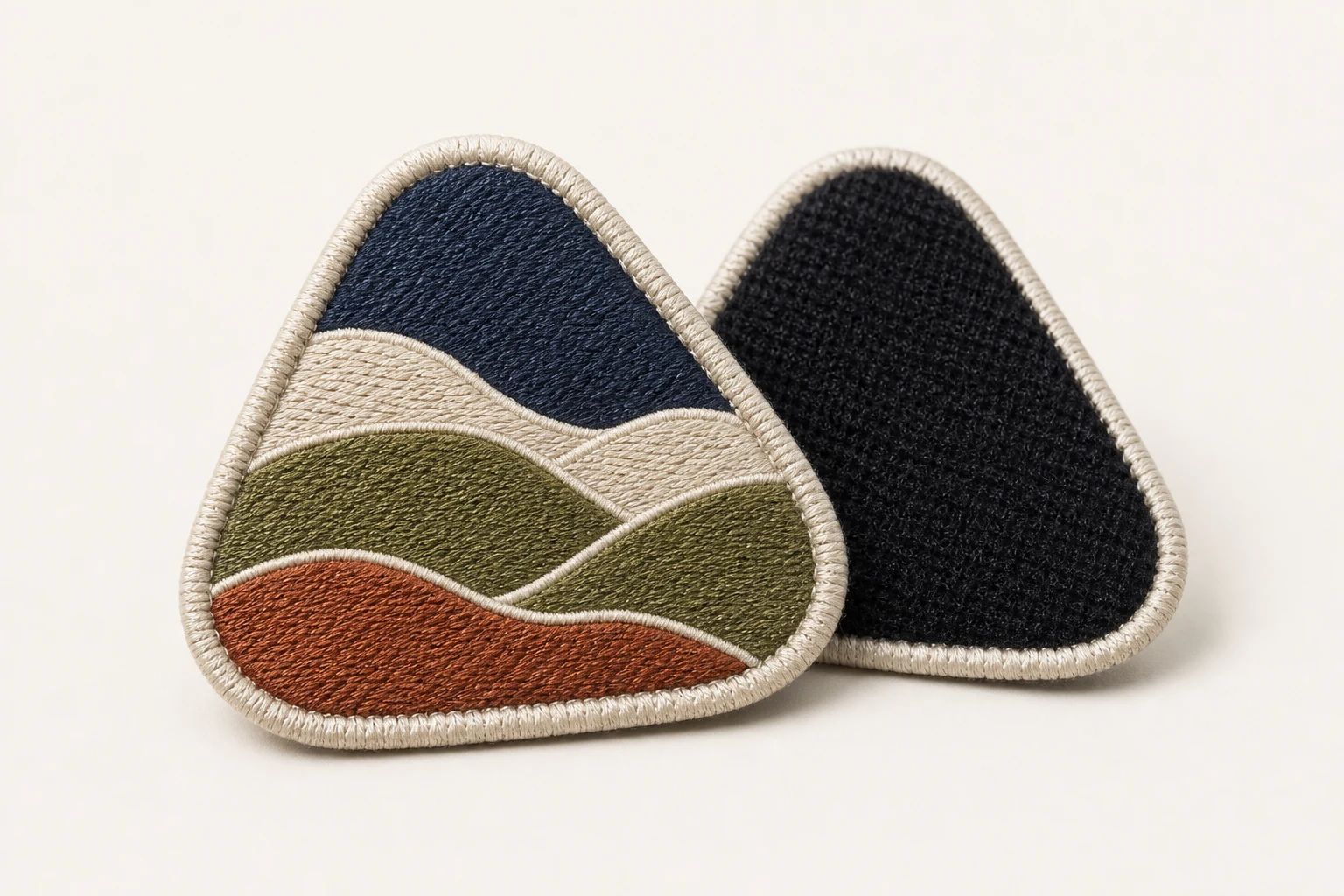
Backing should match the intended application. Available options in the supplied facts are iron-on heat-seal, hook-and-loop, sew-on, and adhesive. Hook-and-loop is the clear choice for swappable morale patches on tactical gear. It allows a patch to be removed or exchanged across compatible hook-and-loop surfaces.
Iron-on heat-seal is intended for one-time application. Sew-on is recommended for jackets and bags exposed to heavy laundering. Adhesive is listed as an available option, but the supplied narrative does not assign it a preferred use case, so its suitability should be confirmed for the target surface during sample review.
| Backing | Supported use from supplied facts | Decision |
|---|---|---|
| Hook-and-loop | Swappable morale patches on tactical gear | Use for removable patches |
| Iron-on heat-seal | One-time application | Use for a patch intended to remain on one item |
| Sew-on | Jackets and bags that get heavy laundering | Use where laundering durability is the priority |
| Adhesive | Available backing option | Confirm surface compatibility and sample performance |
The category also lists merrowed overlock edge and hot-cut or laser-cut edge as border options. It does not assign a standard border to PVC patches or to a particular shape. Include the requested edge treatment in the RFQ and approve it on the sample instead of assuming that an embroidered-patch border applies to PVC.
Size, Samples, and Production Planning
The supplied category facts list 2 to 4 inches as the typical patch size, with back patches available up to 12 inches. Final size should be set before artwork approval because the available molded area affects readability. A design that works at 4 inches may need simplified lettering or wider spacing at 2 inches.
The supplied facts state that a sample is available before bulk production, with a sample lead time of 5 to 7 days. Use it to review molded detail, lettering clarity, edge definition, the requested border, finished thickness, and backing behavior together. Bulk lead time is listed as 12 to 20 days, so these decisions should be settled before bulk approval.
| Planning item | Supported fact | Procurement implication |
|---|---|---|
| MOQ | 100 pieces per design | Plan quantities separately for each patch design |
| Price range | USD 0.25 to USD 2.20 per piece FOB | Use as a category-level budget signal, not a final PVC quote |
| Sample lead time | 5 to 7 days | Allow time for inspection and approval |
| Bulk lead time | 12 to 20 days | Lock artwork, backing, border, and relief before release |
Buyer Checklist Before Bulk Approval
The sample should answer the construction questions that are not defined by the category-level data. Review the complete finished patch against the intended gear, artwork, and commercial requirements before releasing bulk production.
- Confirm patch type: choose PVC rubber for waterproof, UV-stable outdoor or tactical use and molded detail; choose woven or dye-sublimated construction where fine detail or photographic color is more important.
- Confirm finished size, using the 2 to 4 inch typical range or the up-to-12-inch back-patch option where applicable.
- Confirm finished thickness and supplier-stated hardness because neither has a universal value in the supplied facts.
- Confirm backing: hook-and-loop for swappable morale patches, iron-on for one-time application, sew-on for heavily laundered jackets or bags, and adhesive only after surface review.
- Confirm border treatment: merrowed overlock edge or hot-cut or laser-cut edge.
- Confirm that the approved 2D or 3D relief keeps lettering and internal detail clear at final size.
- Confirm quantity by design, sample timing, bulk timing, and the final FOB quote.
Decision Rule for Outdoor, Tactical, and Lifestyle Brands
Use PVC where shape and weather resistance matter. PVC rubber belongs on the short list when the project calls for waterproof performance, UV stability, dishwasher-tough durability, and crisp 2D or 3D molded detail. Pair it with hook-and-loop when the patch must be swappable on tactical gear.
Do not select PVC solely because a team asks for a thick patch. Thickness and durometer are quote- and sample-confirmation points, not universal specifications in the supplied data. Send the RFQ with patch type, finished size, backing, border, artwork, requested relief treatment, quantity per design, and target schedule. Start the specification for [personalized morale patches](/products/custom-patches.html) with those decisions, then hold bulk approval until the sample confirms the finished result.
Ready to get this made?
Send your sketch, target quantity and ship-date. Detailed quotation in 12 hours.