How Do Magnetic Name Badges Work? Holding Force and Fabric Risk
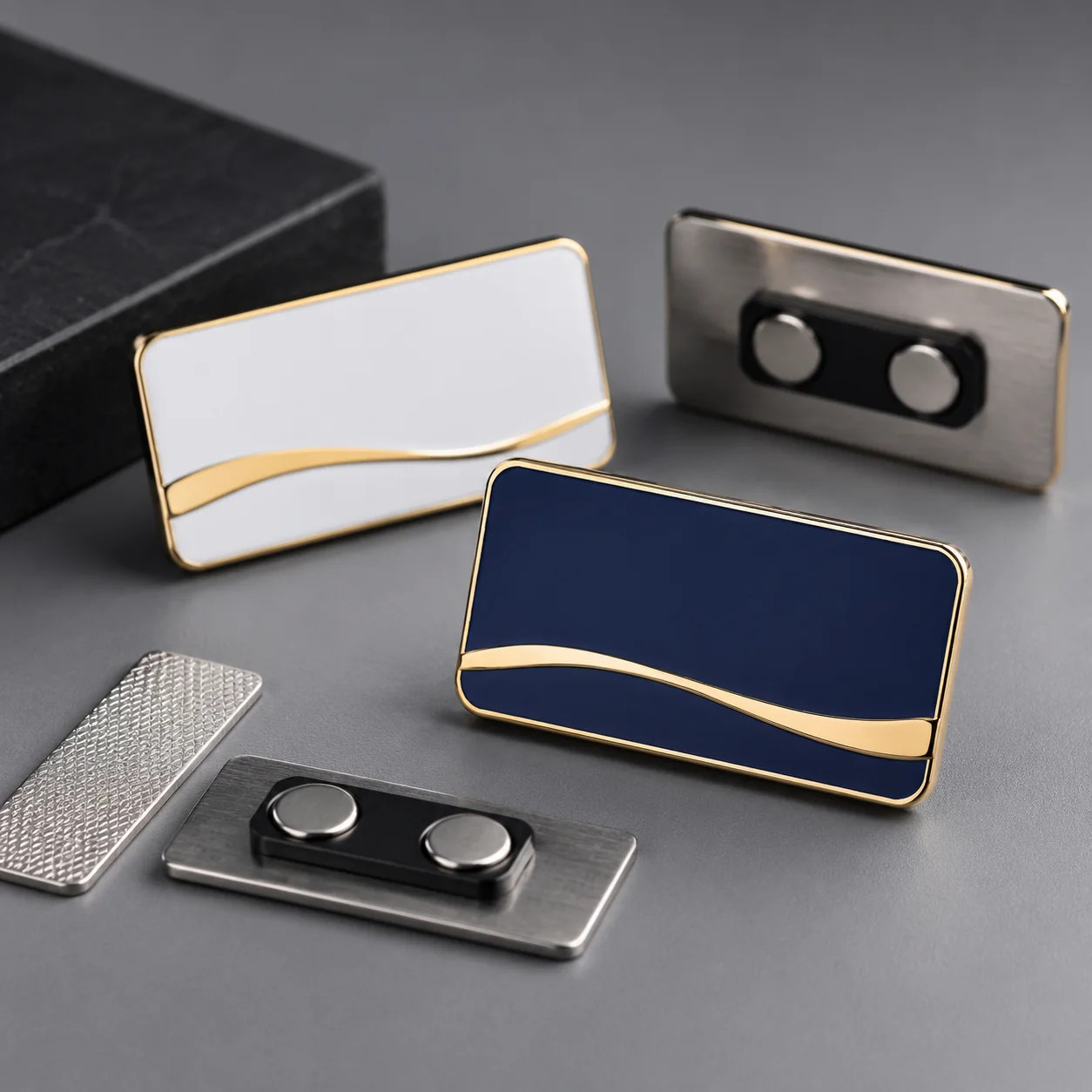
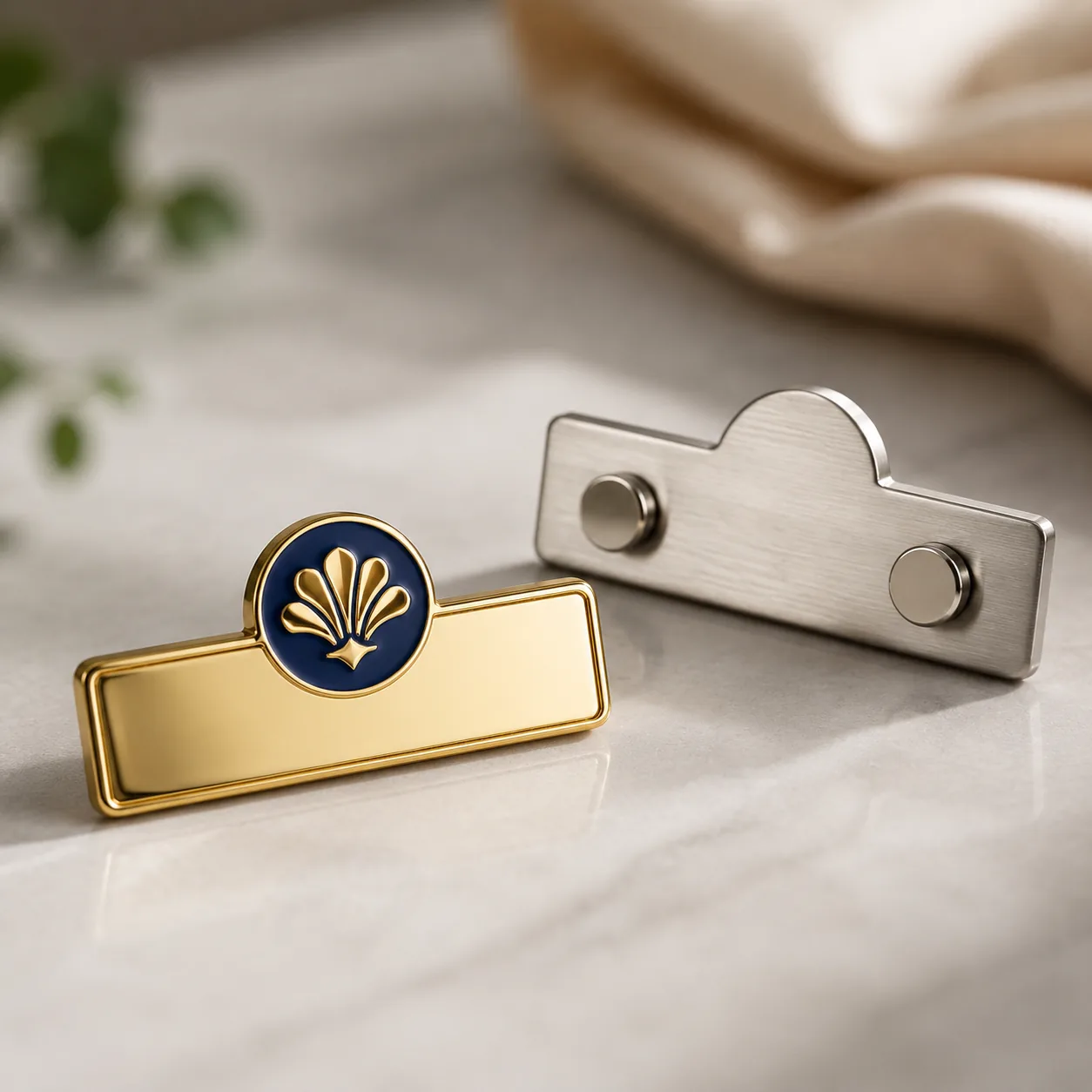
A magnetic name badge places the badge face on the outside of a uniform and a magnetic backing on the inside. Magnetic attraction clamps the garment between the two parts without creating a pin hole. Retention depends on the complete badge and backing assembly, fabric thickness and surface, alignment, placement, and movement during wear. Because the supplied specification does not include a measured holding force or test method, buyers should test a production-intent sample on every relevant uniform during the stated 5-7 day sample stage.
The Holding Mechanism
To understand how magnetic name badges work, separate the system into three elements: the front badge, the uniform fabric, and the magnetic backing. The badge sits on the outside of the garment, while the backing is positioned directly behind it. Magnetic attraction draws the components together and clamps the fabric between them. Unlike a butterfly clutch or safety pin, this attachment does not need to pierce the uniform.
The badge face can be engraved metal, enamel-logo metal, full-color printed material, or a reusable window-insert design. Available base materials include brass, zinc alloy, stainless steel, aluminum, and printed acrylic. Typical badges are 60-80 mm wide and 18-25 mm tall, although custom shapes are available. These choices affect the complete assembly's dimensions and mass, but they do not establish magnetic performance by themselves. Buyers need to evaluate the proposed badge and backing as one system.
A magnetic back is a useful option for hospitality and corporate uniforms because it avoids the pin hole created by a pierced attachment. That benefit should not be expanded into a guarantee that every garment will remain free of marks or wear. Pressure marks, surface changes, pulls, or transferred debris can depend on the fabric, garment construction, placement, and frequency of use. Compatibility still needs to be checked on the actual blazer, shirt, polo, or jacket.
What Determines Holding Force and Alignment
Holding performance is not defined by a general magnet description alone. It depends on the magnetic backing, the mating portion of the badge assembly, and the separation created by the garment. Increasing that separation generally reduces magnetic attraction, so thick, lined, padded, or layered garments can behave differently from a single lightweight shirt.
Pull-off force and in-use retention are also different measures. A pull-off result measures resistance in a defined direction and test setup. A badge worn vertically must resist sliding, sagging, rotation, and detachment as the employee moves. Those outcomes are affected by clamping force, fabric friction, badge dimensions, assembly mass, alignment, and placement.
A supplier force value is only useful when it identifies the test direction, contact arrangement, test material or gap, units, and measurement method. The supplied product specification does not provide those details or a measured holding-force value. Unsupported descriptions such as strong magnet or secure fit should therefore not be used as purchasing acceptance criteria.
| Decision factor | Effect on the application | Evidence to request or check |
|---|---|---|
| Magnetic backing | Provides the attraction used to clamp the badge through the garment. | Request the proposed production backing with the sample. No measured holding-force value is included in the supplied specification. |
| Fabric thickness and layers | Create separation between the front assembly and backing and may reduce retention. | Test every garment construction with the actual number of layers expected in use. |
| Fabric surface | A smooth or low-friction surface may allow a vertically worn badge to move even when it resists a direct hand pull. | Observe sliding, sagging, and rotation on the actual garment. |
| Alignment | An offset backing may reduce effective coupling and allow the badge to tilt or rotate. | Confirm that staff can center the backing consistently at the approved position. |
| Badge dimensions and shape | Badge size and custom shapes affect assembly mass and how visible rotation or sagging will be. | Test the final dimensions and shape instead of relying on a generic badge. |
| Daily movement | Walking, bending, reaching, and garment movement load the attachment differently from a stationary inspection. | Conduct a representative wear check during normal duties. |
A useful approval record identifies the exact badge construction, backing, uniform, placement, test duration, activities, and observed result. Procurement teams can then tie that approved combination to the bulk purchase specification instead of relying on a subjective hand-pull check.
Fabric Thickness and Wear Risk
The main trade-off is straightforward: magnetic attachment avoids puncturing the garment, but the assembly still has to hold through the selected fabric and lining. The supplied product information recommends bulldog clips for heavier garments or name tags that are swapped often. A magnetic back should therefore not be treated as the automatic attachment for every role in a mixed-uniform operation.
Map uniforms by construction rather than department name. A front-desk team may wear shirts, polos, lined blazers, seasonal jackets, or combinations of those garments. Test the badge at its intended chest position because seams, folds, pockets, embroidery, and uneven areas can prevent the front and backing from sitting flat or aligning correctly.
- Include each blazer, shirt, polo, jacket, or other garment construction that will receive the badge.
- Test the actual number of fabric and lining layers between the badge face and magnetic backing.
- Use the intended wearing position instead of an easier but unrealistic flat area.
- Confirm that the backing does not interfere with seams, pockets, labels, or other internal garment features.
- Observe whether the badge stays level or begins to slide, sag, rotate, or detach during representative duties.
- Remove the badge and inspect both sides of the garment for holes, pulls, pressure marks, surface changes, or transferred debris.
- Repeat placement and removal when employees will exchange or reposition badges frequently.
- Record the result for each garment type so one passing uniform is not used to approve every uniform.
The goal is not simply to obtain the highest available force. The selected attachment must maintain the approved position during expected duties, meet the organization's garment-care requirements, and remain practical for staff to place and remove. Because the supplied facts do not provide a quantified force range or universal fabric limit, the decision should be based on production-intent samples and the buyer's actual garments.
Magnetic, Pin, and Clip Options Compared
Custom name badges are available with magnetic backs, butterfly clutch pins, bulldog or alligator clips, and safety pins. One organization may need more than one attachment type. Use garment construction, badge position, frequency of changes, and tolerance for puncturing as the decision criteria.
| Attachment | Best-supported use | Main trade-off | Buyer check |
|---|---|---|---|
| Magnetic back | Hospitality and corporate uniforms where avoiding pin holes is a priority. | Retention depends on the complete assembly, alignment, garment layers, fabric surface, and movement. | Wear-test a production-intent sample on every relevant uniform construction. |
| Bulldog or alligator clip | Heavier garments or situations where name tags are swapped often. | The garment needs a suitable edge, pocket, or attachment point at the required position. | Confirm that the clip grips securely and that the badge remains level during movement. |
| Butterfly clutch pin | Applications where a post-and-clutch attachment is acceptable. | The post passes through the fabric and does not meet a no-puncture requirement. | Confirm that the uniform policy permits pierced attachment and inspect the selected placement. |
| Safety pin | An alternative pierced attachment offered with the badge. | It also passes through the fabric and may take longer to position consistently. | Evaluate placement, orientation, and garment policy before approval. |
Reusable window-insert badges address a separate decision. Their printed name cards can be changed, while laser-engraved or printed names provide piece-specific personalization. Name format and attachment type should be separate fields in the purchase specification. A reusable badge does not automatically require a clip, and a magnetic badge does not automatically require a permanent name.
A Practical Sample and Wear Checklist
The stated sample lead time is 5-7 days. Use that stage to approve appearance, personalization, alignment, and attachment performance before the stated 10-18 day bulk phase. Artwork approval alone does not show whether the magnetic assembly will hold correctly through the operating team's uniforms.
- Confirm the badge type: engraved metal, enamel-logo metal, full-color printed, or reusable window-insert.
- Measure the sample against the approved width, height, and any custom-shape drawing.
- Verify the specified base material: brass, zinc alloy, stainless steel, aluminum, or printed acrylic.
- Check each laser-engraved or printed name against the approved staff name list.
- Compare the logo, layout, plating or finish, and optional epoxy dome with the approved artwork.
- Confirm that the sample uses the proposed production magnetic backing rather than a substitute.
- Place the badge on each actual uniform construction and check that staff can align the backing consistently.
- Wear the sample during representative standing, walking, bending, reaching, and routine work movements.
- Check for sliding, sagging, rotation, or detachment and record the garment, activity, duration, and result.
- Remove and reattach the badge as often as expected in normal use, then inspect the garment and badge surfaces.
- Define pass, rework, and rejection criteria before releasing the bulk order.
Keep one approved sample and a written record of the garments and conditions used for testing. The supplied facts do not state a quantitative magnetic-force tolerance, packaging format, or final inspection plan. If those points matter to the operation, add agreed requirements to the purchase specification instead of treating them as included.
Build the Purchase Specification
A complete specification ties the attachment decision to the visible badge and ordering model. The available program uses one branded logo shell and allows individual names to be personalized by laser engraving or printing. The minimum order is 100 pieces per design, with names personalized per piece.
- State the badge type and whether names are permanent or use a reusable window insert.
- Specify brass, zinc alloy, stainless steel, aluminum, or printed acrylic as the base material.
- Give final dimensions; the typical range is 60-80 mm wide by 18-25 mm tall.
- Provide the approved logo, layout, personalization method, and checked staff name list.
- Select gold, silver, rose-gold, matte black, or brushed-steel finish, and state whether an epoxy dome is required.
- Identify the magnetic back as the attachment and list every uniform construction on which it was approved.
- Record the approved placement, backing alignment, wear duration, activities, and garment-specific observations.
- If a holding-force report is required, define the test direction, test material or gap, setup, units, and acceptance threshold.
- Plan around the stated 5-7 day sample time and 10-18 day bulk lead time.
- Treat the stated $0.45-$3.50 per piece FOB range as a category range, not a confirmed price for a particular magnetic construction.
- Add required packaging, inspection, and lot-acceptance criteria because those details are not stated in the supplied specification.
Choose a magnetic back when avoiding uniform punctures is essential and the production-intent sample remains aligned through the relevant garment layers and work conditions. Consider a bulldog or alligator clip for heavier garments or frequent swapping when the uniform has a suitable attachment point. To source custom name badges, submit the logo, staff name list, badge type, material, dimensions, finish, and attachment request through /products/name-badges.html. Complete and document the uniform wear check during the sample stage before authorizing bulk production.
Ready to get this made?
Send your sketch, target quantity and ship-date. Detailed quotation in 12 hours.