Embossed vs Engraved Dog Tags: Which Mark Method Should You Specify?
Choose embossed stainless steel when the priority is a military-style tag with classic raised GI text. Choose laser engraving when the design requires finer multi-line detail or unique names, ranks, service numbers, blood types or dates on each tag. Choose full-color UV printing when color artwork is essential. The available specifications do not state a numeric emboss depth, guaranteed engraving contrast or comparative wear-test results, so approve the initial appearance on a physical sample and document any measurable durability requirements before production.
The buying decision in one view
The embossed vs engraved dog tags decision should begin with the required appearance, information density and exposure conditions. Embossing forms the traditional raised GI text on a roller press. Laser engraving supports finer multi-line information and variable data. Debossing creates a recessed mark, while full-color UV printing supports logos, color coding and artwork that cannot be represented by formed or engraved metal alone.
| Mark method | Best fit | Primary trade-off | Approval focus |
|---|---|---|---|
| Embossed | Classic military-style tags with raised GI text | Less suitable than laser engraving for fine, dense layouts | Raised profile, character crispness, line alignment and agreed emboss depth |
| Laser-engraved | Fine detail and variable information on individual tags | Does not reproduce the classic raised-text effect | Legibility, visible contrast and consistency across the complete data set |
| Debossed | Programs intentionally requiring recessed text | Has a different visual character from traditional raised embossing | Recess definition, character edges and readability |
| Full-color UV print | Logos, color coding and artwork requiring full color | Comparative print-wear results are not included in the available specifications | Color, registration, initial adhesion and any agreed wear-test result |
For military, veteran and first-responder programs, embossed stainless steel is the appropriate starting specification when authenticity means a familiar raised-text presentation. Laser engraving is better suited to event ID, memorial, fundraising or operational programs in which records differ or the copy is too detailed for an embossed layout. Mixed-method programs are also possible, but each material, mark method and data variation should be identified as a controlled order configuration.
What creates a military-style appearance
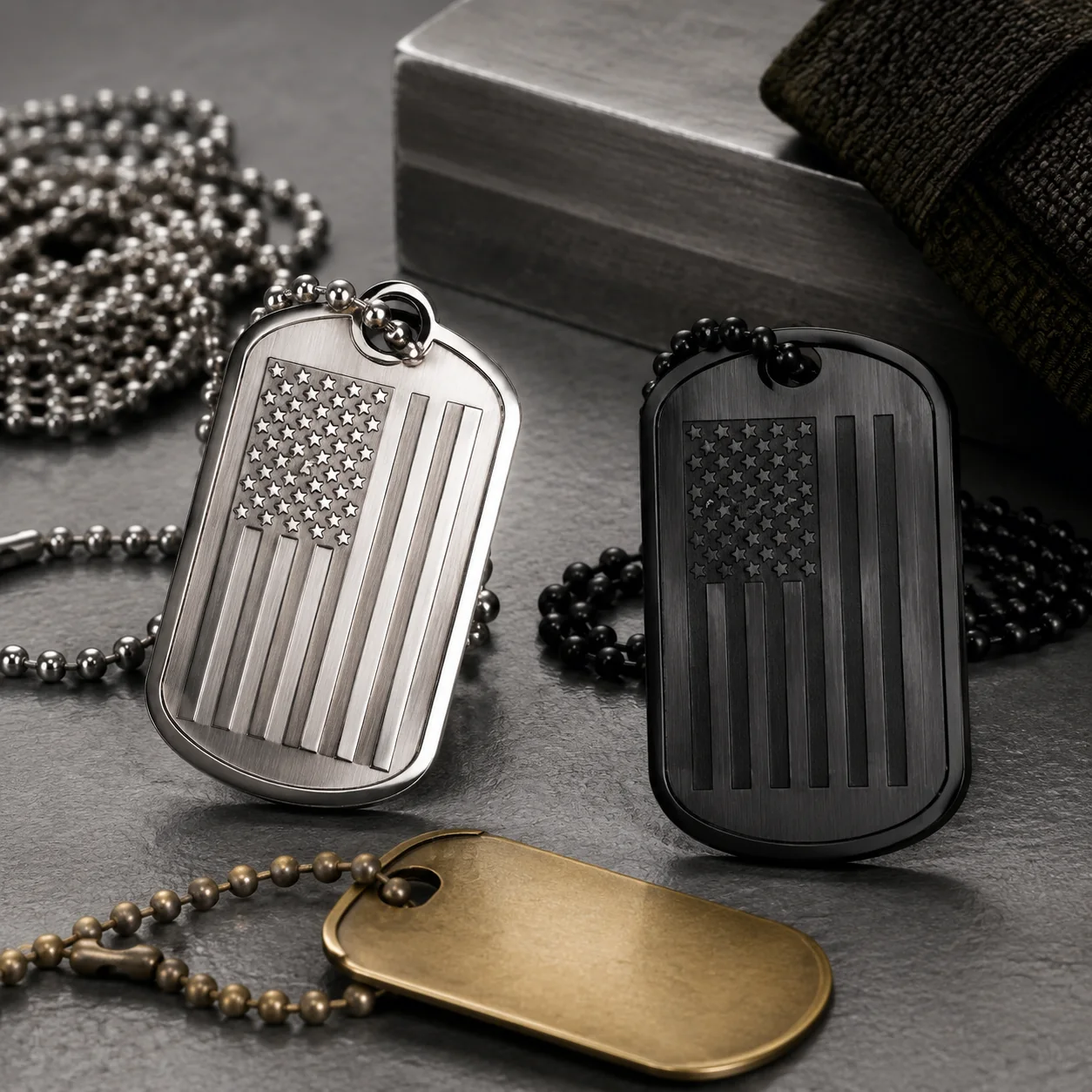
Military-style appearance comes from the complete construction, not from using the word military in a product description. The standard format is a 50 x 28 mm GI shape with raised embossed text available, a rolled or curled safety edge, a 24-inch ball chain, a short chain and optional rubber silencers. Keeping the shape, raised text, edge treatment and hardware consistent produces a more recognizable result than choosing the mark method in isolation.
Embossing is performed on a roller press to form the classic raised GI text. Important controls include crisp characters, an even raised profile, consistent line spacing and stable placement across the tag. The available specifications do not state a numeric emboss depth. Buyers should therefore avoid inserting an unsupported value into the purchase order. If depth must be objectively inspected, ask the supplier to propose a measurable target and tolerance, approve both before production and retain the approved sample as a visual reference.
Laser engraving produces a different surface appearance and should be selected when readable detail has priority over the raised GI effect. Full-color UV printing should be selected because color is necessary, not because it is assumed to match the appearance or wear behavior of embossing or engraving. The available facts do not establish official-issue status, conformance to a military standard or a universal durability ranking. Unless separate documentation establishes otherwise, describe the finished item as military-style.
Evaluate durability with defined evidence
The available specification identifies several substrates, a rolled or curled safety edge and tumbled smooth edges, but it provides no abrasion, corrosion, perspiration or print-wear test results. It is therefore not defensible to claim that one offered method will always last longer in every environment. Control the material, mark, edge and hardware configuration, then match the inspection or test requirement to the actual use.
- Confirm whether the substrate is 304 stainless steel, 316 stainless steel, brass, aluminum or anodized aluminum.
- For embossing, inspect character crispness, raised-profile consistency, line spacing and placement.
- For laser engraving, check fine-text legibility and visible contrast under the intended viewing conditions.
- For variable-data orders, compare the longest realistic records with the approved layout before bulk production.
- Inspect the rolled or curled safety edge and the stated tumbled finish for the required smoothness.
- Verify the exact chain and accessory combination instead of assuming every available extra is included.
- For UV printing, approve color and registration on the selected substrate and define a wear test if print durability affects acceptance.
A physical sample can demonstrate raised-character definition, initial engraving visibility, edge feel, print appearance and assembled hardware. It cannot by itself prove long-term durability. If abrasion, corrosion, perspiration exposure or print wear could cause rejection, the purchase specification should identify an agreed test method, exposure duration and pass criterion. No such values are provided, so they must be agreed with the manufacturer rather than inferred.
The stated sample lead time is 5-7 days, and the stated bulk lead time is 10-18 days. Confirm whether those are calendar or working days and what event starts each period, such as artwork approval, sample approval or receipt of payment. Include both stages in the purchasing schedule instead of authorizing production from a flat artwork file alone.
Specify stainless grade, shape and edge separately
The material list includes 304 and 316 stainless steel as default options, plus brass, aluminum and anodized aluminum. The available facts do not include material certificates or environmental performance data that would justify ranking 304 against 316 for a particular application. State the selected grade on the inquiry, sample approval and purchase order, and request grade documentation when material identity is an acceptance requirement.
Anodized aluminum is available in red, blue, black and gold for team or unit color coding. It is relevant where visual grouping or a colored finish matters more than recreating a plain stainless GI appearance. Brass and standard aluminum are also available. Their finish, mark contrast and suitability should be approved on the requested sample because comparative wear and finish data are not provided.
The standard format is a 50 x 28 mm GI shape, while custom shapes and sizes are available. A rolled or curled safety edge is standard, and the production description states that the edges are tumbled smooth for comfort against the skin. List size, shape and edge treatment separately so that ordering a custom shape does not create ambiguity about the required edge construction or finish.
Control variable personalization as order data
Laser engraving is the practical choice when individual tags require different names, ranks, service numbers, blood types or dates. Variable-data production allows a 500-piece run, for example, to contain 500 unique records while following one approved layout. The stated MOQ is 100 pieces per design. Confirm with the supplier how the design count is applied when one layout contains many variable records.
Before sample production, define the field order, line breaks, capitalization, permitted characters and treatment of blank or missing values. The available facts confirm fine multi-line engraving and unique records, but they do not define a maximum character count, minimum type size or number of lines. Prove legibility with the longest realistic record on the selected tag size rather than using a short placeholder.
Before production release, reconcile the approved data file with the ordered quantity and check for duplicate, missing or malformed records. Bulk inspection should verify both data accuracy and layout consistency across short and long entries. This is particularly important for identification, memorial and first-responder programs, where a visually acceptable tag can still be defective if the personalized information is wrong. Keep the approved data file, artwork revision and sample reference tied to the purchase order.
Define every chain and accessory
The available hardware is listed as a 4.5 mm ball chain at 24 inches, a 2.4 mm short chain, rubber silencers and a split ring. Only the long-chain length is explicitly stated. Confirm what each millimeter value measures, the required short-chain length, connector details and the quantity of each component per set. The product facts describe available configurations rather than confirming that every accessory is included in every quoted price.
Hardware influences whether the finished item functions as a necklace set, access identifier or keychain. If the presentation requires a long and short chain, list both instead of asking only for a dog-tag chain. State the number and color of rubber silencers and whether a split ring replaces or accompanies the chain. The approved sample should include the complete assembly because loose tags alone cannot verify the ordered hardware.
Nickel-free and lead-free options are available for direct skin contact, but this is not a blanket compliance statement covering every material, coating and hardware configuration. If skin-contact requirements apply, identify the requested option in the inquiry and obtain documentation corresponding to the exact ordered construction. Do not assume that a standard quote or the word stainless automatically confirms those requirements.
Final purchase checklist
The listed commercial range is $0.25-$1.50 per piece FOB, with an MOQ of 100 pieces per design. Treat the range as an indication rather than a price for every configuration. Material, marking method, variable personalization, accessories and testing can change the quoted scope. Compare offers only after each supplier is pricing the same specification, and confirm the named FOB location and included packaging.
- State embossed, debossed, laser-engraved or full-color UV printed.
- Specify 304 stainless steel, 316 stainless steel, brass, aluminum or anodized aluminum.
- Confirm the standard 50 x 28 mm GI shape or provide the required custom dimensions.
- Specify the rolled or curled safety edge and approve the smooth tumbled result.
- Provide the complete text layout and identify every variable field.
- Use the longest realistic record for the legibility sample.
- Define an emboss-depth target or engraving-contrast criterion if either will be measured at inspection.
- Define an application-relevant wear test when durability is a contractual requirement.
- Confirm what the 4.5 mm and 2.4 mm chain dimensions represent and state all required chain lengths.
- List the ball chains, rubber silencers and split rings required per set.
- State whether nickel-free or lead-free options and supporting documentation are required.
- Confirm the MOQ, sample timing, bulk timing, FOB location and price for the exact configuration.
For the shortest defensible decision, choose embossed stainless steel when classic raised GI text is the priority, laser engraving when fine or unique data is the priority, and UV printing when full color is essential. Buyers searching for custom army dog tags should still define the product as military-style unless official status is separately documented. Submit the material grade, dimensions, mark method, complete data file, edge treatment, hardware set and inspection requirements through /products/custom-dog-tags.html, then approve a complete physical sample before authorizing bulk production.
Ready to get this made?
Send your sketch, target quantity and ship-date. Detailed quotation in 12 hours.