Belt Buckle Design Guide: Logo Artwork, Strap Fit, and Finish
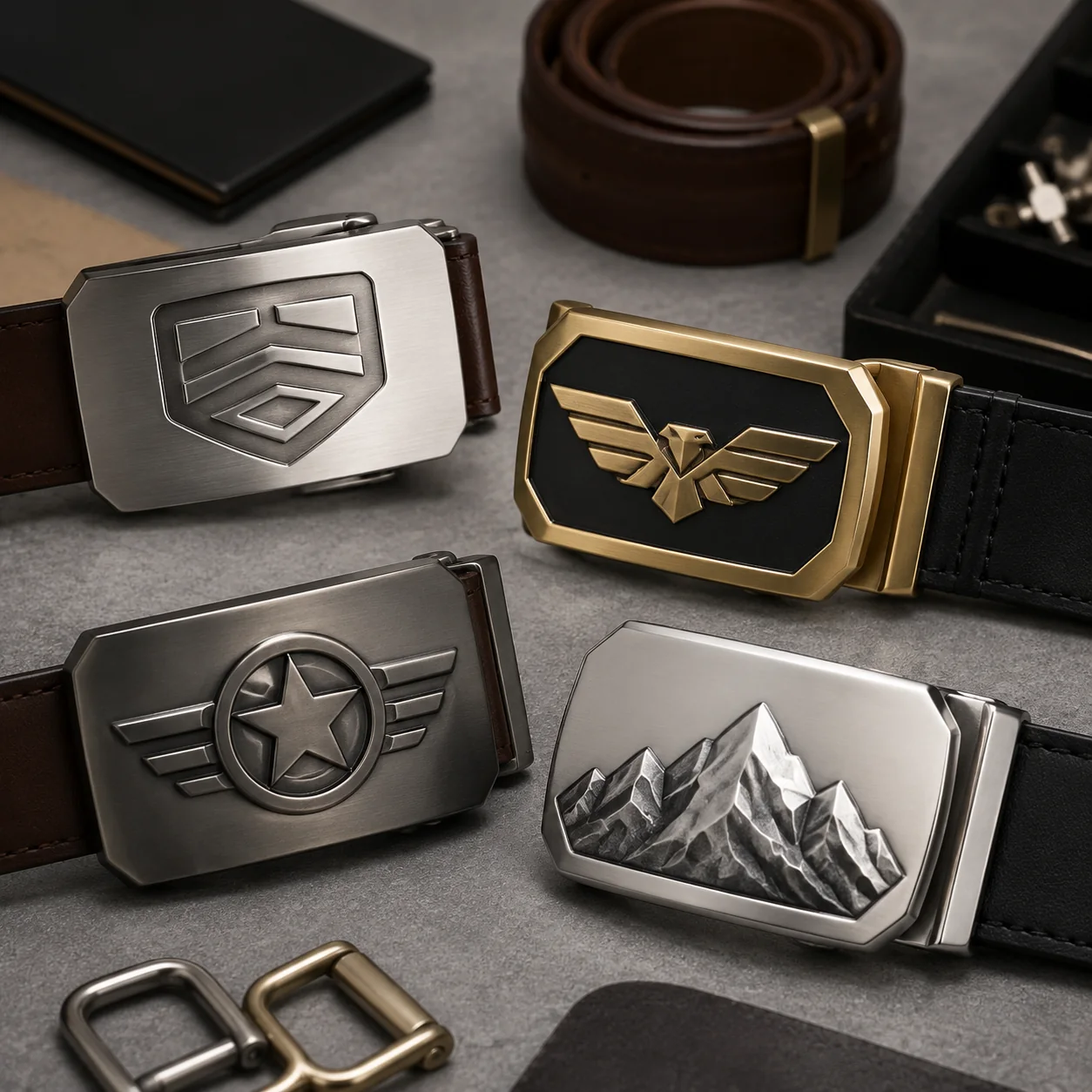
A flat logo becomes a workable custom buckle face when it is simplified for die-cast relief, sized within the standard 3 to 4 inch face range, and paired with the correct integrated snap-fit loop for the intended belt. Zinc-alloy die-cast is the listed choice for deep 3D relief, while brass is also available. Before tooling, buyers should have the supplier confirm producible minimum line width, text size, enamel partitions, finish, and either the standard 1.5-inch (38 mm) belt fit or a requested 1.75-inch fit.
Start with the Produced Buckle Face
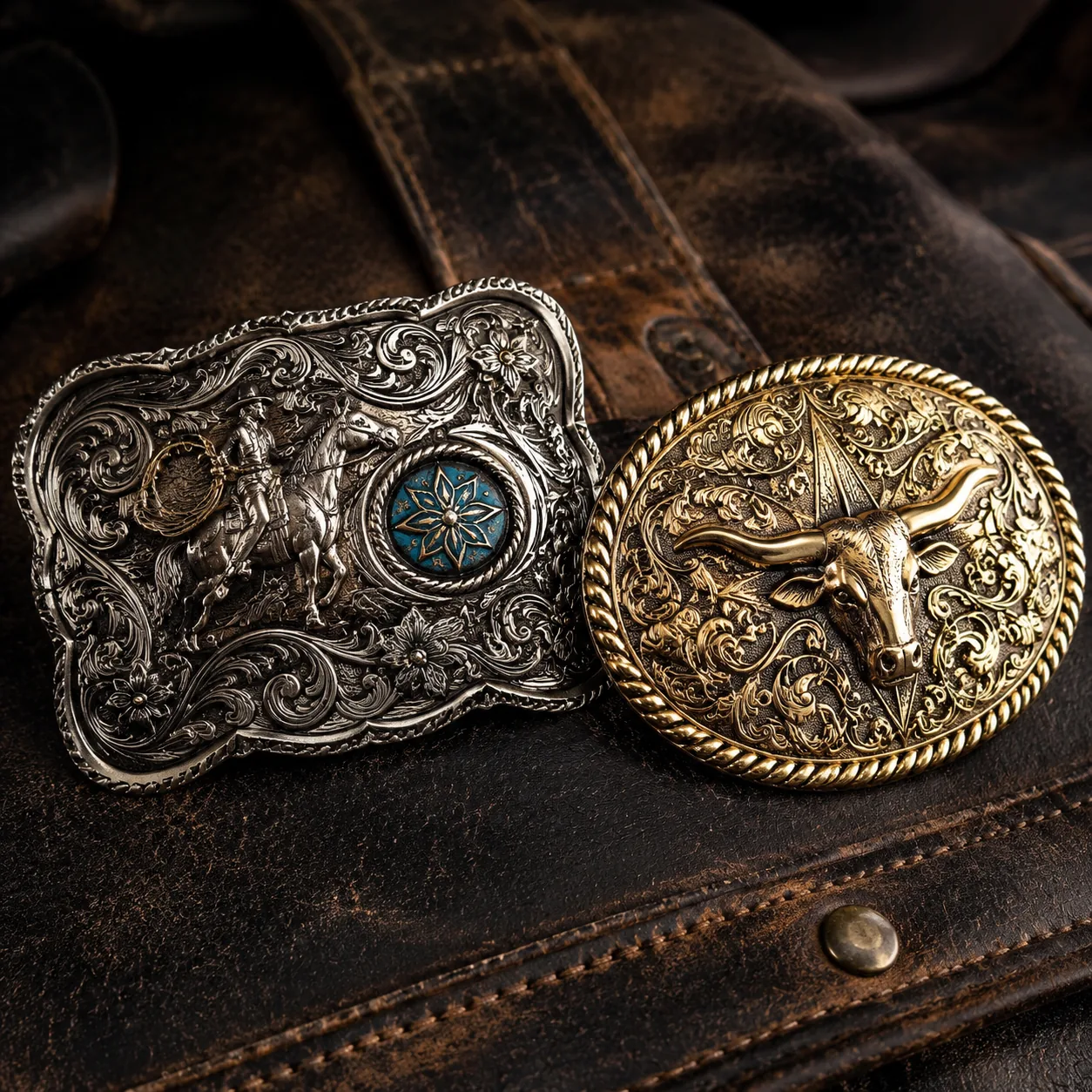
A belt buckle is not a flat print surface. It is a cast metal object whose logo, name, border, and decorative elements are translated into 3D relief, recessed fields, enamel color, plating, and edge treatment. The supplied product options include zinc-alloy die-cast and brass bases, 3D die-cast relief, soft or hard enamel, dual-tone plating, and rope edge decoration. Available finishes include antique brass, antique silver, antique copper, bright gold, bright silver, and gunmetal.
For brand merch and club procurement teams, the decision is to turn a recognizable flat mark into a buckle that works as both decoration and hardware. Do not approve the project from the original logo file alone. Require production artwork that shows intended metal levels, enamel areas, finish direction, outer shape, and a back view with the belt attachment. This allows the supplier to identify details that need adjustment before the die is made.
The standard face size is 3 to 4 inches, with oval, rectangle, shield, and custom shapes available. That range can support a corporate logo, club emblem, western scrollwork, trophy title, or award wording, but the layout should prioritize what must be read at normal wear distance. The main mark and organization name should lead. Optional dates, chapter labels, or secondary wording should not depend on very small details.
Confirm Minimum Line Width Before Tooling
The supplied product facts do not state a numeric minimum line width, minimum text height, enamel partition width, or relief tolerance. Buyers should not place an unverified numeric threshold in the specification. Instead, ask the supplier to confirm the minimum producible raised lines, recessed gaps, enamel partitions, and lettering for the selected size, metal, finish, and decoration method before tooling approval.
This step is particularly important for custom belt buckles with name personalization. Individual names, chapter identifiers, dates, award titles, and slogans often become the smallest elements in the artwork. Ask the supplier to flag lettering or internal logo details that must be enlarged, simplified, merged, or removed for the die-cast design. Where named versions are required, confirm whether each version is treated as a separate design, because the listed MOQ is 100 pieces per design.
- Request production artwork that separates raised metal, recessed fields, enamel zones, and plating areas.
- Review every letter of a name, slogan, or award title at the proposed buckle size.
- Keep the central logo visually strong when the design also uses rope edge, scrollwork, stones, or dual-tone plating.
- Ask the supplier to confirm whether soft enamel, hard enamel, 3D relief, or a combination is appropriate for the artwork.
- Approve fine-detail changes before the one-time die is opened.
Size the Face and Shape for the Use Case
The 3 to 4 inch standard face range is the practical starting point for the supplied buckle program. A smaller face within that range can suit a cleaner corporate, promotional, or fashion presentation. A larger trophy-style face can provide more room for a central emblem, western scrollwork, rope edge, and dual-tone plating. The larger option also creates a more prominent wearable object, so the intended audience should drive the choice.
Shape changes the usable logo area. An oval supports western and rodeo layouts with decorative elements around a central emblem. A rectangle can suit a wordmark or structured corporate logo. A shield can reinforce military, veteran, club, or award symbolism. A custom shape can make the buckle distinctive, but its perimeter and back construction should be reviewed with the supplier so the attachment remains suitable for the selected belt fit.
| Design Need | Available Direction | Approval Check |
|---|---|---|
| Deep 3D scrollwork or trophy styling | 3 to 4 inch face with zinc-alloy die-cast relief, antique finish, dual-tone plating, or rope edge | Confirm that decorative features leave enough clear space for the main emblem and wording |
| Corporate logo or promotional program | Clean logo area with soft or hard enamel and a selected bright, antique, or gunmetal finish | Have the supplier confirm that small text and internal logo details are producible |
| Western, rodeo, or cowboy style | Oval, shield, or custom shape with rope edge, relief, and antique or dual-tone finish | Balance the decorative border against the central design area |
| Club, military, veteran, or motorcycle identity | Bold emblem, clear name placement, and relief or enamel contrast | Confirm that dense crests and title text remain readable at the selected face size |
| Fashion or retail collection | Brass or zinc-alloy with finish and decoration selected for the collection | Review the finish direction together with the artwork rather than as a later change |
Specify Belt Fit and Back Attachment
The supplied buckle uses an integrated snap-fit loop on the back for standard 1.5-inch (38 mm) belts. A 1.75-inch belt fit is available on request. This is a material RFQ detail: a buckle can have an approved front face yet be unsuitable for the belt program if the loop width is not specified correctly.
State the required belt width directly in the RFQ and match it to the snap belt used by the team, club, retailer, uniform program, or award kit. For standalone buckles, record the compatible belt width in the product specification or internal product record. Review the rear view during sample approval so the integrated loop is checked alongside the front artwork.
| Hardware Decision | Supplied Fact | Buyer Action |
|---|---|---|
| Standard fit | Integrated snap-fit loop for 1.5-inch (38 mm) belts | Specify this fit when it matches the intended snap belt |
| Wider fit | 1.75-inch fit available on request | State the requested width before sample tooling |
| Back construction | Integrated snap-fit loop on the back | Approve a back view, not only the front face |
| Face size | Standard 3 to 4 inch face | Check that the selected face and belt combination suits the intended wear use |
Select Metal, Decoration, and Finish Together
Zinc-alloy die-cast is identified as the best listed base metal for deep 3D relief. It is the logical starting point for designs that depend on visible height differences, such as trophy faces, western scrollwork, club emblems, and bold relief borders. Brass is also available and should be specified when it is required by the product brief or commercial positioning.
Decoration and finish should be chosen as one visual system. Soft or hard enamel can carry logo color. Bright gold and bright silver can support a cleaner or more ceremonial appearance. Antique brass, antique silver, and antique copper can emphasize relief through darker recessed areas. Gunmetal can support a restrained or fashion-focused direction. Dual-tone plating can separate a central emblem from a surrounding field, while rope edge adds western or award styling but reduces available face area.
The correct choice depends on the design priority. If brand color is essential, specify the enamel requirement and ask the supplier to confirm the artwork partitions. If relief is the lead feature, specify the desired 3D die-cast direction and finish. If both are important, require production artwork that identifies which elements are metal, enamel, and plating before sample approval.
Plan Quantity, Tooling, and Reorders
The MOQ is 100 pieces per design. The listed price range is $1.20 to $6.50 per piece FOB. A one-time die tooling fee of $100 to $300 applies and is waived above 1,000 pieces. Listed sample lead time is 7 to 10 days, while listed bulk lead time is 18 to 28 days. Confirm the quote, production schedule, and project-specific requirements with the supplier before placing an order.
For small club, award, or team orders, tooling can be a significant part of project cost, so artwork and belt-fit decisions should be stable before the die is approved. For larger orders above 1,000 pieces, the tooling waiver can change the budget structure, but it does not replace sample review. The die is archived for 5 years for color-identical reorders. Preserve the approved artwork, finish, enamel, face size, and belt-fit specification internally so a reorder can be matched to the original program.
| Commercial Point | Supplied Fact | Procurement Implication |
|---|---|---|
| MOQ | 100 pieces per design | Confirm how named, dated, or chapter-specific versions are counted |
| Price range | $1.20 to $6.50 per piece FOB | Compare quotes against size, material, relief, enamel, and finish choices |
| Tooling fee | $100 to $300 one-time die fee | Avoid design changes after tooling approval |
| Tooling waiver | Waived above 1,000 pieces | Confirm the applicable quantity and design count in the quote |
| Lead time | Sample 7 to 10 days; bulk 18 to 28 days | Build sample review and supplier-confirmed production timing into the launch plan |
| Reorders | Die archived 5 years for color-identical reorders | Retain the original approved specification for future purchase orders |
Use This RFQ and Approval Checklist
A complete RFQ resolves artwork and hardware decisions before sample tooling begins. Include the logo or name artwork, intended use case, quantity, face size, shape, base metal, decoration method, finish, enamel requirement, and belt fit. Ask for a production-artwork review that shows both front and back construction.
- State the use case: western, rodeo, award, motorcycle club, military, veteran, fashion, retail, corporate, or promotional.
- Provide the target quantity and identify whether names, chapters, years, or titles create separate designs.
- Select a face size within the standard 3 to 4 inch range and choose an oval, rectangle, shield, or custom shape.
- Specify zinc-alloy die-cast when deep 3D relief is required, or state brass when brass is required.
- Choose 3D die-cast relief, soft enamel, hard enamel, dual-tone plating, rope edge, or the intended combination.
- Select antique brass, antique silver, antique copper, bright gold, bright silver, or gunmetal finish.
- Specify standard 1.5-inch (38 mm) belt fit or request a 1.75-inch fit.
- Ask the supplier to confirm producible minimum line widths, text size, recessed gaps, and enamel partitions for the artwork.
- Review front and back views, including the integrated snap-fit loop, before approving the sample.
- Confirm the $100 to $300 die fee unless the quoted order is above 1,000 pieces, then verify the tooling-waiver terms.
- Plan around the listed 7 to 10 day sample lead time and 18 to 28 day bulk lead time, subject to supplier confirmation.
- Keep the approved artwork and finish record with the purchase order for the 5-year archived-die reorder program.
Approve the project in this order: belt fit first, face size and shape second, artwork producibility third, then finish, price, tooling, MOQ, and schedule. This sequence keeps the front design tied to the actual hardware requirement. Send the artwork, target quantity, selected face size, finish direction, enamel requirement, and belt width to the belt buckle product team at /products/belt-buckles.html and request a 12-hour quote plus production artwork that identifies relief, enamel, plating, and back hardware.
Ready to get this made?
Send your sketch, target quantity and ship-date. Detailed quotation in 12 hours.