Hospitality Name Badge Logo Size Guide: Scale, Finish, and Reorders
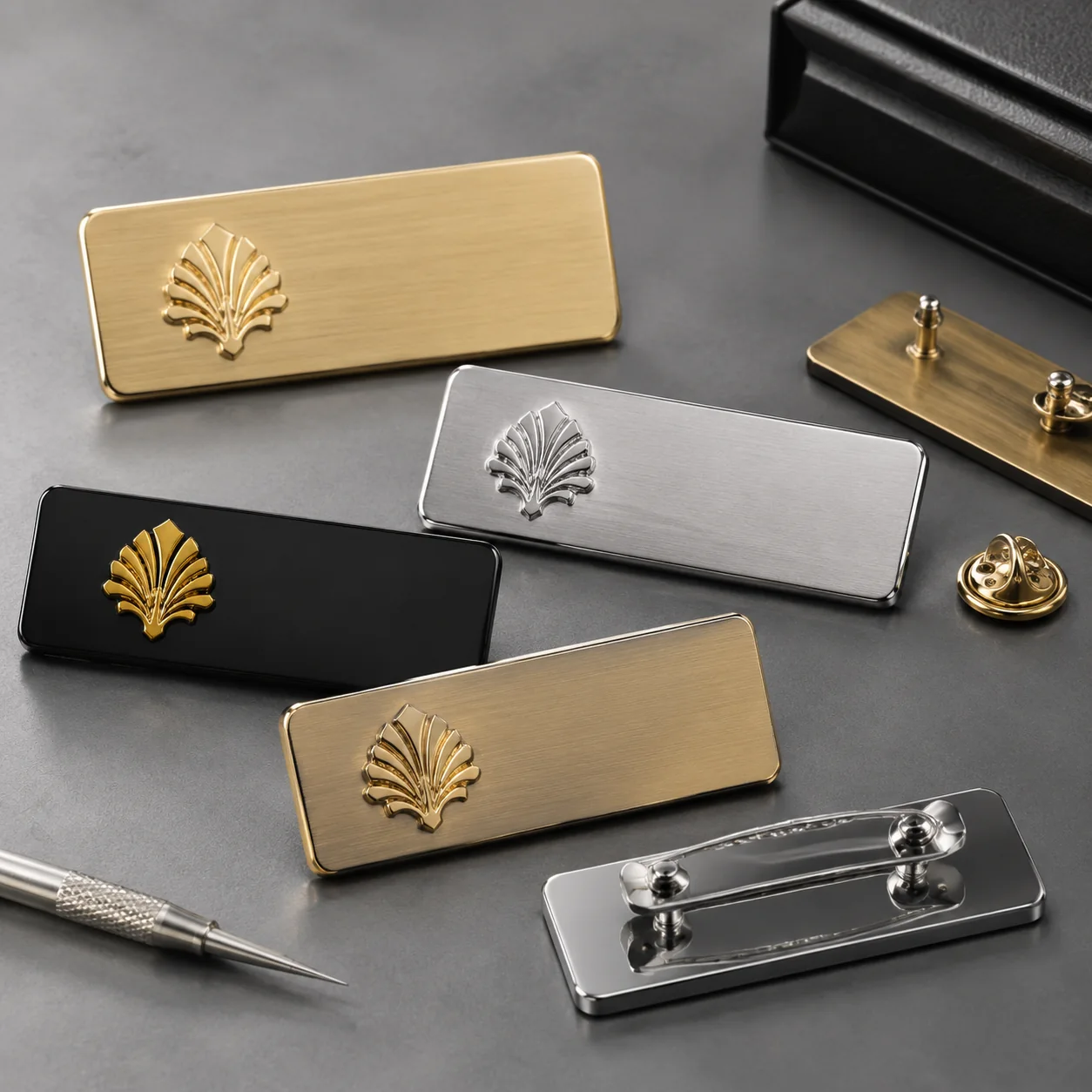
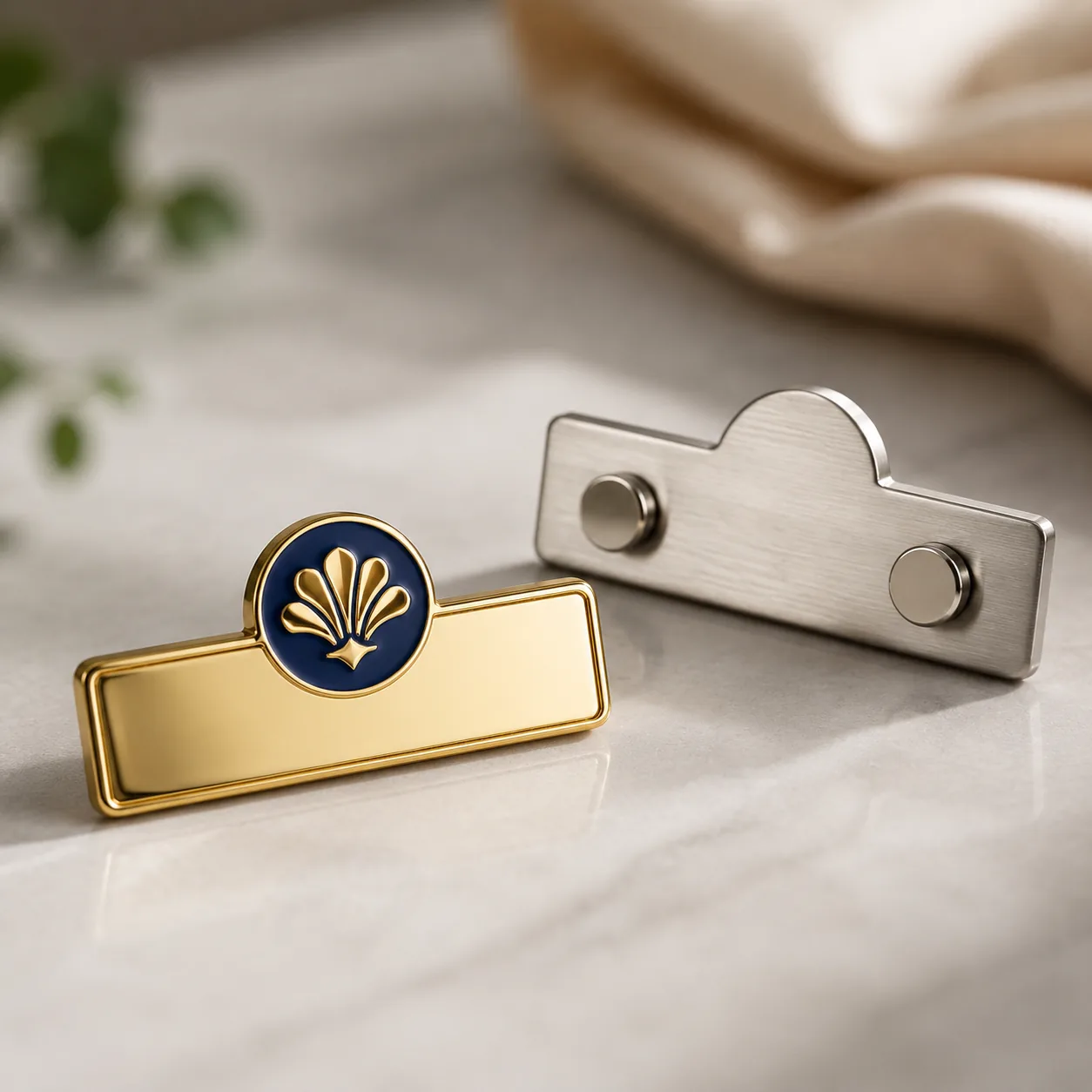
For hotel and restaurant uniforms, choose the badge size first, then scale the logo only after the staff name remains readable at the intended service distance. Use the typical 60-80 mm wide x 18-25 mm tall range as the buying frame: a larger shell provides more room for the name, while an oversized logo reduces the available name area. No universal viewing-distance or letter-height threshold is supplied, so require an actual-size proof with representative names and check it in the intended service setting before bulk approval. For premium daily-service uniforms, magnetic name badges with logo, a branded metal badge, and a fabric-safe magnetic back are a practical default; use reusable window-insert badges when names change often.
Badge Size Comes Before Logo Size
A hospitality badge is not only a small branding item. It is part of the uniform and must identify a staff member quickly during a guest interaction. That makes the buyer's main decision simple: protect name readability first, then fit the logo around it. The supplied production range for custom name badges is 60-80 mm wide x 18-25 mm tall, with custom shapes available. Within that envelope, every millimeter assigned to a crest, icon, border, or decorative space reduces the area available for the name.
For a hotel front desk, host stand, or restaurant floor team, start at the larger end of the typical range when the logo has several words, a complex mark, or the staff list includes long names. A compact badge can still work, but only if the logo is restrained and the name remains the dominant readable element. This is the core rule of a practical name badge logo size guide: the logo supports brand recognition, while the name performs the human-identification role.
| Procurement Question | Stronger Choice | Trade-Off |
|---|---|---|
| Logo is detailed or includes text | Use the wider or taller end of the 60-80 mm x 18-25 mm range | More badge area helps preserve name letter height, but the badge is more visually present on the uniform |
| Uniform appearance must be discreet | Keep the badge closer to the smaller end of the range | The logo must be simplified or reduced to preserve name readability |
| Names vary from short to long | Approve artwork with representative long names before the bulk order | This prevents the layout from being optimized only for short names |
| Staff turnover is frequent | Use reusable window-insert badges | The name card can be changed without remaking the branded badge shell |
Letter Height Is the Real Constraint
The supplied facts define the badge size range, not a universal letter-height value or viewing-distance standard. That distinction matters. A fixed letter height cannot be responsibly promised without the selected badge size, typeface, name length, logo shape, production method, and intended viewing distance. The defensible buying control is to require an actual-size proof using the intended 60-80 mm x 18-25 mm badge format and names that represent the longest expected staff names. Check that proof in the service environment, and ask the supplier to confirm that the final artwork is suitable for the selected production method.
Hotel and restaurant buyers should also check whether the logo uses small text, fine outlines, or multiple colors. Enamel-logo metal and full-color printed badges can both carry a logo, but the artwork should be reviewed at final badge scale. Laser-engraved or printed names should not be squeezed into leftover space. When the selected shell is only 18 mm tall, vertical spacing is limited. At 25 mm tall, there is more room to separate the logo, name, and finish details without making the badge face crowded.
- Approve the badge at actual size, not only as an enlarged artwork file.
- Check the proof at the intended service distance because no supplied numeric readability threshold is available.
- Test the layout with short, medium, and long staff names from the name list.
- Keep the staff name as the clearest visual element on the badge face.
- Move to the larger end of the 60-80 mm x 18-25 mm range if the logo competes with the name.
- Confirm whether names will be laser-engraved or printed before approving final artwork.
Choose the Logo Treatment by Use Case
The product facts support four main badge types: engraved metal, enamel-logo metal, full-color printed, and reusable window-insert. For hospitality, the decision is usually between a premium branded shell for daily uniform wear and a flexible name-change system for operational turnover. A 200-person rollout can use one branded shell design, then personalize each badge with the individual name by laser engraving or printing. That keeps the team visually consistent while allowing names to vary per piece.
If the badge is part of a premium front-desk presentation, a brass shell with a hard-enamel logo, rose-gold plating, and a glossy epoxy dome over the name is one supported configuration. If the order is for a high-volume event or temporary team, full-color printed aluminum is identified in the supplied facts as a lower-unit-cost option. These builds should not be treated as interchangeable: one is a specified premium uniform presentation, while the other is positioned for high-volume event use and lower unit cost.
| Badge Type | Best Fit | Buyer Watchpoint |
|---|---|---|
| Engraved metal | Stable teams needing individual names on a metal badge | Confirm whether names are laser-engraved and review long-name readability |
| Enamel-logo metal | Premium branded shell with logo color | Logo detail must still leave sufficient area for the staff name |
| Full-color printed | Detailed logos, high-volume event tags, or lower-unit-cost targets | Print provides visual flexibility, but the name still needs actual-size approval |
| Reusable window-insert | Teams where name changes happen often | The printed name card slides out, so approve the insert format as part of the system |
Match Material and Finish to the Uniform
Material selection should follow the service setting and the role of the badge in the uniform. The available base materials are brass, zinc-alloy, stainless steel, aluminum, and printed acrylic. For a premium front-desk specification, the supplied product narrative identifies a brass shell with hard enamel, rose-gold plating, and an optional epoxy dome as one available configuration. For high-volume or event-oriented use, the narrative identifies full-color printed aluminum as a lower-unit-cost option.
The supplied finish options are gold, silver, rose-gold, matte black, brushed steel, and an optional epoxy dome. Finish should be specified with the badge material, logo treatment, and uniform color in mind. Approve a finish sample or final proof against the intended uniform where possible, because the supplied facts do not establish a universal legibility result for every finish and garment-color combination.
| Specification Area | Available Options from Supplied Facts | Procurement Implication |
|---|---|---|
| Base material | Brass, zinc-alloy, stainless steel, aluminum, printed acrylic | Specify the selected material in the RFQ; the supplied narrative identifies brass for one premium configuration and printed aluminum for high-volume event use |
| Finish | Gold, silver, rose-gold, matte black, brushed steel | Align the requested finish with the uniform and brand color system |
| Logo method | Soft enamel, hard enamel, or print | Choose the logo treatment as part of the final artwork and actual-size proof process |
| Surface option | Epoxy dome optional | Specify it when a glossy surface effect is required |
Select the Attachment Around Fabric Risk
For hospitality uniforms, magnetic backing is often a practical default because it avoids piercing blazers, shirts, and polos. The supplied facts describe magnetic backs as fabric-safe and as avoiding fabric damage, and the product narrative identifies them as the most requested option for hospitality and corporate uniforms. This makes magnetic name badges with logo a suitable default for hotel and restaurant teams where staff-facing presentation matters and uniforms are reused across many shifts.
Magnets are not the only valid choice. The available attachment options also include butterfly clutch pin, bulldog or alligator clip, and safety pin. The supplied narrative identifies clips as an option for heavier garments or name tags that are swapped often. Pin options may be acceptable where garment piercing is not a concern, but hotel and restaurant buyers should make that decision in the purchase specification rather than discovering fabric objections after delivery.
- Use magnetic backs when fabric appearance is a priority and piercing is unacceptable.
- Consider bulldog or alligator clips for heavier garments or frequent badge swapping.
- Reserve pin-based options for uniforms where pierced fabric is acceptable.
- Confirm attachment type in the purchase specification so the badge shell and backing are built as one system.
Plan Reorders and Name Changes Early
Name badges create repeat purchasing work as teams change. The supplied MOQ is 100 pieces per design for the logo shell, with names personalized per piece. The first procurement decision is therefore not only how many staff members need badges today. It is how the hotel or restaurant group will manage the branded shell, staff names, and future additions without changing the visible uniform standard.
For stable teams, a fixed branded shell with laser-engraved or printed names creates an individual finished badge. For teams with frequent name changes, reusable window-insert badges allow the printed name card to be changed. In both cases, send the logo and staff name list as structured ordering data. The product facts state that the logo shell is built once, then each badge is personalized with the individual name, which is the process used to keep a 200-person rollout on-brand.
| Team Pattern | Recommended Name Process | Reason |
|---|---|---|
| Stable front desk or restaurant team | Laser-engraved or printed names on the badge | The badge is produced as an individual uniform item |
| Seasonal or changing roster | Reusable window-insert with printed name card | The name card slides out when staff names change |
| Multi-location rollout | One logo shell design with personalized names per piece | Keeps the brand layout consistent while allowing different staff names |
| Uncertain headcount | Plan around the 100-piece MOQ per design | The logo-shell MOQ affects first-order and reorder planning |
Build the RFQ Around Supported Facts
A strong request for quotation should be short, specific, and tied to the supplied manufacturing options. The supported price range is $0.45-$3.50 per piece FOB. The supported lead time is 5-7 days for a sample and 10-18 days for bulk production. These ranges are useful for procurement planning, but the buyer must define the build clearly enough for an accurate quote. A request that only says name badges with logo leaves material, finish, size, attachment, name process, and logo method unresolved.
Packaging and inspection criteria are not defined in the supplied product facts and should not be assumed. If the procurement team has receiving, carton-labeling, inspection, or other requirements, include them as buyer-specified clauses in the RFQ and confirm them with the supplier. The factory specification should stay factual: badge type, base material, typical size or custom shape, personalization method, attachment, plating or finish, MOQ, lead time, and the staff name list.
- State the target badge size within 60-80 mm wide x 18-25 mm tall, or request a custom-shape quotation.
- Attach the logo and identify whether it should be soft enamel, hard enamel, or printed.
- Specify the badge type: engraved metal, enamel-logo metal, full-color printed, or reusable window-insert.
- Choose the base material from brass, zinc-alloy, stainless steel, aluminum, or printed acrylic.
- Choose the finish from gold, silver, rose-gold, matte black, or brushed steel, and request an epoxy dome if needed.
- Specify the attachment: magnetic back, butterfly clutch pin, bulldog or alligator clip, or safety pin.
- Provide the staff name list and identify unusually long names for actual-size proofing.
- Plan around 100 pieces per logo-shell design, sample timing of 5-7 days, and bulk timing of 10-18 days.
The Procurement Decision
For hotel and restaurant teams, begin with a badge in the 60-80 mm x 18-25 mm range, treat the name as the primary information, and scale the logo around it. Require an actual-size proof with representative long names and assess it at the intended service distance before bulk approval. Choose magnetic backing when fabric protection matters, and choose reusable window-insert badges when staff names change often. A brass shell with hard-enamel logo, rose-gold plating, and optional epoxy dome is a supported premium front-desk configuration; full-color printed aluminum is the supplied lower-unit-cost option for high-volume event tags.
Next step: send the logo, preferred badge size, finish, attachment choice, and staff name list for magnetic name badges with logo, then request an actual-size proof before bulk approval. Use the custom name badges product path, /products/name-badges.html, and include the required quantity against the 100-piece MOQ per logo-shell design so the supplier can quote the selected material, personalization method, FOB price range, sample timing, and bulk lead time.
Ready to get this made?
Send your sketch, target quantity and ship-date. Detailed quotation in 12 hours.