Fridge Magnet Holding Force: Specify Enough Grip Without Excess Weight
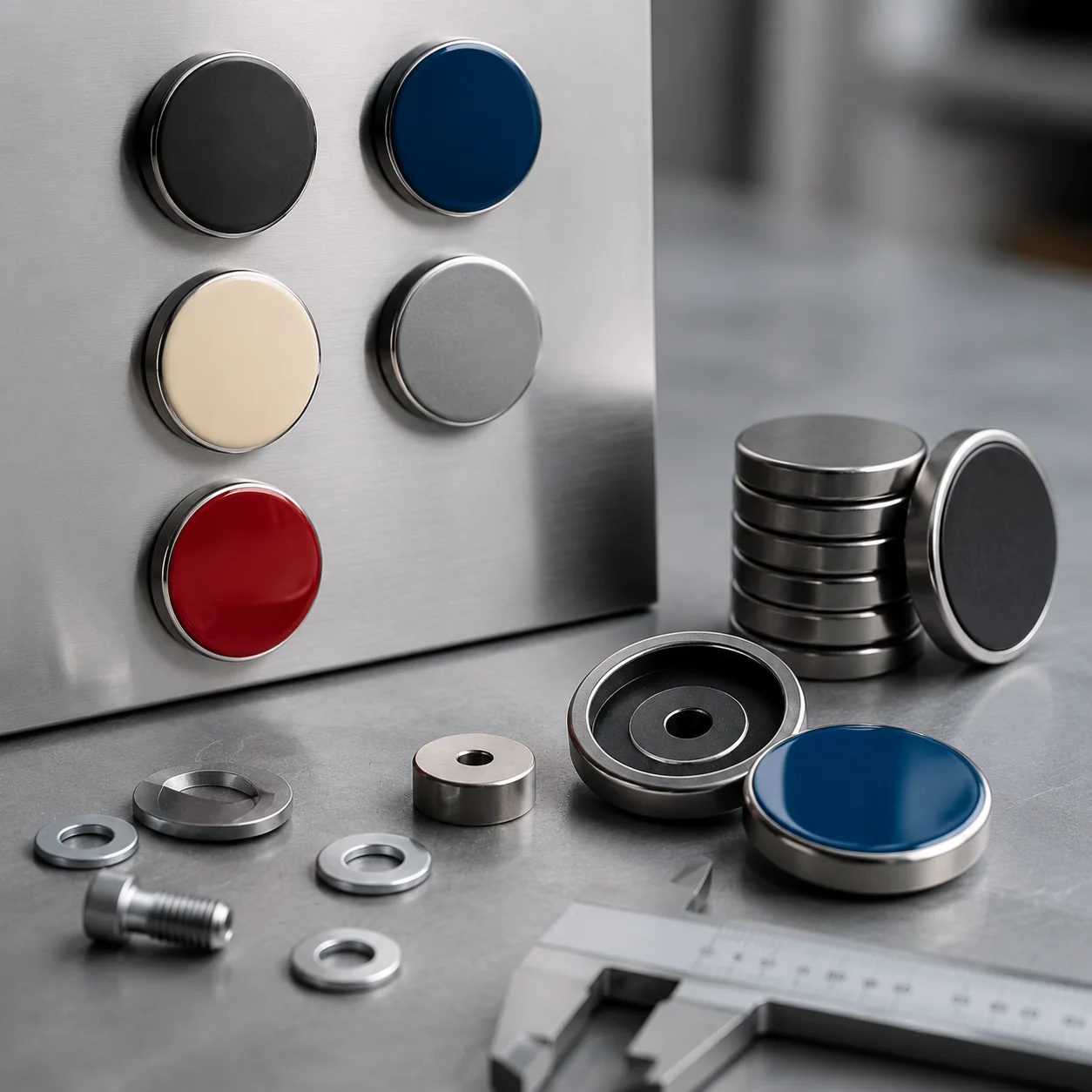
Specify fridge magnet holding force against the finished product and its intended surface, not the magnet material alone. Standard ferrite is a practical starting point for light printed tin and many PVC souvenir magnets. Evaluate neodymium for heavier die-cast or resin products and applications that must hold multiple pages. Approve the construction using the actual product size, weight, backing area, painted surface, and packaging, with both a defined pull-off check and a vertical slip or load test.
Why Holding Force Is a Finished-Product Decision
For tourism and promotional product buyers, fridge magnet holding force comes from the complete construction. Relevant variables include the face material, finished weight, magnet type, magnetic contact area, product shape, surface coating, and any gap between the backing and the appliance. A 40 mm printed tin magnet and a 100 mm die-cast metal magnet should not be approved against the same assumption simply because both are sold as fridge magnets.
The intended function changes the requirement. A tourist souvenir may only need to remain flat and resist sliding during normal use. A restaurant magnet may be expected to hold a menu, coupon, or other paper. A premium metal gift must support more of its own weight. An RFQ that asks only for a strong magnet leaves the supplier to interpret the surface, load, and pass condition.
The available product families are PVC soft rubber for tourist souvenirs, resin dome for photo magnets, die-cast metal for premium gifting, and printed tin for low-cost promotion. Standard ferrite is the default strength option, and neodymium options are available across the range. The commercial decision is to use enough grip for the approved application without adding unnecessary cost or construction weight.
Compare Magnet Options by Use Case
| Buying situation | Likely construction | Strength decision | Approval focus |
|---|---|---|---|
| Tourist souvenir shop magnet | PVC soft rubber or resin dome | Start with standard ferrite and test the finished design | Confirm that the product sits flat and does not slide on the agreed painted surface |
| Photo gift service magnet | Resin dome with photo artwork | Evaluate finished weight before deciding whether neodymium is needed | Test the complete dome, substrate, and backing rather than an unfinished component |
| Restaurant takeout magnet | Printed tin or PVC | Specify whether the product is decorative or must hold paper | Use the agreed menu, coupon, or paper stack during the vertical load test |
| Real estate agent giveaway | Printed tin, PVC, or resin dome | Balance unit cost with the required repeated-use function | Check attachment, sliding, and flatness on a representative appliance surface |
| Premium gifting magnet | Die-cast metal | Evaluate an inset neodymium disc early in sampling | Confirm that the heavier face does not slide, rotate, or separate from its backing |
| Trade show booth giveaway | Printed tin or PVC | Use standard ferrite unless a paper-holding function is required | Prioritize consistent attachment, packing efficiency, and the approved unit cost |
These recommendations structure the sampling process; they do not replace it. The RFQ should identify the material family, dimensions, intended surface, and whether the magnet must support anything beyond its own weight. The supplier can then sample ferrite, neodymium, or both against an observable pass condition.
Match Strength to Area, Weight, and Backing
Typical fridge magnet sizes range from 40 mm to 100 mm in rectangular, round, and custom die-cut shapes. The visible face size is not necessarily the magnetic contact area. A custom skyline, character, or logo may have a broad face but only limited space for clean backing coverage. Buyers should therefore specify both the finished outline and the proposed magnet dimensions or coverage.
The standard backing is a glued flexible magnet sheet, while premium constructions can use an inset neodymium disc. A flexible sheet distributes contact over a broader area and is well suited to many flat, lightweight products. A neodymium disc can provide greater magnetic performance from a compact location, but its result still depends on disc size, placement, contact gap, and finished product geometry.
More face area does not automatically produce proportionally more fridge magnet strength. Magnetic material thickness, pole arrangement, contact quality, and the appliance surface affect the result. A raised resin face or heavy die-cast body can also place the product's center of mass farther from the door, increasing the tendency to rotate, peel, or slide. Test the magnet in its intended upright orientation rather than relying only on a component specification.
Backing attachment is part of the approval. For a glued flexible sheet, the bond to the product body must remain intact during removal and repeated use. For an inset disc, verify that its location keeps the product stable. A magnet that has adequate pull against steel still fails if the backing lifts from the body or the product rotates into an unacceptable position.
Test Pull and Sliding on Painted Surfaces
A supplier pull-force result commonly describes force applied perpendicular to a clean steel test surface. Fridge use is different because the product is normally mounted vertically. Resistance to downward sliding depends on magnetic attraction, friction, product weight, backing contact, and surface finish. For that reason, a pull-off result should not be treated as proof that the finished magnet will remain in position under its real load.
Use a magnet-receptive painted appliance door or a documented painted steel panel that represents the intended surface. Paint thickness, protective films, curvature, contamination, and gaps can reduce effective grip. Although thick fridge door may be used as commercial shorthand, total door thickness alone is not a reliable specification. The outer metal skin, coating, and contact gap are more relevant to magnetic coupling.
The approval plan should include two separate checks. First, define a perpendicular pull-off method if a force result is required. Record the surface, direction, fixture, and unit of measurement so results can be compared. Second, conduct a vertical use test with the finished magnet supporting its own weight and, where applicable, the agreed paper load. Record whether the pass condition concerns pull-off, sliding, rotation, or all three.
Repeat the functional check after changes to dimensions, face material, backing area, magnet type, adhesive, or packaging. Do not compare pull-force claims from different suppliers unless the test surface, contact condition, force direction, and method are equivalent. For bulk production, retain the approved finished sample and its test record as the reference.
Protect the Approved Construction in Packaging
Packaging does not increase holding force, but it can protect the flatness, finish, and backing condition established during sample approval. The default option is a poly-bag, with hangtags and retail header cards available for hanging displays. Printed tin giveaways may only need simple bulk presentation, while resin dome and premium metal products may need retail packaging that prevents face damage during handling.
Review the product both packed and unpacked. Confirm that the package does not bend a flexible backing, place persistent pressure on an inset disc, or conceal a product that slides after removal. A tourism retail order should be approved for shelf presentation and actual fridge use, while a trade show order should be checked for distribution efficiency and function after unpacking.
Set Cost, MOQ, and Timing Before Sampling
The supplied price range is $0.10-$1.80 per piece FOB. The quoted position within that range depends on construction, size, backing, packaging, and order quantity. Standard ferrite is the commercial starting point. Neodymium should be tied to a defined requirement, such as a heavier finished product or an agreed multi-page hold, rather than requested as an unsupported premium upgrade.
MOQ starts at 100 pieces for resin and metal magnets and 300 pieces for PVC magnets. A printed tin MOQ is not specified in the supplied product data and should be confirmed in the quotation. The stated lead time is 10-20 days; the RFQ should clarify when that period begins, particularly when artwork approval, tooling, or sample approval is required.
Most orders are in the 1,000-20,000-piece range, so a small specification error can repeat across a large volume. Production economics are strongest when tooling can continue on one design, but tourism lines often use varied artwork, sizes, or shapes to encourage repeat retail purchases. If SKU weights or backing areas differ, approve each relevant construction rather than assuming one magnet specification will perform identically across the line.
Buyer Checklist Before Sample Approval
- Define the use case: tourist souvenir, restaurant magnet, real estate giveaway, photo gift, trade show item, or premium gift.
- State whether the magnet is decorative only or must hold an agreed paper load.
- Specify the construction family: PVC soft rubber, resin dome, die-cast metal, or printed tin.
- Provide the finished dimensions and shape within the typical 40-100 mm range.
- Request the finished sample weight and proposed magnetic backing dimensions or coverage.
- Confirm a glued flexible magnet sheet or an inset neodymium disc as the backing option.
- Identify a representative magnet-receptive painted surface for approval.
- Define separate pass conditions for pull-off, vertical sliding, rotation, and backing adhesion as applicable.
- Test the finished, unpacked sample with the agreed paper load and orientation.
- Approve the packaging format: poly-bag, hangtag, or retail header card.
- Record the approved construction and retain a reference sample for bulk inspection.
- Confirm price, quantity, MOQ, and the starting point for the 10-20-day lead time.
This checklist keeps the specification tied to observable performance. It also prevents a material label such as ferrite or neodymium from being used as a substitute for testing the complete product.
Write the RFQ Around the Required Outcome
A decorative souvenir RFQ could state: PVC soft rubber tourist magnet, custom die-cut, 70 mm maximum dimension, standard ferrite flexible backing proposed, decorative use only, poly-bag packing, and finished sample to remain flat without sliding on the agreed painted surface. This gives the supplier a defined construction and pass condition without demanding unnecessary maximum strength.
A functional premium RFQ could state: die-cast metal fridge magnet for gifting, size within the 40-100 mm range, finished weight to be reported, inset neodymium disc to be evaluated, and sample to pass the agreed vertical paper-load test on a painted magnet-receptive surface. The test record should identify the paper load, product orientation, backing configuration, and any observed sliding or rotation.
Send the supplier the artwork, target dimensions, construction family, intended hold function, test surface, packaging choice, and order quantity. Use /products/fridge-magnets.html to review the available fridge magnet options, then approve fridge magnet holding force on the finished sample before authorizing bulk production.
Ready to get this made?
Send your sketch, target quantity and ship-date. Detailed quotation in 12 hours.