Fashion Dog Tag Pendants: Finishes That Move the Product Upmarket
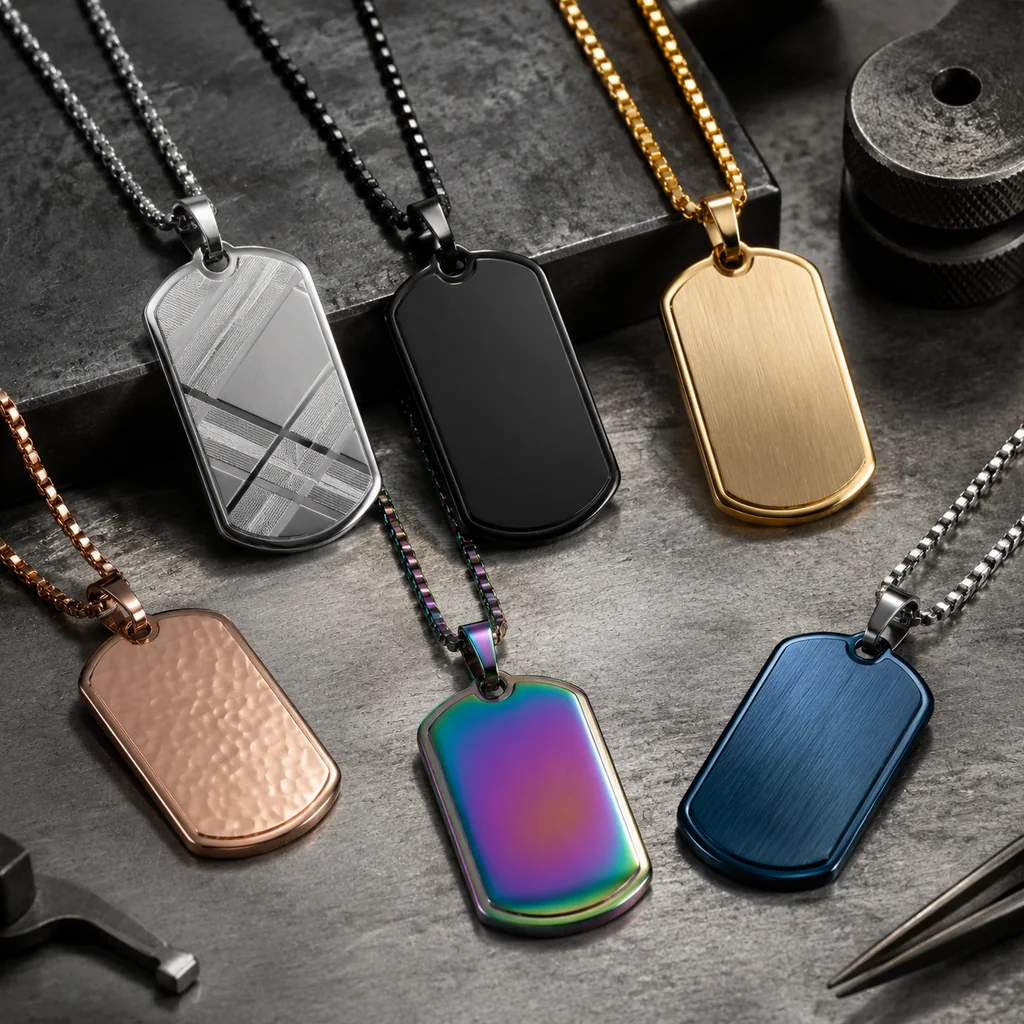
For fashion accessories and private-label buyers, effective dog tag pendant finish options start with 304 or 316 stainless steel, then use a polished, black, gold, or rose-gold appearance to suit the intended retail position. Use laser engraving for clean personalization, enamel or epoxy-dome print for visible brand assets, carbon-fiber inlay for a technical look, and CZ stones for jewelry-oriented styles. The supplied product facts confirm plated color options but do not identify the plating process, so buyers that require PVD or electroplate wording should ask the supplier to confirm the exact process in the RFQ and sample approval.
Start With Retail Positioning
Finish should be decided before artwork is finalized because it changes how the same dog tag silhouette reads at retail. A classic GI-shaped pendant with a polished appearance can suit clean everyday jewelry and personalized keepsakes. Black, gold, or rose-gold finishes move the look closer to fashion jewelry. Hard enamel, epoxy-dome print, carbon-fiber inlay, and CZ stones create a more branded or decorative product.
For buyers sourcing dog tag jewelry personalized for fashion brands, streetwear labels, menswear lines, band merch, artist merch, memorial jewelry, or wholesale programs, the decision is more than a color choice. Material, surface appearance, decoration, pendant size, chain, and skin-contact requirements need to work together. The supported range includes 304 or 316 stainless steel as the default material, brass as an option, pendants from 25 to 50 mm, chains from 18 to 24 inches, and an MOQ of 100 pieces per design.
The stated category price range is $0.35 to $2.20 per piece FOB. It should not be treated as a fixed quote for every configuration. Final pricing depends on the selected material, size, finish, decoration, chain, and order details. More decorative builds can support a more premium retail presentation, but they also require clearer artwork and sample approval.
Material And Finish Options
The default material options are 304 and 316 stainless steel, with brass also available. The category supports polished and matte-black appearances, gold, black, and rose-gold plating, plus laser engraving, enamel, epoxy-dome print, carbon-fiber inlay, and CZ stone decoration. Buyers should confirm the compatibility of their final material, finish, and decoration combination during quotation and sample approval.
Buyers should state the intended visible result precisely, such as a polished appearance, matte-black appearance, gold plating, black plating, or rose-gold plating. The chain should be specified at the same time, including whether its finish must match the pendant.
PVD, electroplate, black finish, and plated finish should not be used as interchangeable terms. The supplied facts confirm plated color options, but they do not identify PVD or electroplating as the process. When a retailer, brand manual, or compliance file requires a named process, the RFQ should request that confirmation and the sample approval record should identify the agreed finish.
| Finish Route | Best Retail Fit | Buyer Trade-Off | Spec To Confirm |
|---|---|---|---|
| Polished appearance | Everyday jewelry, personalized tags, keepsake pendants | The result depends on a clean face, edges, and readable engraving | Base material, approved polished appearance, pendant size, chain type |
| Black or matte-black appearance | Streetwear, music merch, military-style fashion | Chain color needs to look intentional with the pendant | Black finish description, confirmed process if required, matched chain finish |
| Gold or rose-gold plating | Fashion jewelry, private-label capsules, gift programs | A premium visual direction that requires clear color and chain matching | Base material, plated color, matching chain plating, process confirmation if required |
| Soft or hard enamel | Logo-led pendants and color-driven brand collections | Artwork boundaries and color placement require sample review | Enamel type, color areas, metal finish, approved artwork |
| Epoxy-dome print or carbon-fiber inlay | Graphic collections, artist merch, streetwear drops | The feature area must fit the selected pendant size and artwork | Decoration method, artwork placement, pendant size, sample approval |
| CZ stones | Jewelry-oriented and higher-impact fashion tags | Placement must be defined rather than described generally | Stone position, pendant style, plating color, approved sample |
Decoration That Adds Brand Value
Laser engraving is the direct route for names, initials, memorial text, logos, and simple marks. It keeps the military-inspired dog tag silhouette recognizable while making the piece personal. It is a practical choice for lower-complexity private-label programs. When engraving is combined with a plated finish, contrast and readability should be approved on the physical sample.
Soft enamel and hard enamel suit buyers who need visible brand color or a controlled graphic element. They can turn a plain personalized tag into a logo jewelry piece, but the artwork must clearly show which areas receive enamel. Clean vector artwork and a physical sample reduce ambiguity before bulk production.
Epoxy-dome printed artwork is suitable for graphic-led pendants, including band merch, artist merch, and streetwear collections. Carbon-fiber inlay adds a technical visual cue. CZ stones move the product toward fashion jewelry, but the order specification must define placement and quantity so the approved sample represents the intended production build.
- Use laser engraving for names, initials, memorial text, and minimal logo marks.
- Use soft or hard enamel when brand color and logo visibility are central to the design.
- Use epoxy-dome print for graphic artwork that needs a printed face.
- Use carbon-fiber inlay for a darker technical accent.
- Use CZ stones when the pendant is positioned as jewelry rather than a basic military-style tag.
Specify Scratch Control And Sample QC
Scratch control should be written into sample review requirements rather than left as a general quality request. Dog tag pendants have broad, visible faces, so uneven polish, surface marks, edge defects, and decoration misalignment can be easy to see. The correct inspection points depend on the selected finish and decoration.
For a polished appearance, inspect the pendant face, edges, hole area, and engraving zone. For black, gold, or rose-gold finishes, compare the pendant and chain under the same light to confirm they appear as one product. For enamel, inspect the border between metal and color. For epoxy-dome print, carbon-fiber inlay, and CZ stones, compare location and coverage with the approved artwork.
Two-piece tag sets and layered designs deserve an assembled review. The supplied product facts list two-piece sets and mini tags as available styles. Reviewing only loose pendants can miss how finishes, decoration, and pendant contact appear once the necklace is assembled.
- Confirm the approved polished or matte appearance on the pendant face.
- Inspect exposed edges and the hole area.
- Compare pendant and chain finishes under the same lighting.
- Review engraving contrast on the actual selected finish.
- Check enamel, print, inlay, or CZ placement against approved artwork.
- Approve two-piece sets as assembled necklaces.
Match The Chain To The Pendant
A dog tag pendant is not fully specified until its chain is selected. Supported options are ball, curb, box, and rope chain in lengths from 18 to 24 inches. Matched plating is available, which matters when the pendant uses gold, black, or rose-gold plating.
Ball chain keeps the clearest connection to the original military-inspired dog tag look. Curb chain can give the product a more conventional menswear or streetwear jewelry direction. Box chain suits cleaner polished or engraved pendant programs. Rope chain adds texture and can support more styled fashion capsules.
Chain selection should follow pendant scale. A 25 mm mini tag and a 50 mm classic tag will not have the same visual balance. The purchase specification should state chain type, length, finish color, and whether plating must match the pendant.
| Chain Type | Useful For | Finish Note |
|---|---|---|
| Ball chain | Classic GI shapes, military-style fashion, band and artist merch | Preserves the recognizable dog tag reference |
| Curb chain | Menswear and streetwear styling | Confirm color matching for plated pendants |
| Box chain | Clean jewelry programs and engraved personalization | Works well with polished or minimally decorated faces |
| Rope chain | Styled fashion capsules and gift-oriented products | Confirm the added texture does not compete with detailed decoration |
Choose Pendant Style And Size
Supported pendant styles are classic GI shape, mini tag, two-piece set, and custom die-cut. The classic GI shape is the safest option when instant dog tag recognition matters. Mini tags support lighter or layered looks. Two-piece sets can carry paired names, messages, or brand elements. Custom die-cut pendants provide more differentiation, but the outline itself becomes a critical part of sample approval.
Specify size numerically within the available 25 to 50 mm range. Chain length should likewise be stated within the available 18 to 24 inch range. Decoration density should match the pendant scale: a small tag may suit initials or a simple enamel mark, while a larger tag provides more space for engraving, printed artwork, inlay, or stone placement.
RFQ Lines Buyers Should Lock
A useful RFQ should describe the actual build rather than request a general dog tag necklace. The supported MOQ is 100 pieces per design. Sample lead time is 5 to 7 days, and bulk lead time is 12 to 20 days. Request a quote against one controlled specification so the price, sample, and bulk build can be compared consistently.
Nickel-free and lead-free options are available for skin contact, but they should be requested explicitly when required by the destination market, retailer, or brand standard. A general jewelry description is not a substitute for a stated skin-contact requirement.
- Material: 304 stainless steel, 316 stainless steel, or brass.
- Pendant style: classic GI shape, mini tag, two-piece set, or custom die-cut.
- Pendant size: specify a size from 25 to 50 mm.
- Finish: polished appearance, matte-black appearance, gold plating, black plating, or rose-gold plating.
- Process clarification: request confirmation when PVD or electroplate wording is required.
- Decoration: laser engraving, soft enamel, hard enamel, epoxy-dome print, carbon-fiber inlay, CZ stones, or a defined combination.
- Chain: ball, curb, box, or rope chain, with a specified 18 to 24 inch length.
- Chain finish: confirm matched plating when the pendant is plated.
- Skin-contact requirement: request nickel-free or lead-free options when needed.
- Sample approval: review finish, decoration placement, engraving readability, chain match, and assembled necklace appearance before bulk.
Choose The Finish Path
For broad retail programs and personalization, use 304 or 316 stainless steel with a polished appearance, laser engraving, and a chain selected for the target customer. This route suits names, initials, memorial text, and clean brand marks while keeping visual complexity controlled.
For streetwear, artist merch, and fashion drops, black finishes, mini tags, two-piece sets, epoxy-dome print, carbon-fiber inlay, and more prominent chain choices can create a stronger identity. The added styling makes physical sample review more important because color, placement, and chain matching are part of the finished retail impression.
For a jewelry-focused position, gold or rose-gold plating, matched chains, enamel, and CZ stones can create a more premium appearance. Specify the desired plated color and ask the supplier to confirm the finishing process where internal documentation distinguishes PVD from electroplate. Approve bulk only after the sample confirms polish or plating appearance, decoration placement, engraving readability, chain match, and the assembled necklace.
Ready to get this made?
Send your sketch, target quantity and ship-date. Detailed quotation in 12 hours.