Custom Cufflinks for Wedding Parties: A Practical Bulk Specification
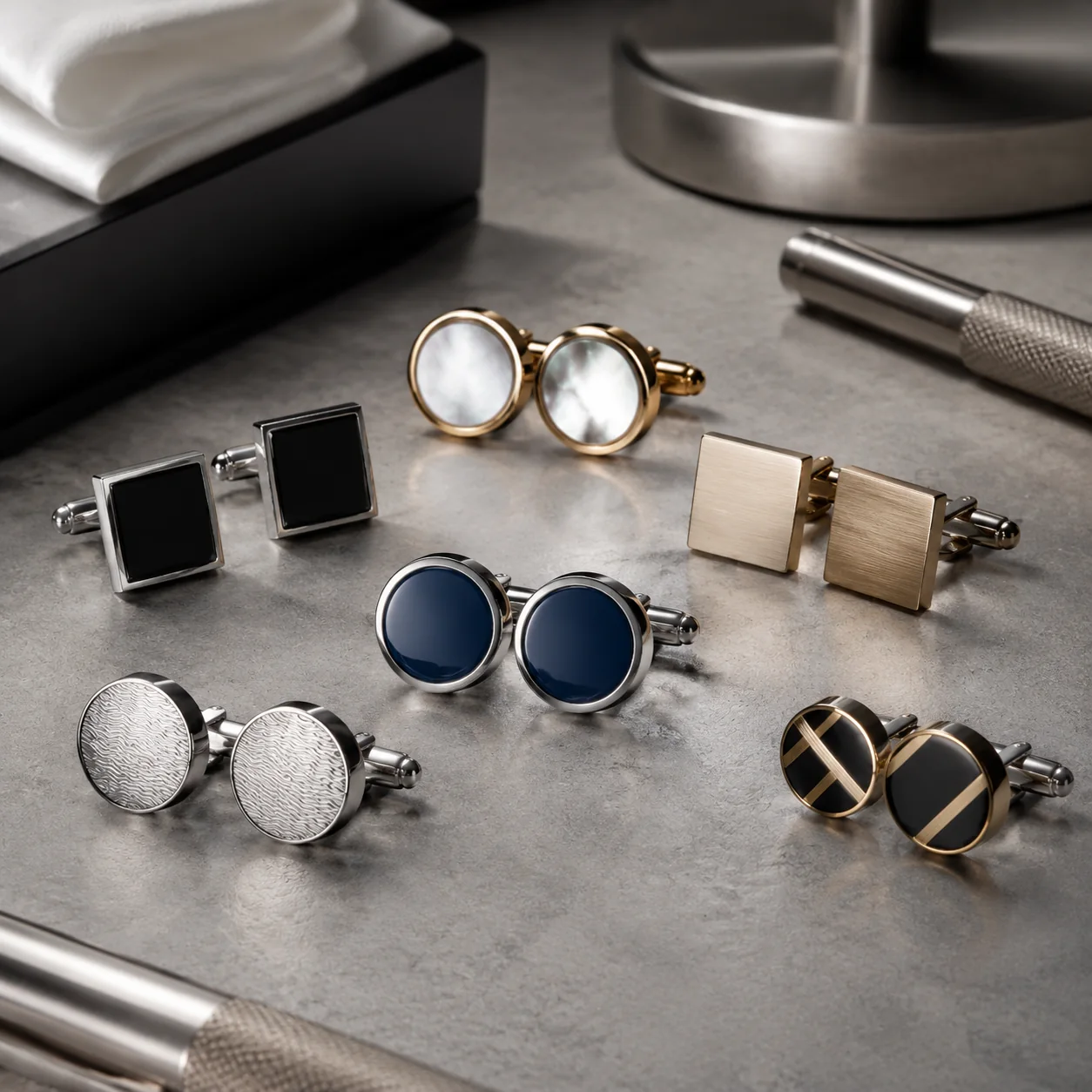
Use one shared front design and limit recipient-level personalization to initials, a date, or a role engraved on the reverse. The order must still meet the MOQ of 100 pairs per design, so a wedding party needing 12 gift pairs must plan and purchase the remaining 88 pairs. Before production, approve the total pair count, exact reverse-variant register, packaging allocation, construction sample, and production schedule. Obtain a written quote for mixed variants, unengraved pairs, packaging, and any changed front artwork because those pricing rules are not supplied.
Lock the batch structure first
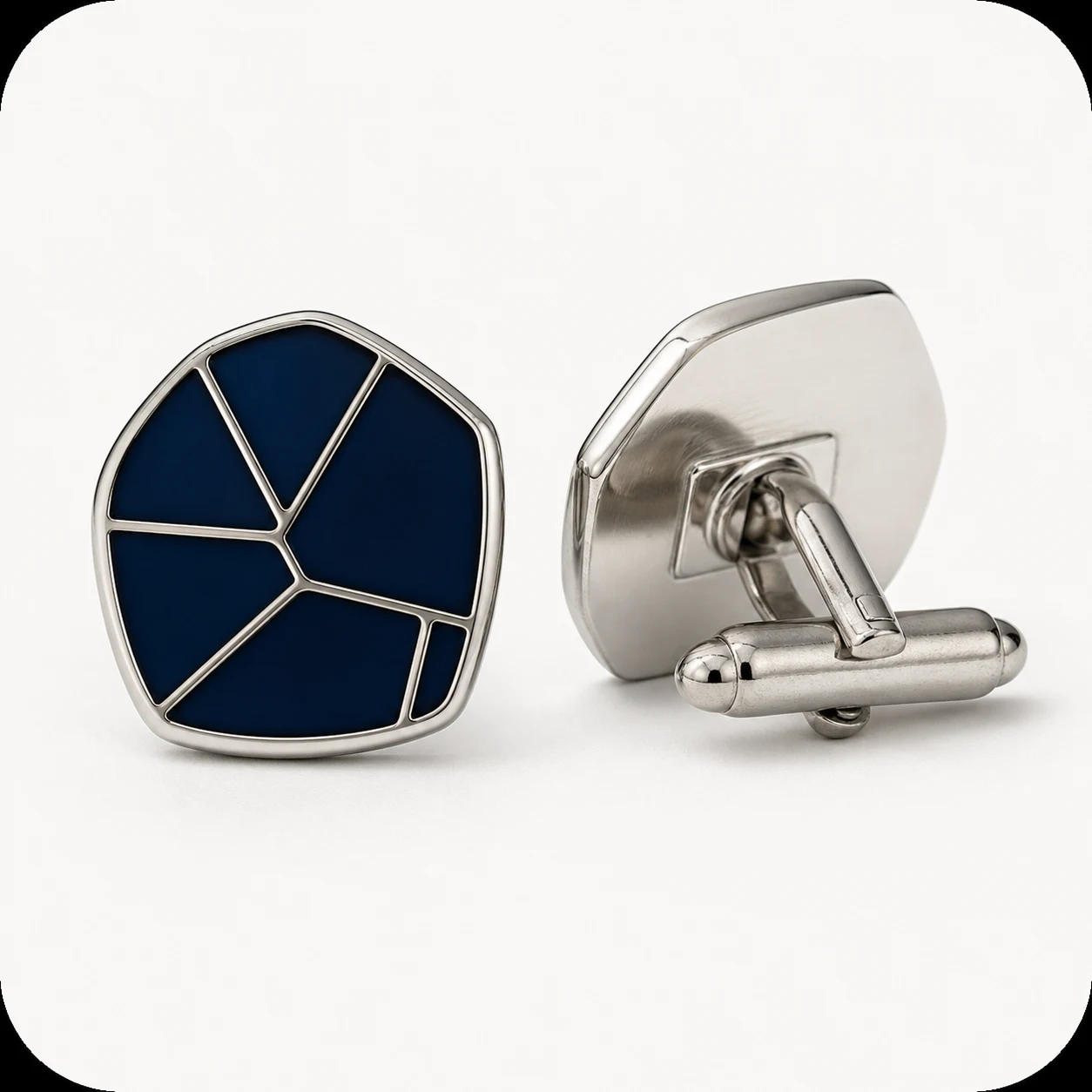
When comparing cufflink personalization options for wedding parties, the main production decision is whether every recipient needs a different visible design. The supplied manufacturing approach supports initials, dates, or roles engraved on the reverse while the front remains identical. That structure keeps the wedding party visually coordinated and allows recipient-specific details within one run.
The stated MOQ is 100 pairs per design, equal to 200 individual cufflink pieces. If 12 recipients each need one pair, the order still requires 100 pairs and creates a balance of 88 pairs. The buyer could propose repeated engraving, a shared date, another listed reverse variant, or no engraving for the balance. However, mixing rules and variant charges are not supplied, so the supplier must approve and quote the complete allocation.
- Keep one identical front artwork across the consolidated order.
- Place recipient-specific initials or roles on the reverse.
- Use a shared reverse date where individual identification is unnecessary.
- Count quantities in complete pairs and reconcile them with the 100-pair MOQ.
- Treat changed front artwork as a possible separate design and request a separate quote.
This MOQ is most practical when surplus pairs have a defined use, such as family gifts, event keepsakes, or replacements using an approved reverse treatment. If there is no credible use for the balance, the buyer should evaluate the full 100-pair cost before approving the project.
Choose the personalization model
The confirmed reverse-engraving options are initials, dates, and roles. Full names, long messages, and combined text layouts are not confirmed. Submit the exact wording with the selected face size so the supplier can assess engraving space and legibility.
| Personalization route | Batch effect | Best use | Required approval |
|---|---|---|---|
| One shared date on the reverse | Uses one repeated reverse treatment with a common front | A uniform gift for the full wedding party | Approve the date format, placement, and quantity |
| Varying initials on the reverse | Uses the stated ability to personalize within one run | Recipient-specific groomsmen gifts | Check every initial set, capitalization choice, and pair quantity |
| Varying roles on the reverse | Keeps the common front while changing reverse text | Best man, groomsman, and other role allocations | Confirm exact wording and available engraving space |
| A mixture of initials, dates, or roles | May remain one run, but mixing rules are not supplied | Parties using more than one identification method | Obtain written confirmation of the mix and any variant charge |
| Different front artwork by recipient | May create multiple designs subject to separate minimums | Orders requiring visibly different fronts | Quote each changed front as a possible separate design |
The practical default is a consistent front with controlled reverse variants. This follows the stated single-run personalization method, but it does not establish final pricing. The supplier still needs the complete variant schedule to confirm feasibility and cost.
Build a pair-count and variant register
Use a controlled register instead of an informal list of recipients. Each line should identify the reverse treatment, exact characters, quantity in complete pairs, and packaging requirement. Unique variants need separate references; repeated variants can share one line. The final quantity must match the purchase order.
| Register field | Buyer entry | Purpose |
|---|---|---|
| Variant ID | A unique reference such as V01 | Connects the proof, order, and packing instruction |
| Reverse treatment | Initials, date, role, or a request for no engraving | Separates confirmed options from requests requiring approval |
| Exact text | Final characters, case, spacing, and punctuation | Provides an unambiguous production record |
| Pair quantity | Number of complete pairs using the variant | Reconciles the register with the MOQ and purchase order |
| Packaging | Poly-bag or paired gift box with foam insert | Defines the presentation and packing allocation |
Keep the front artwork, base metal, decoration, plating, size, and fitting consistent unless the supplier confirms that a proposed change remains within the same design. Do not assume engraved and unengraved pairs can be combined without a process or price change. Ask whether variant IDs can also appear on outer packaging when recipient matching is required.
Specify construction and finish
The typical face size is 14-20 mm. Available shapes are round, square, rectangle, oval, and custom die-cut. Brass is the default base metal; stainless steel, zinc alloy, and copper are also listed. Comparative pricing and performance data for the alternative metals are not supplied, so the RFQ should name one selected material.
| Specification | Available option | Buyer decision |
|---|---|---|
| Decoration | Hard enamel | Select when a mirror-smooth, jewelry-grade finish on brass is the priority |
| Decoration | Soft enamel | Select when the more economical treatment and visible raised metal lines suit the artwork |
| Decoration | Die-struck relief | Use when relief is preferred; relative pricing and performance are not supplied |
| Decoration | Offset print with epoxy dome | Use for artwork intended for printed reproduction beneath an epoxy dome |
| Plating | Gold, silver, rose gold, gunmetal, black nickel, or antique brass | Carry one named finish through the quote, proof, sample, and purchase order |
| Back fitting | Swivel toggle T-bar | Use as the standard fitting unless an optional fitting is specified |
| Back fitting | Fixed bullet back or chain link | Name the optional fitting in every approval document |
Hard enamel on brass is the clearest fit when a smooth, jewelry-grade presentation is required. Soft enamel is the stated economical alternative and shows fine raised metal lines. The supplied facts do not rank die-struck relief or epoxy-domed print by durability, price, or lead time, so compare those methods through artwork review, sampling, and quotation.
Lock packaging and budget
The default packaging is a poly-bag. The recommended presentation option is a paired gift box with a foam insert, stated to add about $0.50-$1.00. Confirm whether that amount applies to each paired box and what the charge includes. If 100 pairs require 100 boxes at the stated addition, the packaging allowance would be approximately $50-$100.
The listed product price is $0.80-$5.50 per pair FOB. At the 100-pair MOQ, the base product range is therefore $80-$550 FOB before gift boxes and any unquoted personalization charges. This is not a landed-cost estimate. Freight, duty, tax, destination handling, and the named FOB port are not supplied.
- State the number of pairs assigned to each packaging type.
- Confirm the per-box price and total gift-box quantity.
- Ask whether variant IDs can be shown on outer packaging.
- Request separate quote lines for product, packaging, and personalization.
- Confirm the named FOB port and transport assumptions.
Approve proofs and samples
The supplied lead time is 7-10 days for a sample and 15-22 days for bulk production. It does not define a digital proof stage, promise a physical sample of every reverse variant, or provide inspection tolerances. Put the required approval sequence into the RFQ and purchase order.
Approve the shared front specification separately from the reverse-variant register. The front approval should identify artwork, shape, face dimension, base metal, decoration, plating, and back fitting. The reverse approval should reproduce every initial, date, or role exactly as it will be engraved. Ask whether approval will use digital artwork, a physical sample, or both.
- Confirm one identical front artwork for the consolidated run.
- Verify base metal, decoration, plating, and back fitting.
- Check the exact face dimension and shape.
- Proofread every reverse variant against the register.
- Confirm the pair quantity assigned to each variant.
- Confirm packaging type and total package count.
- Use the approved sample as the construction reference.
- Reconcile total pairs, variants, and packages before release.
For packing checks, verify that each package contains one complete pair and, where variant matching has been arranged, that the engraving agrees with the approved register. Compare the visible face, plating, fitting, and packaging with the approved specification. Any acceptance tolerances or sampling plan must be agreed separately.
Plan the schedule and issue the RFQ
If bulk production begins only after the 7-10 day sample stage, adding the stated 15-22 day bulk window produces a planning range of 22-32 days before buyer approval time and transport. The supplied facts do not state whether these are calendar or business days. Confirm the schedule in writing and allow contingency before the wedding date.
Steel dies are stated to be archived for five years. For a reorder, reference the approved design and previous purchase order, but reconfirm reverse variants, quantities, packaging, material, plating, and fitting. An archived die does not replace a current specification.
- Total quantity in complete pairs, with at least 100 pairs per design
- Shared front artwork and selected shape
- Face size, typically within the supplied 14-20 mm range
- Selected brass, stainless steel, zinc alloy, or copper base metal
- Selected decoration method and plating
- Selected swivel toggle T-bar, fixed bullet back, or chain-link fitting
- Variant register covering initials, dates, roles, and proposed unengraved pairs
- Poly-bag and paired gift-box quantities
- Required proof method and sample approval
- Required bulk completion date
- Separate quote lines for product, packaging, and variant charges
- Named FOB port and transport assumptions
Prepare one shared front artwork file, a reverse-engraving register totaling at least 100 pairs, and a complete packaging instruction. Submit them through the custom cufflinks for men product page at /products/custom-cufflinks.html. Release bulk production only after the supplier confirms the variant mix and the buyer approves quantities, wording, construction, finish, fitting, packaging, and schedule.
Ready to get this made?
Send your sketch, target quantity and ship-date. Detailed quotation in 12 hours.