Zinc Alloy vs Iron Keychains: Bulk Order Spec Guide
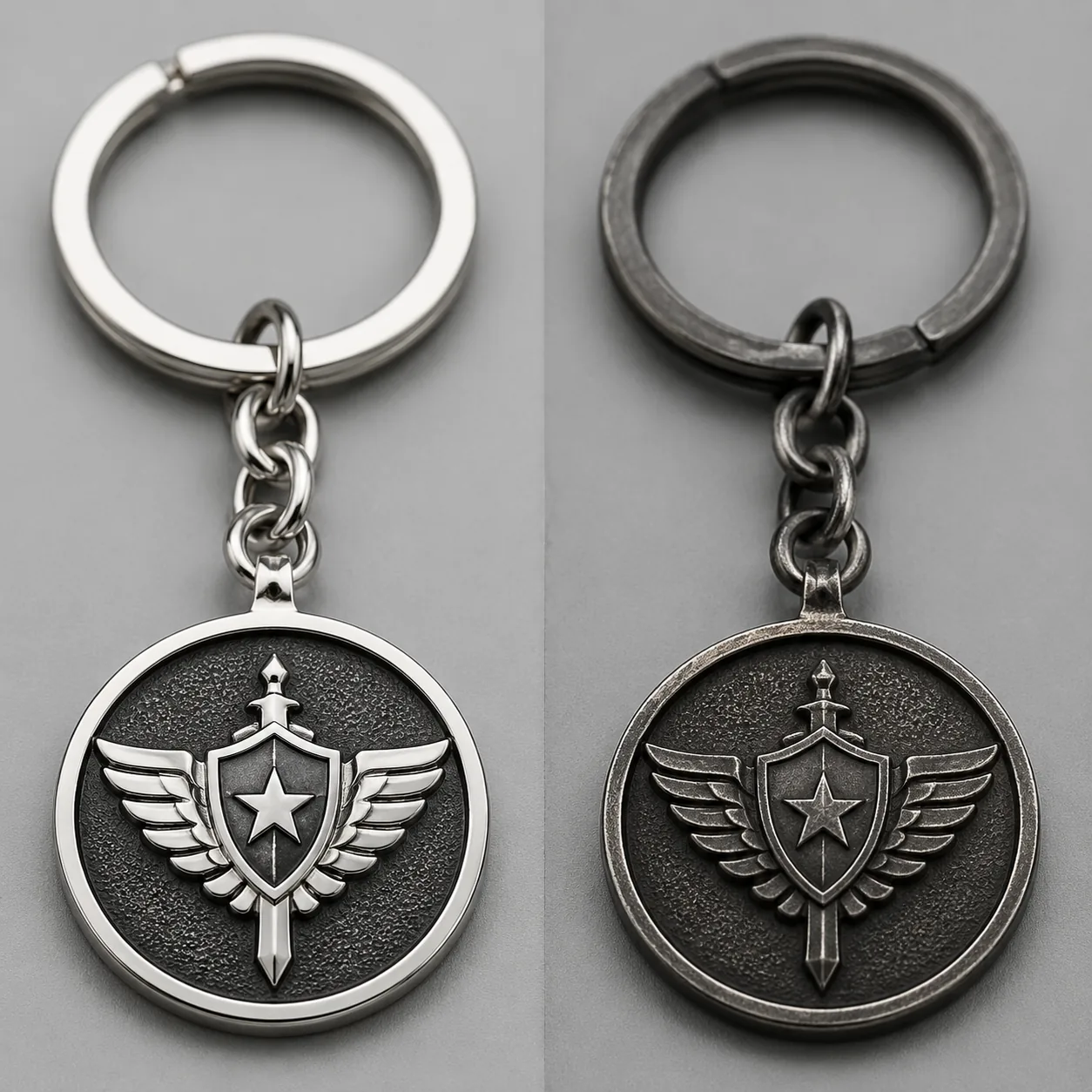
Why the Base Metal Changes the Whole Order
A common RFQ problem is receiving two quotes for what appears to be the same item: “custom metal keychain, nickel plated, soft enamel.” One supplier prices zinc alloy; another prices iron. The spreadsheet difference may be only USD 0.08-0.35 per piece, but the production route changes tooling, weight, polishing time, plating coverage, freight cost and re-order consistency.
At ZheCraft, most custom metal keychain RFQs are first separated into two families. Zinc alloy keychains are die cast in a steel mold, trimmed, polished, plated and colored. They suit thicker, heavier and more sculptural parts. Iron keychains are stamped or die struck from low-carbon sheet, then deburred, polished, plated and colored. They suit flatter, cost-sensitive designs with clean outlines and simple relief.
Neither material is automatically better. Zinc alloy usually gives a premium hand feel and stronger 3D capability. Iron usually gives lower unit cost and sharper flat detail. For a 30,000-piece campaign, choosing the wrong route can cost more than changing the packaging because it affects the mold, freight, corrosion risk, inspection criteria and the way the finished item feels in the user’s hand.
Bulk RFQ Specification Table
Use the table as a purchasing baseline, not a universal price promise. Actual quotes depend on size, thickness, plating color, enamel area, polishing grade, hardware, packing, exchange rate and factory loading. FOB ranges below reflect typical China factory pricing for custom metal keychains and exclude international freight, duty, VAT and local delivery.
| Spec Item | Zinc Alloy Keychain | Iron Keychain |
|---|---|---|
| Main process | Die casting in a custom steel mold, then trimming and polishing | Stamping or die striking from low-carbon sheet, then deburring and polishing |
| Common material | Zamak-style zinc alloy with aluminum and copper additions | Mild steel or low-carbon iron sheet, usually 0.8-2.0 mm before finishing |
| Typical finished size | 35-70 mm longest side for promo and souvenir work | 30-60 mm longest side for flat logo and campaign work |
| Practical finished thickness | 2.5-5.0 mm; 3.0-4.0 mm common for premium items | 1.2-2.5 mm; 1.5-2.0 mm common for soft enamel |
| Approximate weight at 50 mm | 18-38 g depending on thickness, relief and cutouts | 10-24 g depending on sheet thickness and outline |
| Best detail type | Rounded 2D/3D relief, molded contours, recessed backs, cut-through shapes | Sharp flat logos, raised borders, simple text and enamel cells |
| Minimum raised line | 0.35-0.45 mm recommended; 0.50 mm safer after polishing | 0.25-0.35 mm recommended on flat designs |
| Minimum recessed gap | 0.35-0.50 mm recommended to avoid blocked plating or enamel | 0.30-0.40 mm recommended for stamped partitions |
| Normal dimensional tolerance | ±0.15-0.25 mm after casting, shrinkage and polishing | ±0.10-0.20 mm after stamping and polishing |
| Normal thickness tolerance | ±0.15-0.25 mm on decorative parts | ±0.10-0.15 mm on stamped sheet parts |
| Nickel plating baseline | 5-8 microns typical; 10-12 microns for better corrosion resistance | 5-8 microns typical; edge and hole coverage require close checking |
| Gold finish note | Gold flash usually 0.03-0.10 microns over nickel; thicker gold raises cost sharply | Same, but thin edges and ring contact areas may show wear sooner |
| MOQ tier | 300-500 pcs possible; 1,000 pcs practical; 5,000+ pcs stronger pricing | 500 pcs possible; 1,000-3,000 pcs practical; 10,000+ pcs campaign pricing |
| Tooling cost | USD 90-260 for common 2D/3D molds; higher for large or multi-cavity tools | USD 60-180 for simple dies; higher for progressive dies or tight hole control |
| FOB unit price at 1,000 pcs | USD 0.95-2.60 for 45-60 mm with standard ring hardware | USD 0.65-1.70 for 40-55 mm with standard ring hardware |
| FOB unit price at 5,000 pcs | USD 0.58-1.65 depending on finish, size and packing | USD 0.38-1.15 depending on finish, size and packing |
| Sample lead time | 7-10 days after artwork, finish and deposit approval | 6-9 days after artwork, finish and deposit approval |
| Mass lead time | 14-24 days after sample approval for 1,000-10,000 pcs | 12-22 days after sample approval for 1,000-10,000 pcs |
| Main failure risk | Porosity, overweight parts, weak thin projections, polishing waves on 3D areas | Rust at exposed edges, bending on thin large shapes, burrs at holes |
| Typical AQL setting | ANSI/ASQ Z1.4 general level II; major 2.5, minor 4.0, critical 0 | ANSI/ASQ Z1.4 general level II; major 2.5, minor 4.0, critical 0 |
The table explains why a direct unit-price comparison is incomplete. Zinc alloy often costs more because the part is thicker, heavier and slower to polish. Iron often looks cheaper because the blank is faster to stamp and consumes less metal, but it needs reliable deburring and plating coverage at edges, holes and ring contact points.
When Zinc Alloy Is the Safer Choice
Choose zinc alloy when the design needs volume, depth or an object-like hand feel. Typical examples include 3D mascot keychains, hotel souvenirs, automotive dealer gifts, sports club merchandise, bottle-opener shapes and destination retail pieces. If the design needs rounded sides, stepped relief, raised characters above 0.6 mm, a sculpted back or an irregular silhouette thicker than 3.0 mm, zinc alloy normally gives the factory better control.
Zinc alloy also handles integrated features well. A cast loop, opener slot, recessed back logo, tire tread, mascot face or raised border can be formed in the mold before polishing and plating. With iron, the same detail may require secondary piercing, bending, welding or assembly. Each added operation creates another tolerance stack and another point where defects can enter the order.
The trade-off is weight and surface sensitivity. A 60 mm zinc alloy keychain at 4.0 mm finished thickness can reach 35-45 g before packing. On a 20,000-piece order, that weight affects air freight, carton handling and event distribution. Broad flat zinc surfaces may also reveal tiny casting pores after high-gloss nickel, black nickel or gold plating. For premium orders, specify “no visible pinholes, pits, peeling or blistering at 30 cm under white light,” and expect mirror finishes to require more polishing time and tighter rejection control.
When Iron Is the Better Fit
Choose iron when the keychain is flat, price-sensitive and needed in volume. Typical applications include conference giveaways, school fundraisers, political campaigns, tourist tags, corporate logo gifts and simple retail add-ons. For a 45 mm flat logo with soft enamel, nickel plating, jump ring and 25 mm split ring, iron can often save USD 0.15-0.55 per piece compared with zinc alloy at 3,000-10,000 pieces.
Iron gives crisp stamped outlines and clean enamel partitions when the design is mostly 2D. A 1.5 mm iron blank with raised borders can hold standard soft enamel cells reliably if minimum metal lines remain near 0.30 mm and enamel gaps are not too narrow. For imitation hard enamel, the flatter stamped surface may be easier to polish evenly than a deep cast part, especially on simple logos, badges and geometric shapes.
The main weakness is corrosion control. Iron depends on complete plating coverage, especially around punched edges, holes and ring loops where abrasion is concentrated. For humid markets, coastal retail, outdoor campaigns or long warehouse storage, request nickel plating at 5-8 microns minimum, dry inner packing and silica gel where appropriate. A 24-hour neutral salt spray test can be useful for higher-risk orders, but it adds cost and must be specified before quoting. If the product is expected to survive rough outdoor use, stainless steel or a different construction may be more appropriate than standard plated iron.
Cost, MOQ and Lead-Time Reality
For a 50 mm one-sided soft enamel keychain with standard nickel plating, jump ring, 25 mm split ring and individual polybag, a realistic 1,000-piece FOB quote may be USD 1.10-1.90 in zinc alloy and USD 0.75-1.35 in iron. At 5,000 pieces, the same design may fall to USD 0.70-1.30 in zinc alloy and USD 0.45-0.95 in iron. Retail cards, velvet pouches, epoxy coating, antique plating, double-sided color or special ring hardware can move both ranges upward.
Tooling changes the first-order economics. Zinc alloy molds commonly cost USD 90-260 because the cavity must support metal flow, shrinkage, ejection and trimming. Iron dies may be USD 60-180 for simple shapes, but progressive tooling, double-sided embossing, precise holes or multi-step forming narrows the gap. For orders below 500 pcs, tooling can be a larger cost driver than the base metal.
MOQ should be treated as an economic tier, not only a factory rule. A supplier may accept 300 pcs in zinc alloy or 500 pcs in iron, but the unit price is usually inefficient because plating baths, color mixing, mold setup, packing setup and inspection time do not scale down cleanly. For most custom keychains, 1,000 pcs is the first practical price tier, 3,000-5,000 pcs is the stronger procurement tier, and 10,000+ pcs is where material purchasing, fixture use and packing efficiency begin to matter.
Lead time should be quoted in two parts. Prototype samples usually need 6-10 days after approved vector artwork, confirmed finish and deposit. Mass production usually needs 12-24 days after sample approval for 1,000-10,000 pcs. Add time for antique plating, epoxy coating, retail packing, special cartons or peak-season queues. If an event date is fixed, reserve 5-10 days for artwork correction, sample transit and pre-shipment inspection instead of using the factory’s production days as the full schedule.
Tolerances, Plating and AQL Checks
Do not approve zinc alloy and iron samples by appearance alone. Their failure modes differ. Zinc alloy requires attention to casting pores, uneven polishing on curved edges, dimensional shrinkage and weak thin projections. Iron requires attention to burrs, bending, edge rust and plating coverage inside holes.
- Measure finished length, width and critical holes with calipers against the approved drawing; use ±0.20 mm for normal decorative parts and ±0.10 mm only for functional openings such as bottle-opener slots.
- Check thickness at three points; zinc alloy should normally remain within ±0.20 mm, while stamped iron should normally remain within ±0.10-0.15 mm.
- Inspect plating at 30 cm under white light; reject exposed base metal, blistering, peeling, burnt patches, rust stains, sharp burrs and heavy polishing waves.
- Pull-test the ring connection; 5 kg static pull for 10 seconds is a practical minimum for standard promo keychains, while heavier retail items may need 8-10 kg.
- Confirm enamel quality; reject major bubbles, color overflow onto raised metal, wrong Pantone match and sunken fill beyond 0.15 mm unless a soft enamel texture is approved.
- Use AQL consistently; common settings are ANSI/ASQ Z1.4 general inspection level II, major defect 2.5, minor defect 4.0 and critical defects 0 for sharp edges or safety issues.
For plated iron, ask how holes and edges are treated before plating. A sharp punched hole can cut through the plating when the jump ring rotates. ZheCraft usually recommends a deburred or rounded hole edge, with the hole diameter at least 0.3 mm larger than the jump-ring wire diameter to reduce friction. For zinc alloy, ask the factory to confirm whether thin projections, narrow bridges or cast-in loops remain strong after polishing, not only after casting.
Design Rules That Decide the Metal
A buyer can often choose the metal by checking five features: thickness, relief depth, outline complexity, functional stress and visible surface area. If the product needs 3.0 mm or more thickness, rounded sides or sculpted relief, zinc alloy is normally more suitable. If it is a flat logo tag below 2.0 mm thickness with simple color areas, iron is normally more economical.
Small text needs conservative rules in both materials. Raised letters below 1.2 mm character height can fill with plating, enamel or polishing compound, especially on black nickel, antique brass and antique copper finishes. For readable logos, specify at least 1.5 mm character height and 0.25-0.35 mm minimum stroke width depending on the font. Avoid placing tiny text near the ring hole, where polishing pressure and wear are highest.
For bottle openers, trolley tokens or tool-like keychains, do not choose by appearance. The drawing should show functional slot width, hook radius, material thickness and tolerance. Zinc alloy can work for novelty openers and low-frequency use, but repeated stress may require thicker zinc alloy, an iron or stainless insert, or a different construction. For any load-bearing, food-contact or child-facing item, confirm the relevant safety and material requirements before tooling.
RFQ Checklist for a Controlled Comparison
Shortlist zinc alloy when the product must feel premium, include deep relief, support 3D shaping or combine several molded details into one part. It is usually the better route for mascots, destination merchandise, collectible keychains, bottle-opener souvenirs and heavier brand gifts where perceived value matters more than the lowest unit cost.
Shortlist iron when the brief is flat, simple, price-driven and high volume. It is practical for campaigns where logo visibility and budget control matter more than sculptural detail. Avoid pushing iron too thin on large shapes: a 65 mm wide keychain at 1.0 mm thickness can bend in pockets, cartons or mailing packs even if the first sample looks acceptable.
If both quotes remain viable, order one controlled sample comparison. Keep the longest-side dimension, plating color, enamel colors, ring hardware and packing identical. Then compare weight, edge finish, logo sharpness, hole wear, ring movement and perceived value. Two paid samples are cheaper than discovering after mass production that the selected metal does not fit the sales channel.
- Send vector artwork with longest-side dimension, target thickness, front view, back view and required hole diameter.
- State whether zinc alloy and iron should both be quoted, or whether the supplier should recommend one production route only.
- Specify finish clearly: nickel, black nickel, antique brass, antique copper, gold flash, epoxy coating, soft enamel or imitation hard enamel.
- Define plating expectations if corrosion matters; nickel at 5-8 microns is a practical baseline, while 10-12 microns or salt spray testing should be quoted separately.
- Ask for estimated unit weight, carton quantity, gross weight and carton dimensions so freight can be compared correctly.
- Confirm commercial terms: MOQ tier, tooling cost, sample lead time, mass lead time, FOB port, payment terms and AQL inspection standard.
A useful RFQ does more than request a “best quality metal keychain.” It locks the manufacturable specification: material, size, thickness, finish, color method, hardware, packing, tolerance and inspection criteria. For buyers with existing artwork, ZheCraft can review whether zinc alloy or iron is the safer route before tooling starts. That early decision prevents two expensive outcomes: a cheap keychain that fails in use, or an overbuilt keychain that quietly wastes budget.
Have a project? Send your artwork and target quantity and we’ll reply with a detailed quotation within 12 working hours.
Ready to get this made?
Send your sketch, target quantity and ship-date. Detailed quotation in 12 hours.



