Zinc Alloy vs Iron for Custom Pins in 2026
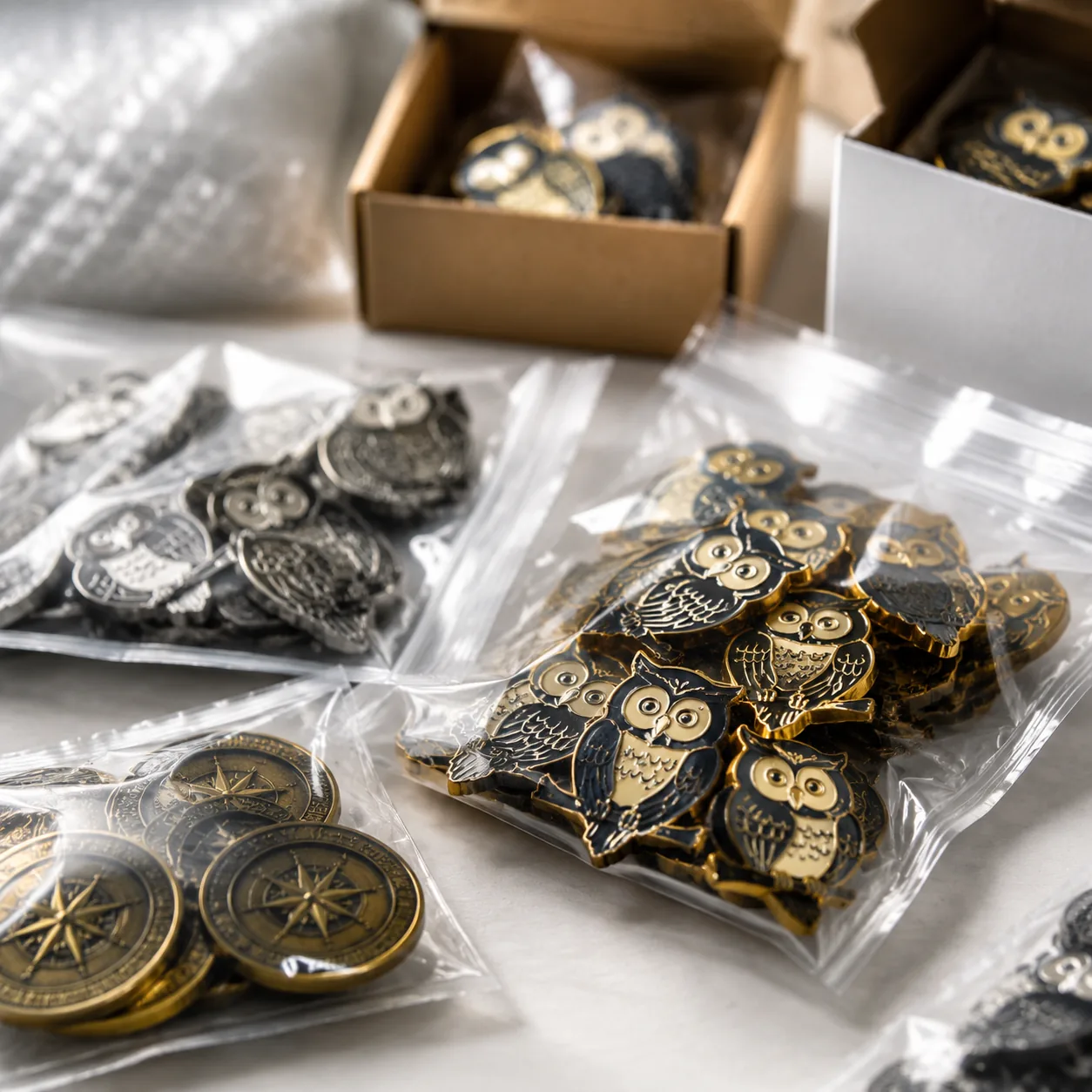
Why base metal selection affects cost, appearance and reorder stability
Many buyers still request quotes for a "custom pin" as if all builds are interchangeable. They are not. A USD 0.44 FOB quote and a USD 0.72 FOB quote for the same 30 mm design often represent two different constructions: stamped iron versus die-cast zinc alloy. That process choice changes tooling cost, achievable detail, body thickness, edge feel, plating behavior, hardware attachment method, shipping weight and reject rate.
In 2026, base metal should be treated as an engineering decision. It determines whether the factory can reliably hold 0.25 to 0.30 mm raised metal lines, whether a 2.8 to 3.0 mm body is practical, whether interior cutouts will survive polishing without distortion, and whether a reorder six months later will match the approved sample in thickness, weight and edge profile.
As a rule, iron is usually the better fit for flat, badge-style enamel pins with crisp outlines, lower tooling cost and lower unit FOB. Zinc alloy is usually the safer fit for irregular silhouettes, deeper relief, openwork, layered forms and thicker builds where stamping becomes inefficient or unstable. The correct sourcing sequence is simple: freeze geometry first, then choose the metal that can produce it at the lowest total risk.
Core spec comparison: zinc alloy vs iron
| Spec area | Zinc alloy | Iron |
|---|---|---|
| Typical process | Die cast in hardened steel mold, gate trim, tumble or hand polish, plate, color fill, inspect | Stamped from low-carbon steel sheet, form relief, trim, plate, color fill, inspect |
| Best for shape complexity | Irregular outlines, 3D relief, mascots, openwork, layered surfaces, spinner bases | Flat logos, flags, seals, school pins, corporate badges, geometric shapes |
| Common thickness | 2.0 to 4.0 mm; 2.5 to 3.0 mm most common | 1.0 to 2.0 mm; 1.2 to 1.5 mm most common |
| Typical size range | 20 to 70 mm standard; 80 mm possible with heavier mold and extra flatness control | 15 to 60 mm standard; above 50 mm needs stricter flatness and post planning |
| Minimum practical raised metal line | 0.30 to 0.35 mm | 0.25 to 0.30 mm |
| Minimum recessed enamel cell | 0.50 mm | 0.40 mm |
| Minimum bridge around cutout | 0.80 to 1.00 mm | 0.70 to 0.90 mm on simple shapes |
| Typical depth/relief | 0.6 to 1.2 mm relief practical; multi-level surfaces feasible | 0.15 to 0.35 mm relief typical on flat badge builds |
| Edge character | Rounded cast edge; softer hand feel | Crisper stamped edge; flatter badge feel |
| Typical weight at 30 mm | 9 to 14 g at 2.5 to 3.0 mm | 4 to 8 g at 1.2 to 1.5 mm |
| Plating behavior | Good with antique, matte, textured and dark finishes; mirror finish depends heavily on polish quality | More consistent on bright nickel, bright gold-tone and smooth polished faces |
| Soft enamel suitability | Very good | Very good |
| Imitation hard enamel suitability | Good; flatness depends on polishing and cast face quality | Very good; generally flatter and more uniform |
| True hard enamel suitability | Possible but less common and costlier | More common for premium hard enamel and cloisonne-style programs |
| Attachment method | Cast-in bosses, drilled holes or welded posts on thicker backs | Soldered posts on flat backs; strong and economical |
| Typical MOQ | 100 to 300 pcs | 100 to 300 pcs |
| Best pricing tier | 500+ pcs | 500+ pcs |
| 2026 tooling cost | USD 90 to 220 standard; complex 3D/openwork often USD 250 to 380 | USD 50 to 130 standard; larger or multi-cut dies often USD 140 to 220 |
| FOB at 30 mm, 1 color, 100 pcs | USD 0.80 to 1.20 | USD 0.62 to 0.95 |
| FOB at 30 mm, 1 color, 300 pcs | USD 0.55 to 0.85 | USD 0.38 to 0.60 |
| FOB at 30 mm, 1 color, 1,000 pcs | USD 0.36 to 0.68 | USD 0.24 to 0.42 |
| Pre-production sample lead time | 7 to 10 calendar days | 5 to 8 calendar days |
| Mass production lead time | 12 to 18 days after approval; 18 to 25 with assembly or cards | 10 to 15 days after approval; 14 to 20 with assembly or cards |
| Typical dimensional tolerance | ±0.20 mm on major features; thickness ±0.10 to 0.15 mm | ±0.20 mm on major features; thickness ±0.08 to 0.12 mm |
| Typical post-position tolerance | ±0.50 mm | ±0.50 mm |
| Suggested inspection target | AQL 2.5 major / 4.0 minor | AQL 2.5 major / 4.0 minor |
| Best use case | Retail merch, commemoratives, premium shape-driven pins | Corporate programs, low-cost promos, clean flat enamel badges |
The key takeaway is that the lower quote is not automatically the better buy. A stamped iron build is often correct for a 25 mm two-color flag pin. A zinc alloy build is often correct for a 45 mm mascot pin with two interior windows and sculpted facial relief. Problems begin when a supplier quotes the process that best fits its own workshop instead of the artwork.
Geometry first: when stamping works and when casting is safer
Iron stamping starts with flat sheet, usually 1.0 to 1.5 mm for standard enamel pins. A die forms the raised outlines and recesses in a single directional press operation, which makes the process efficient for planar artwork with clear borders, regular enamel cells and limited vertical depth. For a 28 mm company logo pin, 1.2 mm iron with soft enamel or imitation hard enamel is often the cleanest cost-to-appearance option.
The process becomes less forgiving when the design requires mass, depth or structural complexity. For example, a 45 mm pin with a 3.0 mm body, asymmetrical outline, two cutouts and stepped relief is routine in zinc alloy but usually compromised in iron. To force that artwork into a stamped build, the supplier may flatten relief, enlarge tiny windows, widen bridges to at least 0.80 mm and simplify contours. Those changes are process limitations, not necessarily poor workmanship.
Zinc alloy is more flexible because molten metal fills a cavity rather than being pushed from flat stock. That makes it the better choice for deeper recesses, layered forms, rounded contours, animal silhouettes, medallion-style pins and spinner or hinge assemblies. If the concept includes a 2.5 mm to 3.5 mm body, undercut-like visual depth, or multiple interior openings, casting is usually the lower-risk route even if the unit FOB is USD 0.10 to 0.25 higher at 300 to 500 pieces.
There is also a noticeable tactile difference. Iron feels flatter, lighter and more formal. Zinc alloy feels heavier and more dimensional. For conservative membership badges or employee service awards, the crisp stamped look can be exactly right. For museum merch, game IP, fan collectibles or commemorative event pieces, the heavier cast hand-feel often adds perceived retail value.
Finish and plating performance: bright, antique and textured builds
Both metals can produce attractive pins, but they favor different finishes. Iron generally gives a cleaner visual plane for imitation hard enamel, polished borders and bright nickel or bright gold-tone plating. Because the face starts flatter, reflective plating tends to read more evenly and needs less corrective polishing. That is why many simple premium-looking school, club and corporate pins still use iron.
Zinc alloy performs especially well with soft enamel, antique brass, antique nickel, matte black, sandblasted backgrounds and sculpted surfaces where slight cast texture is either hidden or intentional. It is less forgiving when the design depends on a flawless mirror face across a broad raised area. Minor porosity, polish drag or subtle casting texture can show under bright nickel or shiny gold plating, particularly on large flat fields.
Plating language should be more specific than just "gold" or "silver." For promotional pins, decorative top coats are commonly about 0.03 to 0.08 microns over a nickel or copper-plus-nickel underlayer. Some suppliers plate copper first to improve smoothness before nickel and final color. Those thicknesses are adequate for most indoor promotional use, but they are not a wear-proof specification. If the product will be sold at retail, packed loosely in bulk, or worn repeatedly on bags or jackets, ask for the plating stack, whether a copper strike is used, and the target salt-spray performance in hours. A typical decorative target might be 24 to 48 hours neutral salt spray; buyers needing more should confirm it explicitly rather than assume it.
A practical comparison makes the difference clearer. A 35 mm vintage-look pin with heavy texture, recessed black enamel and antique brass finish is usually safer in zinc alloy. A 28 mm membership pin with a white imitation hard enamel face, smooth background and mirror nickel borders is usually safer in iron. The right question is not which metal is best overall, but which metal makes the selected finish easier to control at scale.
Pricing, MOQ tiers and where cost crossover happens
Iron is usually cheaper, but not in every build. At 100 pieces, a simple 25 to 30 mm iron soft enamel pin commonly lands at USD 0.62 to 0.95 FOB, while zinc alloy is more often USD 0.80 to 1.20. At 300 pieces, iron typically falls to USD 0.38 to 0.60 and zinc alloy to USD 0.55 to 0.85. At 500 pieces, iron often reaches USD 0.30 to 0.50, while zinc alloy commonly sits at USD 0.43 to 0.75. At 1,000 pieces, the spread narrows to roughly USD 0.24 to 0.42 for iron and USD 0.36 to 0.68 for zinc alloy.
The crossover appears when secondary operations stack up. A stamped iron pin that needs two cutouts, a custom backstamp, two posts, upgraded polish, printed backer card, spinner rivet or thicker-than-standard build can lose much of its cost advantage. In some assemblies, zinc alloy becomes simpler because the geometry, hardware and part thickness are better matched to casting. Comparing only the headline unit price without matching the construction assumptions leads to poor sourcing decisions.
Tooling should always be listed separately. In 2026, a straightforward iron die is often USD 50 to 130, while standard zinc alloy tooling is more often USD 90 to 220. Deep 3D, openwork, hinges, dangles, magnetic backs or multi-piece construction can push tooling above USD 250 and sometimes above USD 350. Common adders in 2026 include roughly USD 0.03 to 0.08 for upgraded plating, USD 0.02 to 0.06 for individual polybagging when not standard, USD 0.05 to 0.20 for printed back cards, and much more for magnets, chains, velvet boxes or moving components.
A disciplined RFQ should ask for pricing at 100, 300, 500 and 1,000 pieces, plus tooling, sample charge, standard packaging, carding cost and any assembly adders. That shows the real cost curve. In some programs, iron is best at 300 pieces but no longer economical once assembly complexity rises. In others, the artwork gains nothing from casting, so every extra cent spent on zinc alloy is avoidable.
Quality control, tolerances and the defects that matter most
The highest-value inspection points differ by metal. For iron, focus on die sharpness, front-face flatness, enamel fill level, burrs, solder strength on posts and plating consistency on smooth raised borders. For zinc alloy, focus on parting-line visibility, polish uniformity, porosity on raised faces, incomplete plating in recesses and survival of fine details after trim and polish.
Tolerance expectations should remain realistic. For most custom pins, ±0.20 mm on major external dimensions is achievable. Thickness is typically held within ±0.10 to 0.15 mm on zinc alloy and ±0.08 to 0.12 mm on iron, depending on where it is measured. Post placement should stay within ±0.50 mm so rubber or butterfly clutches align and the pin fits backing cards, foam inserts or rigid presentation boxes without stress. On larger pieces over 50 mm, asking for an informal flatness limit such as bow or twist under 1.0 mm across the body can help avoid argument later.
Fine artwork increases defect risk quickly. Metal lines below 0.25 mm, recessed cells below 0.40 to 0.50 mm, or bridges narrower than 0.70 to 0.80 mm raise the chance of underfill, chipped enamel edges, bent walls, polish distortion and warpage after plating. In practice, changing artwork by just 0.10 to 0.20 mm before tooling often saves more money than any unit-price negotiation.
Inspection standards should be written into the PO, not assumed. AQL 2.5 major and 4.0 minor is common for promotional metal items, but defect definitions should be named. Major defects usually include detached posts, missing plating, wrong enamel color, visible front-face scratches at normal viewing distance, severe underfill, sharp unsafe burrs or warped bodies that do not sit properly. Minor defects can include light backside polish marks, slight backside color spread or tiny non-visible casting specks that do not affect appearance or function.
Lead times, reorders and how to lock construction before scale-up
Lead time differences between iron and zinc alloy are real but usually not dramatic. Pre-production samples are often 5 to 8 days for iron and 7 to 10 days for zinc alloy. After sample approval, standard mass production is usually 10 to 15 days for iron and 12 to 18 days for zinc alloy. Add 2 to 5 more days for printed backer cards, individual barcoding, polybagging with silica gel, multi-piece assembly or presentation boxes. Around Lunar New Year or peak Q4 promo windows, buyers should expect these timelines to stretch.
The bigger risk is reorder inconsistency. If the first lot was stamped iron at 1.2 mm with bright nickel and the reorder is zinc alloy at 2.5 mm because the supplier changed workshop or subcontracted differently, the edge feel, thickness, weight and light reflection will all change even if the artwork dimensions remain close. That difference is obvious to end users and often unacceptable in corporate or retail programs.
To prevent drift, freeze the construction in the purchase order and golden sample record. At minimum, document base metal, process route, nominal thickness, plating finish, enamel type, Pantone references, post quantity and coordinates, backing type, packaging method, approved artwork revision, acceptable tolerance and AQL standard. Photos alone are not enough because they rarely capture thickness, backside structure, post location or plating stack accurately.
One useful supplier-screening question is: what process do you recommend for this artwork and why, and what process would you reject and why. Strong suppliers answer with geometry, finish and yield logic. Weak suppliers answer only with price. For repeat programs, that difference matters more than a few cents of FOB spread on the first order.
PO checklist: choosing the right metal fast
- Choose iron for flat badge-style designs, crisp borders, lower target FOB and typical quantities from 100 to 5,000 pcs.
- Choose zinc alloy for 3D relief, irregular silhouettes, body thickness above about 2.0 mm, spinner bases or multiple interior cutouts.
- Use iron for imitation hard enamel when front-face flatness and bright polished outlines matter most.
- Prefer zinc alloy for antique, matte, sandblasted or heavily textured finishes where depth matters more than mirror reflectivity.
- Request FOB pricing at 100, 300, 500 and 1,000 pcs, with tooling, sample charge, packaging and carding listed separately.
- Lock minimum line width, cutout bridge width, nominal thickness and post-position tolerance before approving tooling.
- Specify plating by finish type, underlayer expectation, top-coat range in microns and desired salt-spray performance if durability matters.
- Set AQL 2.5 major and 4.0 minor in the PO and define major defects in writing.
- Approve one pre-production sample built exactly as mass production will run: same metal, same plating, same posts, same packaging and same artwork revision.
If the design sits on the border between iron and zinc alloy and the order value is meaningful, sampling both can be justified. In most cases, however, the safest commercial decision is the process that fits the geometry and finish cleanly, not the one that saves a few cents on the first quote.
Have a project? Send your artwork and target quantity and we’ll reply with a detailed quotation within 12 working hours.
Ready to get this made?
Send your sketch, target quantity and ship-date. Detailed quotation in 12 hours.



