Zinc Alloy vs Brass Pins: Which Respec Saves More Rework
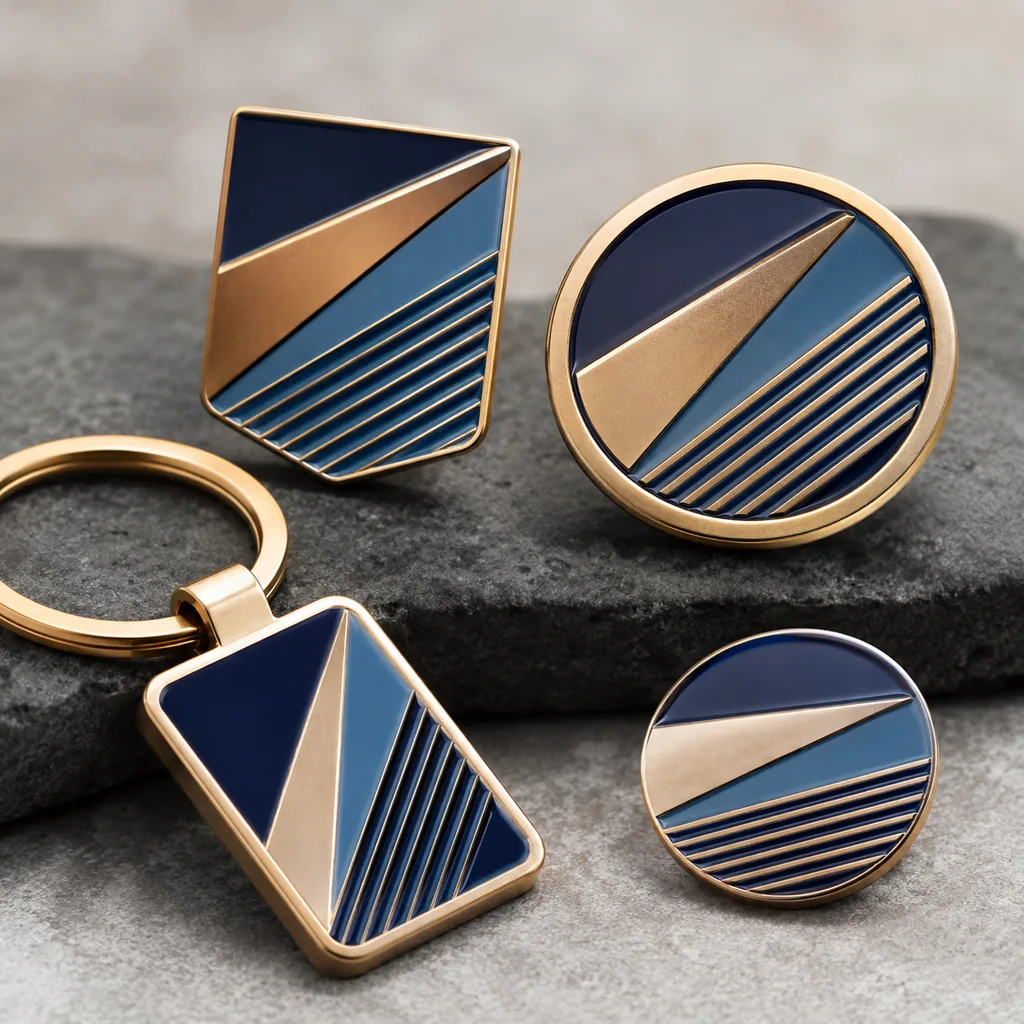
When a low quote becomes a non-releasable sample
The failure pattern is usually visible by the first pre-production sample. Artwork is approved for a 38 to 45 mm pin, tooling is opened on the lowest workable quote, and the sample comes back with rounded corners, soft fine text, enamel flooding into narrow cells, or a face too wavy for a premium badge. Those are often treated as plating or polishing issues. In most cases, the actual mistake happened earlier: the drawing was matched to the wrong forming process.
For custom lapel pins, the main early decision is typically zinc alloy die casting versus brass die striking. Both are standard production routes, but their process windows are different enough that the wrong choice creates predictable rework. Zinc alloy handles thicker sections, sculpted relief, large open cutouts, and irregular outlines well. Brass holds sharper 2D geometry, flatter faces, cleaner corners, and tighter enamel separation. When the first sample is already showing process-limit defects, asking for better polishing or stricter final inspection rarely fixes the root cause.
The practical sourcing question is not which metal sounds more premium. It is which route reduces second sampling, tooling edits, and bulk rejection against the actual drawing. That means comparing measurable capability: minimum line width, enamel gap minimums, body thickness, face flatness, dimensional tolerance, plating build, MOQ breakpoints, lead times in days, and the defect patterns that should trigger a material respec before mass production.
Capability snapshot: what each process will reliably hold
| Spec point | Zinc alloy die cast | Brass die struck |
|---|---|---|
| Best-fit design type | 3D mascots, layered relief, 2.5 to 3.5 mm thick badges, large openwork, bottle opener backs, organic silhouettes | 2D soft enamel or imitation hard enamel logos, school crests, corporate identity pins, geometric badges |
| Typical alloy / process | Zamak 3 or equivalent die cast, gate trim, polish, plate, enamel fill | Brass sheet die struck, trim, polish, plate, enamel fill |
| Typical finished thickness | 2.0 to 3.5 mm; 2.5 to 3.0 mm most common | 1.2 to 2.0 mm; 1.5 mm most common |
| Practical size range | 25 to 70 mm; most stable at 35 to 60 mm | 15 to 60 mm; most stable at 20 to 50 mm |
| Recommended MOQ tiers | 100 pcs minimum; strongest economics at 300 / 500 / 1000 pcs | 100 pcs minimum; strongest economics at 300 / 500 / 1000 pcs |
| Minimum raised metal line width | 0.35 to 0.40 mm practical; below 0.30 mm high risk | 0.20 to 0.30 mm practical; 0.25 mm is a safer release target |
| Minimum recessed gap for enamel fill | 0.45 to 0.50 mm | 0.30 to 0.35 mm |
| Minimum readable positive text height | 1.2 to 1.5 mm capital height | 0.8 to 1.0 mm capital height |
| Internal corner behavior | Small radii soften; sharp inside points tend to round | Sharper edge retention and cleaner inside corners |
| Openwork capability | Very good for larger cutouts and irregular silhouettes | Good for moderate cutouts; intricate small openwork raises die cost and burr cleanup risk |
| Typical face flatness / warpage at 40 mm | 0.20 to 0.35 mm across face; premium programs should target 0.25 mm max | 0.10 to 0.20 mm across face; premium programs should target 0.15 mm max |
| Overall size tolerance | +/-0.20 mm typical | +/-0.20 mm typical |
| Thickness tolerance | +/-0.15 mm typical | +/-0.10 to 0.15 mm typical |
| Post location tolerance | +/-0.50 mm | +/-0.50 mm |
| Decorative plating build | Copper strike plus nickel base, with 0.03 to 0.08 micron decorative top finish | Copper strike plus nickel base, with 0.03 to 0.08 micron decorative top finish |
| FOB price, 38 mm, 300 pcs | USD 0.68 to 1.08 each | USD 0.86 to 1.26 each |
| FOB price, 45 mm, 500 pcs | USD 0.75 to 1.20 each | USD 0.98 to 1.42 each |
| Tooling, simple 38 to 45 mm design | USD 80 to 160 | USD 100 to 220 |
| Pre-production sample lead time | 5 to 8 days | 5 to 7 days |
| Mass production lead time after approval | 10 to 18 days | 10 to 16 days |
| QC advantage | More forgiving for thick, sculpted, cast-friendly geometry | More forgiving for fine 2D detail and visual consistency |
These are buying ranges, not theoretical maximums. Capability still shifts with outline complexity, color count, plating finish, epoxy dome, screen print, cutouts, and back hardware. But this level of detail is what a buyer should request before approving tooling. It quickly separates factory execution problems from a process mismatch built into the drawing.
Where brass usually saves the most rework
Brass is usually the safer respec when the front face has to read cleanly both at arm's length and under hand inspection. Typical examples are corporate logo pins, school crests, service awards, hospitality name badges, security programs, and any mark where a 0.10 mm loss in edge definition changes brand perception. In those programs, the acceptance standard is visual precision, not sculptural depth.
A die-struck brass pin generally holds cleaner metal boundaries between enamel cells, straighter outer borders, and more repeatable small text. On a 35 to 40 mm pin, a controlled brass program can usually keep visible face warpage in the 0.10 to 0.20 mm range and maintain reliable enamel walls around 0.30 to 0.35 mm recesses. That matters because most bulk failures are not dramatic defects. They are small inconsistencies that become obvious when 50 pieces are laid side by side under 800 to 1000 lux inspection lighting.
Brass also gives more margin when release is tied to AQL visual criteria. A common incoming or final random inspection setup for pins is AQL 2.5 for major defects and AQL 4.0 for minor defects, using General Inspection Level II. Under that standard, repeated enamel bleed into narrow channels, softened logo corners, or text below 1.0 mm losing legibility can push a lot into rejection even when the supplier argues the parts are commercially acceptable. Switching those designs from zinc to brass often removes the recurring defect source faster than another sample loop on the same cast geometry.
A concrete case: a 40 mm recognition pin with six enamel colors, 0.25 to 0.30 mm border lines, and 1.0 mm cap-height text is usually safer in 1.5 mm brass than in 2.0 mm zinc alloy. The brass FOB may be USD 0.18 to 0.25 higher at 300 pcs, but one extra sample round can easily consume 7 to 10 calendar days, plus tooling revision cost and possible air freight to recover the launch date. On a branded program, that premium is often the cheaper decision.
Where zinc alloy is the correct engineering choice
Zinc alloy should not be treated as the budget fallback. It is the right process when the design intent depends on thickness, relief, openwork, or an irregular silhouette that does not require razor-sharp 2D edges. For these jobs, zinc often reduces total risk because it matches the geometry instead of forcing the artwork into a flatter struck format.
For a 45 to 60 mm pin at 2.5 to 3.0 mm thick with multiple internal cutouts, zinc alloy is usually the more stable route. A brass version can sometimes be pushed through, but cost rises quickly once thickness, relief depth, and cut-through complexity increase together. At that point, the buyer pays more without improving the attributes that actually matter: silhouette accuracy, body thickness, and cast relief.
Zinc is also a practical spec when the artwork can tolerate realistic casting limits. If brand recognition happens at one meter rather than at close hand inspection, and the design does not depend on 0.25 mm edge fidelity, a zinc-alloy part may be fully acceptable. The right QC move is then to write cast-appropriate limits into the spec instead of expecting brass-like line sharpness from a cast surface.
A common example is a 50 mm event mascot pin with 3.0 mm body thickness, four open cutouts, and sculpted relief across the face. In zinc alloy, that part may run about USD 0.92 to 1.28 FOB at 500 pcs, with tooling around USD 120 to 180 and production in 12 to 18 days after approval. A brass version will typically cost more, require artwork simplification, and still fail to improve the rounded, dimensional aesthetic that defines the design.
Defect patterns that tell you the process is wrong
The first sample usually tells more truth than the quote sheet. Zinc-alloy samples most often fail on rounded micro-detail, softened inside corners, slight surface waviness on large flat faces, enamel inconsistency in recesses below roughly 0.45 mm, and visible warpage on larger 2D badges. Brass samples more often show burr-related cleanup marks near cutouts, over-ambitious relief on thick sections, or avoidable cost pressure because the design was specified too thick or too sculptural for a struck part.
The important step is to match each visible defect to the process limit that caused it. If narrow color cells repeatedly flood on zinc alloy, asking for more careful enamel filling will not change the cast geometry. If the design requires a 3.0 mm body with stepped relief, moving it to brass may simply replace one defect pattern with another. A material respec works only when it addresses the actual forming limit.
- Respec to brass when repeat defects cluster around thin channels, small text, straight borders, certification marks, or logo corners that must remain sharp.
- Stay with zinc alloy when the design requires 2.5 mm or greater thickness, broad openwork, deep relief, irregular silhouette, or a cast 3D appearance.
- Change the artwork before changing the metal if line width falls below 0.20 to 0.25 mm, enamel islands are too small to fill, or isolated details are below practical text height.
- Review rear hardware as a separate risk area: loose posts, weak solder or bond pads, poor clutch fit, and back-side scratches can occur on either metal if rear geometry and assembly control are weak.
Engineering comments should be dimensional, not subjective. Instead of asking the factory to make lines sharper, issue measurable corrections: increase a border from 0.28 mm to 0.38 mm, widen an enamel gap from 0.30 mm to 0.45 mm, delete 0.7 mm text, or convert a 1.8 mm brass concept into a 2.5 mm zinc-cast construction. Factories act faster on controlled numbers than on general quality language.
What the 2026 price gap actually buys
In 2026, the direct unit-price difference between zinc alloy and brass on standard pin programs is usually smaller than buyers expect. On a 38 mm design at 300 pcs, the spread is commonly around USD 0.18 to 0.22 per piece. At 500 pcs, both routes usually decline slightly, but the absolute spread often stays near USD 0.20. That is real money, but it is still modest compared with one failed sample round, a tooling remake, or delayed delivery that forces air shipment.
The more useful calculation is total decision cost, not unit FOB alone. If brass avoids two additional sample loops on a brand-critical logo pin, the higher metal cost is normally justified. If zinc alloy avoids overengineering a thick 3D openwork badge into an unsuitable struck process, zinc is the lower-risk and lower-total-cost choice even when internal stakeholders assume brass automatically means higher quality.
MOQ rarely decides the issue because both routes commonly start at 100 pcs. The real buying breakpoints are usually 300 pcs, 500 pcs, and 1000 pcs. Other features often move price faster than the base metal itself: number of enamel colors, screen print passes, glitter, glow pigment, epoxy dome, dual posts, butterfly clutch versus rubber clutch, backing cards, and individual polybagging. Buyers who compare only the metal premium often miss the larger cost drivers.
QC thresholds that should trigger a material respec
Do not wait until final random inspection to admit the wrong process was chosen. The right respec point is pre-production sample review, when tooling and artwork changes are still manageable. At that stage, compare the sample against release criteria with numeric thresholds rather than general appearance comments.
Typical trigger points include minimum metal line width not being achieved, enamel overfill or sink greater than 0.05 to 0.08 mm in critical face zones, corner softness that changes logo recognition, visible face warpage above 0.20 mm on a premium 40 mm badge, or post location drift beyond +/-0.50 mm from drawing. For most B2B programs, a workable baseline is overall size tolerance of +/-0.20 mm and thickness tolerance of +/-0.10 to 0.15 mm depending on part class. For imitation hard enamel styles, many buyers also cap face unevenness more tightly because polishing exposes waviness faster than on standard soft enamel.
Plating expectations also need to stay realistic. Decorative nickel, imitation gold, black nickel, rose gold, and similar finishes commonly run at 0.03 to 0.08 micron top plating over a copper and nickel build. Extra decorative thickness does not rescue poor line formation. It often makes substrate problems easier to see, especially on bright finishes. Uneven polishing and shallow sink marks typically show up faster on reflective zinc-alloy surfaces than on a flatter die-struck brass face.
For repeat-order programs, the best control package is a signed golden sample plus a locked specification sheet covering material, thickness, plating, post style, packaging, approved artwork revision, and defect definitions. That keeps the next reorder from reopening the same zinc-versus-brass debate and improves lot-to-lot consistency.
Respec checklist before you change tooling
If the current sample is not releasable, rewrite the specification in one controlled revision instead of sending scattered comments through email threads. A clean respec package gives the factory a usable basis to decide whether to modify tooling, simplify artwork, or change the metal while preserving the approved design intent.
- State the visual priority first: crisp 2D line fidelity or thicker sculpted form with openwork.
- Lock final size and target thickness, for example 40 mm x 1.5 mm for brass or 40 mm x 2.5 mm for zinc alloy.
- Mark the minimum metal line width and minimum enamel gap directly on the production artwork.
- Set key tolerances clearly: size +/-0.20 mm, thickness +/-0.10 to 0.15 mm, post location +/-0.50 mm.
- Define the plating finish and inspection standard, such as AQL 2.5 major / 4.0 minor under normal visual inspection.
- Identify no-defect zones, including logo text, straight outer borders, badge points, or compliance marks.
- Require one signed golden sample with revision notes before bulk approval.
- Keep packaging unchanged during the respec unless the current pack method is causing scratches, bent posts, or pressure marks.
A disciplined respec package shortens sample loops because it turns a subjective argument into a manufacturable drawing. That matters most when procurement, design, and QC are reacting to different symptoms of the same underlying process mismatch.
Bottom line: match the geometry before you approve the metal
If tooling has not been opened yet, ask the supplier to quote the same drawing in both zinc alloy and brass and require them to state recommended thickness, minimum achievable line width, expected warpage range, and any geometry they would simplify before production. That side-by-side review is more useful than generic claims that one metal is always superior.
If a first sample already exists, classify the defects by type. Rounded micro-detail, unreadable text, flooded narrow enamel cells, and soft logo corners usually justify a brass respec or artwork simplification. Thick irregular forms, deep relief, heavy cutouts, and cast-style organic shapes usually justify staying with zinc alloy and rewriting the QC standard around cast-capable limits.
The objective is not only to rescue one order. It is to lock a material decision that matches geometry, tolerances, inspection level, lead time, and cost so reorders do not reopen the same failure. Once material, AQL, tolerances, and the golden sample are aligned, the project stops being a sourcing debate and becomes controlled production.
Have a project? Send your artwork and target quantity and we’ll reply with a detailed quotation within 12 working hours.
Ready to get this made?
Send your sketch, target quantity and ship-date. Detailed quotation in 12 hours.



