Your First China Promo Order: From Brief to Shipment
Start with a brief factories can price
A first China promo order usually arrives under time pressure: a trade-show handout in 8 weeks, a retail launch in 6 weeks, or a corporate gift tied to a fixed event date. The fastest way to lose time is to send a vague request like “custom promo product, 2,000 pcs, quote please.” That forces factories to assume the material, tooling method, finish, packaging, and inspection standard, so the quotes you get back are not comparable.
A usable brief should define the exact product family, end use, quality level, and commercial constraints. A stamped zinc-alloy lapel pin for mass giveaway use is not the same build as a polished die-struck challenge coin for executive gifting, even if both are “metal promo items.” The cleanest RFQs usually include vector artwork, finished dimensions in millimeters, thickness, destination country, target arrival date, and the required incoterm, usually FOB for apples-to-apples supplier comparison.
- State the exact product family: pin, badge, keychain, magnet, coin, patch, medal, or lanyard.
- Give dimensions in mm and include thickness, not only a photo or mockup.
- Separate mandatory specs from optional upgrades such as plating, epoxy, or packaging.
- Include destination country, shipment mode, and target arrival date.
- Ask for MOQ tiers, sample fee, and lead time in days, not vague promises.
Convert the idea into a manufacturable spec
Once the brief is clear, the next step is turning a marketing concept into a factory spec. For metal promo items, the core fields are size, thickness, alloy, plating, color method, attachment, packaging, and allowable tolerance. A 30 mm soft-enamel pin at 1.2 mm thickness will not price or feel like a 30 mm hard-enamel die-struck version at 1.5 mm thickness, and buyers who do not define that difference often compare the wrong samples later.
If the spec is loose, the quote can look attractive while the sample comes back with thinner walls, weaker edge definition, or a flatter finish than expected. Typical tolerances for small metal promo products are about +/-0.3 mm on length and width, with thickness variance around +/-0.2 mm depending on the process and finishing stack. For color-critical work, specify Pantone C or U references and say whether the supplier should match coated or uncoated standards. That matters for enamel, print, thread, and even packaging inserts.
| Spec field | Typical buyer choice | Why it matters |
|---|---|---|
| Size | 25-35 mm for pins; 40-50 mm for coins | Controls tooling stability, visual impact, and unit cost |
| Thickness | 1.0-1.5 mm for most pins; 1.8-3.0 mm for coins | Affects weight, rigidity, and perceived quality |
| Plating | Nickel, black nickel, gold, antique brass | Changes appearance, durability, and price |
| Tolerance | +/-0.3 mm common for small metal items | Prevents fit, alignment, and assembly complaints |
| Artwork format | AI, EPS, editable PDF | Reduces redraw time and accidental distortion |
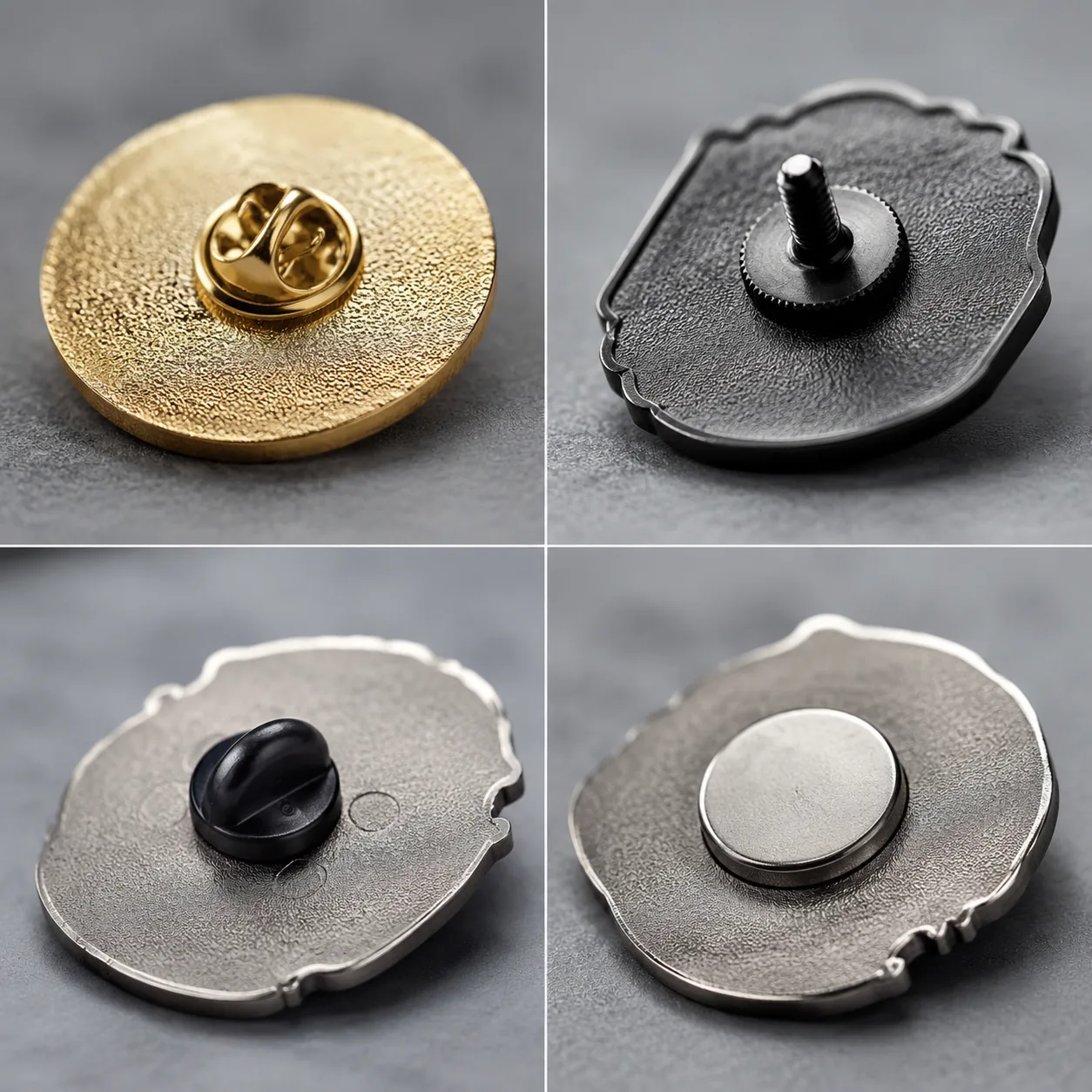
For common promo hardware, a sensible spec sheet also names the attachment and finish stack. A light pin may use a single butterfly clutch, while a heavier badge often needs a double clutch, safety pin, or magnet back to prevent rotation and sagging. If the item includes epoxy dome coating, call out the coating thickness and finish, because a dome that is too thick can distort fine text and a dome that is too thin can leave edges exposed.
Quote apples to apples
A quote comparison only works when every supplier is pricing the same specification. If one factory quotes soft enamel, another quotes hard enamel, and a third quietly changes the backing or packaging, the lowest number is meaningless. On the first round, ask each supplier to restate the full spec in writing before they quote; that catches missing plating, padding, and assembly assumptions early.
For a realistic benchmark, simple custom enamel pins often land around USD 0.35-1.20 FOB per piece at common promo volumes, depending on size, plating, and color count. Custom keychains typically run USD 0.60-2.50 FOB, while standard challenge coins often start around USD 1.20-4.50 FOB. At low MOQs, expect the unit price to rise sharply because setup and plating costs are spread over fewer pieces. A quote at 100 pieces can easily be 20-60% higher than the same item at 1,000 pieces.
MOQ tiers matter because they change both price and process choices. A simple stamped pin may be offered at 100, 300, 500, 1,000, and 3,000 pieces, while a more complex item with multiple colors, print, or mixed materials may start at 300-500 pieces. If a factory says it can do 50 pieces, check whether the tooling is reused, whether plating is simplified, and whether the quoted lead time excludes sampling or inspection.
Lead time should be split into sample and mass production. A pre-production sample usually takes 5-10 days, while mass production typically needs 12-25 days after sample approval, depending on the decoration method and factory load. If a supplier promises “7 days all-in” for a multi-step metal item, ask what is excluded. Plating, curing, QC, and packing are often compressed unrealistically in that kind of promise.
Sample the risk before you scale
The sample is not just a visual check; it is where production risk shows up early. A good sample tells you whether line widths hold, whether fills sit evenly, whether plating looks clean at corners, and whether the attachment works under real use. A butterfly clutch may be fine for a lightweight pin, but a heavier badge often needs a stronger backer to avoid rotation and sagging.
Review the sample under bright neutral light and compare it against the approved artwork and written spec, not memory. For enamel work, check whether the fill sits flush with the metal walls, whether the surface is smooth, and whether small text still reads cleanly at arm’s length. For printed or epoxy-coated items, confirm that there are no bubbles, pinholes, dust specks, or washed-out edges. If the item mixes metal, print, and fabric, make sure all surfaces match in sheen and tone, because a glossy insert next to a matte shell can look mismatched even when the colors are technically close.
For a first order, keep one golden sample and one backup photo set. That gives procurement, design, and the supplier a single reference if the reorder comes 60 or 90 days later. A factory sample that passed casually over email is easy to forget; a signed sample with notes is much safer.
- Confirm dimensions with calipers, not eyeballing.
- Test the fastening or attachment at least 10 times.
- Check edge burrs, plating skips, and color bleed.
- Compare the sample against the written approval sheet.
- Record every change request before mass production starts.
Inspect the first lot before release
Once production begins, the first lot should be treated as a controlled release, not a blind shipment. Ask for in-process photos at plating, filling, or printing, then request a pre-shipment inspection with clear acceptance criteria. For many B2B buyers, a practical AQL target is 2.5 for major defects and 4.0 for minor defects on general promo goods, though stricter programs may require tighter limits for presentation or retail use.
A useful factory-side check is to separate defects into structural, cosmetic, and packaging categories. Structural issues include broken clasps, loose magnets, warped parts, or poor pin alignment; cosmetic issues include plating spots, color mismatch, scratches, or print blur; packaging issues include wrong inserts, crushed cartons, or count errors. For small promotional runs, checking 5-10% of cartons by position is a sensible minimum, especially when multiple SKUs share the same master carton label.
A first-lot inspection is also where tolerance drift shows up. If the order spec calls for 30.0 mm +/-0.3 mm and the lot is running 30.7 mm to 31.0 mm, the line may still be producing usable parts, but the product is no longer the one you approved. Catch that before full shipment, not after the goods land.
| Inspection item | Typical check | Buyer decision |
|---|---|---|
| Plating quality | Uniform tone, no dark spots or burn marks | Approve or reject for cosmetic inconsistency |
| Attachment | Pull test and alignment | Reject if weak, rotated, or loose |
| Color fill | Even coverage, no pinholes | Reject if visible substrate shows through |
| Carton count | Piece count per inner and master carton | Hold shipment if count mismatches PO |
| Print/engraving | Legible text and correct placement | Reject if artwork is cropped or blurred |
Treat packaging as part of the product
Many first-time buyers separate the product from the packaging and only realize the mistake at the end. If the item is a giveaway, a simple polybag or bulk carton may be enough; if it is a retail or executive gift, backing cards, trays, sleeves, or rigid boxes can change perceived value materially. Packaging also affects damage rate, freight density, and packing labor, so it should be in the quote from the beginning.
For pins and badges, backing cards usually add a small unit cost but improve presentation and reduce handling problems. Basic card stock is commonly 300-350 gsm, while premium presentation cards can run 400-600 gsm with spot UV, foil, or die-cut windows. If the shipment will travel long distance or pass through warehouse handling, specify inner pack counts, carton compression limits, and whether the factory should use individual OPP sleeves, polybags, or foam separators to reduce scuffing.
Packing also changes landed cost. A carton that looks cheap at the factory may cost more after extra labor, air volume, or damage claims. The right question is not “what is the cheapest packing?” but “what packing gets the product to the end user in the right condition at the lowest total cost?”
For export shipments, ask for a carton spec in writing. A common starting point is a 5-ply export carton with 10-15 kg gross weight per carton, but the exact carton size should be matched to the item and freight method to avoid crushed corners and wasted cube. If the product is sensitive to scratches, request individual sleeves or tray dividers rather than relying on loose bulk packing.
Freeze the spec for the reorder
After approval, the final job is locking the specification so the next order does not drift. Save the signed sample, artwork file, plating reference, Pantone codes, dimensions, tolerance, attachment type, packing method, and carton spec in one written approval record. If the item will be reordered next quarter, the factory should have a repeatable spec sheet that prevents silent changes in metal thickness, finish tone, or backing hardware.
Reorders fail when buyers rely on memory or old email threads. A small change like switching from black nickel to antique silver, or from butterfly clutch to rubber clutch, can change both appearance and unit price. For buyer teams managing multiple promo products, one spec sheet per SKU is safer than a loose image library because it gives procurement, design, and the supplier the same source of truth.
ZheCraft’s in-house production setup is useful here because tooling, plating, filling, packing, and final QC stay under one roof instead of bouncing between vendors. That does not eliminate risk, but it does shorten feedback loops when a sample needs correction or a reorder needs to match the last approved batch. The practical benefit is fewer handoffs and less chance of spec drift between quote, sample, and shipment.
If your product depends on a tight visual match, request a retained sample from the production lot. Keeping one physical reference from the approved run helps resolve disputes on finish, color, and edge detail when the next order is scheduled months later.
What to send next
If you are preparing a first order, build a one-page RFQ that includes product type, size in mm, thickness, finish, quantity tiers, packaging, destination, and target delivery date. Ask every supplier to quote against the same document and to confirm any assumptions in writing before sampling starts. Then approve one golden sample, keep the full spec record, and use that as the control file for production and reorders.
If you want the order to move faster, send artwork in editable vector format, mark the must-have specs, and tell the factory which trade-offs are acceptable if lead time tightens. That lets the supplier propose realistic options instead of guessing. The best first order is not the most elaborate one; it is the one that arrives on time, matches the approved sample, and can be repeated without surprises.
A practical first-order checklist is simple: spec it tightly, sample it once, inspect the first lot, and freeze the approved version. That sequence avoids most of the cost overruns and schedule slips that hit promo buyers on their first China purchase.
Have a project? Send your artwork and target quantity and we’ll reply with a detailed quotation within 12 working hours.
Ready to get this made?
Send your sketch, target quantity and ship-date. Detailed quotation in 12 hours.



