Why Rush Promo Orders Fail: 2026 QC Specs That Save Deadlines
Rush orders fail at the spec stage, not on the factory floor
When a trade-show date is fixed, rush orders usually miss because the specification was incomplete or unstable, not because the factory lacked capacity. The most common chain is predictable: artwork arrives with tiny text and thin bridges, the buyer approves a sample without measuring critical details, then finish, packing, or hardware changes land after tooling. A two-day artwork revision can turn into a 7-14 day restart if a mold, die, plating bath, or print setup has to be redone.
For custom pins, coins, badges, patches, magnets, and lanyards, speed depends on reducing unknowns before production starts. A deadline-safe RFQ should lock product type, size, thickness, material, decoration method, backing or attachment hardware, packaging, and inspection standard. It should also state what may be simplified if the schedule tightens. In practice, that means the factory can remove a cutout, reduce color count, change a clasp to stock hardware, or switch from retail packaging to bulk packing without waiting for another approval cycle.
Artwork that looks clean on screen can still be unbuildable
Rush jobs are often lost before tooling begins because the art file is printable but not manufacturable. A logo may look sharp in vector format and still fail because line weight is too fine, text is too small, or adjacent cutouts leave weak bridges that cannot survive stamping, casting, or enamel fill. For soft enamel pins and metal badges, a practical floor is 0.20 mm minimum line width, with 0.25 mm preferred for rush production. Text below 1.2 mm in height is risky on stamped metal; for hard enamel or polished pieces, 1.5 mm is safer because polishing softens fine detail visually.
Use a production drawing, not a presentation mockup. The factory needs outer dimensions, thickness, attachment points, cut lines, color zones, and a clear note on which elements are non-negotiable. For small metal items, a realistic size tolerance is ±0.2 mm on pins and small charms and ±0.5 mm on coins, medallions, and larger badges. If the artwork includes openwork, leave at least 0.3 mm between cutout edges on thin brass or iron, and 0.5 mm when the design has multiple adjacent holes or the part will be die-struck at higher volume. Hairline gradients, reversed text, nested holes, and ultra-thin scripts should be removed before quoting, not after sample review.
- Minimum visible text height: 1.2 mm for stamped metal; 1.5 mm preferred for hard enamel
- Minimum line width: 0.20 mm workable floor; 0.25 mm preferred for rush jobs
- Minimum gap between cutouts: 0.3 mm on simple thin metal parts; 0.5 mm for denser geometries
- Keep enamel cells deep enough for fill and polish: about 0.8 mm is a practical baseline for standard soft enamel
- Avoid gradients, hairline scripts, nested holes, and reversed microtext in rush work
- Request digital preflight before tooling so bad geometry is rejected before steel is cut
Choose the build method that can actually meet the date
Rush schedules expose the difference between methods that tool quickly and methods that require repeated finishing. Simple stamped soft enamel pins, flat or lightly relieved coins, and basic die-cast keychains move faster because the tooling path is straightforward and the finish sequence is short. Complex 3D coins, openwork badges, merrowed-edge patches with tiny lettering, and multi-color jacquard lanyards are slower because they add setup, sampling, or labor-intensive finishing.
A 30 mm soft enamel pin with two colors and nickel plating can often ship in 8-12 days after artwork approval. The same size in hard enamel, with multiple polish stages and tighter surface requirements, is more likely to need 12-18 days. For coins, a flat 2D challenge coin with standard edge detail is materially faster than a deep-relief sculpted coin with antique plating, laser numbering, or a presentation box. For lanyards, printed sublimation is usually the quickest route for full-color artwork; woven or jacquard styles can add several days if the pattern changes late because the loom setup must be reworked.
| Item type | Fastest realistic build path | Typical rush lead time after sample approval | Common rush risk |
|---|---|---|---|
| Enamel pin | Stamped soft enamel, 20-35 mm, one plating finish | 8-12 days | Too many colors, fine text, or cutouts |
| Challenge coin | 2D relief, standard edge, single plating finish | 10-14 days | Deep 3D sculpting or late laser-number changes |
| Keychain | Single-sided metal with standard split ring or lobster clasp | 7-10 days | Multiple moving parts or mixed materials |
| Patch | Heat-cut or standard embroidered patch with clean border | 6-9 days | Tiny text, gradient art, or border changes |
| Lanyard | Sublimation or simple printed webbing | 5-8 days | Last-minute weave pattern revisions |
Plating, color, and surface finish must be locked early
Many rush orders slip because finish decisions are treated as cosmetic instead of schedule-critical. Plating, color matching, and surface texture all affect process order, inspection time, and sometimes the tooling itself. If a buyer changes from shiny nickel to matte black nickel after tooling, or adds glitter enamel, transparent fill, or epoxy dome late in the cycle, the order may need rework because the finishing sequence changes and so does the QC standard.
For most promotional metal products, the RFQ should name the finish explicitly and, when possible, the target deposit range or process class. Decorative flash plating is typically thin and appearance-driven, while more durable decorative plating commonly falls around 0.1-0.2 micron depending on base metal, bath control, and wear expectations. Do not expect flash plating to behave like wear plating. Color should always be called out with a Pantone reference plus a match standard, such as “visual match acceptable within normal production variation” or “strict shade match required.” A strict shade requirement can force a second mix, another pour, or a new proof cycle.
| Spec item | Good rush spec | Likely delay trigger |
|---|---|---|
| Plating | Nickel, gold, black nickel, antique bronze named in RFQ | “Make it premium” without a finish callout |
| Color | Pantone number plus whether close match or strict match is required | Multiple stakeholders changing the shade after sample |
| Surface | Polished, sandblasted, brushed, or matte stated early | Texture revision after first article |
| Special effect | Glow, glitter, transparent, or epoxy declared before tooling | Adding effects after the color proof |
Mixed promo sets need one master spec, not five separate assumptions
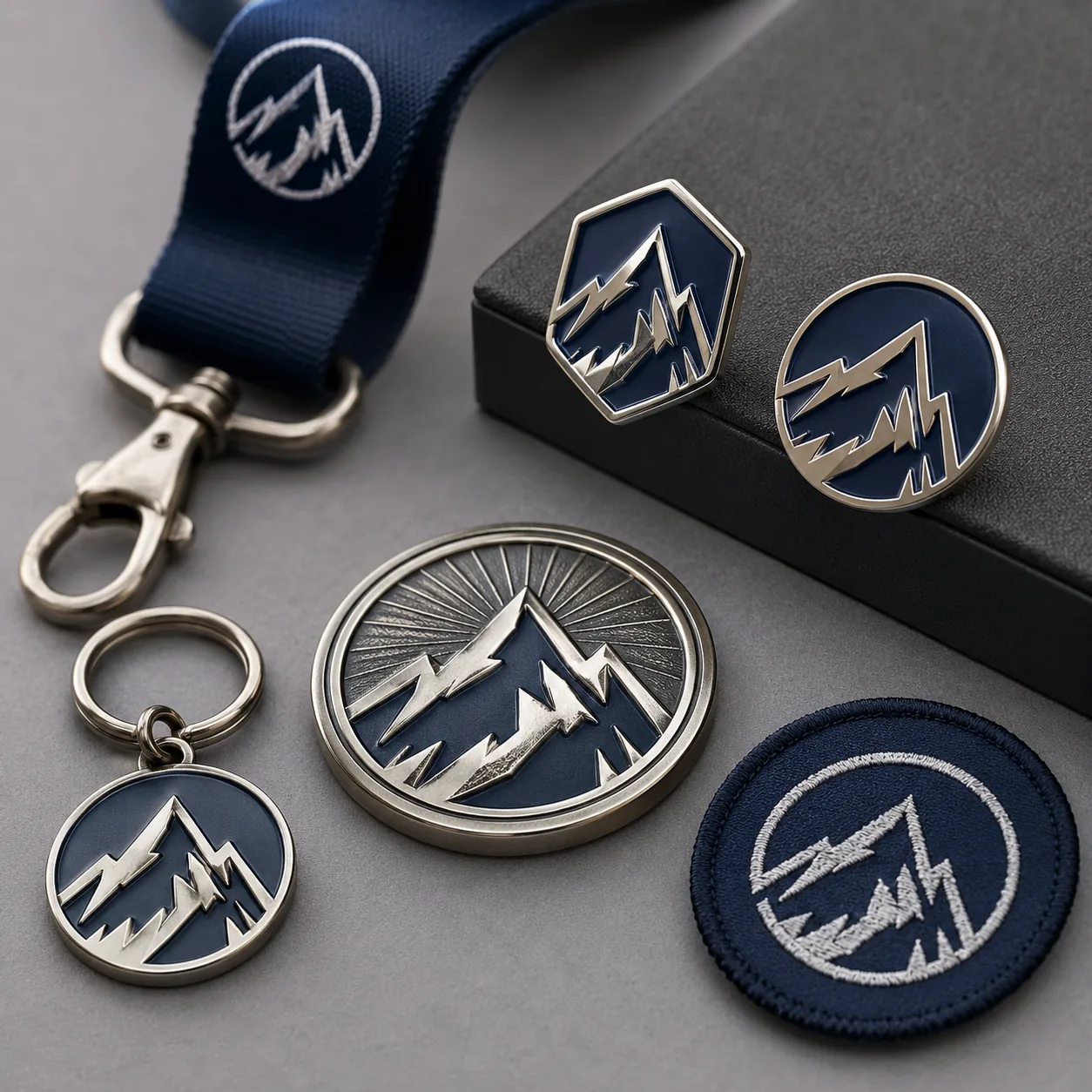
Rush orders often involve sets: pin, coin, keychain, patch, and lanyard for the same event. The hidden failure is inconsistency. Each item may be acceptable on its own, yet the set looks mismatched when packed together. A 1 mm size drift on a pin is easy to miss in isolation but becomes obvious when it sits next to a coin or badge card using the same artwork. The same issue appears when the blue on a patch is warmer than the blue on a lanyard, or when the icon is centered differently across product types.
Prevent this with a master spec that treats the set as one system. Define the shared artwork scale, logo clear space, minimum border weight, and approved color palette across all items. If the same icon appears in both metal and fabric, allow process variation but state what must remain identical: Pantone target, logo proportion, and legibility at a minimum viewing distance of 30-50 cm. Rank the items by importance so the factory knows which product must stay exact if time runs short.
- Use one master logo file for all products; do not redraw each item separately
- Put shared Pantone targets and acceptable visual variance on one control sheet
- Assign separate tolerances by product type: metal, fabric, and printed webbing are not interchangeable
- Define pack-out order so the most important item is on top or first in the set
- Confirm carton count, inner pack count, and label content before production starts
Sample approval should be a measurable gate, not a formality
The fastest way to lose a trade-show deadline is to approve a sample without checking the features that fail in bulk. Buyers often judge the overall look, then miss weak pin posts, rough die lines, loose keychain rings, thread tension variation, or fill shrinkage that only becomes obvious once hundreds of pieces are produced. A sample that photographs well can still fail a pull test, drop test, or attachment check when shipping quantities increase.
For rush work, sample approval should be a true go/no-go step with measurable criteria. Ask the factory to confirm post diameter, clasp fit, ring gauge, magnet pull, patch border width, thread density, or lanyard seam strength before releasing mass production. A practical QC baseline for promotional goods is AQL 2.5 for major defects and AQL 4.0 for minor defects, but event-critical orders often require tighter visual control on the highest-risk features. Define major and minor defects before production begins, not after the first shipment issue.
| QC check | Typical acceptance target | Why it matters in rush orders |
|---|---|---|
| Pin clasp fit | Firm attachment, no excessive play | Loose backs fail at events and create replacements |
| Keychain ring | Closed and uniform with no opening gap | Prevents breakage during giveaway use |
| Patch border | Edge width consistent, no fraying | Avoids replacement claims after distribution |
| Lanyard seam | No skipped stitches, straight heat seal | Stops tearing during badge use |
| Coin edge | No sharp burrs, clear edge detail | Reduces handling complaints and rework |
Packaging can break the schedule if it is decided too late
Packaging is often the last decision buyers make, but it can be the step that breaks the schedule. Backing cards, polybags, OPP bags, gift boxes, blister cards, and individual labels all require materials, setup, and sometimes separate labor. If printed backing cards are added after the goods are finished, the factory may need another print cycle, another count check, and another pack-out window. That can add 2-5 days, and longer if the card artwork was not approved early.
For 2026 rush campaigns, the rule is simple: choose the simplest packaging that still protects the item and supports distribution. Bulk polybag packing is the fastest option, while custom backing cards or retail boxes should be reserved for programs with real schedule buffer. For trade-show handouts, the better question is not what looks nicest, but what ships safely, counts accurately, and can be handed out immediately.
| Packaging option | Typical use | Relative speed | Indicative FOB add-on |
|---|---|---|---|
| Bulk polybag | Fastest shipment and basic protection | Fastest | USD 0.02-0.06 per piece |
| OPP bag with insert card | Presentation plus light protection | Medium | USD 0.06-0.15 per piece |
| Custom backing card | Retail presentation for pins and keychains | Slower | USD 0.10-0.28 per piece |
| Gift box or rigid box | Premium coin or medal presentation | Slowest | USD 0.35-1.20 per set |
What a deadline-safe spec sheet should include
A deadline-safe spec sheet is less about marketing language and more about preventing factory guessing. It should list the exact product type, size, thickness, material grade, plating finish, decoration method, backing or attachment hardware, packing format, and inspection standard. It should also state MOQ and timing assumptions, because a rush order quoted at one quantity may not be feasible at another. Typical 2026 promotional MOQs are about 100-300 pieces for simple pins and keychains, 200-500 pieces for coins and magnets, and 100-200 pieces for patches and lanyards, with smaller quantities usually carrying a setup surcharge.
Lead times and price ranges should be written clearly. As a reference, simple stamped soft enamel pins often land around USD 0.60-1.80 FOB per piece depending on size, plating, and packaging; challenge coins commonly run USD 1.80-4.50 FOB; embroidered patches often fall around USD 0.25-1.20 FOB; and printed lanyards commonly land around USD 0.20-0.75 FOB. For simple keychains, FOB pricing is often USD 0.45-1.50 per piece depending on metal weight and accessory choice. Rush premiums are normal when labor is compressed or freight is consolidated.
If speed matters, also identify which decisions are locked and which are flexible. For example, a buyer might lock logo size, Pantone, and back stamp while allowing the factory to simplify internal cutouts or swap to a stock clasp if inventory is tight. This is where an integrated factory helps: when metal forming, enamel, attachment, inspection, and packing are controlled in one place, there are fewer handoffs and fewer opportunities to miss the date.
What to do next before placing a rush PO
Before you place a rush order, build a one-page risk sheet for each item and rank the top three failure modes: art complexity, finish complexity, and pack-out complexity. Then ask the supplier for a dated production plan that shows artwork lock, sample approval, mass production, QC, and dispatch milestones in days, not vague promises. For pins, coins, badges, magnets, keychains, patches, or lanyards headed to a trade show, ZheCraft can usually help simplify the build so the deadline is protected without changing the core brand look.
The practical test is simple: if a spec cannot be inspected, measured, or simplified, it is not ready for a rush order. The best deadline-saving decision is often to remove one color, one cutout, one packaging step, or one special effect before the factory starts cutting steel.
Have a project? Send your artwork and target quantity and we’ll reply with a detailed quotation within 12 working hours.
Ready to get this made?
Send your sketch, target quantity and ship-date. Detailed quotation in 12 hours.



