Why Metal Giveaways Arrive Scratched: Failure Modes and Fixes
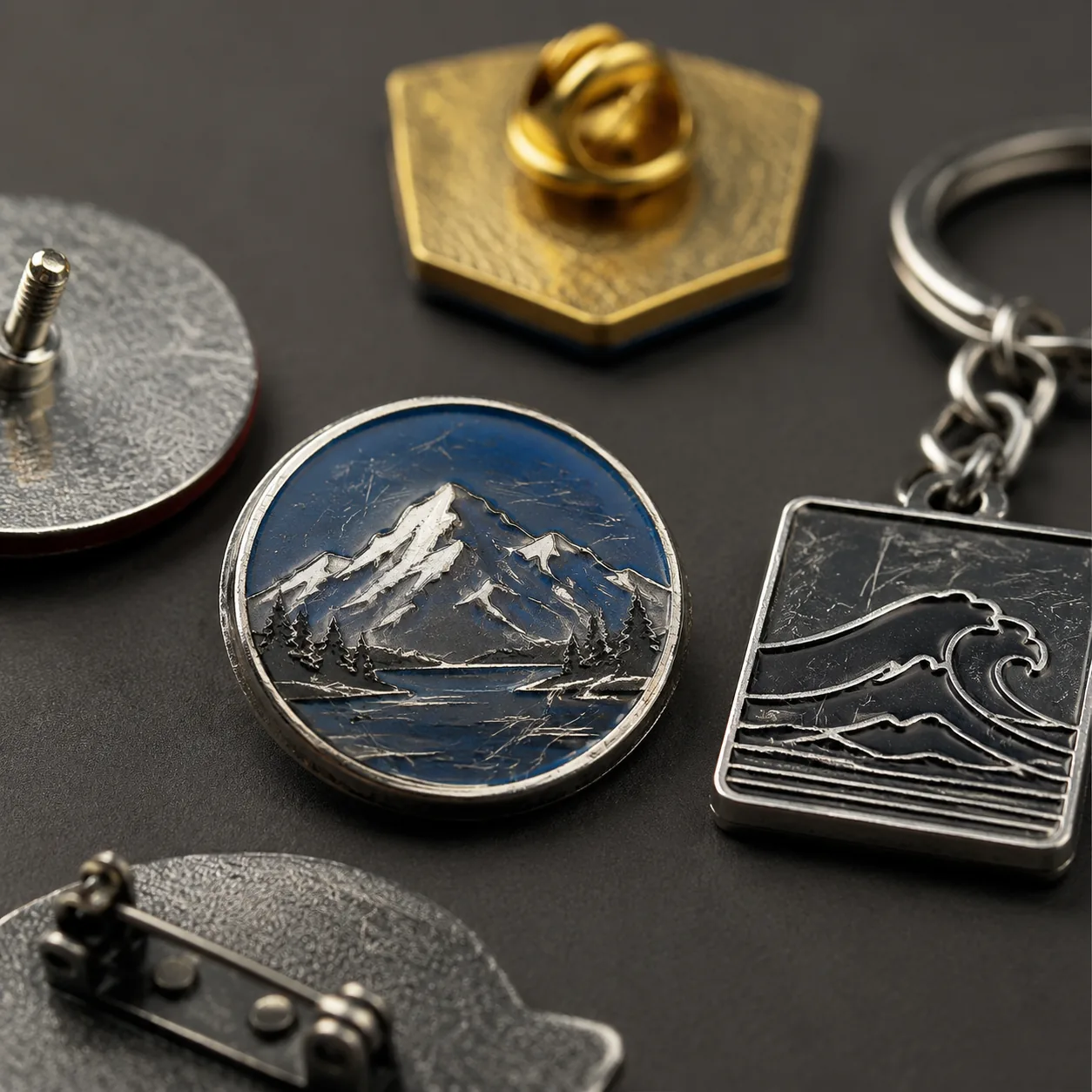
1. Scratches are often built into the base metal before plating
Most scratch disputes are noticed after cartons are opened, but the damage often starts before the first plating bath. Stamping, trimming, die-casting, parting-line cleanup, deburring and rough polishing can all leave marks that become more visible after bright metal finishing. Zinc alloy die-cast keychains are especially vulnerable around parting lines and gate removal points. Iron and brass stamped pins can pick up straight sanding lines across raised metal borders if burr removal is too aggressive.
Plating does not level these defects. Bright nickel, imitation gold, rose gold and black nickel follow the base metal profile and reflect light from every groove. A scratch that looks faint on raw brass can look severe after a 3 micron nickel layer. Large smooth fields are the biggest risk: a coin center over 25 mm, a mirror-finish medal rim, or a keychain logo frame with wide flat borders. If the artwork contains these areas, specify polishing quality instead of relying on “standard finish.”
| Surface risk area | Typical failure | Practical specification | Design caution |
|---|---|---|---|
| Raised metal field under 10 mm | Minor tool marks visible only when tilted | Standard tumble polish; visual check at 30 cm under 800-1000 lux white light | Avoid mirror plating if the artwork needs a flawless reflection |
| Smooth field 10-25 mm | Straight polishing lines after plating | Manual buffing on visible face; no scratch over 0.05 mm wide or 3 mm long on front face | Avoid borders under 0.4 mm that may round off during buffing |
| Mirror field over 25 mm | Waves, orange peel, fingerprints, transfer scratches | Progressive sanding/buffing before plating; single-layer tray transfer after finish | Avoid for low-budget giveaways where added handling cost is not acceptable |
| 3D relief coin or medal | Residue in recesses; over-polished high points | Controlled buffing only on high points; ultrasonic cleaning before plating | Avoid bright finish if relief depth is under 0.25 mm |
| Reeded or rope edge coin | Bright edge cuts nearby parts in bulk packing | Edge deburr plus individual pouch or capsule | Do not bulk pack premium coins |
2. Plating thickness and adhesion are too weak for normal handling
Some “scratch” complaints are actually plating wear or poor adhesion. Thin plating can pass a quick factory visual check, then show base metal after hardware assembly, vibration, or bagging. Edges, rim peaks, split-ring holes and pin-post weld areas are high-risk points because they receive the most contact and often plate thinner than flat faces.
For commercial promotional metal items, a realistic plating stack is copper undercoat 3-5 microns plus nickel or color finish 2-5 microns. Zinc alloy usually benefits from a copper strike or copper undercoat to improve leveling and adhesion. Brass and iron may need different pretreatment, but the principle is the same: the decorative layer is only as good as the cleaning, undercoat and handling before final finish. For daily-use products such as trolley coin keychains, bottle opener keyrings and bag charms, ask for thickness measurement on both the face and one edge, not only the easiest flat point.
- Set minimum plating thickness by finish: nickel 3 microns on visible face, black nickel 3 microns, imitation gold 2 microns over nickel, copper undercoat 3 microns minimum on zinc alloy where adhesion risk is high.
- Define edge acceptance clearly: no exposed base metal on outer rim, chain hole, coin edge, pin post weld zone or brooch catch area when viewed at 30 cm under normal white light.
- For retail or premium orders, request XRF thickness readings from the pre-production sample lot. For very high-risk projects, add one cross-section report, but expect extra testing cost and 2-4 days.
- Do not solve every cosmetic issue by adding plating thickness. Thick plating will not correct dents, poor buffing, dirty enamel, sharp hardware or loose bulk packing.
- For antique finishes, remember that the dark recess is not the protective layer. The copper-nickel base underneath still needs adequate thickness.
As a pricing reference, standard enamel pins often quote with commercial nickel or gold-color plating included. Upgrading to verified retail-grade plating and controlled handling may add about USD 0.03-0.12 FOB per pin, while thicker finish control on large coins may add USD 0.08-0.30 FOB per piece depending on diameter and packing.
3. Finished parts scratch each other between process steps
Many defects occur after plating, not inside the plating line. A tray of bright nickel badges poured into a plastic crate can damage itself in seconds. Hard enamel pins with raised metal outlines, challenge coins with reeded edges and keychains with split rings are all hard enough to mark nearby pieces. Once plated, metal-to-metal contact should be treated as a defect source.
The fix is a handling plan, not a final sorting promise. Bulk trays are acceptable before polishing on many low-cost jobs. After final plating, however, visible faces should move in shallow lined trays, PE sleeves, paper interleaves or divided boards. This adds labor and space, so it should be tied to the cosmetic grade and quoted before production.
| Process stage | Bad practice | Better handling specification | Typical added lead time |
|---|---|---|---|
| After polishing, before plating | Loose pile in crate | Layered trays with soft liner; maximum 2 layers | 0-1 day |
| After final plating | Bulk transfer by scoop | Single-layer tray or PE film separation for visible faces | 1-2 days for 5,000-20,000 pcs |
| After enamel fill | Stacking before enamel is stable | Flat drying racks; no face contact for 12-24 hours | 1 day |
| After epoxy dome | Bagging before full cure | Cure 24-48 hours depending on dome thickness and room temperature | 1-2 days |
| Hardware assembly | Split rings dumped over plated faces | Assemble over rubber mat; keep hardware in separate bins | 0-1 day |
| Final packing | Operators slide parts across table | Use clean pads; replace dirty pads daily; no loose metal on workbench | 0-1 day |
4. Hardware is harder than the item it supports
Keyrings, jump rings, lobster clasps, brooch catches, magnetic backs and deluxe clutches can scratch the product during assembly or transit. A 25 mm steel split ring with 1.8 mm wire is harder than many decorative finishes. If it rests directly on a black nickel or imitation gold keychain face inside one bag, it can leave half-moon marks before the goods reach the buyer. On brooches, a loose safety catch can rub the back plating and create black dust inside the pouch.
The purchase order should define both hardware grade and packing position. Common split rings are 24-30 mm outside diameter with 1.6-2.0 mm wire. Heavy rings improve strength but raise scratch risk. Jump rings should close cleanly; a gap over 0.3 mm or a cut end with burrs can catch plating, fabric or pouch material. For enamel pins, a rubber clutch or butterfly clutch is usually safe if packed behind a card, while a locking clutch may need a thicker card or separate small pouch.
- State whether split rings are pre-attached or packed separately. Separate packing reduces scratches but may create end-user assembly work.
- For retail-grade keychains, require a clear OPP sleeve or paper interleaf between the metal charm and split ring if both are packed in the same bag.
- Specify jump ring gap tolerance under 0.3 mm and no sharp cut ends.
- For brooches over 45 mm long, use a safety catch with smooth rivet ends; inspect for burrs before attachment.
- Reject hardware with rust, oil residue, plating peel, sharp wire ends or black dust. These defects transfer directly to the main product.
- For magnetic backs, separate the magnet from the plated face with card stock or foam so it cannot slide during freight.
5. Enamel, epoxy and paint can become the scratch source
Soft enamel pins and painted zinc alloy keychains may appear scratched when the real issue is contamination in the color area. Dust, polishing compound, metal powder or dried enamel flakes can be dragged across the surface during wiping. Transparent enamel and dark colors such as black, navy, burgundy and forest green show tracks more clearly than white, yellow or light blue.
Epoxy domes add another failure path. A dome that is too soft, too thin at the edge or under-cured can scuff inside the bag. A practical epoxy dome thickness for pins and keychains is 0.6-1.2 mm at the highest point. The dome should normally stop at least 0.3 mm inside the outer metal rim to reduce edge lift and rubbing. For large printed keychains or medals, thicker domes may need 48 hours of cure time before bulk handling.
Do not choose epoxy automatically as a scratch solution. It protects printed graphics and soft enamel recesses, but it changes the feel, adds glare, can yellow faster outdoors and can make small text harder to read if the dome is uneven. For hard enamel with polished metal, correct polishing, clean transfer and good packing are usually better than covering the surface with epoxy. If epoxy is required, define acceptable haze: for promo grade, faint side-angle haze may be acceptable; for retail grade, scuffs visible straight-on at 30 cm should be rejected.
6. The inspection standard accepts defects your customer will reject
Cosmetic inspection fails when the buyer and factory use different viewing rules. One inspector may reject a 6 mm hairline scratch on a coin face; another may accept it because it appears only when tilted. For B2B orders, define distance, lighting, viewing time, defect size and AQL before mass production. Without those details, “good quality” becomes an argument after shipment.
A workable standard for promotional metal items is inspection at 30 cm distance, 800-1000 lux white light, unaided eye and about 5 seconds per side. For paid retail or licensed goods, use 20 cm distance and longer review, but expect higher inspection labor and more rework. Separate critical, major and minor defects so a tiny back-side hairline is not treated like a front-face gouge through plating.
| Defect | Classification | Suggested acceptance rule | Inspection note |
|---|---|---|---|
| Exposed base metal on front face | Major or critical | Not acceptable | Check rim peaks, chain holes and raised borders |
| Scratch over 5 mm on front face | Major | Reject if visible at 30 cm | Tighten to 2-3 mm for retail grade |
| Fine hairline under 3 mm on back | Minor | Accept if isolated and not through plating | Backstamp recesses often hide minor marks |
| Dent on raised logo | Major | Reject if it changes logo shape or strongly catches light | More common on zinc alloy than brass |
| Bag scuff on epoxy dome | Minor or major | Reject if visible straight-on; define side-angle haze by grade | Use approved sample as reference |
| Rust spot on hardware | Critical | Zero tolerance | Inspect split rings, chains and catches separately |
| Sharp burr or exposed pin point | Critical | Zero tolerance | Safety issue, not only cosmetic |
For standard promotional shipments, many buyers use AQL 2.5 for major defects and AQL 4.0 for minor defects under ANSI/ASQ Z1.4 or ISO 2859-1 sampling. For retail and licensed merchandise, AQL 1.0 major and 2.5 minor is more suitable. Critical defects such as sharp edges, rust contamination, wrong attachment, unsafe magnet assembly or exposed dangerous points should be zero tolerance.
7. Packing passes a carton drop test but still scuffs in transit
A carton can survive a drop test while individual pieces scuff inside. The outer box may be strong, but the inner packing can still allow vibration. Air, sea and truck freight all create repeated micro-movement, especially when metal items are packed in loose polybags with hardware touching the decorated face.
Packing should match item weight and cosmetic grade. For pins, an economical pack is one pin on a backing card in an OPP bag, then 50 or 100 pieces per inner carton. For coins, individual PVC pouches, acrylic capsules, velvet pouches or paper envelopes are common; loose bulk coin packing is only appropriate for low-grade tokens where scratches are expected. For keychains, the ring should not press against the main logo face unless a separator is used.
Carton weight also matters. Keeping master cartons under 15 kg reduces crushing and handling damage; for heavy 40-50 mm challenge coins, 8-12 kg is safer. Inner cartons should fit tightly enough to prevent shifting while allowing 3-5 mm for bag thickness. Forcing bags into an undersized box can bend pin posts, rub corners and make the packing itself the cause of damage.
| Product type | Promo packing | Retail packing | Premium packing |
|---|---|---|---|
| Enamel pin 20-35 mm | OPP bag; optional backing card | Backing card plus OPP bag; clutches behind card | Individual card, pouch or box; front face protected |
| Challenge coin 40-50 mm | PVC pouch or paper envelope | PVC pouch or capsule; 25-50 pcs per inner box | Capsule, velvet pouch or presentation box |
| Metal keychain | OPP bag with ring positioned behind charm | OPP sleeve between ring and charm | Separate ring pouch or fitted box |
| Medal or badge over 60 mm | Individual polybag | Foam sheet or paper interleaf; low inner carton count | Fitted tray or box; no face contact |
8. Put the cosmetic grade in the RFQ, not in the complaint email
The most expensive scratch dispute is the one discovered after production, when the purchase order only says “good quality.” A factory will quote standard handling and standard inspection unless a cosmetic level is defined. If the end customer is a museum shop, sports league, luxury brand, corporate retail store or paid fan merchandise program, standard giveaway assumptions may not be enough.
A simple three-level grade works well. Promo grade allows tiny back-side marks and faint side-angle hairlines. Retail grade tightens front-face scratches and requires better individual packing. Premium grade adds controlled transfer, measured plating thickness and stricter AQL. Match the grade to the selling environment; do not request premium handling for every low-cost handout.
| Grade | Suitable use | Typical MOQ and lead time | Typical FOB impact |
|---|---|---|---|
| Promo grade | Trade shows, staff giveaways, mass campaigns | MOQ 300-500 pcs; sample 5-7 days; production 10-18 days after approval | Base price; typical enamel pin USD 0.45-1.20 FOB depending on size and quantity |
| Retail grade | Gift shops, licensed merchandise, paid merch tables | MOQ 500-1,000 pcs; sample 7-10 days; production 15-25 days | Add USD 0.03-0.12 per pin or USD 0.08-0.25 per coin for handling and packing |
| Premium grade | VIP coins, luxury launch kits, collector brooches | MOQ 500-1,000 pcs; sample 10-14 days with finish checks; production 20-35 days | Add USD 0.15-0.60+ per piece depending on size, plating report, pouch or box |
Before sample approval, mark the critical zones: front face, plated rim, backstamp, attachment area, epoxy dome, chain hole and hardware contact points. A supplier can control risk much better when the critical surfaces are named. For a new RFQ, write the requirement in measurable terms: “45 mm zinc alloy keychain, black nickel, daily-use retail giveaway, no front-face scratch over 3 mm visible at 30 cm, plating minimum 3 microns on face, split ring separated by OPP sleeve, AQL 2.5 major and 4.0 minor.”
The useful deliverable is not a perfect-sounding promise. It is a short control plan covering polishing level, plating thickness, transfer method, hardware handling, packing and inspection. Ask for that plan before mass production. After 10,000 pieces are plated, assembled and bagged, scratch prevention has already become scratch sorting.
Have a project? Send your artwork and target quantity and we’ll reply with a detailed quotation within 12 working hours.
Ready to get this made?
Send your sketch, target quantity and ship-date. Detailed quotation in 12 hours.



