Why Custom PVC Patches Fail in Production and QC
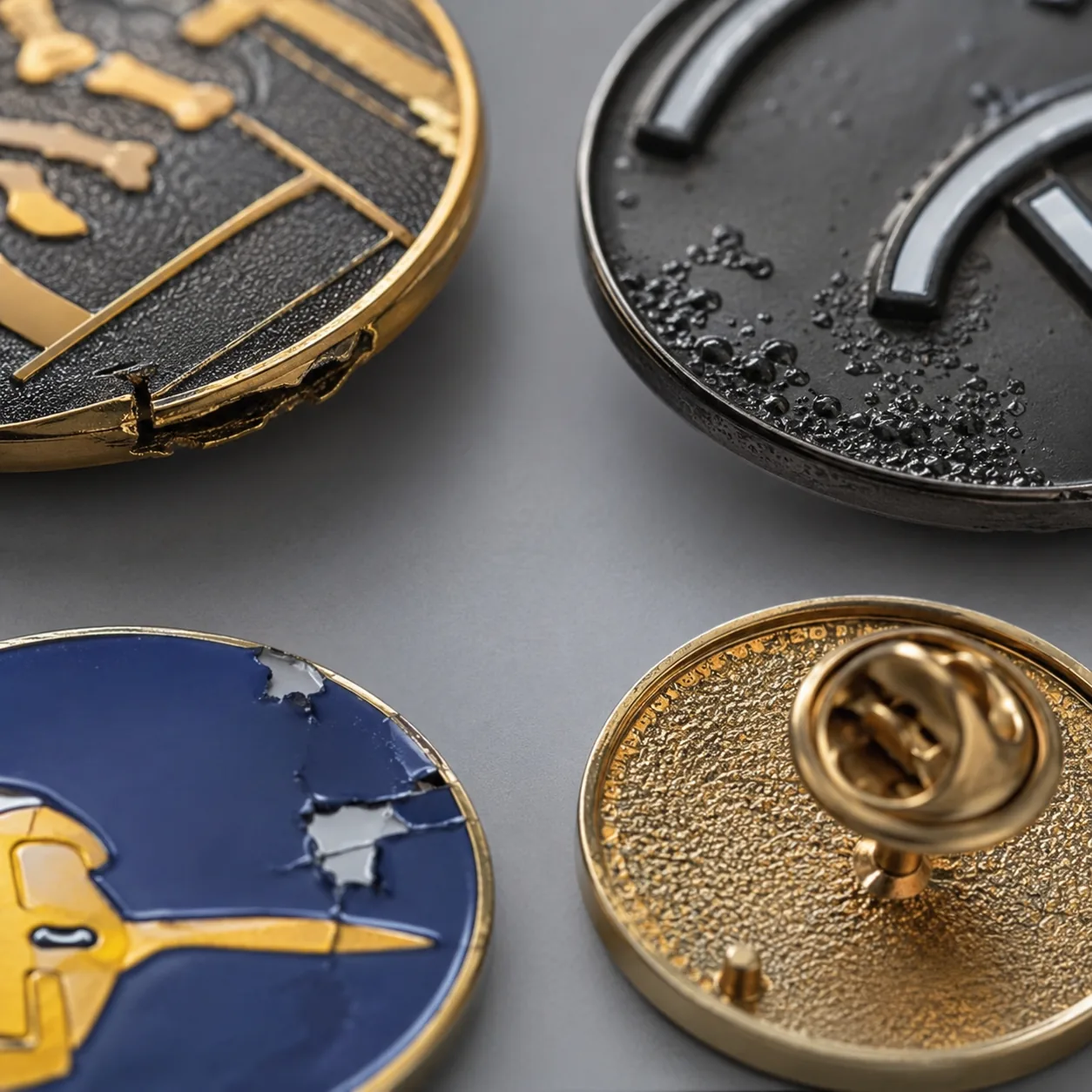
1. Curl and Warping Start With Thickness, Not Packing
Most warped PVC patches are not damaged in the carton. The problem usually starts in the drawing, mold, and cooling profile. Flexible PVC shrinks as it cools; the effect becomes visible when a wide patch has a thin base, uneven relief height, sharp corners, or full hook backing pulling against the body. Rectangles, name tapes, shields, flags, and long morale patches show distortion more readily than round patches because straight edges make even 1 mm of lift obvious.
A practical thickness rule is 2.0 mm total thickness for patches up to 60 mm, 2.5 mm for 60–90 mm, and 3.0 mm for 90–120 mm. Above 120 mm, the supplier should confirm whether 3.5 mm thickness, a wider flat base, stitched hook, or a less aggressive shape is required. Total thickness means the distance from the lowest back plane to the highest raised PVC detail, not only the flat base.
Typical molded PVC tolerance is ±0.5 mm on outside length and width, ±0.2 mm on total thickness, and 1.0–1.5 mm maximum corner lift when the patch is placed on flat glass. For uniform panels, badge holders, and tactical loop fields, the PO should state the receiving panel size and the maximum acceptable lift. “Same as artwork” is not a measurable warpage standard.
Reducing a 90 mm hook-backed patch from 2.5 mm to 1.5 mm may save only USD 0.03–0.08 per piece FOB China, but it can make the item curl after sewing, heat pressing, or repeated removal from loop fabric. Thin PVC is suitable for zipper pulls, small soft key tags, and decorative tabs under 50–60 mm. It is a poor cost-saving method for large patches that must stay flat in daily use.
2. Muddy Detail Is a Mold Geometry Issue
PVC patch detail is limited by mold cavity width, dispensing accuracy, color wall height, and PVC flow. It cannot reproduce every hairline in a vector file the way offset print or woven labels can. If a raised wall is too narrow or two colors are separated by a shallow groove, liquid PVC can bridge the channel during filling or curing. The result looks like dirty printing, but the root cause is geometry.
For repeatable bulk production, use 0.5 mm as the absolute minimum raised color wall and 0.6–0.8 mm as the safer commercial range. Recessed grooves should be at least 0.6 mm if they must stay clean after molding. For 3D sculpted relief, avoid critical lines below 0.8 mm because sloped faces reduce visible edge definition. Bold uppercase text should be at least 4.0 mm high; mixed-case, condensed, or serif text should be 5.0–6.0 mm. Legal copy, QR codes, serials, and micro slogans should be printed on packaging, moved to a label, or removed.
| Design feature | High-risk spec | Production-safe spec | QC check |
|---|---|---|---|
| Raised color wall | 0.3 mm wide | 0.5–0.8 mm wide | Mold review; no color bridging |
| Recessed groove | 0.3–0.4 mm wide | 0.6 mm or wider | Clean at 30 cm under D65 light |
| Bold uppercase text | 2.5–3.0 mm tall | 4.0 mm or taller | Legible on golden sample |
| Mixed-case text | Under 5.0 mm tall | 5.0–6.0 mm tall | No filled counters in A, e, o, R |
| Outer size | No stated tolerance | ±0.5 mm | Caliper measurement |
| Total thickness | One thickness for all sizes | 2.0–3.5 mm by patch size | ±0.2 mm |
The RFQ should include actual-size vector artwork, Pantone references, overall dimensions, total thickness, backing type, and a requirement that the supplier flag all lines below molding minimum before tooling. A factory should not silently thicken a police badge, licensed logo, or military-style insignia because the altered shape may change the identity of the mark. Approve a dimensioned production drawing, not only a colored sales mockup.
3. Color Drift Requires a Physical Standard
PVC color is mixed from liquid compounds, so shade control depends on pigment recipe, PVC grade, cure temperature, layer thickness, operator technique, and batch size. A sample can look acceptable on a desk but drift in bulk if the factory changes compound lots or cures dark colors longer. Bright orange, fluorescent green, pale gray, tan, skin tone, and translucent colors show drift more easily than black, navy, OD green, or dark brown.
Pantone Solid Coated references are useful, but they are only a starting point. PVC is not coated paper. For brand-critical work, pair the Pantone callout with an approved physical pre-production sample and define the measurement method. Delta E under 2.0 is possible on controlled programs but may require extra sampling and pigment adjustment. Delta E under 3.0 against the approved sample is more realistic for most promotional PVC patches. Tactical and outdoor orders often care more about visual compatibility with fabric than lab-perfect brand color.
Color inspection should be performed under D65 daylight or a standard lightbox, not under mixed warehouse LED and sunlight. If a kit includes PVC patches, woven labels, lanyards, and silicone wristbands, do not require every material to match identically. State a priority rule: for example, “PVC patch logo red is the master; lanyard red acceptable within approved shade range.” This prevents the supplier from chasing an impossible cross-material match.
For reorders, keep the signed golden sample and pigment recipe reference. A reorder six months later can shift even when the same Pantone numbers are used. For uniform programs, franchise rollouts, and seasonal retail drops above 5,000 pieces, request one PVC compound batch where possible and confirm whether split shipments will come from the same production lot.
4. Hook Backing Fails When the Bond Line Is Underspecified
Hook-backed PVC patches usually fail at the bond line between the PVC and hook tape, not in the hook tape itself. Peeling starts when the PVC back is too glossy, adhesive coverage is uneven, heat-press time or temperature is wrong, or the patch flexes repeatedly on backpacks, plate carriers, workwear, or caps. A carton-level visual check misses this defect because the patch can look acceptable until the corner is pulled.
For standard hook-and-loop patches, specify 280–320 gsm hook tape for promotional and uniform use. Nylon hook is preferred for higher durability; polyester hook may be acceptable for low-cycle retail or event patches. Require full-surface bonding with no dry corner gaps over 2 mm. If the patch will be removed frequently or used outdoors, stitched perimeter hook is safer than adhesive-only heat bonding. Stitching typically adds USD 0.05–0.15 per piece depending on size, shape, and thread color, but it reduces field returns.
A useful incoming check is a 180-degree peel test or a defined manual peel test on the golden sample and random bulk pieces. For normal promotional orders, a practical rule is “no continuous corner peel over 10 mm after firm manual pulling.” For police, military, safety, or industrial applications, define a lab peel target before production; many buyers use an internal requirement in the range of 8–12 N per 25 mm, depending on the backing system. Backing orientation also needs a drawing. A flag, shield, or name tape rotated 180 degrees can pass a count inspection and still fail in use.
| Backing option | Best use | Typical FOB upcharge | QC focus |
|---|---|---|---|
| Heat-bonded hook | Events, giveaways, low-cycle uniform patches | Included to +USD 0.05 | Corner peel, full coverage, correct orientation |
| Stitched hook | Uniforms, backpacks, tactical gear | +USD 0.05–0.15 | Stitch line, thread match, no skipped stitches |
| No backing | Sew-on patches, craft trims | Lower cost | Clean back surface, stable thickness |
| 3M-style adhesive | Temporary branding, packaging inserts | +USD 0.03–0.12 | Release liner, adhesive shelf life, surface prep |
| Magnet or pin | Retail souvenirs, display badges | +USD 0.08–0.30 | Attachment strength, corrosion, child-safety risk |
5. Fragile Shapes Crack During Demolding and Use
PVC is flexible, but it still tears at stress points. Narrow bridges, sharp internal corners, long unsupported points, and thin cutouts create failure during demolding, trimming, packing, and later use. Common weak areas include lightning bolts, animal tails, antlers, small stars, negative-space letters, weapon silhouettes, and logo shapes connected to the main body by a thin neck.
Keep the narrowest PVC bridge at 2.0 mm minimum for soft patches under 80 mm wide. For patches over 80 mm, use 2.5–3.0 mm minimum bridges. Internal corners should have at least a 0.5 mm radius instead of a sharp V cut. Unsupported holes smaller than 3.0 mm should be avoided unless the patch is purely decorative and the buyer accepts higher breakage risk. A 1.0–1.5 mm raised outer border protects interior detail and gives the operator a stronger handling edge during demolding.
- Review every free-standing point, tail, bridge, and internal cutout before tooling.
- Convert fragile silhouette details into printed detail on a stronger base shape.
- Avoid unsupported holes below 3.0 mm unless the patch is decorative only.
- Use a 1.0–1.5 mm raised border to protect fine internal artwork.
- Confirm whether flash will be hand-trimmed, die-cut, or controlled by the mold edge.
- Approve a demolding review before releasing complex 3D tooling.
Tooling for common PVC patches is often USD 40–120 for simple 2D molds, USD 80–200 for larger or 3D molds, and higher for oversized multi-level designs. Once the mold is cut, adding radius, widening a bridge, or changing the outline may require new tooling. Structural review belongs before sample mold release, not after the first sample cracks.
6. Dirty Grooves Need Practical Inspection Limits
Many complaints described as dirt are actually trapped pigment residue, polishing dust, overflow, or shadowing inside narrow grooves. Deep black recesses beside white, yellow, or light gray PVC make tiny overflow lines highly visible. Translucent PVC can reveal contamination that opaque colors would hide. High-contrast artwork needs wider channels and a realistic inspection standard.
If grooves must be cleaned after molding, keep them at least 0.6 mm wide and avoid very deep channels unless shadowing is allowed. For high-contrast designs, state the inspection condition: “no visible contamination at 30 cm under D65 light” is practical for most commercial patches. A 10x magnifier standard is not practical unless the item is a precision component; using it for giveaways or uniform patches creates unnecessary disputes.
Surface finish changes how defects appear. Matte PVC hides fingerprints, light scuffs, and flow marks, but it can make colors look less saturated. Glossy PVC appears brighter and more retail-ready, but it shows handling marks, uneven flow, and rub marks more easily. For licensed retail merchandise, request both matte and glossy pre-production samples if finish affects shelf appearance. For tactical patches, matte is usually preferred because it reduces glare and hides minor handling marks.
Packing should match the finish and sales channel. Large glossy patches should not be bulk-dumped into cartons because raised PVC can rub against adjacent pieces. Individual OPP bags with barcode labels typically add USD 0.02–0.06 per piece and reduce scuffs for retail or distributor receiving. For low-cost bulk programs, 50 or 100 pieces per inner bag with cardboard separation is usually enough.
7. A Real QC Plan Measures Fit, Bond, Color, and Packing
PVC patch inspection should cover size, thickness, warpage, color, backing strength, orientation, surface cleanliness, and packing. Counting cartons is not QC. The defects that trigger returns are functional: weak hook adhesion, curled bodies, wrong backing, color mismatch, dirty grooves, wrong rotation, or a patch that does not fit the customer’s loop panel.
For normal B2B promotional orders, use ANSI/ASQ Z1.4 or ISO 2859-1, general inspection level II, with critical defects at 0, major defects at AQL 2.5, and minor defects at AQL 4.0. For orders under 500 pieces, 100 percent visual inspection is often simpler than statistical sampling. For urgent orders, do not reduce QC; reduce design risk by removing small text, simplifying relief, using fewer colors, or choosing a standard shape.
| QC item | Inspection method | Common acceptance rule |
|---|---|---|
| Outside size | Caliper on length and width | ±0.5 mm from approved drawing |
| Total thickness | Caliper from back plane to highest relief | ±0.2 mm |
| Warpage | Place on flat glass or metal plate | Corner lift under 1.5 mm unless agreed |
| Hook bond | Manual peel or 180-degree peel test | No continuous peel over 10 mm |
| Color | Compare to golden sample under D65 | Within approved sample or stated Delta E target |
| Surface cleanliness | Visual inspection at 30 cm | No obvious dirt, overflow, stain, or embedded debris |
| Backing orientation | Compare with signed drawing | Wrong rotation treated as major or critical |
| Packing | Check inner bags, labels, carton marks | Matches PO, barcode, and shipping plan |
Lead time should be written in days, not vague promises. A normal PVC patch program usually needs 2–4 days for artwork proofing, 5–7 days for mold and pre-production sample, 10–18 days for bulk production after sample approval, and 3–7 days for factory QC and packing depending on quantity. Air shipment from China commonly adds 4–8 days door to door. Ocean freight is only sensible for large, non-urgent programs.
MOQ and pricing vary by size, colors, backing, finish, and inspection level, but buyers should benchmark early. A 60–80 mm 2D PVC patch with 4–6 colors and hook backing is commonly quoted around USD 0.45–1.20 FOB China at 500 pieces, USD 0.32–0.85 at 1,000 pieces, and USD 0.25–0.65 at 5,000 pieces. Complex 3D relief, oversized shapes, stitched hook, retail packing, strict Delta E color control, or 100 percent inspection can push the range higher. Very low quotes often remove inspection time, use lighter hook tape, thin the PVC body, or skip proper sampling.
8. Pre-Production Checklist Before Mold Release
A PVC patch is a molded component with defined geometry, color limits, bonding performance, and inspection criteria. A rendering helps sales approval, but the factory needs production data. Before mold cutting, confirm actual-size vector artwork, Pantone colors, total thickness, backing type, surface finish, border style, packaging, intended use, and the inspection plan. A trade-show giveaway and a daily-use uniform patch should not share the same specification.
- Confirm final size, total thickness, and outside tolerance before mold cutting.
- Flag all lines below 0.5 mm, grooves below 0.6 mm, and text below 4.0 mm.
- Approve Pantone targets plus a physical PVC sample for color-critical orders.
- Specify hook tape weight, bonding method, and whether the edge must be stitched.
- Set AQL level, defect definitions, peel checks, and warpage limits in the PO.
- Confirm MOQ tier, FOB unit price, mold charge, packing cost, and lead time in days.
- Keep one signed golden sample for bulk inspection, reorders, and dispute handling.
For a controlled launch, approve a physical pre-production sample made with the correct PVC colors, thickness, backing, finish, and packaging. Lock that sample as the golden sample and require bulk production to match it within agreed tolerances. If timing is tight, skipping the sample is rarely the safest shortcut. It is usually better to simplify the design, reduce color count, remove tiny text, or choose a standard patch shape than to discover after shipment that the patch cannot pass functional QC.
Have a project? Send your artwork and target quantity and we’ll reply with a detailed quotation within 12 working hours.
Ready to get this made?
Send your sketch, target quantity and ship-date. Detailed quotation in 12 hours.



