Why Custom Patches Fail Wash Tests: Production Failure Modes
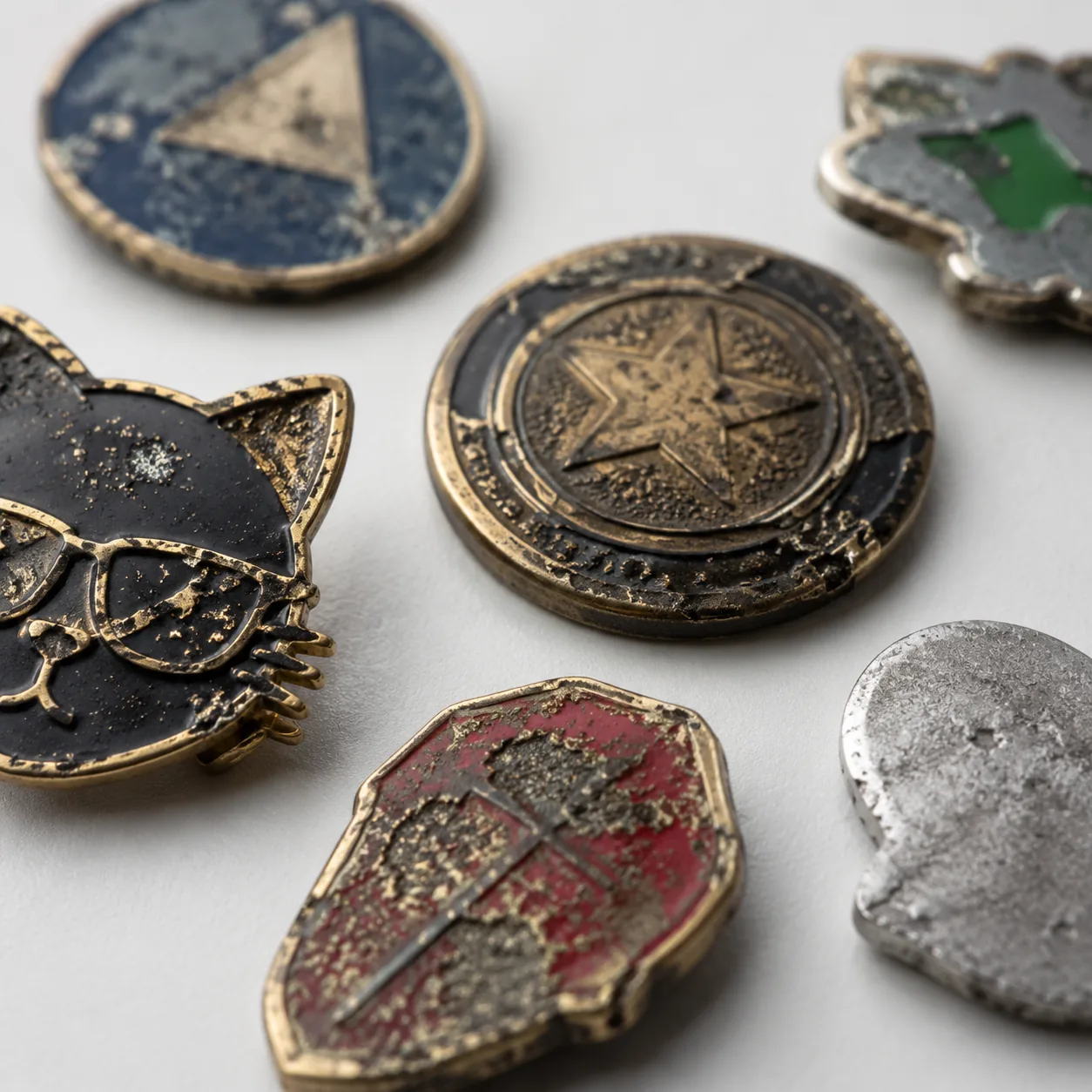
1. Frayed borders: edge construction was under-specified
The most common patch complaint from uniform distributors is not a bad logo on day one. It is edge fuzz after five to ten washes, especially on merrowed embroidered patches, laser-cut woven patches, and sublimated twill patches without a stitched border. The root cause is usually not artwork quality. It is a purchase order that names size and colors but omits border width, cutting method, heat sealing, stitch density, and loose-thread limits.
For embroidered patches with round, oval, shield, square, or other simple outlines, specify a merrow border of 2.5-3.5 mm using 100 percent polyester thread. For irregular mascots, stars, flags, thin lettering, and die-cut silhouettes, a satin border is usually safer: 1.8-2.5 mm wide, with at least 1.2 mm clearance between the design and the cut edge. For woven or sublimated patches, require hot-knife cutting plus heat-sealed edges; untreated scissor-cut polyester twill will fuzz quickly in wash and abrasion tests.
Inspection language should be numeric. Loose threads over 3 mm on the front face should be treated as a defect for apparel programs, with edge fuzz over 0.5 mm after final trimming flagged for rework. For promotional patches, AQL 2.5 major and 4.0 minor is usually workable. For retail apparel, police, school, aviation, and security uniform programs, many buyers move to AQL 1.5 major and 2.5 minor. That tighter inspection may add one to two days before shipment, but it is cheaper than carton-level sorting after delivery.
| Patch type | Edge spec that reduces fraying | Avoid when |
|---|---|---|
| Embroidered | 2.5-3.5 mm merrow border or 1.8-2.5 mm satin border; loose threads under 3 mm | Artwork has sharp points, micro text, or thin negative spaces |
| Woven | Hot-knife cut edge, heat seal, cutting tolerance +/-0.3 mm on simple shapes | Patch will face heavy abrasion unless a stitched border is added |
| Sublimated | Heat-cut polyester twill with 2.0 mm satin border for uniforms | Buyer wants a premium textile edge but refuses stitching |
| PVC | Raised molded edge 1.0-1.5 mm high; no textile fibers to fray | Application needs soft hand feel or very low weight |
2. Curling after heat press: backing and fabric were mismatched
Curling appears when patch structure, adhesive film, fabric composition, and press settings are treated as separate decisions. A patch can sit flat on a factory inspection table and still curl at the corners after pressing onto polyester sportswear, coated nylon, fleece, or cotton workwear. The risk increases on patches over 80 mm wide, high-stitch-count embroidery, and designs with dense thread coverage on only one side.
A practical heat-press starting point for many iron-on embroidered patches is 150-165 degrees Celsius for 12-18 seconds at 2.5-4.0 bar, followed by a warm peel or cold peel according to the adhesive. That is not universal. Coated nylon and rainwear may distort below 150 degrees Celsius. Heavy cotton twill or canvas may need the upper end of the range. Stretch polyester can recover unevenly and pull the patch edge upward after cooling.
Control the patch build before mass production. A 0.4-0.6 mm nonwoven stabilizer is common for embroidered patches; large woven patches often use a 0.2-0.3 mm fusible film to limit edge lift. Finished size tolerance should be +/-1.0 mm for patches under 80 mm and +/-1.5 mm for 80-150 mm patches. Backing film should be inset 0.5-1.0 mm from the edge; oversized adhesive can squeeze out and leave a shiny glue halo around the border.
For heat-applied patches wider than 80 mm, ask for an anti-curl backing or a press test on the actual garment fabric before bulk production. If the garment has a water-repellent finish, silicone coating, raised pile, or stretch content above 5 percent, specify sew-on plus temporary heat seal instead of relying on adhesive alone.
3. Adhesive failure: the sample bonded, the real garment did not
Heat-seal backing is convenient, but it is easy to overpromise. A small approval sample pressed onto clean cotton may pass a peel check, while the same patch fails on DWR-coated outerwear, fleece, stretch polyester, oily workwear, or uniforms washed at elevated temperature. If the end use includes industrial laundry, tumble drying, disinfectant chemistry, or repeated abrasion, heat seal alone is normally not a safe attachment method unless the exact garment and wash process have been tested.
For light promotional apparel, EVA or PES hot-melt film in the 80-120 micron range is usually sufficient. For uniforms, bags, caps, and outerwear, specify sew-on backing, heat seal plus perimeter stitching, or hook-and-loop depending on use. If the patch will be sold loose to consumers, include an instruction card stating temperature, dwell time, pressure, peel method, and a warning that coated or textured fabrics may require sewing.
Price changes are measurable. At 1,000 pieces, a 75 mm embroidered patch with no backing may run about USD 0.28-0.55 FOB China, depending on stitch count and thread colors. Iron-on backing usually adds USD 0.03-0.08 per piece. Hook backing adds roughly USD 0.12-0.28, and a hook-and-loop pair can add USD 0.20-0.45. For orders below 300 pieces, setup, digitizing, and thread changes dominate cost. At 1,000-5,000 pieces, backing choice, trimming labor, and inspection level become more visible in the unit price.
| Application | Recommended backing | Test before approval |
|---|---|---|
| Giveaway T-shirt | 80-120 micron EVA or PES heat-seal film | One press cycle plus 5 domestic washes at 40 degrees Celsius |
| Workwear uniform | Sew-on or heat seal plus perimeter stitch | 10-20 washes, tumble dry, edge-lift check under 1 mm |
| Coated jacket | Sew-on or hook-and-loop; avoid adhesive-only attachment | Fabric compatibility test at target press temperature |
| Consumer loose patch | Iron-on backing with printed instruction card | Peel test after 24-hour cure and 3 wash cycles |
4. Color shift and bleed: Pantone approval was not enough
Patch color failures are not the same as metal pin color failures. Polyester thread, rayon thread, woven yarn, sublimation ink, PVC compound, base fabric, and adhesive film all respond differently to heat, detergent, UV exposure, and garment dye migration. A Pantone number is useful, but it does not define fiber type, light source, tolerance, or the test condition.
For washable embroidered and woven patches, specify polyester thread or yarn rather than rayon unless gloss is more important than durability. Polyester 120D/2 is a common embroidery thread for standard patches, while 75D yarn is common for finer woven detail. For printed or sublimated patches, require a white polyester base fabric, 300 dpi artwork at final size, and color tolerance within Delta E 3.0 where instrument measurement is possible. For visual approvals, use D65 daylight or a named light box condition instead of office lighting.
Dark garments create a separate failure mode: dye migration into light patch areas during heat pressing or laundering. Black, red, navy, and high-visibility orange fabrics are common offenders. If the patch includes white, cream, yellow, or pastel areas, request a barrier layer or a strike-off applied to the actual fabric. The sample should be reviewed after one press cycle and at least five domestic washes; uniform programs should use 10-20 cycles.
- Specify polyester thread or yarn for washable uniforms; use rayon only for decorative shine.
- Define color tolerance as visual match under D65 light or Delta E 3.0 for printed areas.
- Require 5 wash cycles for promotional use and 10-20 cycles for uniform programs.
- Test light patches on dark garments before approving heat-seal backing.
- Approve a physical strike-off sample; do not rely only on a digital mockup.
5. Blurred text and lost detail: the artwork exceeded the process
Artwork that looks sharp in a PDF can become a fuzzy stripe when converted into stitches or woven yarn. Embroidery has thread thickness, stitch direction, pull compensation, and minimum gap limits. Woven patches hold finer detail but do not provide the same raised texture. Sublimation handles gradients and photographs but needs a durable border if the patch will be washed or worn heavily.
For embroidery, block capital text should normally be at least 5 mm high. Lowercase, serif fonts, and curved text usually need 6-7 mm. Satin stitch columns should stay between about 1.0 mm and 6.0 mm; below 1.0 mm they become unstable, and above 6.0 mm they can snag. Keep negative spaces and line gaps at 1.0 mm or larger where possible. For woven patches, simple high-contrast text can often be held at 2.5-3.0 mm high, with yarn detail around 0.3-0.5 mm. For PVC, raised lines should be at least 0.6 mm and recessed gaps at least 0.5 mm.
The best fix is not always enlarging the patch. Brand teams can move legal text or sponsor names to a backing card, simplify a crest, thicken key strokes, or switch from embroidery to woven construction. If the badge must show coordinates, QR-like graphics, gradient art, fine feathers, or small sponsor logos, woven or sublimated construction is usually safer than embroidery.
| Detail requirement | Best construction | Minimum practical spec |
|---|---|---|
| Raised logo with simple text | Embroidered | Text height 5 mm+, line gaps 1.0 mm+ |
| Fine crest or detailed mascot | Woven | Text height 2.5-3.0 mm, yarn detail 0.3-0.5 mm |
| Photo, gradient, full-color art | Sublimated | 300 dpi artwork, polyester base, stitched border for wash durability |
| Tactical rubber appearance | PVC | Raised line 0.6 mm+, recessed gap 0.5 mm+ |
6. Hook-and-loop problems: attachment thickness was ignored
Hook-and-loop patches fail when the hook tape is low grade, the loop side is missing from the quote, the lamination is weak, or the finished patch is too bulky for the garment. A tactical patch may measure correctly on paper but sag on a thin sleeve, feel stiff on a cap, or peel at the corners after repeated removal.
Specify whether the supplier is quoting hook side only or a hook-and-loop pair. Many patch quotes include only the hook backing sewn to the patch. Standard hook-and-loop backing is usually 1.5-2.2 mm thick after lamination, so a finished embroidered patch can reach 2.5-4.0 mm depending on stitch coverage and foam height. That thickness may be acceptable for tactical gear but excessive for lightweight retail apparel.
For patches over 90 mm wide, use a stitched perimeter to secure the hook tape; adhesive lamination alone is not enough for repeated peel cycles. Use a corner radius of at least 2 mm to reduce snagging and corner lift. For curved caps, keep patch width below 80 mm where possible or request a curved-surface fit check. If the loop side is being sewn onto a garment, confirm its color, size, and shrinkage behavior as a separate component.
7. Bulk mismatch: the golden sample was not locked
Patch production has more soft variables than many hard-goods buyers expect. Thread lot, fabric tension, machine speed, stabilizer thickness, trimming method, border width, and backing film can all change the final look. A buyer may approve one clean sample and later receive bulk patches with slightly different density, shine, edge shape, or backing alignment.
The prevention method is a controlled golden sample. Keep one sealed approval sample at the factory and one with the buyer. The purchase order should state finished size, border width, thread or yarn codes, backing type, packing method, and defect limits for loose thread, skipped stitch, oil mark, glue overflow, edge burn, wrong orientation, and color mismatch. Do not approve bulk production from a digital proof alone if the patch will be used on retail or uniform goods.
Typical timing is 2-3 days for digital proof after clean artwork, 5-7 days for physical sampling after artwork and material confirmation, and 10-18 days for 500-5,000 pieces after sample approval. Complex embroidery, PVC molds, hook-and-loop pairs, retail packing, or tighter AQL sorting can add 2-5 days. Rush orders can work, but they raise the risk of thread substitution, reduced wash testing, or lighter pre-shipment inspection.
| Spec item | Why it matters | Practical tolerance or target |
|---|---|---|
| Finished size | Controls fit on uniforms, caps, and backing cards | +/-1.0 mm under 80 mm; +/-1.5 mm from 80-150 mm |
| Border width | Prevents fraying and visual drift | +/-0.3 mm satin border; +/-0.5 mm merrow border |
| Backing alignment | Reduces glue halo and edge lift | Backing inset 0.5-1.0 mm from patch edge |
| Loose threads | Prevents retail and uniform complaints | No front-face loose thread over 3 mm |
| Inspection level | Defines shipment acceptance | AQL 2.5/4.0 for promo; AQL 1.5/2.5 for uniforms |
8. Pre-PO checklist: specify the risk, not only the logo
Before placing a custom patch order, send more than a logo file. Send the garment fabric, attachment method, wash condition, packaging requirement, target market, and whether the patch is promotional, retail, or uniform-grade. These inputs determine construction more than the artwork alone. A patch for a giveaway cap, a school blazer, a tactical sleeve, and a washed workwear program should not share the same backing and inspection standard.
Realistic MOQ tiers are 100 pieces for simple club or sample orders, 300-500 pieces for stable promotional pricing, and 1,000 pieces or more for distributor programs. FOB price ranges for a 70-80 mm patch commonly run USD 0.25-0.70 for embroidered, USD 0.35-0.85 for woven, USD 0.30-0.75 for sublimated with stitched edge, and USD 0.70-1.80 for PVC. Prices move with stitch count, coverage, mold complexity, backing, packing, and AQL level. Very cheap quotes usually remove something important: density, backing quality, trimming time, or inspection labor.
Use a written spec sheet before sampling, not after a failure. If the patch must survive home laundering, ask for at least five wash cycles on the sample; if it will go into uniforms or repeat-use workwear, ask for 10-20 cycles and a peel test after each cycle block. For adhesive-backed products, request the exact garment fabric in the trial, not a generic cotton swatch. The goal is to verify construction against the real use case, not against the best possible sample.
- Define end use: giveaway, retail apparel, workwear, tactical gear, school uniform, cap, bag, or event merchandise.
- Choose construction by failure risk: embroidery for texture, woven for detail, sublimation for gradients, PVC for water resistance.
- Write backing clearly: sew-on, iron-on, adhesive, hook side only, hook-and-loop pair, or no backing.
- State tests: heat-press trial, 5-20 wash cycles, edge-fray review, peel check, and color review under consistent light.
- Lock the golden sample with size, border, backing, colors, packing, and defect limits before mass production.
- Ask the supplier to quote MOQ tiers, sample lead time, bulk lead time, FOB price range, and inspection AQL in one document.
Have a project? Send your artwork and target quantity and we’ll reply with a detailed quotation within 12 working hours.
Ready to get this made?
Send your sketch, target quantity and ship-date. Detailed quotation in 12 hours.



