Which Decoration Method Should You Choose for Promo Items?
What problem are buyers really solving?
Most procurement teams do not start by asking for a decoration method name. They start with a constraint: the logo must stay readable, the finish must survive handling, the buyer needs a repeatable reorder later, and the factory must not return with artwork surprises after the quote is approved. Decoration is where those constraints either fit together or fail.
The real question is not which method is best in theory. It is which method matches the substrate, logo complexity, quantity, wear condition, and delivery window. Screen print can be ideal on a flat polyester lanyard, but it is a poor fit for a curved metal badge. UV print can look crisp on acrylic, but it can chip faster than engraved or filled metal if the item is rubbed every day. The right method protects both appearance and schedule.
For buyers, three variables dominate: surface geometry, required durability, and order volume. Once those are fixed, the shortlist usually collapses from six or seven options to two or three. That is the point where quotes become comparable instead of misleading.
A practical rule: if the item will be touched daily, carry abrasion matters more than color count; if it will be viewed from arm’s length, print resolution matters more than depth; if it will be reordered, process stability matters more than a slightly lower first-order price.
Which method fits which product body?
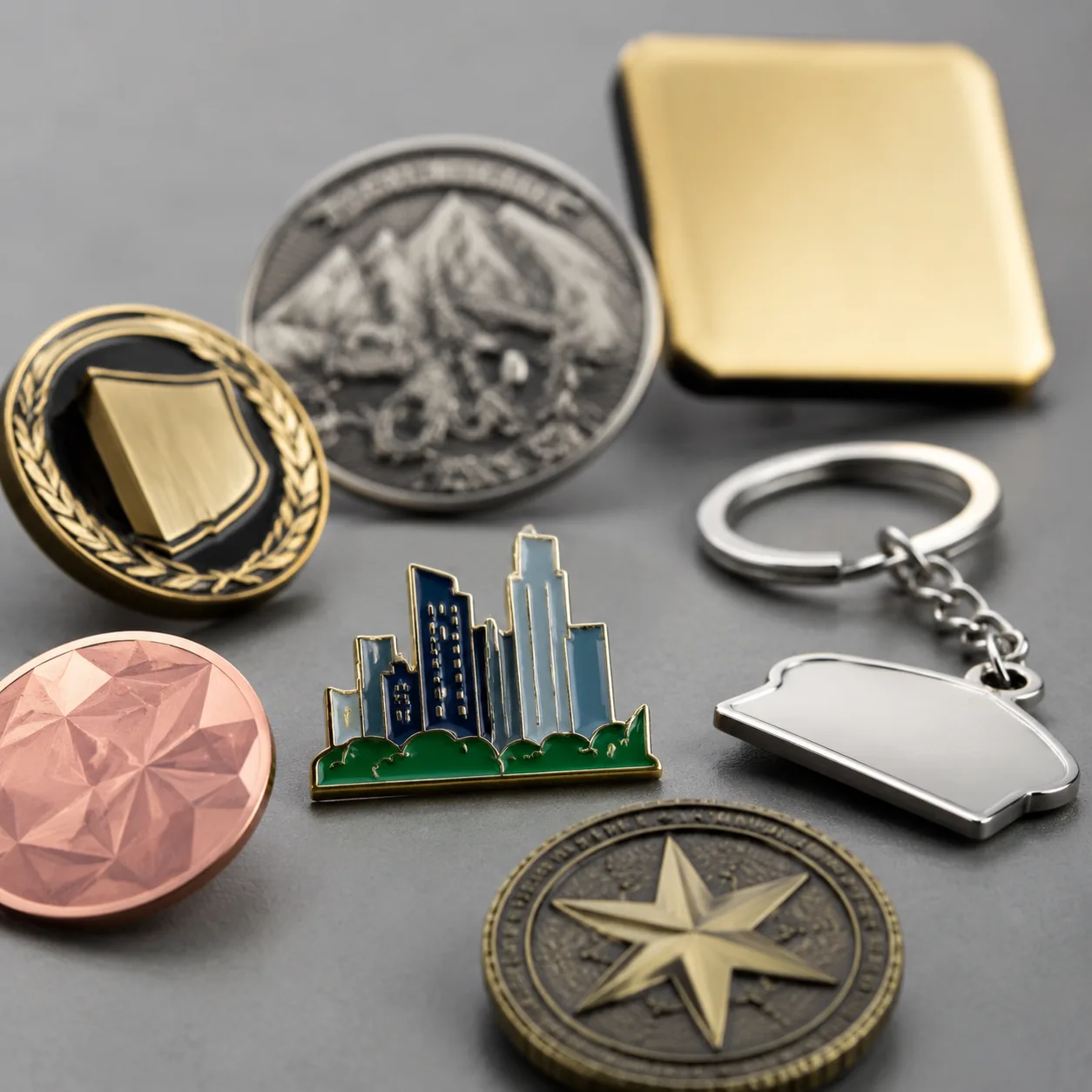
Different substrates accept decoration very differently. Metal can be stamped, etched, printed, or enamel-filled; plastic and acrylic often favor UV print or epoxy dome; fabric usually needs woven, embroidered, or printed decoration. Curved, textured, or high-contact surfaces reduce the workable methods fast. Flatness, adhesion, and edge wear matter more than design complexity in many cases.
Use the matching table below as a first filter before requesting quotes. It helps buyers avoid asking for a process that looks fine on a sample board but fails on the actual product geometry or use case.
| Product body | Best-fit methods | When not to choose it |
|---|---|---|
| Metal pin / badge | Soft enamel, hard enamel, laser engraving, UV print | Avoid tiny full-bleed print on raised edges or very small recessed areas |
| Challenge coin | Die struck, 2D/3D relief, antique fill, selective color print | Avoid delicate printing if the coin will be pocket-carried or frequently handled |
| Acrylic keychain | UV print, double-sided print, epoxy dome | Avoid etched detail unless the acrylic is thick enough and the line work is large |
| Lanyard | Sublimation, screen print, woven, jacquard | Avoid screen print for gradients, halftones, and tiny reversed text |
| Patch | Embroidered, woven, PVC, sublimation | Avoid embroidery for photo detail, micro text, or dense QR codes |
As a rule of thumb, metal bodies tolerate relief and engraving best, flexible textiles favor print or weave, and transparent plastics reward flat, protected graphics. If the item will contact keys, clothing, desktop edges, or skin oils, choose the method with the best abrasion margin rather than the prettiest first sample.
Typical material and process clues help narrow the choice quickly: brass and zinc alloy support die striking and enamel filling well; 300D/420D polyester and nylon webbing take print and weave cleanly; 2.0-3.0 mm acrylic can take UV print on one or both faces; PVC and silicone patches usually need molded color rather than ink-heavy decoration.
What should the buyer ask before choosing a method?
A strong RFQ should ask more than the decoration process name. It should state what the logo must survive: abrasion, UV exposure, bending, washing, cleaning chemicals, or daily pocket carry. It should also specify smallest readable text, target color tolerance, and whether both sides need decoration. If the supplier knows the method but not the performance target, they will often choose a cheaper method that passes approval but fails in use.
The fastest way to narrow the shortlist is to answer four screening questions: How many colors? How fine is the line work? Is the part flat, curved, or textured? Will the item be handled daily or displayed? Those four questions usually identify the correct process faster than a broad request for options. When the brief is clear, the factory can quote the same assumptions across all methods instead of mixing different standards.
- Is the artwork mainly text, line art, or filled shapes?
- Will the decoration touch skin, fabric, metal, or a hard case?
- Does the item need one side or both sides decorated?
- Is color matching tight enough to require Pantone control?
- Will the finish need to be matte, gloss, metallic, transparent, or raised?
For buyer-side clarity, add one line that defines the use case in plain language. For example: “Pocket-carried for 12 months,” “washed weekly at 40°C,” or “display only, no abrasion.” That single sentence often changes the recommended method more than the artwork itself.
How do common decoration methods compare?
Buyers often compare methods only by unit price, but that misses setup cost, minimum line width, and rejection risk. A low piece price can still be expensive if it needs multiple screens, special tooling, or high sorting loss. Quote comparisons should always use the same assumptions: artwork size, color count, coverage area, substrate, and acceptance tolerance.
The ranges below reflect typical FOB China pricing for standard promotional items. Actual numbers move with size, complexity, finish, and order volume, but these ranges are useful for initial sourcing and budget planning.
| Method | Typical MOQ | Typical lead time | FOB price range | Best use case |
|---|---|---|---|---|
| Screen print | 300-500 pcs | 10-15 days | USD 0.05-0.25 per color per side | Flat, bold logos on lanyards, bags, and soft goods |
| Sublimation | 200-300 pcs | 10-14 days | USD 0.20-0.60 per side | Full-color gradients on polyester lanyards and fabric |
| UV print | 100-300 pcs | 12-18 days | USD 0.15-0.80 per side | Acrylic, flat metal, ABS, and mixed-color graphics |
| Laser engraving | 100-200 pcs | 8-12 days | USD 0.10-0.40 per item | Text, serial numbers, and durable one-color marking |
| Embroidery | 300-500 pcs | 15-20 days | USD 0.30-1.20 per pc | Patches with texture and long wear life |
| Woven | 500-1000 pcs | 12-18 days | USD 0.25-0.90 per pc | Small text and clean edges without thread build-up |
Method selection should also reflect repeatability. Screen print and sublimation can be highly efficient once artwork is stable, while laser marking and UV print are better when artwork changes often or includes variable data. If a program needs serial numbers, names, or batch codes, that detail should be included before the supplier quotes.
At the lower end of the market, simple one-color laser marking on a zinc alloy or stainless-steel part can land around USD 0.08-0.20 FOB at 500-1,000 pcs, while a multi-color UV print on a rigid acrylic keychain can sit closer to USD 0.25-0.80 FOB depending on size and coverage. For lanyards, one-color screen print is usually cheaper than sublimation at higher volumes, but sublimation wins when full coverage or gradients are required. Die-struck metal with one soft-enamel fill often moves into the USD 0.35-1.20 FOB range for common badge sizes, with complex 3D relief priced higher.
Quality control terms also affect cost. A standard commercial decoration job is often inspected to AQL 2.5 major and 4.0 minor, while premium gift programs may specify AQL 1.0 major and 2.5 minor. The tighter the inspection target, the more sorting and replacement allowance must be built into the quote.
When should the buyer prefer texture over print?
Texture is the right answer when the product needs tactile presence, better wear resistance, or a premium look without relying on ink coverage. Embroidery, die-struck metal relief, and woven construction all create physical depth that print cannot match. The trade-off is reduced micro-detail: tiny disclaimers, QR codes, and photo images are usually poor candidates.
If the logo needs to be felt as much as seen, texture usually wins. That is especially true for challenge coins, metal badges, premium patches, and commemorative items. If the artwork depends on shaded gradients, thin reversed type, or photo realism, print or sublimation is usually safer. Do not force one method to imitate another; that is how rework starts.
A useful rule is to choose texture when the item is handled but not read closely, and choose print when the item is read closely but not scraped heavily. For mixed projects, many buyers use both: engraved metal for the product body and print for a label, insert, or packaging card.
Concrete examples help. A 40 mm challenge coin for a sales award should usually be die struck with antique fill or soft enamel, because the edge and relief matter more than fine text. A 25 mm acrylic keychain for a trade show giveaway is better with UV print or epoxy dome, because full-color branding and low tooling cost matter more than abrasion resistance. A 20 mm woven patch for a cap should keep text above 1.5 mm high to remain legible after stitching.
What specs prevent ugly surprises in sampling?
Most decoration failures are not mysterious. They come from missing numbers in the purchase spec: line thickness, registration tolerance, color tolerance, coverage boundary, edge clearance, and acceptable defect rate. The factory can only control what the buyer defines. If the artwork is beautiful but the technical brief is vague, the sample becomes a design negotiation instead of a manufacturing approval.
These are the specification points that matter most when comparing samples and production output:
- Minimum readable text: 1.0-1.2 mm for metal print and laser marking; 1.5 mm safer for woven or embroidered details
- Minimum line width: 0.15-0.20 mm for UV print on flat rigid substrates; 0.30 mm or more is safer for mass production
- Registration tolerance: ±0.2-0.3 mm for premium visual alignment; ±0.5 mm is more typical on basic promo goods
- Color variance target: Delta E 2-4 for brand-sensitive work; looser only when the buyer approves a visual match rather than a lab match
- Print edge clearance: keep ink 0.2-0.5 mm away from high-wear edges when abrasion is a concern
- Surface flatness: specify whether the decoration must follow curvature or remain visually centered on the face
For physical quality control, a buyer should also define the acceptable defect rate. Common AQL targets for promotional decoration are AQL 2.5 for major defects and AQL 4.0 for minor defects, with stricter programs using AQL 1.0/2.5. If the item is premium or gift-grade, define this before mass production begins so the supplier does not inspect to a looser standard.
If you need more technical control, ask for the actual sample criteria in writing: acceptable ink bleed under 5%, no exposed base metal on filled areas wider than 0.3 mm, no misregistration visible at 30-40 cm viewing distance, and no cracking after a 3-5 bend test for flexible items. That keeps approval grounded in measurable limits rather than opinion.
Which method is most cost-efficient at different order sizes?
Cost efficiency changes with quantity. A process that looks expensive at 300 pieces may become cheaper than a simpler method at 3,000 pieces because setup gets diluted. Buyers should compare total landed decoration cost, not only unit price. That includes setup, tooling, proofing, color matching, and yield loss. A low per-unit quote with a high reject rate is not a good deal.
As a rule, small runs favor methods with low setup cost and flexible artwork, such as UV print or laser marking. Larger runs favor processes that amortize tooling well, such as woven patches, screen print, or die-struck metal decoration. For premium corporate gifts, buyers often accept a slightly higher unit price if the decoration is stable, repeatable, and reorder-friendly.
| Order size | Usually best value | Why it wins |
|---|---|---|
| 100-300 pcs | UV print or laser engraving | Low setup cost, faster approval, and fewer tooling dependencies |
| 300-1000 pcs | Screen print, woven, embroidery | Setup cost spreads across more pieces and yields stay predictable |
| 1000+ pcs | Sublimation, woven, die-struck finishes | Repeatability improves and unit cost drops as tooling is amortized |
| Mixed-logo kits | Laser plus print combination | Different elements can use the process that fits each surface best |
As a budgeting benchmark, one-color screen print on a flat polyester lanyard often lands around USD 0.06-0.18 FOB at 1,000 pcs and can drop lower at higher volume. Sublimation typically sits around USD 0.20-0.50 FOB for full-coverage work. Woven patches commonly sit around USD 0.30-0.80 FOB depending on size and stitch density, while a simple laser-marked metal tag usually stays around USD 0.10-0.30 FOB. When a process needs special tooling, expect MOQ to rise and first-article approval to add 2-4 days.
For a fair comparison, ask each supplier to quote the same artwork dimensions, same number of colors, same packing method, and same inspection standard. Otherwise one quote may look cheaper only because it quietly assumes smaller print size, looser color matching, or a lower-grade base material.
What should go in a final buyer checklist?
The final checklist should be short enough to use during quote review, but specific enough to prevent a production argument later. If the factory cannot answer one of these items clearly, pause before approving artwork. The goal is not to over-spec everything; it is to lock the variables that affect appearance, durability, or cost.
Use this checklist before releasing a PO:
- Confirm the exact decoration method for each item, not just the product type
- State artwork size, side count, and color count for every SKU
- Define smallest text, minimum line width, and any reversed-type requirements
- Request a sample acceptance standard for color, alignment, gloss, and finish
- Ask whether the method is stable for reorder production after 6-12 months
- Confirm whether the decoration is built into tooling or added as a secondary process
- Verify whether any epoxy, clear coat, or lamination changes gloss or color
- Lock the inspection standard, including AQL targets and any critical visual defects
If the item includes multiple elements, separate them in the RFQ. For example, a metal badge may need die-struck body detail plus printed numbering, while a keychain may need a printed insert plus a laser logo on the ring. Treat each element as its own process choice so the quote stays apples-to-apples.
Also specify the packaging and handling that may affect the finish. A UV-printed face packed loose in a carton has a different risk profile than the same item poly-bagged with a soft insert. If a clear coat or epoxy dome is required, state the acceptable gloss range and whether yellowing resistance matters for long storage.
What should the buyer do next?
Start by classifying the item into one of three groups: flat and printed, textured and durable, or mixed-material and decorative. Then ask the factory to quote only the methods that fit that group, with the same artwork size, the same quality target, and the same inspection standard across all options. That keeps the comparison honest and avoids mixed quotes that look cheap only because they assume different specs.
If you are sourcing from China, send one clear RFQ with the product photo, AI or PDF artwork, quantity tiers, target delivery date, and the one sentence that matters most: what must not fail in use. A practical RFQ should also state preferred FOB port, packaging format, whether you need first-article approval or production samples, and whether reorders are expected within 6-12 months. That usually saves at least one round of clarification and shortens the lead time by several days.
A good next-step quote sheet compares method, MOQ, lead time in days, FOB price range, AQL target, and sample risk side by side. If a supplier cannot supply those numbers, they are not yet quoting to production reality. The fastest path to the right decoration method is not more options; it is better-controlled options.
Have a project? Send your artwork and target quantity and we’ll reply with a detailed quotation within 12 working hours.
Ready to get this made?
Send your sketch, target quantity and ship-date. Detailed quotation in 12 hours.



