Which Custom Promo Product Format Fits Your Brief?
Start With the Job, Not the Product
Most sourcing mistakes happen because the buyer starts with a product type and only later discovers the real job: a staff giveaway needs to be lightweight and cheap, a retail item needs perceived value, an event pass needs visibility, and a membership token needs durability and repeatability. Those are different requirements, so the best format is the one that matches the use case with the fewest compromises. If you force the wrong format into the brief, you usually pay in rework, higher freight, or a product that looks good in a sample but fails in the field.
The decision framework below is built for procurement teams, distributors, brand teams, and event organizers who need a practical choice, not a design exercise. At ZheCraft, we see the same pattern across pins, coins, badges, keychains, magnets, patches, and lanyards: the winning order is the one that is easiest to manufacture consistently at the required spec, not the one with the most decoration options.
- If the item must hang from clothing, prioritize weight, attachment safety, and surface detail.
- If the item must be mailed in volume, prioritize thickness, carton density, and breakage risk.
- If the item must show a logo clearly at arm’s length, prioritize contrast and minimum line width.
- If the item must survive frequent handling, prioritize plating, coating, and hardware fatigue.
Choose by Primary Use Case
The fastest way to narrow the field is to identify the primary job the product must perform. A commemorative item, a wearable brand marker, a giveaway, a functional accessory, and a mailer-friendly insert all point to different formats. The right answer is rarely “the prettiest one”; it is usually the one that balances display value, manufacturability, and landed cost.
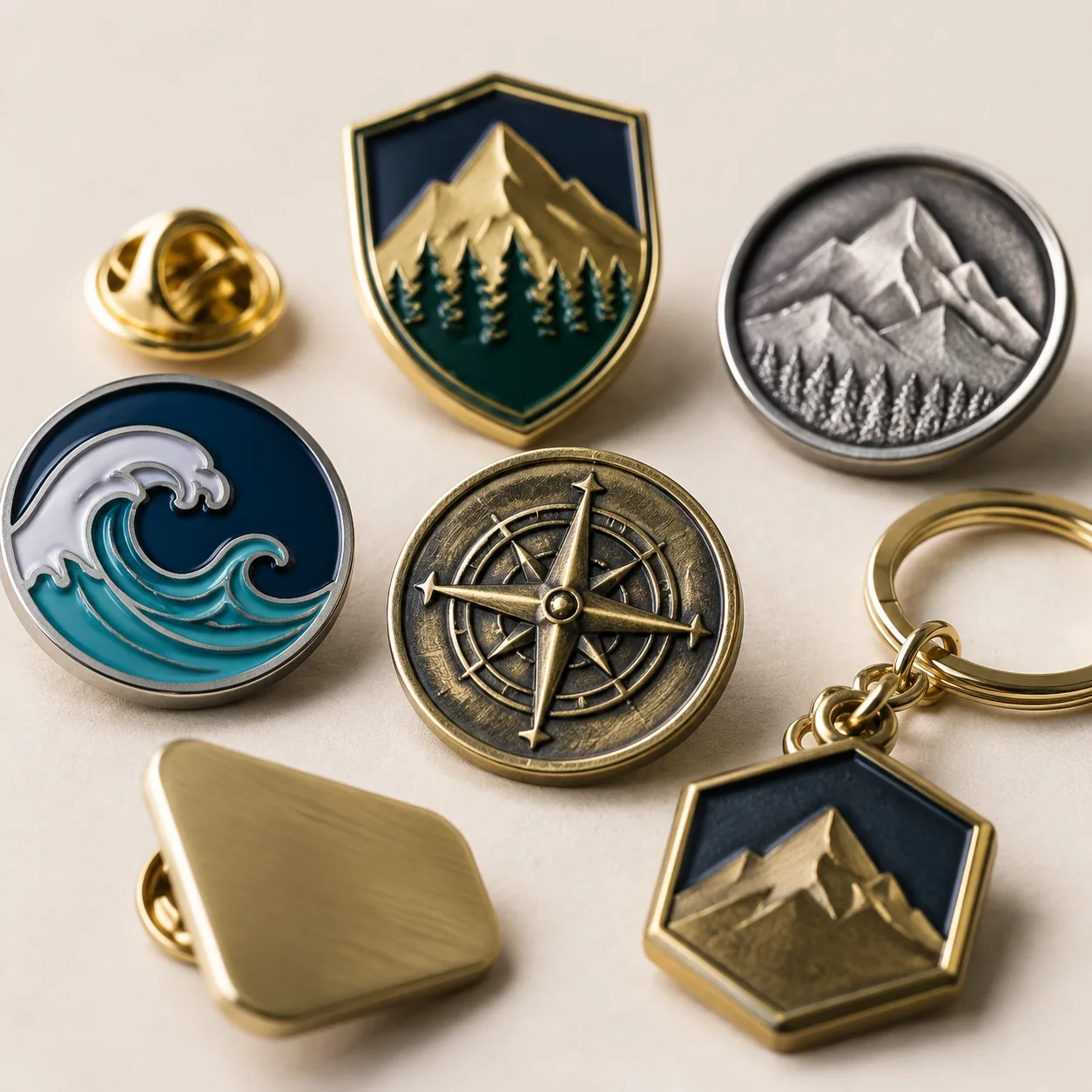
For example, challenge coins and metal badges work well when the buyer wants a heavier, more premium object with better edge definition and long service life. Pins and patches are better when wearability matters. Keychains and magnets make sense when the buyer wants daily utility or fridge/desk exposure, while lanyards are the right choice when the item must carry credentials or create large brand visibility at events.
| Primary job | Best-fit formats | Typical buyer trade-off |
|---|---|---|
| Premium keepsake | Challenge coin, hard enamel pin | Higher unit cost and tooling complexity |
| Wearable identity | Badge, lapel pin, patch | Attachment and fabric compatibility |
| Daily utility | Keychain, lanyard | More hardware failure points |
| Mass giveaway | Magnet, simple pin, woven patch | Lower perceived value than metal items |
| Event visibility | Lanyard, badge, large pin | More print area, less dimensional detail |
Decide What Must Be Seen, Touched, or Used
This is where many briefs become clearer. If the product must be seen from several meters away, use larger shapes, stronger contrast, and simpler art; lanyards and badges usually beat small pins in visibility. If the product must be touched and kept, a heavier coin, a domed keychain, or a well-finished badge often performs better because tactile weight signals value. If the product must be used every day, utility becomes more important than decoration.
Metal products typically offer the best edge definition and the most stable brand presentation, but they are not always the best if the buyer needs softness, flexibility, or ultra-light handling. Patches can be more forgiving for apparel, while PVC or fabric-based items can reduce scratch risk and lower shipping weight. ZheCraft generally recommends matching the format to the handling environment first, then selecting finish and attachment second.
- Seen at a distance: lanyards, large badges, bold patches.
- Handled often: keychains, coins, well-plated pins.
- Worn on clothing: lapel pins, brooches, patches.
- Inserted into packs: magnets, small coins, flat keychains.
Compare the Formats on Manufacturing Risk
A buyer should not compare only unit price; the real comparison is production risk. A product with a low quote but high rework probability can cost more once you include approvals, delays, and replacement freight. In factory terms, simpler geometry, fewer moving parts, and less exposed hardware usually mean better first-pass yield and more stable repeat orders.
Metal pins and coins are usually predictable once artwork, thickness, and plating are locked. Keychains add hardware complexity, which raises the chance of failures in rings, chains, and connectors. Lanyards are comparatively stable in print production but can vary in color registration, stitch alignment, and accessory assembly. Patches are flexible, but embroidered detail limits and backing selection can still create rejection risk if the art is too fine.
| Format | Main risk | When not to choose it |
|---|---|---|
| Pin | Small size limits artwork detail | When the logo needs long text or tiny legal copy |
| Coin | Higher tooling and material cost | When the budget is tight or the item must be ultra-light |
| Keychain | Hardware fatigue and breakage | When the buyer needs zero moving parts |
| Patch | Detail loss in small graphics | When the design has thin gradients or micro text |
| Lanyard | Color shift and accessory mismatch | When the item is meant to be collectible rather than functional |
| Magnet | Lower perceived premium value | When the audience expects a gift-level keepsake |
Match the Budget to the Right Cost Profile
The wrong product choice often looks cheap on paper and expensive in practice. A simple stamped pin may have a low tooling threshold, but if the design needs multiple colors, special plating, or custom packaging, the landed cost can move quickly. By contrast, a lanyard can absorb more artwork economically because the print area is large, but it will never feel as premium as a solid metal coin or badge.
As a rough FOB framework, simple lanyards and basic magnets usually sit at the lowest end of the range, often around USD 0.20 to 1.20 depending on width, printing method, and accessories. Basic pins, patches, and simple keychains often land around USD 0.35 to 2.50. Premium coins, brooch-style badges, and complex plated items can run roughly USD 1.20 to 6.00+ depending on size, thickness, finish, and packaging. The exact price depends heavily on MOQ, artwork complexity, and whether tooling is shared or custom.
- Choose the lowest-complexity format that still meets the brand objective.
- Use fewer colors and fewer accessory parts when the order is price-sensitive.
- Avoid premium plating or dome coating unless the design needs it visually or functionally.
- Check whether packaging is consuming more budget than the item itself.
Use Lead Time and MOQ as a Filter
Lead time should be treated as a product-selection constraint, not just an order-management detail. If an event date is fixed, formats with less assembly risk and simpler decoration are easier to recover if something slips. On typical factory schedules, straightforward lanyards and basic magnets may be ready in about 12 to 18 days after approval, while metal pins, badges, and keychains often need around 18 to 30 days, and more complex coins or multi-part builds can run 25 to 40 days or more.
MOQ also pushes the decision. Small-run buyers often overestimate what a factory can economically set up, especially for multi-color metal products. In practice, many factories can accommodate lower quantities on simple items, but unit pricing usually becomes much less efficient below 300 to 500 pieces for custom metal goods, while print-based formats may stay workable at lower quantities if the setup is simple. ZheCraft typically recommends locking MOQ only after confirming whether the final design needs custom tooling, accessory sourcing, or special finishing.
| Constraint | Favors | Avoid if |
|---|---|---|
| Short lead time | Lanyards, simple magnets, basic patches | You need cast metal detail or special finishing |
| Low MOQ | Simple pins, basic keychains, print-based items | The design requires multiple custom parts |
| High reorder frequency | Stable metal or print formats with fixed specs | You expect artwork changes every run |
| Event-date certainty | Fewer-part products with predictable QA | Anything with assembly-heavy hardware |
Build a Shortlist With a Simple Rule Set
A useful rule set removes emotion from the choice. First, define the product’s job in one sentence. Second, rank the top three constraints: budget, lead time, durability, display value, or wearability. Third, eliminate any format that fails the top constraint, even if it looks attractive on paper. This prevents the common mistake of choosing an item that scores well in one area but creates risk in the one area that matters most.
A practical shortlist often looks like this: if you need wearable premium branding, compare lapel pins against brooch-style badges; if you need a premium desk or award piece, compare challenge coins against heavy badges; if you need daily utility, compare keychains against lanyards; if you need mass visibility at a low unit cost, compare lanyards against magnets or simple patches. ZheCraft’s factory-side experience is that the fewer formats you request in a quote round, the faster you can compare real apples-to-apples pricing and avoid spec drift.
- Write the use case in one sentence before asking for quotes.
- Rank the top three constraints before choosing a format.
- Reject any format that fails the top constraint, even if it looks attractive.
- Ask suppliers to quote only the shortlisted formats with identical packaging assumptions.
What to Do Next
Take your current brief and convert it into a decision sheet with five fields: use case, audience, quantity, deadline, and acceptable risk. Then compare only the formats that satisfy those five fields, not every product the factory can make. If you need a premium wearable, ask for pin and badge quotes; if you need event visibility, ask for lanyard quotes; if you need a collectible, ask for coin or heavy badge quotes; if you need utility, ask for keychain quotes. That simple filter will usually cut your options to two or three serious candidates.
If you want a cleaner sourcing round, send suppliers one brief with the same artwork, the same quantity, the same packaging assumption, and the same delivery window. At ZheCraft, that is usually the fastest way to identify the right format before any sampling starts, because the comparison stays focused on function, cost, and risk instead of vague preference.
Have a project? Send your artwork and target quantity and we’ll reply with a detailed quotation within 12 working hours.
Ready to get this made?
Send your sketch, target quantity and ship-date. Detailed quotation in 12 hours.



