When Your Promo Set Must Match: One Order, Multiple Items
The order that looks simple until the samples arrive
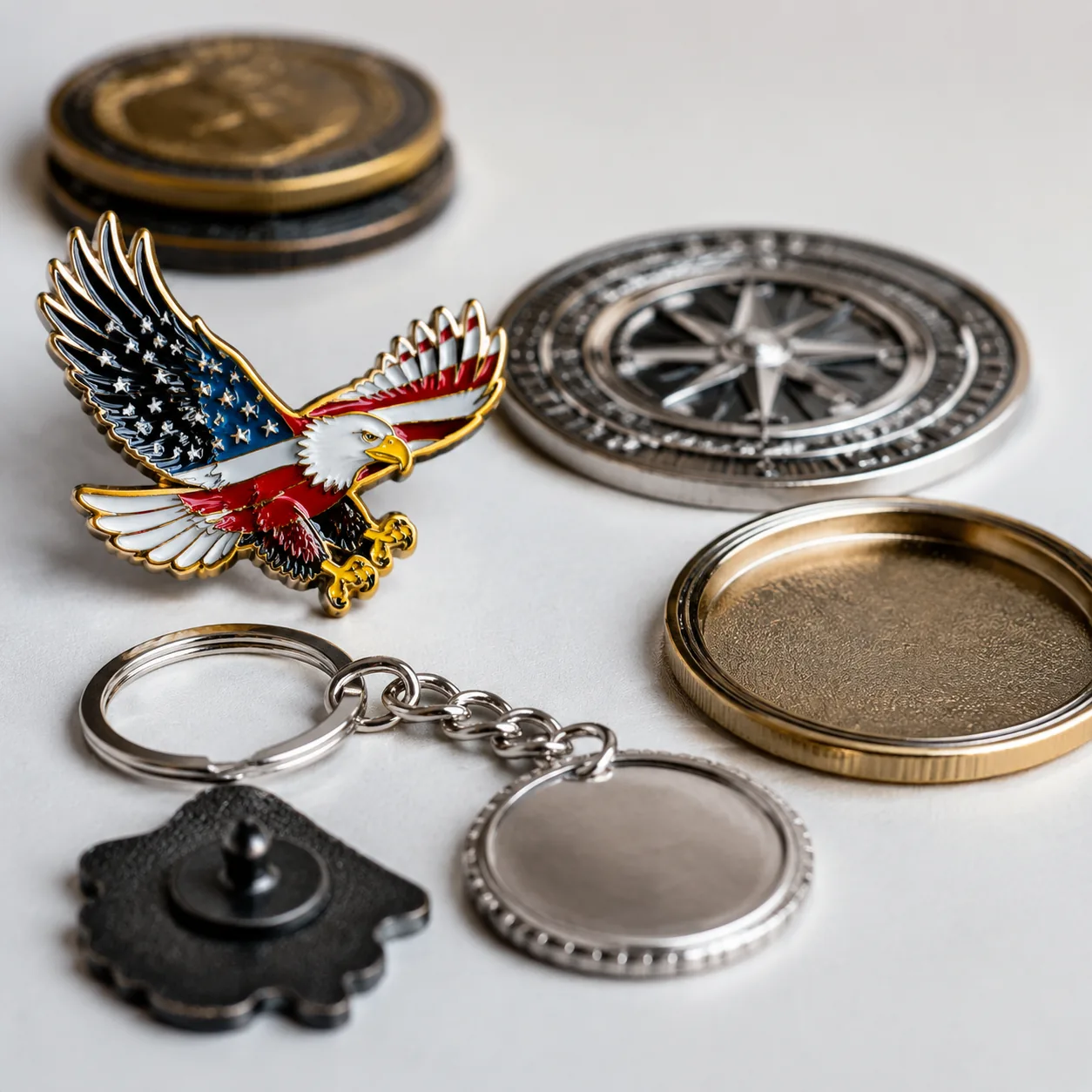
The most expensive promo mistakes usually happen when a buyer tries to make one brand look consistent across several product types at once. A soft enamel pin, a die-cast coin, a woven patch, and a printed lanyard can all carry the same logo, but they do not age, reflect light, or hold detail in the same way. If each SKU is approved in isolation, the full kit can still arrive looking mismatched even when every individual part technically passes inspection.
This scenario shows up in event kits, onboarding packs, retail bundles, and campaign gifts, where the items are judged as one system rather than four separate products. The real challenge is not selecting categories; it is locking a shared spec language early enough that the factory does not improvise across different production methods. ZheCraft sees this often when buyers source the set from separate vendors and only discover the integration problem at pre-production sample stage.
The first decision is not the product mix but the intended perception: premium, durable, or cost-controlled. That choice affects plating, thread density, packaging insert quality, and acceptable variation. A premium retail kit may justify tighter tolerances and a second sample round; a giveaway pack should not be priced as if it needs jewelry-grade finishing on every component.
A practical rule: if the set will be judged at arm’s length in a box, prioritize visual harmony and packaging fit. If it will be worn or handled repeatedly, prioritize edge durability, hardware retention, and abrasion resistance. That distinction keeps the brief focused and prevents over-specifying parts that do not need it.
Start with the user moment, not the product list
Before asking for pricing, define how the recipient will receive and use the set. Will the items be handed out loose at a conference, packed into a mailer, or sold as a merch bundle with retail presentation? The answer changes the allowable fit tolerance, carton protection, surface finish, and even the order in which samples should be reviewed. A flat-pack mailer can tolerate slightly looser packaging dimensions than a rigid gift box, but a retail box needs consistent internal alignment so the first-open experience feels intentional.
A strong buyer brief names one lead item that sets the tone for the rest. For example, a challenge coin may define the premium look, while the pin and patch only need to match its color family, metal temperature, and logo scale. If no lead item is chosen, every supplier optimizes its own category and the set loses coherence.
Use one of these three operating modes: exact match, controlled match, or family match. Exact match applies to packaging panels, printed cards, and some metal finishes. Controlled match applies to mixed substrates where the same Pantone must be interpreted by different processes. Family match applies when a woven patch, embroidered patch, and lanyard are expected to sit in the same brand family but not read identically under inspection light.
A workable spec map for a mixed promo set
The easiest way to control a multi-item order is to split the brief into shared specs and item-specific specs. Shared specs are the brand rules that must stay aligned across all SKUs: Pantone targets, logo proportions, metal tone, protective finish, packaging style, and approved reference images. Item-specific specs cover the limits that only apply to one process, such as enamel fill depth, woven thread density, lanyard print repeat, or coin relief depth.
For mixed sets, use one production control sheet that travels with every quote request. It should not be a design deck. It should be a concise spec map with the few details a factory cannot safely guess. When the same information is repeated consistently, quote comparison becomes meaningful instead of just comparing low numbers.
| Spec area | Shared across the set | Item-specific control |
|---|---|---|
| Color | Pantone reference, approved digital proof, allowable visual delta | Enamel formula, thread chart nearest match, print profile limits |
| Finish | Plating family, gloss level, and anti-tarnish expectation | Coating thickness, texture, epoxy use, and protective topcoat |
| Logo geometry | Approved artwork file and minimum readable line | Line width by process, relief depth, stitch count, and print edge behavior |
| Packaging | Card size, insert copy, bag or box format | Fit allowance, die-cut position, closure strength, and carton count |
A practical set brief should include vector artwork, a master Pantone list, one approved daylight photo, packaging dimensions, the target shipment window in calendar days, and the required carton configuration. If the factory has to infer these points, the quote may look cheaper only because the supplier has not priced the real risk yet.
Good briefs also state what can be substituted. Example: if a lanyard must hit a lower unit price, can the attachment switch from a swivel hook to a J-hook? If a pin needs tighter cost control, can the backing card be simplified from four-color print to one-color black? These decisions belong in the brief, not after the sample arrives.
How to line up color across different materials
Color drift is the most visible failure in a matched set, and it happens because metal, textile, and printed substrates do not reflect color the same way. A deep blue on hard enamel can look richer than the same Pantone on polyester webbing, and a brushed coin surface will mute contrast that looks fine on a screen. Expecting identical optical output across all items is a common mistake.
The practical approach is to lock one master color target, then define acceptable appearance by process. For enamel pieces, specify Pantone matching to the nearest practical formula and approve under D65 daylight or a comparable daylight booth. For woven or printed items, specify the nearest thread chart or print profile and accept a controlled visual match rather than a lab-perfect match. Many buyers allow a color shift of about ΔE 2.0 to 3.0 between substrate types when the full set reads consistently in hand.
For mixed sets, put the color rule in writing: one master Pantone list, one approval light source, one sample background, and one final reference retained by the factory. If a metal item needs a darker antique tone to hold contrast, say so explicitly. If a lanyard print will appear slightly flatter than enamel, accept that in advance rather than treating it as a defect after mass production.
Keep one master swatch in the same paper stock or substrate family as the final item whenever possible. A Pantone chip on coated paper is helpful, but a printed textile swatch or plated metal chip gives the factory a better target when the order spans multiple materials. That extra reference reduces avoidable debate over whether the color is “close enough.”
Where the technical differences actually bite
This is where buyers usually get surprised: each item type has its own tolerance stack. A pin can hold a crisp edge at 0.25 mm detail, but a woven patch may need broader strokes to stay legible. A lanyard can carry repeated text, but if the print repeat is not aligned to the clip position, the whole piece feels off-center even if the artwork is technically correct.
The following ranges are practical, not universal standards. They are the kinds of numbers that keep production stable for typical custom promo work and make quote review much easier.
| Item | Common buyer spec | Typical practical range |
|---|---|---|
| Soft enamel pin | Edge quality, plating, and color accuracy | Minimum line width 0.25-0.30 mm; raised metal lines typically 0.10-0.15 mm above fill; AQL 2.5 for major defects |
| Challenge coin | Relief, rim, and antique contrast | Relief depth 0.3-0.8 mm; rim width 1.5-2.5 mm; die strike tolerance around +/-0.3 mm; AQL 2.5 |
| Woven patch | Thread clarity and border finish | Text height usually 2.0 mm minimum; border tolerance about +/-1 mm on cut shape; thread density commonly 50-75 stitches/cm depending on artwork |
| Lanyard | Print repeat and hardware placement | Length tolerance commonly +/-10 mm; width tolerance about +/-2 mm on 20 mm webbing; attachment position should stay within the approved repeat |
MOQ and lead time also differ by item. A typical enamel pin order starts at 100-300 pcs per design, with FOB pricing roughly USD 0.35-1.20 per piece depending on size, plating, and color count. Challenge coins often start at 100 pcs, with FOB pricing around USD 1.20-4.50 each for common sizes and finishes. Woven patches frequently begin at 100-200 pcs, with FOB pricing near USD 0.40-1.80 each. Sublimated or woven lanyards may start at 100-200 pcs, with FOB pricing roughly USD 0.25-0.90 each, excluding accessories such as badge reels, safety breaks, or metal buckles.
Lead times matter just as much as unit price. A straightforward mixed set usually needs about 12-18 days for samples after artwork approval, then 18-35 days for mass production depending on complexity and packing. If the order includes custom inserts, nested packaging, or multiple decoration methods, add 5-10 days. Buyers who need a hard launch date should work backward from the ship window, not from the purchase order date.
For tighter schedules, the risk is not only factory time but also proof cycling. A one-day delay in confirming plating tone can push every downstream item because the set should be color-matched off the same approved reference. In practice, the slowest item often sets the schedule for the whole kit.
One sample round is not enough unless you control the right things
A common mistake is to approve one sample of each item and assume the set is locked. In reality, the first samples often show only that the supplier understood the artwork, not that the production system is stable. For a mixed order, you need to confirm how the items relate to each other, not just whether each one looks acceptable on its own.
That means checking the full set together under the same lighting, on the same background, and in the final packaging layout. Look for visual imbalance in thickness, sheen, scale, and edge quality. If the coin feels heavy and matte while the pin is shiny and delicate, the set can read as four unrelated products even if each item passed approval individually.
A stronger approval process includes pre-production samples, a packaging mockup, and a final golden sample retained by the buyer. Inspect dimensions against spec, then verify that the group presentation works at arm’s length and in hand. For high-visibility projects, a buyer may also require a pilot run of 20-50 sets before the full order is released.
The final approval should include three checks: visual match, fit check, and packing sequence. Visual match confirms the items belong to one family. Fit check confirms the set closes, stacks, or hangs as designed. Packing sequence confirms the packaging line can assemble the kit without forcing parts into the wrong orientation or damaging the finish.
- Check all samples together, not one by one
- Compare sheen, scale, and edge sharpness side by side
- Verify card or box layout before mass packing
- Confirm hardware orientation and attachment position on every item
- Retain one signed golden sample at both buyer and factory
How to buy without creating split responsibility
The best way to reduce risk is to keep design responsibility and production responsibility in one place. If a distributor designs the set, one factory makes the pins, another makes the lanyards, and a third handles packing, any defect can get passed around instead of solved. That is how a missing shade match becomes a packaging problem and then a scheduling problem.
When one factory manages multiple item types, the internal handoff is simpler: one color target, one packaging standard, one approval record. ZheCraft’s advantage here is not just that the product categories exist under one roof; it is that the production team can compare them before shipment and catch mismatches that a single-category supplier would never see. That said, an integrated supplier still needs a disciplined brief, because internal coordination cannot fix vague specifications.
If you must split sourcing, assign one party as spec owner and one final approver. Without that, the set will drift because each factory optimizes for its own process efficiency. The buyer then becomes the integration layer, which increases admin time, sampling cost, and the chance of late-stage rework.
Split sourcing is most dangerous when the packaging supplier receives the goods last. If the carton insert was dimensioned off a pin sample that later changed by 2 mm, the assembled kit may rattle, lean, or require a manual rework step. That kind of issue is easy to prevent at the brief stage and expensive to fix after goods are in transit.
The commercial trade-offs buyers should expect
A matched set is usually more expensive than ordering each item independently from the cheapest source. You pay for alignment work, extra proofs, more sample coordination, and tighter packing controls. On a mixed promo set, that premium is usually worth it because the cost of rework, missed launch dates, and inconsistent presentation is higher than the production delta.
The trade-off is that some specs should be loosened intentionally. If you demand absolute sameness across enamel, woven, and printed parts, you may force rejections for differences that are normal to the process. Better buyers decide where appearance consistency matters most and where process realism should win. That is how you protect both budget and schedule.
As a planning benchmark, budget the final kit at roughly 8-18% above the cheapest single-category bid once packaging, coordination, and one extra sample round are included. That premium is often lower than the cost of a missed launch, especially when the set is tied to an event date, sales meeting, or retail ship commitment.
For cost control, negotiate by tier rather than by piece. Example: 300 sets may justify a lower coin FOB, but not if the patch and lanyard quantities remain at 100 each and force separate setup charges. In mixed orders, the total kit quantity and shared packaging often matter more than one low headline unit price.
What to do next
Build a one-page master spec sheet for the whole set, then attach item-specific annexes for pins, coins, patches, and lanyards. Put the shared Pantone targets, packaging format, acceptable finish family, MOQ targets, and approval lighting conditions in the same document so there is no room for interpretation. Ask the supplier to quote against that sheet, not against separate emails.
Then request one coordinated pre-production sample of the full kit, laid out together in final packaging, and approve it as a system rather than as four unrelated products. A strong brief should also state the target quantities by item, the expected ship window, and any allowable substitutions, such as changing a split ring to a lobster clasp if the lead item needs heavier hardware. If you want, ZheCraft can help turn a mixed promo concept into a production-ready spec pack so the first mass run matches the approved set with less back-and-forth.
Have a project? Send your artwork and target quantity and we’ll reply with a detailed quotation within 12 working hours.
Ready to get this made?
Send your sketch, target quantity and ship-date. Detailed quotation in 12 hours.



