When to Use Specialty Finishes on Custom Pins and Coins
Why Specialty Finishes Raise Process Risk
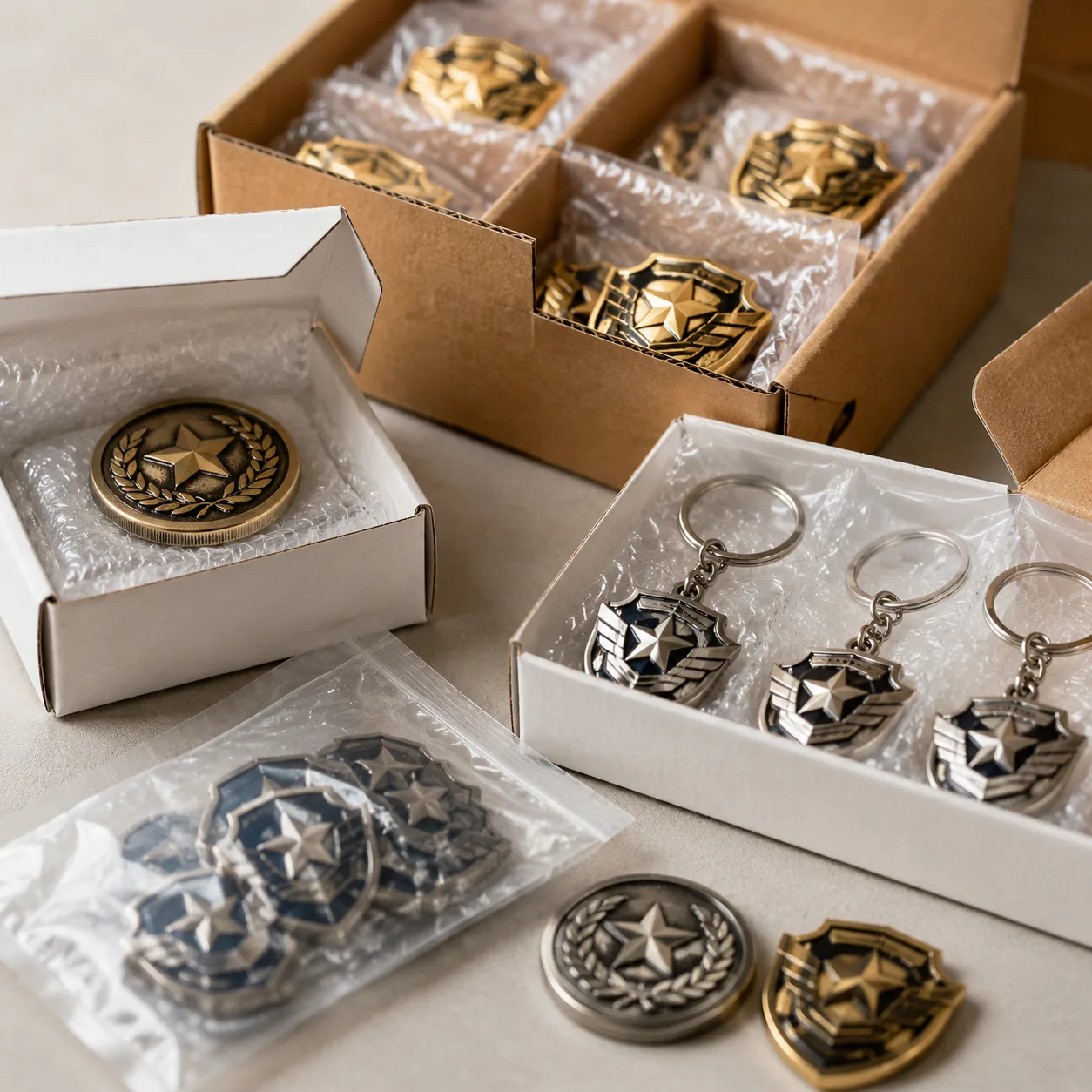
Specialty finishes should be treated as manufacturing operations, not decorative afterthoughts. Glow enamel, glitter enamel, transparent enamel, epoxy domes, antique washes, matte plating, sandblast texture, and dual plating change how a factory stamps, polishes, plates, fills, cures, inspects, and packs custom pins or challenge coins. A standard soft-enamel pin can hide minor variation in fill level. A transparent blue enamel over polished nickel will show trapped air, polishing scratches, uneven recess depth, and any plating tone shift beneath the enamel.
Most promotional pins and coins use zinc alloy, iron, brass, or stainless steel with soft enamel, hard enamel, offset print, screen print, or antique plating. Decorative plating is normally thin. Nickel underlayers are commonly 3-8 microns, while gold, silver, copper, black nickel, or rose-gold top flashes may be only 0.05-0.30 microns unless the RFQ calls for heavier plating. A quoted “gold finish” is usually decorative FOB merchandise plating, not jewelry-grade wear plating or a corrosion-rated outdoor coating.
Inspection also becomes stricter because defects are more visible. A normal commercial order may use AQL 2.5 for minor cosmetic defects, AQL 1.0 for major defects, and zero acceptance for critical defects such as sharp burrs, unsafe attachments, exposed rust, or wrong artwork. Specialty finishes increase the reject rate when dust, haze, bubbles, pigment streaks, glitter pooling, or antique-wash stains appear at 30-50 cm viewing distance. Use them when they support the buying reason: collector value, retail shelf impact, award presentation, brand differentiation, or low-light visibility. Avoid them on low-budget giveaways with dense artwork and a fixed event date.
Match the Finish to the Buying Goal
Choose the finish by defining the failure the buyer cannot accept. If the item must feel conservative and premium, a 50 mm antique brass coin at 3.5 mm thickness will usually outperform a glitter-filled design. If the item must sell on a concert merch table, glitter or glow enamel may create better first-look value. If the logo must match a strict Pantone standard, transparent enamel is risky because apparent color changes with enamel depth, base-metal reflectivity, plating shade, and viewing angle.
For coins handled often, recessed enamel with antique plating is usually more durable than a full epoxy dome. Epoxy is useful for photographic art, gradients, QR-style printed labels, and keychains, but it softens edges and can magnify print defects near the perimeter. On pins, domes protect printed surfaces from abrasion, but they can make small text look swollen. If text stroke width is below 1.0 mm or a scannable code is required, approve a flat printed sample before adding a 0.8-1.5 mm dome.
| Finish | Best use case | Avoid when | Practical MOQ tiers | Typical FOB add-on USD/pc |
|---|---|---|---|---|
| Glow enamel | Night events, youth programs, safety campaigns, Halloween pins | Strict daylight Pantone match or understated corporate awards | 300 trial; 500 standard; 1,000+ better pigment pricing | 0.10-0.35 |
| Glitter enamel | Fandom merch, festivals, seasonal retail, cosmetic-brand pins | Fine text, tiny enamel cells, muted brand palettes | 300 trial; 500 standard; 2,000+ stable batch cost | 0.08-0.30 |
| Transparent enamel | Depth over stamped relief, guilloche texture, waves, stained-glass effects | Dark plating, low-contrast art, visible polish marks under fill | 500 standard; 1,000+ preferred for color consistency | 0.10-0.40 |
| Epoxy dome | Printed keychains, magnets, photo badges, acrylic-look labels | Collector pins needing crisp metal borders or hard enamel feel | 300 standard; 500+ economical | 0.06-0.22 |
| Selective antique plating | Challenge coins, service awards, heritage badges, military-style pieces | Very shallow relief or bright retail artwork | 100-300 coins; 500+ pins or badges | 0.12-0.45 |
| Matte or sandblast texture | Premium coins, tactical styling, tone-on-tone logos | Dense copy, small isolated islands, rushed orders | 300 standard; 1,000+ for repeatable texture | 0.15-0.55 |
Write the RFQ as a Process Specification
A strong RFQ does not say “make the star sparkly” or “give it a premium translucent look.” It states where the effect appears, how it should be produced, how it will be inspected, and how much variation is acceptable. Include finished size in millimeters, thickness, base metal, plating color, enamel type, attachment, packaging, order quantity, target ship date, and Incoterm. For comparable pricing, ask all suppliers to quote the same basis, such as FOB Shenzhen, FOB Ningbo, or EXW factory. A low unit price may exclude inner packing, export handling, carton labels, or domestic freight.
Add measurable requirements for each effect. For soft enamel, state whether the fill should be recessed, near flush, or intentionally deep. A typical recessed soft-enamel fill sits 0.10-0.30 mm below raised metal. Hard enamel is filled high, baked, ground, and polished close to flush, but it is less suitable for glitter and some glow effects. For small enamel cells, allow fill-position tolerance around ±0.20 mm; for larger open fields, define acceptable waviness, pinholes, and color streaking.
For epoxy, specify dome height, edge condition, and cure requirement. A 25-40 mm pin or printed badge often uses a 0.8-1.2 mm dome; larger keychains or magnets may use 1.2-1.5 mm. Edge overflow, tackiness after cure, trapped lint, cloudy edges, and fisheyes should be listed as major defects. For plating, specify decorative thickness if it matters: for example, nickel underplate 5 microns minimum plus gold flash 0.10 micron minimum, or heavier gold plating by quotation if the item needs improved wear resistance.
Color control must be realistic. Opaque enamel can usually be matched visually to Pantone within normal commercial tolerance, but glow, glitter, transparent, antique, and rainbow finishes cannot be judged like flat print. Require approval under a named light source, such as D65 daylight LED at 5,000-6,500 K, and also under normal office light if the item is used indoors. For reorders, send a physical golden sample and require the factory to retain one approved sample for 12-24 months.
- Mark the exact artwork areas receiving glow, glitter, transparent fill, epoxy, antique wash, matte plating, or sandblast texture.
- Define enamel level, dome height, texture depth, plating tone, and inspection distance instead of using mood words.
- State whether natural variation is acceptable or whether the effect must match the approved sample unit by unit.
- Set defect limits for bubbles, dust, pinholes, haze, overflow, plating stains, exposed base metal, and uneven particles.
- Require approval lighting, front and back inspection, and angled photos for reflective or transparent finishes.
- Lock pigments, plating process, cure time, packing method, and retained golden sample for repeat orders.
Cost, MOQ, and Lead-Time Realities
Specialty finishes add cost through extra material, slower handling, and higher rejects. Glow and glitter usually keep the die-struck metal process unchanged, so the premium is modest unless the artwork has many small cells. Transparent enamel can be inexpensive on broad geometric areas but costly on relief-heavy coins because the metal underneath must be cleaner. Epoxy is low in raw material cost, but it adds dispensing, dust control, flat tray curing, and longer handling time. Sandblast, matte, selective antique, and dual plating add masking or post-plating labor, which increases both cost and schedule risk.
For a 25-40 mm soft-enamel pin order at 500-2,000 pieces, a standard FOB unit price may run about USD 0.55-1.40 depending on metal, size, plating, color count, attachment, backing card, and polybag. Specialty effects commonly add USD 0.06-0.55 per piece. Challenge coins vary more: a 45-50 mm zinc alloy or brass coin at 300-1,000 pieces may range from USD 1.60-4.80 FOB. Heavier brass, 3D relief, dual plating, cutouts, sequential numbering, epoxy, velvet boxes, or coin capsules can push the finished price above USD 5.00 per piece.
Lead time should be quoted from artwork approval or physical sample approval, not from the first inquiry. A normal custom pin often needs 5-7 calendar days for mold and sample, then 12-18 days for production after approval. Coins often need 7-10 days for sampling and 18-28 days for production, especially with 3D relief, reeded edges, or dual plating. Specialty finishes typically add 2-10 days. Add another 3-7 days if a second sample is required after a finish failure.
| Order condition | Typical MOQ | Sample lead time | Production lead time after approval | Planning note |
|---|---|---|---|---|
| Standard soft-enamel pin | 100-300 possible; 500 economical | 5-7 days | 12-18 days | Best for clean logos, tight budgets, and short schedules |
| Glow or glitter pin | 300 possible; 500-1,000 preferred | 6-9 days | 15-22 days | Request batch photos before packing |
| Transparent enamel pin or coin | 500 preferred | 7-10 days | 18-25 days | Requires clean polishing below the enamel |
| Printed item with epoxy dome | 300-500 preferred | 5-8 days | 14-21 days | Needs dust control and full cure before packing |
| Antique challenge coin | 100-300 possible; 500 economical | 7-10 days | 18-28 days | Relief depth matters more than color count |
| Dual plating or selective texture | 300-500 preferred | 8-12 days | 22-35 days | Masking and rework drive schedule risk |
Sample Checks That Prevent Rework
Treat the pre-production sample as a process audit. Do not approve it from one front-view photo. Ask for straight-on images, angled images, macro photos of the most difficult areas, back-side photos, edge photos, and a short video under consistent lighting. If the order is high value or the finish is new, approve a physical sample before mass production. The courier cost is small compared with rejecting 2,000 pins because transparent enamel looks muddy or epoxy captured lint.
Measure the item against the drawing. Small pins commonly hold overall size within ±0.20 mm, while larger coins may be closer to ±0.30 mm depending on diameter, thickness, and edge style. Check thickness and weight because a 50 mm coin quoted at 3.0 mm but delivered at 2.5 mm will feel cheaper even if the face artwork is correct. For lapel pins, verify post location, post strength, clutch fit, plating coverage on edges, and whether the pin sits flat without rocking.
Test the finish in the way the buyer will experience it. For glow enamel, charge the sample under strong light for a fixed period, then compare brightness after 1, 5, and 15 minutes in a dark room. For glitter, inspect whether particles are evenly distributed rather than pooled at one edge. For transparent enamel, look for trapped air, underfill, scratches, and dark shadows from the metal below. For epoxy, check after full cure; tackiness, fingerprints, oily surfaces, cloudy edges, or fisheyes indicate a process problem.
- Check size, thickness, weight, plating tone, attachment, and packing against the approved quote and drawing.
- Inspect under daylight LED and normal office light at 30-50 cm viewing distance.
- Confirm raised metal, recessed enamel, transparent areas, and printed text remain readable after the finish is applied.
- Reject obvious bubbles, lint, plating burns, edge overflow, uncured epoxy, exposed base metal, and bent posts.
- Run a light microfiber rub test on coins, plated edges, and domed printed surfaces.
- Approve a second sample only when the first failure is process-related, not because the buyer changed the artwork.
When to Skip the Specialty Finish
Skip specialty finishes when the artwork is already difficult. Dense copy, thin metal dividers, many tiny enamel cells, micro-icons, halftone print, and multiple close Pantone shades all reduce yield. Adding glitter, transparent color, glow powder, or epoxy on top of that complexity usually makes the product less precise, not more premium. A cleaner build with fewer colors, stronger relief, and better polishing often looks more expensive than a crowded design with three effects.
Urgency is another reason to simplify. A 200-piece rush order with glow enamel, matte black plating, custom backing cards, and a fixed event date leaves little time for sampling, curing, inspection, and correction. If the date cannot move, choose standard soft enamel or a printed epoxy item and spend the premium on faster freight, better packaging, or a cleaner backing card. For premium coins, upgrade diameter, thickness, edge style, antique contrast, or packaging before adding a risky surface treatment.
Avoid unstable effects when future reorders must match exactly and no physical standard exists. Transparent enamel depth, antique-wash darkness, glitter density, and rainbow plating vary by batch. They can be controlled within an agreed range, but they are not as repeatable as opaque enamel with a retained golden sample. If brand compliance is strict, prioritize stable plating, opaque enamel, documented Pantone references, and AQL inspection over experimental effects.
Buyer Approval Checklist
Use this checklist before releasing the purchase order. The purpose is to convert subjective finish preferences into written, inspectable requirements before the factory opens the mold, orders pigment, plates parts, or starts mass production.
- The vector artwork marks every specialty-finish area and separates it from standard enamel, metal, print, and plating.
- The quote states MOQ tier, unit price, mold charge, sample fee, packing method, Incoterm, FOB port, and validity period.
- The PO confirms lead time in calendar days after sample approval, not only after deposit payment.
- The approved sample is reviewed under the same lighting, distance, and angle used for production inspection.
- The inspection plan states AQL levels and defines major defects for bubbles, haze, overflow, plating loss, and uncured coating.
- The factory keeps a golden sample and records pigment, plating, cure, polishing, and packing requirements for reorders.
- The packaging prevents coating transfer, scratched domes, bent posts, coin edge abrasion, and moisture exposure in transit.
- The design has a fallback option if the specialty finish fails sampling or misses the event deadline.
What to Send the Factory Next
If the design is still flexible, request two quotes using the same size, base metal, plating, attachment, and packing: one standard build and one specialty-finish build. Ask for quantity tiers such as 300, 500, 1,000, and 2,500 pieces. Compare the real difference in unit cost, mold charge, sample timing, production lead time, reject risk, and freight timing. This prevents paying for an effect that adds manufacturing risk but little commercial value.
If the artwork is final, send a concise RFQ with vector artwork, dimensions, thickness, quantity tiers, target FOB port, requested sample date, packaging, AQL expectation, and finish specifications. Include one acceptable reference and one unacceptable reference if the appearance is hard to describe. A capable supplier can then flag small artwork areas that may fail, recommend cell-width changes or relief adjustments, and confirm whether glow, glitter, transparent enamel, epoxy, antique plating, matte plating, or texture fits the quantity, budget, and deadline.
Have a project? Send your artwork and target quantity and we’ll reply with a detailed quotation within 12 working hours.
Ready to get this made?
Send your sketch, target quantity and ship-date. Detailed quotation in 12 hours.



