When to Use Soft Enamel, Printed, or Die-Struck in 2026
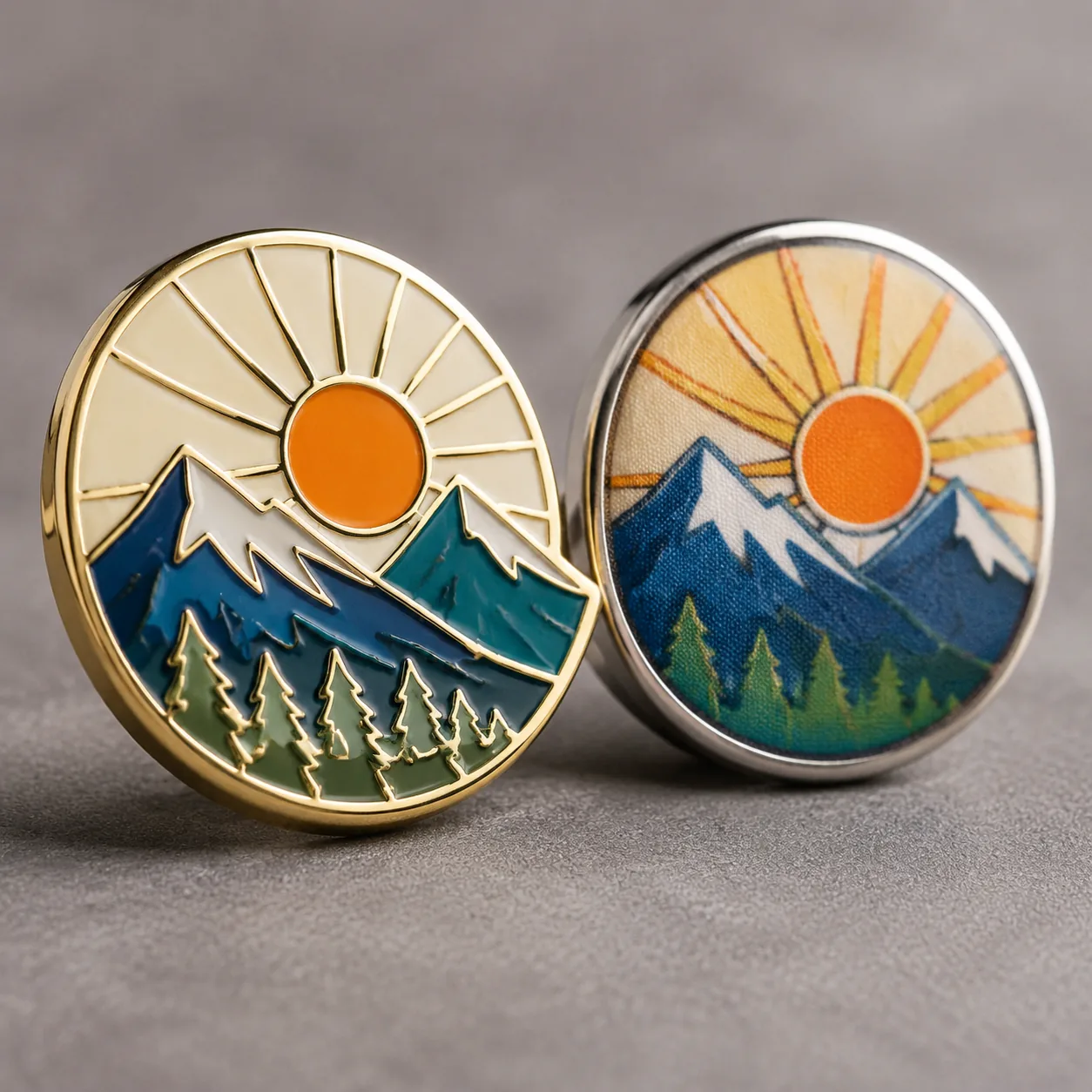
Start with the failure you cannot afford
Most bad metal-product orders are decided before sampling. The buyer selects a process for perceived prestige or unit price, then asks the factory to force artwork into a method that cannot repeat the required detail, color separation, or wear profile at production scale. A common failure case is a 28 mm lapel pin with six Pantone colors, 0.20 mm outlines, 0.9 mm legal text, and a fixed event date in 22 calendar days, specified as die-struck because stakeholders want a premium metal feel. In practice, that usually produces unreadable detail, weak contrast after plating, one or two tooling revisions, or a late conversion to printed metal after pre-production sample rejection.
The useful question in 2026 is not which method is best in general. It is which method creates the lowest combined risk for artwork density, tactile target, budget ceiling, use abuse, and inspection plan. For custom pins, badges, keychains, magnets, and challenge coins, the realistic shortlist is usually soft enamel, printed metal, or die-struck metal with no color fill. Make the decision in this sequence: smallest feature, color count, required surface feel, actual wear exposure, then inspection distance. Teams that follow that order usually cut redraw rounds, remake risk, and schedule drift faster than teams that start by debating brass versus zinc alloy.
1) Judge the artwork by the smallest reproducible feature
Overall size is a poor predictor of manufacturability. A clean 25 mm pin can be easier to make than a dense 50 mm badge. The first gate is the smallest feature the process can hold repeatedly across the full lot, not on one hand-finished sample. For soft enamel on stamped iron or brass, a safe internal metal line is typically 0.25-0.30 mm, but 0.30-0.35 mm is the better production target once quantities exceed 1,000 pcs. Practical minimum enclosed color areas are about 0.50 x 0.50 mm. Text below about 1.2 mm high often loses legibility after plating build, enamel flow, and polishing. If the artwork contains 0.20 mm outlines, isolated color dots, or stacked legal text, soft enamel becomes a high-risk choice even if a sample can be pushed through.
Printed metal holds finer graphic information because the color sits on the surface rather than being divided by raised metal walls. Screen printing can usually hold 0.18-0.20 mm positive linework on flat, stable blanks and is strongest for 1-4 spot colors with clean Pantone targets. Offset printing can often hold 0.15-0.18 mm lines and text around 0.8-1.0 mm high, making it better for maps, gradients, mascots, skin tones, and disclaimer text. UV digital printing is now common on low-MOQ programs, often from 50 pcs, and can reproduce dense art well, but lot-to-lot color consistency is usually weaker than controlled screen print unless the supplier is running calibrated RIP settings and documented color management.
Die-struck metal performs best when the design reads through relief, shadow, and plating contrast rather than flat color. For pins and badges, relief depth is commonly 0.25-0.45 mm. For challenge coins and medallions, 0.40-0.80 mm is more typical, with 0.50-0.60 mm a practical target for good visual separation and die life. The method becomes risky when adjacent raised areas are too fine, multiple relief levels must stay distinct inside a small diameter, or stakeholders still expect Pantone-accurate brand color. A die-struck sample may photograph well under directional light yet underperform in hand if the art relied on color blocks to stay readable.
| Decision factor | Soft enamel | Printed metal | Die-struck metal |
|---|---|---|---|
| Safe repeatable line width | 0.25-0.30 mm; target 0.30-0.35 mm for volume | 0.15-0.20 mm depending on screen, offset, or UV | 0.20-0.30 mm relief edge |
| Practical smallest text | About 1.2 mm high | About 0.8-1.0 mm high | About 1.0-1.2 mm high |
| Minimum isolated area | About 0.50 x 0.50 mm color cell | About 0.30 x 0.30 mm printed area | Not applicable |
| Typical surface profile | Recessed color, usually 0.05-0.12 mm below metal line | Flat print; optional 0.30-0.50 mm epoxy dome | Relief depth typically 0.25-0.80 mm |
| Most common approval failure | Tiny fills, underfill, overflow, unreadable text | Scratch, registration drift, dust under epoxy, color shift | Low contrast, shallow relief, over-polished high points |
2) Pick the process by what the buyer must feel and see
Soft enamel is still the best middle-ground option when you need branded color plus obvious metal structure. The raised metal lines create tactile separation and partially protect the recessed color fields from rubbing. Standard pin thickness is usually 1.2-1.5 mm, with 1.5 mm the safer choice for long narrow sections, sharp points, or retail sale. Keychains and magnets are more often 2.0-3.0 mm because extra body improves rigidity and perceived value. Soft enamel is a good fit for logos, flags, club crests, school insignia, simple mascots, and merch using roughly 1-8 spot colors. It is weak for photo effects, soft gradients, and any design where the digital artwork must be reproduced almost exactly.
Printed metal is the correct process when graphic fidelity outranks tactile structure. Screen print is strongest for bold spot-color graphics and can be very repeatable when the blank is flat and registration marks are stable. Offset print is stronger for full-color scenes and dense illustration. UV digital print is useful for test runs, personalized names, or highly variable artwork, but it should be treated as a decoration method first and a durability method second. A clear epoxy dome of about 0.30-0.50 mm adds gloss and better scratch resistance, but it also rounds the edge, can trap visible dust or bubbles if process control is weak, and may yellow after prolonged UV or dashboard exposure.
Die-struck metal is strongest when the message is prestige, weight, and metal texture rather than exact brand color. It is a good choice for institutional seals, anniversary emblems, donor recognition pieces, military-style insignia, and challenge coins in antique gold, antique silver, antique brass, or polished dual-finish combinations. Typical thickness is 1.5-2.0 mm for pins and 2.5-3.5 mm for coins, with 3.0 mm a common coin target for good hand feel without excessive cost. If internal reviewers will compare the piece directly against a digital brand guide, die-struck often creates approval friction because plating tone, antique wash, and lighting all become part of the final visual system.
3) Match the process to real abuse, not ideal use
Assume the item will be dropped, rubbed against keys, exposed to sweat or lotion, and packed tightly in export cartons. Soft enamel generally wears better than unprotected print because the metal ridges take first contact while the color sits recessed. Even so, enamel can chip under hard edge impact, especially on 1.0-1.2 mm thin builds, star shapes, or long unsupported points. For keychains, zipper pulls, and bag charms, moving from 1.2 mm to 2.0 mm thickness usually reduces bend and edge-damage complaints more than changing the plating from nickel to black nickel.
Printed products without epoxy create the most cosmetic complaints on high-contact items. They are suitable for event giveaways, display magnets, backing-card collector pins, and pieces that are mostly worn briefly or displayed. They are poor candidates for keychains or coin-like keepsakes handled daily. If printing must be used for a higher-contact application, specify one of three protections up front: epoxy dome, recessed print field, or conversion to soft enamel. Also require an adhesion test on the approved sample. A low FOB quote on printed metal can easily turn into sorting labor, claim deductions, or a remake if the print scratches in transit.
Die-struck products usually win on long-term wear because there is no filled color layer to crack or peel. For challenge coins and commemorative medallions, 2.5-3.5 mm thickness with relief around 0.50 mm and antique plating handles repeated handling well. The main risk is cosmetic, not structural: polished mirror fields show hairline scratches quickly, while matte, sandblasted, or antique finishes hide them better. If the item will live in an acrylic capsule or presentation box, polished fields may be acceptable. If it will be passed hand to hand, antique or brushed surfaces are safer.
4) Compare total cost by MOQ, tooling, and correction time
Soft enamel is often the lowest-risk total-cost option even when it is not the lowest first quote. For a standard 30 mm custom pin at 300 pcs with butterfly clutch, 1.2-1.5 mm thickness, and individual polybag, typical 2026 FOB pricing is about USD 0.50-0.85 in stamped iron and USD 0.72-1.08 in zinc alloy if the shape needs cast contours, deep cutouts, or heavier sculpting. Printed metal at the same size typically lands around USD 0.40-0.72 without epoxy and USD 0.52-0.88 with epoxy. Die-struck at 30 mm is commonly USD 0.58-0.98 in iron or brass depending on relief complexity, finish, and back attachment.
Tooling and correction cost matter almost as much as unit FOB. A simple stamped die commonly runs USD 60-120. A more complex zinc alloy mold is often USD 120-220. Larger multi-level coin dies can run USD 180-350 depending on diameter and relief. Printed items may have little or no hard tooling cost, but they still generate expensive corrections if registration, dust under epoxy, or Pantone mismatch triggers rejection. Standard production after artwork approval is often 10-14 calendar days for soft enamel, 7-12 days for printed metal, and 10-15 days for die-struck. Pre-production samples usually add 3-5 days. Tool or mold revisions normally add another 2-4 days, and courier transit can consume 3-7 days each direction if physical approvals are required.
| 30 mm pin pricing guide | 100 pcs | 300 pcs | 1,000 pcs |
|---|---|---|---|
| Soft enamel FOB USD | 0.62-1.02 | 0.50-0.85 | 0.38-0.68 |
| Printed metal FOB USD | 0.48-0.90 | 0.40-0.72 | 0.32-0.58 |
| Printed + epoxy FOB USD | 0.60-1.05 | 0.52-0.88 | 0.42-0.70 |
| Die-struck FOB USD | 0.70-1.15 | 0.58-0.98 | 0.46-0.78 |
| Common MOQ | 100 pcs | 100 pcs | 100 pcs |
| Typical tooling | USD 0-220 | USD 0-220 | USD 0-220 |
At higher volumes, pricing compresses quickly but not evenly. Many standard 30 mm pins at 100 pcs cost 15-25 percent more per unit than at 300 pcs, while 1,000 pcs may be 20-35 percent lower than 300 pcs depending on color count, plating, and packaging. That is why quote requests should always ask for side-by-side tiers at 100, 300, and 1,000 pcs. The spread shows whether the job is mainly tooling-driven, labor-driven, or defect-risk driven.
5) Write a QC spec that fits the process
Each method fails differently, so generic metal-goods inspection language is not enough. For soft enamel, the main watchpoints are underfill, overflow onto metal lines, pinholes, trapped contamination in color wells, plating pits, rough deburring, and attachment misalignment. A practical cosmetic standard is that enamel sink below the metal line should appear visually uniform and generally not exceed about 0.10-0.15 mm on standard promotional grade unless the golden sample allows more. For printed items, focus on registration offset, color drift from approved artwork, print scratches, dust under epoxy, edge lift near cut lines, and bare spots on high points. For die-struck, inspect relief consistency, weak high points, die-polish drag marks, plating tone variation, and incomplete antique wash removal from recessed areas.
AQL 2.5 for major defects and 4.0 for minor defects is common for promotional metal products, but it only works if defect definitions are written with examples. Front-face cosmetics should be stricter than side or back cosmetics. Inspection distance must also be stated. A workable standard is 30 cm under normal indoor light, about 500-1,000 lux, for front-face appearance. For premium collector runs, many buyers keep the same AQL but classify front-face scratches, plating pits, unreadable text, or weak relief as major defects rather than writing zero-defect language the factory cannot apply consistently.
Plating and dimensional limits should be explicit. Decorative nickel, black nickel, imitation gold, and silver-tone finishes on promotional metal goods are commonly controlled around 0.03-0.08 microns. That is adequate for appearance, not for heavy corrosion resistance. If the item will face sweat, outdoor display, or repeated abrasion, specify the use environment separately because thicker plating, e-coat, or lacquer changes cost and lead time. For dimensions, a stamped 30 mm item can often hold overall size within +/-0.15 mm; cast zinc alloy is more commonly around +/-0.20 mm depending on geometry. Pin post placement is often held within +/-0.30 mm from drawing centerline unless the design needs tighter backing-card alignment.
- Define inspection distance: 30 cm in 500-1,000 lux indoor light for front-face cosmetics.
- Separate front, side, and back cosmetic standards; do not inspect all surfaces to one grade.
- Approve one golden sample that includes plating, attachment, and final packaging together.
- For printed items, require tape or cross-hatch adhesion results on the approved sample.
- For soft enamel, state acceptable underfill sink and whether pinholes under 0.20 mm are rejectable.
- For die-struck, specify target relief depth and tolerance, commonly +/-0.05 to 0.10 mm depending on size.
- Confirm AQL by defect class, such as Major 2.5 and Minor 4.0, with written examples and photos if possible.
6) Choose base metal after process, not before
Material should follow process. Stamped iron is usually the most cost-efficient choice for soft enamel pins in the 20-40 mm range with clean outlines and limited undercuts. Brass costs more but is often preferred for crisp die-struck detail, cleaner polishing, and a more refined feel on badges and coins. Zinc alloy is not automatically more premium; it is useful when the part needs deep cutouts, irregular contours, thicker sections, or 3D cast geometry that stamping cannot produce efficiently.
For printed products, the print system matters more than the substrate for the front-face visual result. Aluminum, stainless steel, brass, iron, and zinc alloy are all used depending on weight target, rigidity, cost, and shape. Aluminum is useful when a lighter badge or magnet is needed, but it does not give the same edge character as stamped brass or iron. For die-struck products, brass and iron remain the common choices for stamped relief, while zinc alloy is more often selected when the buyer wants a cast perimeter, bottle-opener function, or a sculpted 3D form.
Material also changes edge quality and tolerance. A 30 mm stamped iron pin can typically hold size within about +/-0.15 mm with a sharper perimeter after deburring. Cast zinc alloy often lands closer to +/-0.20 mm and has a slightly softer edge feel, especially on organic shapes. If a program includes a matching pin, keychain, and coin, define what must match visually such as plating tone, logo proportion, backing-card position, and silhouette rather than assuming every process will produce identical edges and reflectivity.
7) When one design should become two or three SKUs
One of the highest-value decisions is to stop forcing one process across every channel. The same core artwork can become a soft enamel employee pin, a printed giveaway badge, and a die-struck executive coin. That split often lowers total risk because each SKU is matched to its real use. Marketing gets graphic fidelity where dense artwork matters, procurement gets lower cost on event quantities, and leadership gets a premium object with better tactile value and wear resistance.
This works best when one supplier, or one tightly managed vendor group, handles redraws, plating references, dimensions, and packing standards across all variants. That reduces outline drift, mismatched gold tones, and packaging inconsistencies. The buyer still needs to define what is non-negotiable by SKU: exact Pantone match, minimum text size, relief depth, attachment type, packaging, abuse expectation, and target inspection standard. Once those points are fixed, the factory can recommend the right process split before sampling instead of after a failed first article.
Before requesting quotes, send a one-page manufacturing brief rather than artwork alone. Include product type, target size in mm, smallest readable detail, number of colors, expected abuse level, target FOB, and required in-hands date. Then request three comparable options: soft enamel, printed with or without epoxy, and die-struck if the art allows it. Ask for MOQ tiers at 100, 300, and 1,000 pcs; tooling charge; unit FOB; thickness; plating spec in microns; attachment; production lead time in calendar days; and recommended AQL plan. That format exposes trade-offs early and prevents more respecs than any late-stage inspection can catch.
Have a project? Send your artwork and target quantity and we’ll reply with a detailed quotation within 12 working hours.
Ready to get this made?
Send your sketch, target quantity and ship-date. Detailed quotation in 12 hours.



