When to Respec a Custom Metal Promo Order Before It Fails
Why approved samples still fail in bulk production
Most preventable claims in custom metal promotional products do not start with supplier bad faith. They start when artwork approval and a hand-finished pre-production sample create false confidence, while the production specification still leaves too much freedom on thickness, plating build, enamel depth, hardware gauge, packaging, and acceptance criteria. The factory then produces to the written standard, not to the buyer’s unstated expectation.
That gap is common on enamel pins, die-struck badges, challenge coins, medallions, magnets, and keychains because small dimensional changes materially affect appearance, strength, and packout. Reducing a stamped iron pin from 1.5 mm to 1.2 mm lowers metal mass by roughly 18% to 22%, makes posts easier to bend during packing, and increases the chance of edge waviness after polishing. Moving a pin post by 0.5 mm on a 45 mm badge can increase rotation on fabric. Shipping a mirror-polished coin without face protection can turn an approved sample into a bulk lot with visible hairline abrasion after 28 to 40 days of ocean transit, deconsolidation, and final-mile handling.
The practical buying skill is knowing when to stop and respec before tooling release, plating, color fill, epoxy, or final assembly make correction expensive. If the likely failure will be costly to sort after plating, impossible to repair after epoxy, or likely to trigger returns after delivery, respec immediately. Stable programs are not won by the prettiest rendering. They are won by converting risk into measurable production limits before the first production lot starts.
1. Identify the real failure mode before changing the spec
Start by classifying the risk correctly. Cosmetic failures include plating haze, pits, burn marks, exposed base metal, underfilled enamel, color bleed, offset print blur, epoxy bubbles, and visible finish mismatch between the body and hardware. Functional failures include bent posts, weak butterfly clutches, loose tack welds, open jump rings, split rings that spread in use, magnets that slide, and brooches that rotate because the attachment layout is wrong. Logistics failures include face scratching, mixed-SKU labels, warped backing cards, crushed gift boxes, moisture damage, and master cartons that exceed safe handling weight.
Each category is controlled differently. Cosmetic failures usually need tighter appearance standards, line-width limits, color references, and lighting conditions for inspection. Functional failures usually need a build change: thicker base metal, wider post spacing, larger post diameter, heavier ring wire, stronger weld penetration, higher magnet grade, or more bonding area. Logistics failures are often solved faster with packout changes such as PET protective film, tissue separators, cavity trays, desiccant, thicker OPP bags, inner-pack limits, and carton gross-weight limits rather than with a full product redesign.
- If the item is handled daily, prioritize attachment strength, hardware closure, and anti-rotation performance before front-face perfection.
- If the item is retail, licensed, museum, or VIP merchandise, tighten front-face appearance, define inspection distance and light level, and inspect by SKU.
- If sea transit exceeds 25 days, specify face protection, desiccant, inner-pack counts, and a master carton gross weight cap of 10 to 12 kg.
- If the proposed fix depends on heavy hand-sorting or touch-up, assume the build is unstable and correct the root cause.
- If one defect can create a safety issue, chargeback, or event failure, classify it as critical and set acceptance at zero.
2. Replace vague wording with measurable production limits
Terms such as standard plating, normal color fill, export packing, and factory standard attachment are acceptable only at RFQ stage. They are unsafe once a purchase order is released. A QC-driven respec turns those phrases into values that can be verified at first-off, in-line inspection, and final inspection.
For a 30 mm soft enamel iron pin, a production-safe spec is concrete: stamped iron, finished size 30.0 mm ±0.20 mm, body thickness 1.5 mm ±0.10 mm before plating, raised metal line width not less than 0.25 mm, soft enamel recess 0.08 to 0.15 mm below metal lines, front polish uniform, post diameter 0.9 to 1.1 mm, post location tolerance ±0.50 mm, clutch fit secure, no exposed base metal visible at 30 cm under 800 to 1000 lux neutral white light, critical defects 0, major AQL 2.5, minor AQL 4.0.
For a 50 mm zinc alloy die-cast coin, use the same logic: finished diameter 50.0 mm ±0.25 mm, thickness 3.0 mm ±0.15 mm, relief depth 0.4 to 0.8 mm, edge style explicitly defined as rope, spur, or flat, antique finish matched to a retained golden sample, burr height not above 0.05 mm on touch points, and individual polybag plus tissue or 0.03 to 0.05 mm PE face separator. If plating performance matters, specify a nickel undercoat of 3 to 5 microns and decorative top coat in the approximate 0.03 to 0.10 micron range where the supplier can declare and control that process. If they cannot declare it, specify the visible outcome instead: no blistering, peeling, black spots, or bare base metal at inspection distance.
| Spec area | Unsafe wording | QC-driven respec example |
|---|---|---|
| Plating | Gold finish | Specify shiny gold, imitation gold, nickel, black nickel, antique brass, or antique copper; nickel underplate 3-5 microns where declared; no blistering, burn marks, peeling, or exposed base metal visible at 30 cm |
| Enamel fill | Soft enamel | Recess 0.08-0.15 mm below metal lines; no front-face void over 0.30 mm; no color bleed across borders; primary brand colors matched to approved PMS reference within agreed visual tolerance |
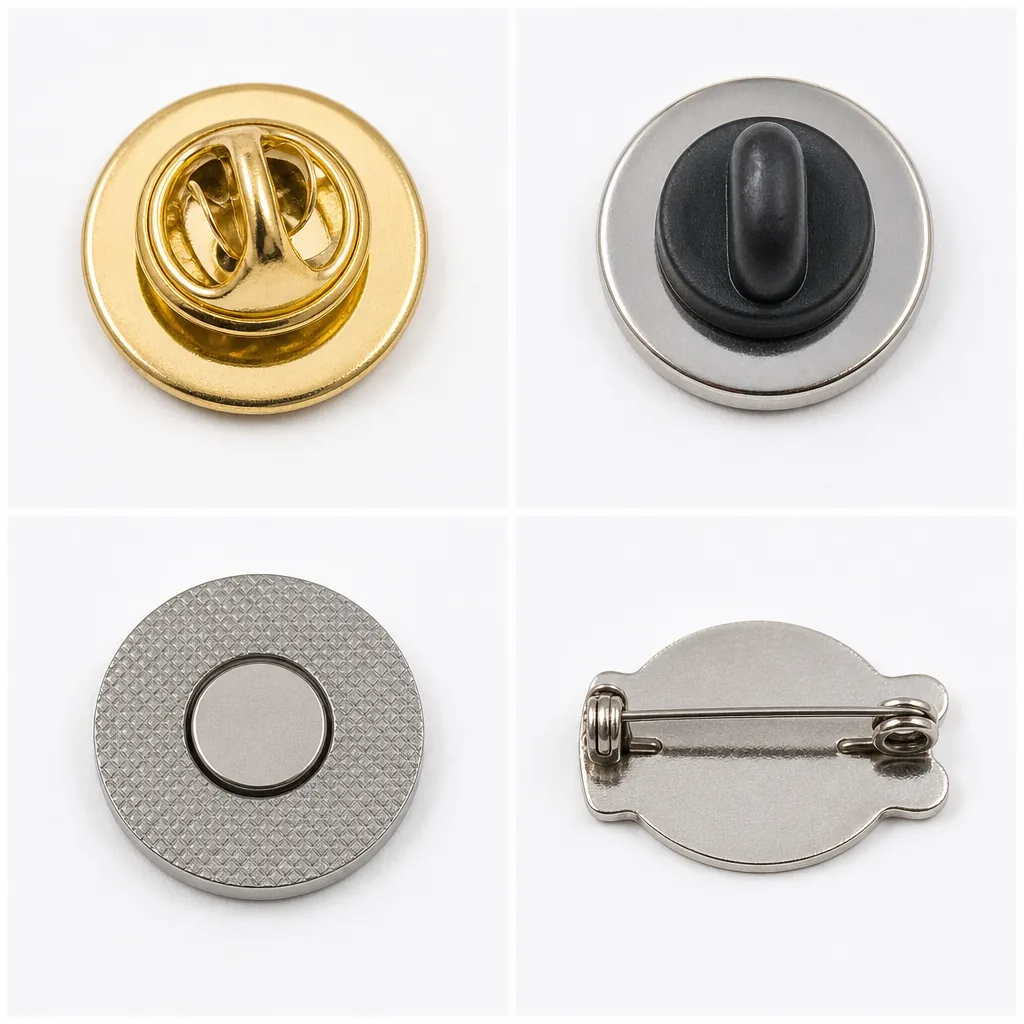
| Attachment | Standard clutch | Single post only for pieces under 25 mm; use 2 posts for items 45 mm or wider or aspect ratio above 1.8:1; post diameter 0.9-1.1 mm; secure fit after three attach-remove cycles |
| Keychain hardware | Strong ring | Jump ring wire 1.8-2.2 mm for standard 45-55 mm keychains; use fully closed or welded jump ring for daily-carry items; split ring 25-30 mm OD with consistent spring temper |
| Packing | 1 pc per bag | 1 pc per OPP bag, tissue or PET film on polished face, 50 pcs per inner pack, desiccant for sea shipment, master carton under 12 kg gross, carton suitable for 76 cm drop testing |
| Inspection | Normal QC | Critical defects 0; AQL 2.5 major / 4.0 minor for standard programs; tighten to AQL 1.5 major for retail, licensed, or audited programs |
| Magnet | Strong magnet | N35-N42 grade magnet sized to product mass; adhesive coverage at least 80% of pad area; no slide for 24 hours on clean painted steel in vertical hold test |
3. Know when tightening tolerance will not solve the problem
Some failures cannot be fixed by telling the factory to be more careful. The issue is not operator attention. It is a mismatch between artwork, process, and geometry. Buyers lose time when they demand an unrealistic cosmetic standard from the wrong construction.
Fine lines are the classic example. If artwork contains recessed channels below about 0.20 to 0.25 mm, die-struck soft enamel often fills inconsistently and adjacent borders can merge after polishing and plating. The correct respec is to thicken the line, simplify detail, enlarge the finished size, or move to offset print with epoxy dome. Likewise, a 50 mm brooch with a single center post may pass sample review and still rotate in use. No extra inspection will fix that. The correct change is wider post spacing, a second post, or a bar-pin assembly.
Mirror-polished raised surfaces on coins and keychains are another common trap. A pre-production sample finished by a senior polisher may look excellent, but the same design packed at full-line speed in shared bags will pick up micro-scratches even when plating quality is acceptable. The better respec may be recessed-face architecture, satin texture on high-contact zones, PET face film, tissue separation, or individual sleeves. When a supplier says the design is possible but yield will be low, that usually means the design is unstable at production speed and will cost time, scrap, or claims.
Typical build-change triggers include iron pins below 1.2 mm that bend in handling, zinc alloy castings with deep blind cavities that trap plating chemistry, magnet backs with less than 60% flat bonding area, epoxy domes placed over abrupt relief transitions, and chain assemblies where the hardware grade looks visibly lighter than the medallion body. In those cases, changing the build before tooling release is usually cheaper than sorting defects afterward.
4. Check tolerance stack at assembly level, not only part level
A custom metal promo item is rarely a single part. It is a metal body plus plating, enamel or print, posts or welded hardware, jump rings, split rings, chains, magnets, adhesive pads, backing cards, inserts, and bags. Each component can pass its own tolerance while the assembled item still fails in use. That is a tolerance-stack problem, and it is a strong signal that the order needs respecing before mass production.
Take a 50 mm souvenir keychain packed in a box with a foam insert. The medallion thickness may be within ±0.15 mm, the jump ring may meet wire tolerance, and the split ring may be nominal, yet the total assembled hang length can still exceed the insert cavity by 3 to 5 mm and force the piece against the box wall. All parts pass; the delivered product still rubs and scratches. Magnets fail the same way: total product weight may be acceptable, but if the back recess reduces contact area or the EVA pad shifts by 1 mm, the item can slide down a vertical steel surface even though each subcomponent passed incoming inspection.
The better correction is to specify assembly-level checks instead of relying only on part checks. Define total assembled length, total weight, cavity fit, backing-card hole alignment, pull resistance, no-rotation performance on fabric, and no-slide performance on steel. For a 45 mm double-post pin, require no visible rotation on medium-weight fabric after three attach-remove cycles. For a coin in a gift box, require full cavity fit with lid closure and no movement that causes edge rub during a 10-drop shipper test from 76 cm. For a magnet, require 24-hour vertical hold on painted steel at 23°C with no movement greater than 2 mm.
5. Match inspection intensity to the commercial risk
A 300-piece internal recognition pin and a 30,000-piece retail launch do not need the same control plan. The right question is where inspection effort removes the most commercial risk at the lowest added cost.
For repeat orders with stable specifications, a practical control plan is artwork signoff, pre-production sample approval, in-line checks on plating, fill, and attachment, and final inspection at AQL 2.5 major and 4.0 minor. For first runs, licensed merchandise, children-adjacent items, event-date-critical launches, and high-mix sets, add more gates: plating confirmation against a retained golden sample, first-off production photos, assembly-level function checks, packaging verification by SKU, and pre-shipment inspection by SKU rather than by total cartons only.
Use the defect hierarchy consistently. Critical defects should always be zero acceptance and include sharp hazardous burrs, missing attachments, wrong logo or text, wrong SKU labeling, detached magnets where safety matters, or plating flakes that leave unsafe edges. Major defects include broken hardware, severe plating damage, obvious color mismatch, missing enamel, front-face epoxy defects, or attachment weakness that affects use. Minor defects include slight antique variation, small backside marks, or bag wrinkles that do not affect saleability.
- Use `AQL 2.5 major / 4.0 minor` as a common baseline for standard commercial orders above roughly 1,000 pcs.
- Tighten to `AQL 1.5 major` for retail, licensed, museum-store, subscription-box, and premium gifting programs.
- Keep critical defects at zero acceptance regardless of volume, urgency, or price point.
- Inspect high-mix programs by SKU, backing-card version, and pack configuration, not only by total quantity.
- Retain one approved golden sample for plating tone, antique depth, print sharpness, hardware style, and packout reference.
6. Compare respec cost with the cost of failure
Buyers often resist respecing because the unit cost may rise by only a few cents. That concern is real, but it needs to be compared with the actual cost of failure: rework labor, scrap, missed vessel cutoff, replacement air freight, relabeling, retailer chargebacks, marketplace penalties, and missed event dates. In practice, many of the strongest respec decisions add only USD 0.03 to USD 0.20 per piece while preventing claims that cost several times more.
Typical FOB China ranges help anchor the decision. A 30 mm iron soft enamel pin at 3,000 pcs is commonly around USD 0.28 to USD 0.55 FOB, depending on plating, color count, and pack method; increasing body thickness from 1.2 mm to 1.5 mm often adds about USD 0.02 to USD 0.05 per piece. At 500 pcs, the same pin may land closer to USD 0.55 to USD 0.95 because tooling and setup are spread over fewer units. A 50 mm zinc alloy keychain at 2,000 pcs often runs USD 0.75 to USD 1.40 FOB; upgrading from a light open jump ring to a heavier closed or welded ring usually adds USD 0.03 to USD 0.08. A 45 to 50 mm challenge coin at 1,000 pcs often lands around USD 0.90 to USD 1.80 FOB, and PET face film, tissue separators, or individual sleeves typically add USD 0.02 to USD 0.06 while sharply reducing scratch claims.
Lead time needs the same discipline. Typical die or mold setup is 5 to 10 calendar days, pre-production sample approval 3 to 7 days after tooling, and mass production 12 to 20 days for standard runs of roughly 1,000 to 10,000 pcs. Ocean transit is often 25 to 40 days depending on lane and season. Rework, repacking, or partial remake can easily add 7 to 21 days. A one-day respec decision before tooling release is usually much cheaper than losing two weeks after a failed first lot.
MOQ also changes the economics. On 100 to 300 pcs, some structural upgrades are proportionally expensive, so the better move may be simplifying artwork, enlarging fine details, or upgrading packout instead of changing the whole build. On 1,000 to 5,000 pcs, thicker bodies, stronger hardware, and SKU-specific controls usually pay back quickly. On 10,000 pcs and above, even USD 0.02 per piece in avoidable defect cost becomes meaningful enough to justify tighter specs, retained golden samples, and earlier inspection gates.
7. Use a practical respec sequence before PO release
If an order feels under-specified, do not rewrite the entire quotation. Start with the three highest-risk failure modes and convert each into one measurable rule. Then ask the supplier a direct production question: can the current tooling, process, and build meet this rule consistently at normal line speed, or does the construction need to change before release?
A workable sequence is straightforward. Confirm end use first: giveaway, daily carry, event handout, resale, or premium gifting. Rank cosmetic, functional, and logistics risk. Review the quotation for unsafe phrases such as standard plating, standard attachment, and export packing. Tighten only the specifications that influence claim cost. Approve one retained appearance sample, and add one simple functional test whenever the product includes magnets, chains, polished faces, moving parts, or mixed assemblies.
For buyers managing multiple SKUs, the fastest improvement is usually a one-page control sheet per item listing material, finished size, thickness, plating, minimum line width, color count, hardware type, pack method, defect definitions, AQL level, MOQ tier, target FOB range, and assembly-level checks. That sheet usually stabilizes a program better than artwork approval alone because it defines what must be repeatable in bulk, not just what looked good once on a sample bench.
Respec before failure when the quotation still leaves too much process freedom, when the build is fighting the design, when part tolerances do not guarantee assembled performance, or when the hidden cost of a claim exceeds the visible cost of a stronger specification. That is the point where a buyer stops purchasing a decorative object and starts controlling a manufacturable product.
Have a project? Send your artwork and target quantity and we’ll reply with a detailed quotation within 12 working hours.
Ready to get this made?
Send your sketch, target quantity and ship-date. Detailed quotation in 12 hours.



