When to Respec a Custom Metal Promo Order Before It Fails
A good sample can still be a bad production spec
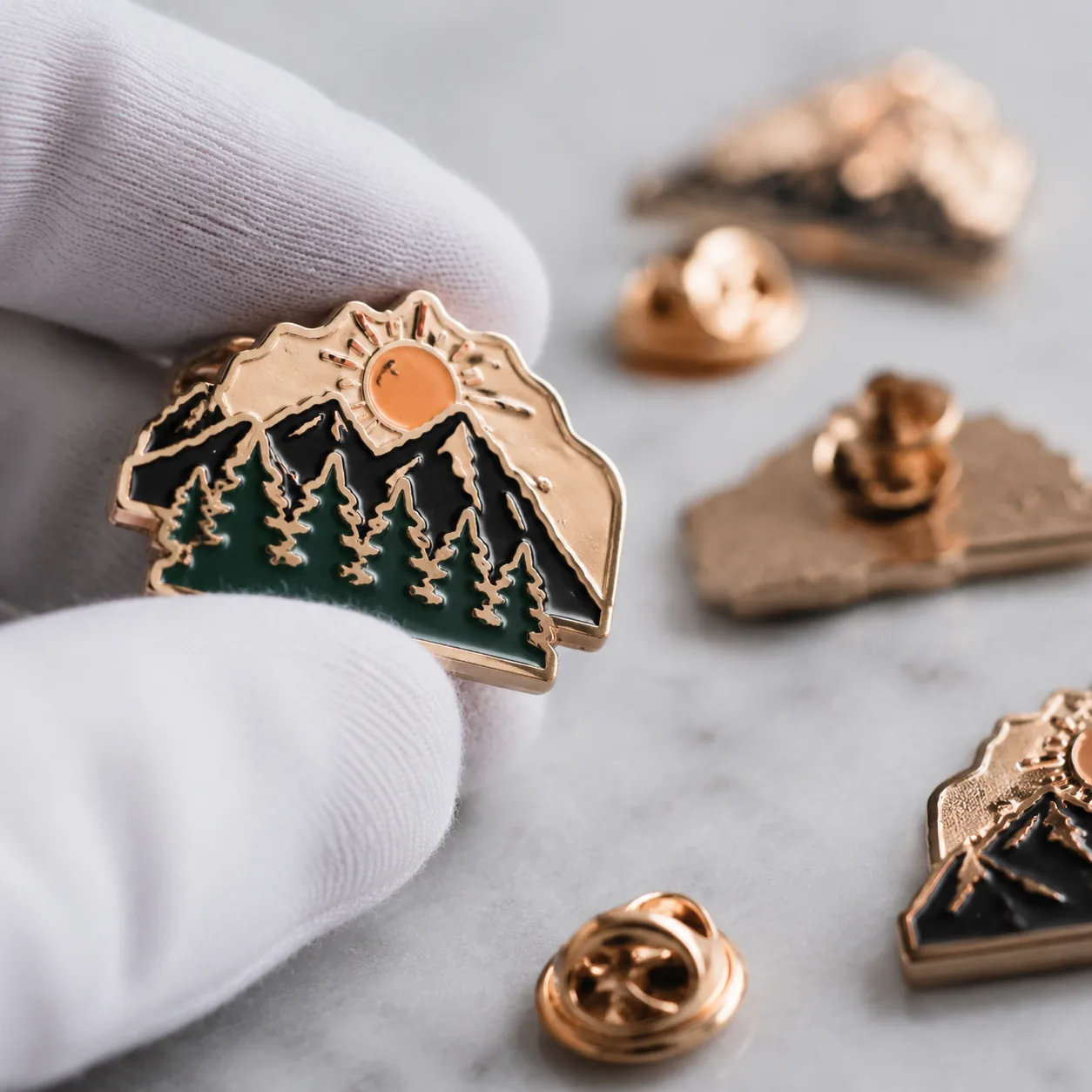
In custom metal promo, the most dangerous sample is often the one that looks fine on one table, under one light source, handled by one careful operator, but cannot be repeated across 500, 3,000, or 10,000 units at normal line speed. That is where bulk failures come from: soft enamel underfill, plating haze on bright fields, mixed hardware orientation, burrs around cutouts, loose jump rings, and pins that rotate once they are actually worn.
When that gap shows up in mass production, the issue is no longer artwork approval. It becomes a timing and claim problem. A remake typically adds 7 to 15 production days. Replacement air freight can add another 3 to 7 days and materially increase landed cost. If the order supports an event, launch, museum store delivery, or distributor ship window, a technically acceptable but low-margin spec can be more expensive than a cleaner build released two days later.
This risk is common on 25 to 45 mm soft enamel pins, 38 to 55 mm coins, zinc alloy keychains with cutouts or moving parts, and mixed-SKU gift sets sharing one design across different production lines. Typical warning signs include raised lines below 0.25 mm, enamel cells below 0.35 mm, soft-enamel recess depth below 0.35 mm, one post on a long pin body, unsupported bridges around cutouts below 1.0 mm, and mirror plating over textured or uneven relief. None guarantees failure, but each reduces process margin.
1. Start with process capability, not artwork intent
Geometry drives most downstream quality outcomes. For stamped iron or brass pins and badges, raised metal line width and enamel cell opening are the first screening points. As a practical production baseline, raised lines should stay at 0.25 to 0.30 mm minimum. If the art includes sharp corners, tiny counters, serif text, or intersecting borders, 0.30 mm is safer. Enamel openings should generally be at least 0.35 mm, with 0.40 mm preferred on small logos that still need clean color separation after polishing and plating.
Soft-enamel recess depth is another common failure point. A recess depth of 0.35 to 0.45 mm is usually more stable than 0.25 to 0.30 mm because it gives the fill station more volume, reduces edge starvation, and leaves more polishing margin on raised metal. When the recess is too shallow, typical defects are low corners, edge wash, pinholes, and uneven gloss after cure. Hard enamel or imitation hard enamel can deliver flatter surfaces, but the cells still need enough width and metal support to survive polishing without collapsing fine detail.
For die-cast zinc alloy, the tradeoff shifts. Casting handles openwork, 3D relief, bottle-opener forms, spinner parts, and hollow sections better than stamping, but tolerances are looser and surface texture is less controlled. A realistic dimensional tolerance is often plus or minus 0.15 mm for small stamped parts, plus or minus 0.20 mm for small cast parts, and plus or minus 0.25 mm for irregular openwork keychains above 50 mm. Bridges around cutouts should be at least 1.0 mm, while 1.2 to 1.5 mm is a better target for daily-carry items.
Coins need the same discipline. On two-sided bright plated coins, relief depth under about 0.40 mm often reads flat after polishing, especially on artwork with broad fields and shallow transitions. A more stable target is 0.50 to 0.80 mm relief, with clear level separation between foreground and background. If the art only works when tooling stays exceptionally sharp and polishing preserves hairline borders, it is not production-safe yet.
- Raise stamped metal lines below 0.25 mm to at least 0.25 to 0.30 mm
- Widen enamel cells below 0.35 mm, especially sharp tips and enclosed counters
- Move soft-enamel recess depth toward 0.35 to 0.45 mm where underfill is likely
- Increase unsupported bridges around cutouts to at least 1.0 mm, preferably 1.2 mm or more on larger zinc alloy parts
- Change pins above about 35 mm from one post to two posts with wider spacing
- Replace mirror-polish backgrounds on uneven art with matte, sandblast, frosted, or antique fields
2. Separate build problems from inspection problems
Inspection matters, but it cannot rescue a weak build. The useful split is simple: some defects can be screened within tolerance, while others are built into the product. If the issue affects attachment security, readability at normal viewing distance, edge safety, plating durability in use, or assembly alignment, change the build first and adjust inspection second.
Pins are the clearest example. A 30 mm brass pin at 1.2 mm thickness with one butterfly clutch can pass visual approval and still rotate on a shirt placket or tote strap. Two posts spaced roughly 18 to 22 mm apart on a 30 to 40 mm pin usually solve more field complaints than lowering final visual AQL from 2.5 to 1.5. For pieces above about 8 to 10 g, upgrading from standard butterfly clutches to rubber clutches or locking clutches usually adds only USD 0.03 to 0.08 FOB per unit, but it materially improves wear performance.
The same logic applies to keychains. A 45 mm zinc alloy keychain weighing 20 to 30 g should not rely on a light decorative ring. A split ring wire diameter of 1.8 to 2.0 mm, plus a fully closed jump ring with no visible gap over 0.10 mm, is a stronger control than occasional pull testing after packing. If a spinner, dangler, or bottle-opener feature is central to the design, the hardware spec should include ring gauge, hinge pin diameter, and a simple functional test count, such as 20 open-close cycles without deformation.
| Risk trigger | Better response | Typical spec change | Why it works |
|---|---|---|---|
| Pin rotates on garment | Respec build | Change from one post to two posts; target 18-22 mm post spacing on 30-40 mm pins | Improves stability in actual wear instead of relying on tighter visual inspection |
| Enamel edge looks thin or patchy | Respec geometry | Increase recess depth to 0.35-0.45 mm and widen narrow cells | Adds fill volume and polishing margin, reducing underfill and color washout |
| Mirror finish shows haze, pits, or waves | Respec finish | Change non-logo fields to matte, antique, or sandblast texture | Makes polishing variation less visible and improves yield consistency |
| Keychain hardware opens under load | Respec hardware | Use 1.8-2.0 mm split ring and require a fully closed jump ring | Addresses the mechanical failure mode directly |
| Coin rim feels sharp in hand | Respec edge detail | Add chamfer or increase edge radius in die design | Reduces handling complaints and safety risk |
| Minor Pantone shade drift | Tighten approval standard | Approve a color chip or sealed sample with tolerance note | Usually manageable through sample control rather than rebuild |
| Backing card shifts 2-3 mm | Tighten packing QC | Add a placement jig and set card tolerance at plus or minus 1.5 mm | Packaging issue usually does not justify a product redesign |
3. Match metal, plating, and finish to real end use
Many respec decisions are actually end-use corrections. Iron is cost-efficient for basic stamped pins, but brass generally holds finer die-struck detail, cleaner edges, and more stable polish on small logos or text. Zinc alloy is the right base for 3D relief, wide cutouts, spinner assemblies, and bottle-opener shapes, but buyers should expect more visible casting texture, more cleanup at parting lines, and slightly looser dimensions than on a flat stamped badge.
Finish choice matters as much as base metal. Bright gold, nickel, and black nickel plating look strong on flat, clean raised areas, but they also reveal pits, die marks, polish waves, and slight surface sinks. Antique brass, antique silver, matte nickel, bead-blast, and dual-finish combinations are more forgiving and are often a better fit for challenge coins, commemorative badges, and daily-use keychains. If the artwork depends on a perfect mirror background to look premium, the spec probably does not have enough production margin.
Plating thickness should also be stated realistically. Decorative nickel, imitation gold, and black nickel on promotional metal goods are commonly around 0.03 to 0.05 micron. That is adequate for appearance, but it is not a heavy-wear coating. For items expected to be handled daily for 6 to 12 months, the better answer is usually a more forgiving finish, a thicker base section on exposed edges, or an epoxy dome over printed graphics, rather than assuming decorative plating will resist abrasion.
Epoxy is useful, but it is not a free upgrade. A 0.3 to 0.5 mm epoxy dome can protect print and smooth the touch surface, yet it also introduces its own risks: dust inclusions, edge chipping if cure is poor, and ambering over time under UV exposure. For short-life event pins, epoxy may be unnecessary. For printed key tags or logos with fine screen detail, it can be worth the extra USD 0.04 to 0.12 FOB per unit if the supplier has stable curing control.
4. Price the respec against MOQ and failure cost
Respecing is usually cheap compared with remaking. On standard pins, coins, and keychains, a die note revision, post relocation, hardware upgrade, or finish change often adds USD 30 to 120 in setup cost and 1 to 3 working days. By contrast, a failed bulk run can add 7 to 15 production days, replacement freight, repacking labor, extra inspection, and customer service cost. On date-driven programs, schedule risk is often the largest cost even when the factory absorbs part of the remake.
Volume changes the economics quickly. A practical 2026 market range for a 30 mm soft enamel pin is about USD 0.75 to 1.20 FOB at 100 pieces, USD 0.38 to 0.65 at 1,000 pieces, and USD 0.24 to 0.42 at 5,000 pieces, depending on metal, plating, clutch type, and packaging. A 45 mm zinc alloy keychain commonly runs USD 1.20 to 2.00 FOB at 100 pieces and USD 0.62 to 1.15 at 1,000 pieces. A 45 mm die-struck coin in iron or brass often lands at USD 0.95 to 1.65 FOB at 300 pieces and USD 0.50 to 0.98 at 2,000 pieces. Typical MOQs are 100 pieces for standard pins and keychains, and 300 pieces for many coin programs, although custom boxes, inserts, or multi-part assemblies can push the effective MOQ higher.
Use failure math instead of intuition. If a 5,000-piece order has a plausible 3 percent defect rate because the build is marginal, that is 150 problem units before counting overrun sorting or replacement stock. If each failed unit creates even USD 1.50 to 3.00 in handling, customer service, or retail disruption, the cost of not respecing quickly exceeds the cost of a better die note or stronger hardware. As a working rule, if expected failure cost is more than 1.5 times the cost of the spec change, revise the build before release.
5. Lock measurable approvals, tolerances, and AQL
Even the right respec decision fails if the approval package stays vague. The release file set should include dimensioned artwork, material and thickness callout, plating and finish specification, Pantone references, post or attachment layout, hardware specification, packaging method, and an approved pre-production sample or retained golden sample. If geometry is critical, add a die line or mold drawing with key dimensions. Without those controls, repeat orders drift in color, thickness, hardware orientation, and packout.
AQL should match the actual risk. For normal decorative defects, AQL 2.5 major and 4.0 minor is common and workable. For sharp edges, missing hardware, loose jump rings, wrong plating, mixed-SKU assortments, incorrect backing cards, or omitted attachments, a 100 percent in-line or pre-pack check is usually more sensible than just lowering general AQL. AQL is a sampling method, not a substitute for process control on functional or safety-related failure modes.
The tolerances themselves need to be explicit. Reasonable starting points are plus or minus 0.15 mm for small stamped dimensions, plus or minus 0.20 mm for small cast dimensions, plus or minus 1.5 mm for backing-card placement, and a burr standard of no sharp edge felt under normal finger sweep on outer rims and cutouts. For enamel fill, note whether slight sink below the metal line is acceptable on soft enamel, or whether a flush polished surface is required because the product is imitation hard enamel.
Lead times should be tied to those checkpoints. Many standard orders need 7 to 10 calendar days for sampling after artwork approval, then 12 to 18 calendar days for mass production after sample sign-off. Tooling revisions usually add 1 to 3 working days. Custom backing cards, barcode labels, retail boxes, or mixed-SKU kitting can add 2 to 5 more days. If the sample is approved visually but the measurable release limits are still unclear, the schedule is not actually protected.
6. Use a practical respec test before the PO is released
Most decisions can be reduced to three questions. First, is the issue likely to repeat in volume rather than appear as a rare outlier? Second, does it affect function, safety, or brand presentation at normal viewing distance and handling? Third, can inspection catch it without heavy sorting cost or line slowdown? If the answers are yes, yes, and no, respec before mass production.
The examples are usually straightforward. A 50 mm bright plated coin with relief under 0.40 mm may look elegant in one sample but read flat across a 2,000-piece run. A 45 mm keychain using a decorative chain and lightly closed jump ring may survive a desk pull test yet fail after a week in a pocket. A 38 mm brooch with one pin stem may pass visual approval and still sag on lightweight fabric. Those are build issues, not inspection issues.
By contrast, not every variance justifies a redraw. Slight antique tone shift between plating lots, a 1 mm backing-card offset, or faint polish marks on the back of a low-cost giveaway generally belong in process control, acceptance criteria, or packaging QC. The goal is not cosmetic perfection at any cost. The goal is to remove avoidable variation before the factory repeats the same weakness thousands of times.
What to lock before approving the current order
Before releasing a custom metal promo PO, run a short respec review against measurable limits. Confirm that geometry sits inside normal process capability, functional risks are solved in the build, the base metal and finish match the actual use case, and the order quantity justifies any upgrade. Then separate what belongs in product specification from what belongs in inspection and packaging control.
For most B2B orders, the supplier file set should lock five items: final dimensioned artwork, material and thickness specification, hardware specification, finish and color standard, and packaging standard with tolerance. Reasonable baseline references for standard 2026 programs are 100-piece MOQ for basic pins and keychains, 300-piece MOQ for common coin programs, 7 to 10 days for sampling, 12 to 18 days for bulk production after approval, decorative plating around 0.03 to 0.05 micron, and dimensional tolerance around plus or minus 0.15 to 0.20 mm depending on process.
If any critical feature still depends on unusually careful polishing, coloring, plating, or assembly to look right, the specification is not finished. That is the point to respec, while the cost is still a die note, hardware change, or two extra production days instead of a failed shipment, remake claim, and missed delivery window.
Have a project? Send your artwork and target quantity and we’ll reply with a detailed quotation within 12 working hours.
Ready to get this made?
Send your sketch, target quantity and ship-date. Detailed quotation in 12 hours.



