When to Reject a Custom Metal Promo Batch in 2026
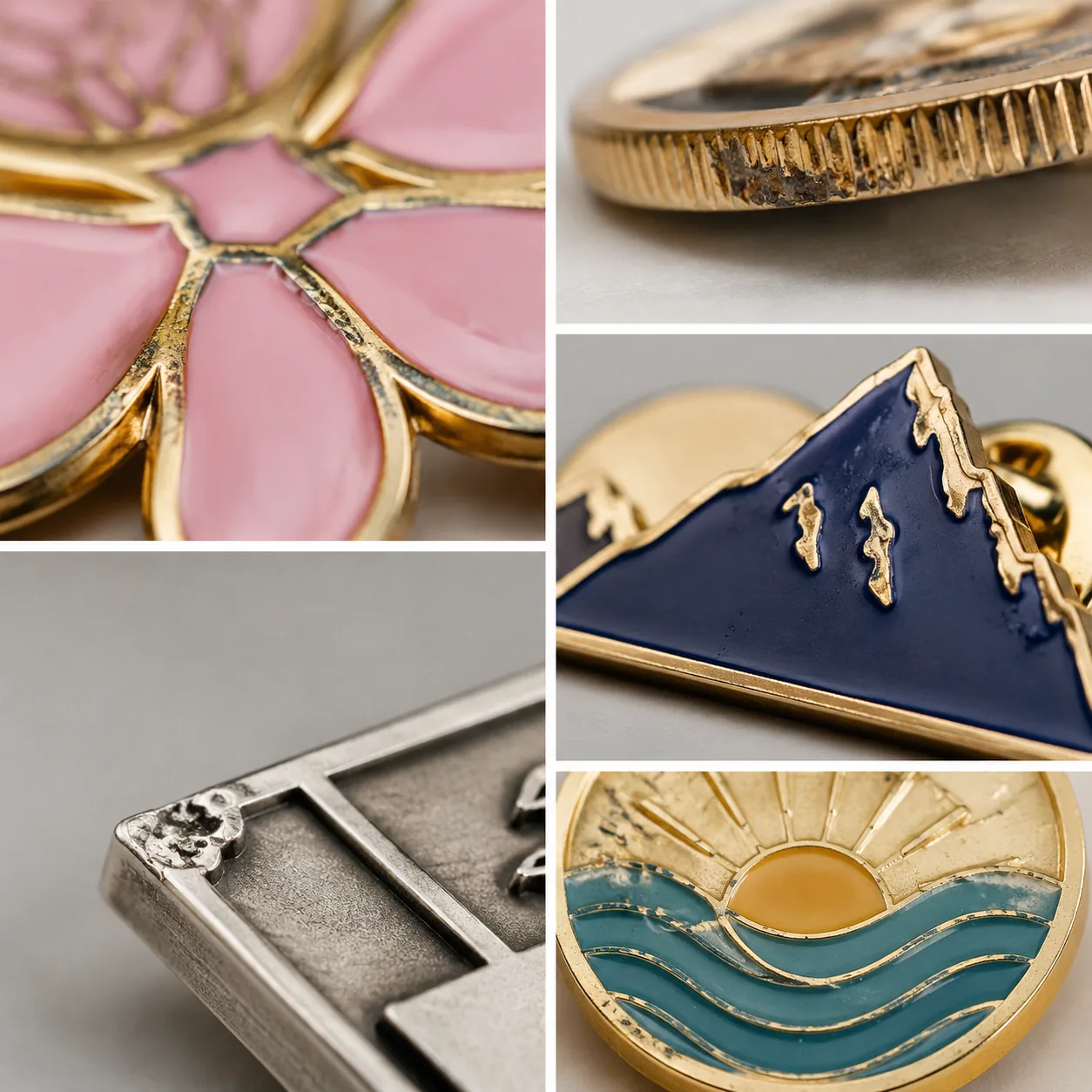
Decide by disposition rules, not cosmetic frustration
A custom metal promo batch should not be accepted because the event date is close, or rejected because a macro photo looks ugly. The decision should follow the approved standard, the product’s risk level, and the commercial use. For enamel pins, challenge coins, keychains, magnets, badges, brooches, and medallions, every inspection outcome should lead to one of four actions: accept, sort, rework, or remake.
The biggest mistake is approving only artwork and then treating the first production lot as if every implied detail was controlled. A complete approval package should include finished size and thickness tolerances, attachment location, burr limits, plating reference, enamel expectations, hardware specification, packaging method, carton count, and the named golden sample. Without those details, final inspection becomes a negotiation instead of a quality decision.
Disposition also has a time cost. Sorting 10,000 pins for visible black-nickel spotting can take 2 to 4 factory labor-days and still produce inconsistent decisions if the defect boundary is unclear. Replacing 300 wrong clutches may take 1 to 2 days. A partial remake of one failed SKU may add 7 to 12 production days plus freight. Rejecting a full 5,000-piece lot because antique silver is slightly darker than a sample is usually not rational if size, hardware, logo readability, and packaging meet the agreed standard.
Classify defects by risk, function, and sales channel
Defect classes should match business risk. Critical defects create safety, compliance, or total functional failure. Examples include sharp burrs that can cut skin, loose magnets, pin posts that detach, clasps that will not close, exposed adhesive on wearable items, or a wrong material where nickel release, lead, cadmium, or CPSIA compliance was required. Critical defects should be treated as AQL 0 unless a written engineering concession is issued.
Major defects impair use or create obvious brand damage. Typical examples are reversed artwork, wrong plating finish, enamel voids over 0.50 mm on the front face, visible plating peel, wrong attachment hardware, missing epoxy, mislocated posts causing rotation, weak magnet adhesion, or dimensions outside tolerance. For standard die-struck pins and badges, a practical finished size tolerance is ±0.15 mm up to 30 mm and ±0.20 to ±0.30 mm above 30 mm. Thickness tolerance is commonly ±0.10 mm for stamped brass or iron and ±0.15 to ±0.20 mm for zinc alloy castings after polishing and plating.
Minor defects are visible but do not materially affect use. Examples include light backside scuffing, a dust point under epoxy below 0.20 mm, faint polish swirls visible only under direct light, or slight plating tone variation visible only when compared side by side under 5000 K to 6500 K lighting. A retail collector coin in a capsule needs tighter cosmetic control than a conference giveaway packed in bulk cartons.
| Defect class | Concrete examples | Default disposition |
|---|---|---|
| Critical | Sharp burr, detached magnet, loose pin post, non-closing clasp, exposed adhesive on wearable item, wrong restricted material | Contain lot; reject affected units or full lot; no normal AQL concession |
| Major | Artwork reversed, enamel void >0.50 mm, plating peel, wrong backer, post off-location causing rotation, size outside tolerance | Sort, rework, or partial remake; reject lot if sample exceeds AQL |
| Minor | Backside scratch, epoxy dust <0.20 mm, small shade drift, faint polish swirl, minor carton rub | Accept within AQL; record trend and tighten next PO if needed |
| Process drift | Thin enamel across many units, softened die detail, rounded edges, low relief visibility | Compare to golden sample; escalate to engineering if repeated across samples |
Set AQL and lot structure before production
For most custom metal promotional products, use ANSI/ASQ Z1.4 single sampling, General Inspection Level II, with separate AQL limits by defect class. A common 2026 setup is Critical 0, Major 1.0 or 1.5, and Minor 2.5 or 4.0. Licensed merchandise, retail-ready pins, collector coins, and influencer launch kits usually justify Major 1.0 and Minor 2.5. Internal employee merch or event giveaways often run at Major 1.5 and Minor 4.0 when cosmetic perfection is not the commercial requirement.
Inspect by SKU, finish, hardware type, and packaging configuration. A 5,000-piece order split across five designs should not be inspected as one mixed lot. One badge with black enamel, 0.25 mm raised lines, and dual posts has different risk than a simple antique silver coin. If several SKUs are sold as a boxed set, inspect the finished set for count, orientation, insert placement, barcode, and mixed-packing errors.
As a reference point, under Z1.4 General Level II, a lot size of 3,201 to 10,000 pieces normally uses code letter L and a 200-piece sample. At Major AQL 1.5, the common acceptance and rejection numbers are Ac 7 / Re 8. At Minor AQL 4.0, they are commonly Ac 14 / Re 15. Teams should verify the table edition named in their SOP, but these numbers are useful for catching informal under-sampling.
- Name the golden sample or approved pre-production sample in the PO.
- Apply Critical 0 to wearable hardware, magnets, sharp edges, and regulated materials.
- Separate sampling by SKU, plating finish, attachment, and final packaging style.
- State AQL by defect class instead of using one blended pass/fail number.
- Define viewing distance, lighting, and which surfaces are customer-facing.
- Require measured data for size, thickness, post location, magnet bond, and count accuracy.
- Do not let a mixed retail set pass unless the assembled set was inspected.
Control the specifications that cause real rejects
The parameters that create returns are usually not abstract color preferences. They are dimensions, attachment strength, burr condition, enamel coverage, plating adhesion, magnet performance, count accuracy, and packaging protection. Buyers often over-specify antique plating tone and under-specify pin post location, split-ring gauge, magnet thickness, or carton packing.
For standard stamped iron or brass pins, common finished thicknesses are 1.2 mm, 1.5 mm, 1.8 mm, and 2.0 mm. For stamped parts under 40 mm, size tolerance of ±0.15 mm and thickness tolerance of ±0.10 mm are realistic. For zinc alloy keychains and irregular cast badges, use ±0.20 mm on size and ±0.15 to ±0.20 mm on thickness unless a tighter capability study has been approved. Pin post location should typically be held within ±0.50 mm from drawing centerline; ±0.30 mm is possible on simple shapes but can be uneconomical on irregular bodies.
Artwork geometry needs numeric limits. Enamel channels should be at least 0.25 mm wide for stable production; below 0.20 mm, fill inconsistency and flooding become common. Raised metal lines below 0.20 mm can lose definition after polishing. Soft enamel height variation of about 0.05 to 0.10 mm between adjacent colors is normally acceptable. Hard enamel gives a flatter face, but hand polishing still creates small differences; do not specify “perfectly flush” unless the supplier has priced collector-grade finishing.
Decorative plating on promo metal is thin compared with jewelry plating. Nickel, black nickel, imitation gold, rose gold, copper, and antique finishes are commonly about 0.03 to 0.10 micron in this category. For high-rub items, moisture exposure, or long storage, a clear anti-tarnish topcoat, individual OPP bags, capsules, tissue wrap, or foam pouches may prevent more complaints than asking for thicker plating without changing the protection method.
| Specification item | Standard promo default | Tighten when |
|---|---|---|
| Finished size | ±0.15 mm up to 30 mm; ±0.20 to ±0.30 mm above 30 mm | Retail sets, mating parts, display stands, precision backers |
| Thickness | ±0.10 mm stamped; ±0.15 to ±0.20 mm cast | Collector coins, premium medals, fitted packaging |
| Minimum enamel channel | 0.25 mm preferred; avoid below 0.20 mm | Fine text, dense logos, multi-color micro artwork |
| Raised metal line | 0.20 mm minimum preferred | Small logos, hard enamel, heavy polishing |
| Decorative plating | Approx. 0.03 to 0.10 micron | High-rub use; add topcoat and individual packing |
| Post location | ±0.50 mm typical | Long badges, anti-rotation design, dual-post alignment |
| Magnet thickness | 1.0 to 1.2 mm common for 50 to 60 mm fridge magnets | Large footprint, coated surfaces, heavier cast bodies |
Use product-specific functional tests
A batch should fail faster for function than for mild cosmetic variation. Pins and badges should be checked for secure post attachment, clutch retention, burrs, and rotation on fabric. Pins wider than about 25 mm usually perform better with dual posts. Long horizontal badges should have post spacing approved at sample stage; moving the posts after mass production is usually a remake issue, not a simple repair.
For keychains, ring and connector strength must match pendant weight. A 45 to 60 mm zinc alloy body should not automatically use 1.2 mm split-ring wire; 1.4 mm or 1.6 mm is often more appropriate. Spring clasps and swivel hooks should survive at least 20 open-close cycles in routine factory QC without gate misalignment. Jump rings should be fully closed, not merely touching, and should not deform under normal hand force.
For magnets, adhesive cure time matters. Many factory glue systems need at least 24 hours before reliable testing; 48 hours is safer for larger bonded magnets. Require a manual pry check, tape pull or shear check on the bond area, and a review of whether the magnet slides on a smooth coated refrigerator surface. On 55 mm fridge magnets, upgrading from 0.8 mm to 1.0 or 1.2 mm magnet thickness often fixes field complaints.
For plating and epoxy, require named checks rather than a generic “passed.” Plating peel should be evaluated on customer-facing surfaces and edges. Epoxy domes should be checked for bubbles, sink marks, yellowing, edge lift, and contamination. A cross-hatch tape test may not fit curved decorative parts, but the supplier still needs a defined adhesion assessment and photo evidence at normal viewing distance.
Recognize when the specification is the problem
Some lots should be respecified rather than argued over. If the artwork depends on 0.18 mm text, dense openwork, transparent enamel over rough texture, black nickel over micro-raised lettering, or a single post on a long badge, the factory may be showing the natural process limit. Rejecting one shipment may recover money, but it will not fix the next PO.
Common respec triggers include enamel channels at 0.20 mm or less, split rings undersized for heavy keychains, magnet area too small for the casting footprint, pin posts placed for appearance rather than balance, and vector text that is legible on screen but soft after die cutting, polishing, and plating. Another frequent trap is demanding exact color identity across different materials. The same Pantone red will not read identically in soft enamel, silicone, woven labels, and dyed polyester.
Practical fixes are usually modest: increase a raised line from 0.20 mm to 0.30 mm, enlarge text height to 1.5 mm or more, move a pin post 2 to 3 mm for balance, switch from stamped iron to cast zinc alloy for complex cutouts, enlarge the magnet bonding area, or increase split-ring wire from 1.2 mm to 1.4 mm. If the same borderline issue appears across two sample rounds, change the construction instead of tightening inspection language.
Balance rework, remake, price, and lead time
When a lot fails, choose the lowest-risk action that protects the end use and delivery date. Accessory defects are often repairable: clutches, O-rings, split rings, back cards, barcodes, and polybags can usually be corrected quickly. Body-level defects are different. Misplaced posts, poor die detail, wrong plating base, enamel flooding, or distorted casting geometry often justify partial or full remake because aggressive rework can create secondary scratches, softened relief, or finish mismatch.
Typical 2026 FOB price ranges give context. Standard soft enamel pins often run USD 0.28 to 0.90 each at 500 to 5,000 pieces, depending on size, colors, posts, carding, and plating. Challenge coins commonly run USD 1.20 to 4.50 each. Metal keychains often run USD 0.60 to 2.20 each. MOQ is commonly 100 pieces for simple repeat orders, 300 pieces for many new custom designs, and 500 pieces where unit pricing becomes materially better.
Normal timing is also predictable. Digital proofing may take 1 to 2 days. Pre-production samples are commonly 5 to 9 days after artwork approval. Mass production is often 10 to 18 days for standard pins and keychains, and 20 to 25 days for multi-SKU, complex plating, capsules, gift boxes, or heavy assembly. A partial remake usually adds 7 to 12 production days plus freight. Air freight for a remake can add roughly 15% to 40% of order value depending on weight, route, and carton volume.
| Disposition | Best use case | Typical time effect | Main risk |
|---|---|---|---|
| Accept with concession | Minor defects within functional use; deadline fixed | 0 to 1 day | Creates precedent unless documented as one-time |
| Factory sort | Separable plating spots, mixed backs, wrong clutches, carton errors | 1 to 4 days | Inconsistent decisions if defect photos are unclear |
| Rework affected units | Accessory swap, repacking, magnet reattachment, simple hardware correction | 2 to 7 days | Secondary scratches, adhesive failure, or finish rub |
| Partial remake | One SKU or one sub-lot failed | 7 to 12 production days plus freight | Finish may not perfectly match original lot |
| Full remake | Critical defect or body-level major defect across lot | 10 to 25 production days plus freight | Highest cost and launch-date exposure |
Require evidence that makes the decision obvious
A useful QC report should be grouped by SKU and defect class. It should state lot size, sample plan, sample size, AQL, acceptance and rejection numbers, defect counts, measured dimensions, and functional test results. For hardware, require the method and result: ring gauge, clasp cycling, post pull or bend check, magnet cure time, magnet pry check, carton count, and packing audit. Close-up photos alone are not evidence of control.
Visual evidence should include macro details and normal-use views. A speck visible only at 10 cm under phone magnification should not be treated the same as a defect visible at 50 cm in normal handling. A practical PO standard is front-face cosmetic review at 30 to 50 cm under neutral white light, with backside judged more leniently unless it is retail-visible. Plating tone comparisons should be photographed side by side with the approved sample under 5000 K to 6500 K lighting.
The strongest control is simple: attach a one-page acceptance standard to every PO. Include defect classes, AQL limits, measurable tolerances, hardware tests, magnet tests, packaging counts, carton labels, viewing conditions, and the golden sample reference. That page turns “bad batch” arguments into evidence-based accept, sort, rework, or remake decisions.
Have a project? Send your artwork and target quantity and we’ll reply with a detailed quotation within 12 working hours.
Ready to get this made?
Send your sketch, target quantity and ship-date. Detailed quotation in 12 hours.



