When to Consolidate Custom Promo Items Into One Factory
Start with the real decision: reduce coordination or reduce production risk
The practical question is not whether one supplier can quote pins, coins, patches and lanyards. Most trading companies and many factories can. The real question is whether one production system can control the failure modes across those categories tightly enough to justify one PO, one critical path and one shipment. That distinction matters more in 2026 because event lead times are shorter, import paperwork is scrutinized more closely, and split inbound deliveries still create extra customs entries, courier charges, warehouse receiving time and internal follow-up.
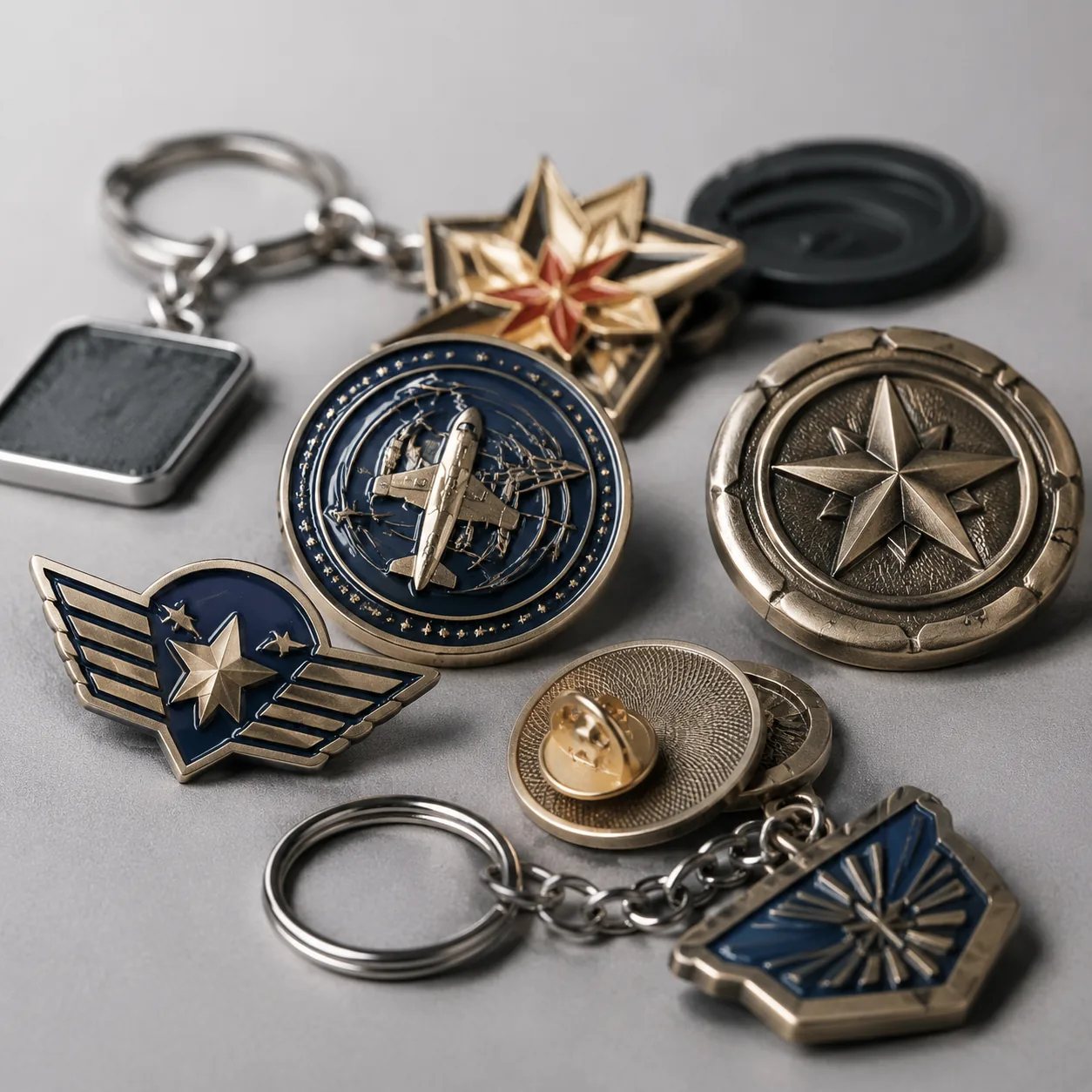
Consolidation works best when the SKUs share the same manufacturing logic. For metal promo goods, that usually includes soft enamel pins, imitation hard enamel pins, die-struck badges, zinc alloy keychains, metal magnets and challenge coins. Those items rely on overlapping controls: die or mold accuracy, base-metal thickness, plating consistency, enamel fill, edge polishing, attachment alignment and cosmetic inspection under a defined accept/reject standard.
Risk rises when buyers bundle metal products with textile or print-heavy products and assume the same supplier is equally strong across all lines. Patches depend on stitch density, thread conversion, border finish, backing adhesion and trimming control. Lanyards depend on webbing quality, dye or print registration, buckle and hook sourcing, and sewing accuracy at the joint and hardware points. Those are separate production disciplines with different equipment, tolerances and rework patterns. In many cases, the best answer is selective consolidation: combine SKUs with shared process capability and split the categories where remake risk is more expensive than admin savings.
Group the RFQ by process family, then compare MOQ, lead time and price
Sort the order by process family before requesting quotes. Metal is one family: stamped iron soft enamel, brass die-struck, photo-etched brass, die-cast zinc alloy, coins, keychains and badges. Typical MOQ is 100 pieces per design for standard pins, badges and simple keychains; 100 to 300 pieces for challenge coins depending on diameter, thickness and edge treatment; and 100 pieces for simple rigid metal magnets. Sampling usually takes 5 to 7 calendar days after artwork approval and tooling payment. Bulk production commonly runs 10 to 18 days for 1,000 to 5,000 units when plating is standard and no retail kitting is involved.
Textile is a separate family. Embroidered patches commonly start at 100 pieces per design; woven patches often start at 100 to 300 pieces depending on size, border style and backing; PVC patches may start at 100 to 200 pieces depending on mold complexity and color count. Patch samples usually take 4 to 6 days, with bulk production in 7 to 14 days. Lanyards typically start at 100 to 300 pieces per design. Standard widths are 15 mm, 20 mm and 25 mm, with a common finished length of 900 mm folded before attachment. Screen-printed polyester lanyards often run in 7 to 12 days, dye-sublimated versions in 8 to 14 days, and woven jacquard lanyards in 12 to 18 days because loom setup and text clarity are more restrictive.
A useful planning rule is spend concentration. If about 70 percent or more of project value sits in one process family, consolidation often improves control and reduces coordination friction. If spend is spread more evenly across metal, textile and PVC, a hybrid structure is usually safer: one lead factory plus one specialist supplier, with final pack-out handled by the lead factory only if it can document incoming QC, storage segregation, assortment verification and final inspection to an agreed standard. For commercial promo programs, AQL 2.5 major and 4.0 minor is still a common baseline. Premium retail or membership programs often tighten to AQL 1.5 major and 2.5 minor.
| Order mix | Best sourcing model | Typical MOQ logic | Main risk if consolidated badly |
|---|---|---|---|
| Pins, coins, keychains, metal magnets | One metal-focused factory | 100 per design for most SKUs; tooling remains design-specific | Outsourced plating or coloring creates visible finish mismatch |
| Metal items plus embroidered or woven patches | Lead factory plus patch specialist | 100 to 300 depending on size, border and backing | Thread interpretation, border quality or backing performance drifts from approved sample |
| Metal items plus printed or woven lanyards | Lead factory plus lanyard specialist or proven in-house line | 100 to 300 depending on width, hardware and print method | Color drift, hardware substitution or sewing inconsistency |
| Retail kits with multiple SKUs, insert cards and barcode labels | One integrator only if pack-out is controlled in-house | Higher effective MOQ because wastage, assorting and verification must be absorbed | Late assortment errors, barcode mistakes or carton mix-ups |
Quantify the savings, then compare them with blocked-shipment risk
The savings case for consolidation is real, but buyers often measure only unit FOB. The broader economics include fewer sample couriers, fewer pickup charges, one export file instead of several, fewer proof cycles, less supplier chasing and less receiving work after arrival. On a mixed order of 5,000 to 10,000 total units, those soft savings can equal roughly USD 0.03 to 0.08 per unit on simpler SKUs, especially when the order requires backer cards, polybags, barcode labels or assorted kit packing.
Typical 2026 FOB China ranges show where the numbers sit. A 1.0 to 1.25 inch stamped iron soft enamel pin at 500 pieces usually runs about USD 0.32 to 0.58 FOB with standard butterfly clutch, 4 colors or fewer, and individual polybag. A 1.75 inch zinc alloy challenge coin at 300 pieces commonly runs USD 1.25 to 2.40 FOB depending on relief depth, cutouts, dual plating or epoxy. A 2.0 inch stamped brass or iron coin with edge text often lands around USD 1.60 to 2.80 FOB. A 3 inch embroidered patch at 500 pieces usually ranges from USD 0.28 to 0.70 FOB depending on stitch coverage, merrow or laser edge, and backing type. A 20 mm polyester lanyard with one-color screen print and standard swivel hook at 1,000 pieces commonly runs USD 0.35 to 0.75 FOB; a sublimated version typically runs USD 0.45 to 0.90 FOB. Woven jacquard lanyards are often higher, around USD 0.60 to 1.10 FOB at similar volume because setup and weaving speed are less favorable.
The risk side matters just as much as the nominal savings. A consolidated shipment moves at the speed of the slowest or most problematic SKU. If pin samples clear in 6 days, patch samples in 5 days and lanyards in 7 days, the program still stops if one coin plating batch fails appearance review or a lanyard hook arrives in the wrong finish. In mixed kits, one blocked component can delay the full shipment by 4 to 10 days. If the missing part then has to move by air, the freight uplift can wipe out the original consolidation benefit immediately.
A practical threshold is this: consolidate when admin, freight and pack-out savings are worth at least 8 to 12 percent of total project overhead, and split when one component failure would threaten a fixed event date, retail launch or customer handover. For conference giveaways, onboarding kits, distributor packs and retail merchandise drops, schedule certainty is often more valuable than saving a few cents on nominal FOB.
Audit process control with measurable specs, not catalog claims
A broad product list tells you very little. Ask factories to explain process control in numbers. For metal goods, confirm the base material used most often: iron for economical stamped pins, brass for cleaner fine lines and sharper die-struck detail, and zinc alloy for 3D forms, inner cutouts and thicker sections. Common thickness ranges are 1.2 to 1.5 mm for standard pins and badges, 1.5 to 2.0 mm for heavier keychains, and 2.0 to 3.5 mm for challenge coins. Finished size tolerance on small stamped pieces is commonly plus or minus 0.15 to 0.20 mm; coin diameter tolerance is often plus or minus 0.20 to 0.30 mm; attachment placement tolerance on pin posts is commonly held within about plus or minus 0.5 mm.
Plating should also be discussed in practical terms. Decorative nickel, gold, black nickel or copper plating on promo metal goods is usually specified in the appearance range of roughly 0.03 to 0.08 microns, often with anti-tarnish topcoat where needed. On premium programs, some buyers request documentation of plating bath control, salt-spray reference testing or retention samples from the actual production run. The exact micron figure matters less than line stability, bath maintenance and whether the factory uses a controlled plating line rather than shifting batches among multiple subcontractors.
Probe the likely failure points. Imitation hard enamel should present a smooth polished surface with no exposed pits, major overfill, obvious low-fill pockets or polished-through edges. Soft enamel should show consistent recess depth, clean metal lines and no color contamination across boundaries. For soldered pin posts, jump rings and keychain loops, require a defined attachment check such as a manual twist test plus sample pull testing. Larger badges and heavy keychains deserve closer review because post failure and ring separation are common field complaints.
For patches and lanyards, the checklist changes. Ask what twill weight or base fabric is used, how thread conversion is approved, the minimum legible woven text height, and what backing options are stocked locally. Embroidered patches often use 150D to 210D twill with stitch coverage from about 50 percent to over 85 percent depending on design density. Iron-on backing may be rated around 135 to 160 degrees Celsius for 10 to 15 seconds, but it still needs validation on the actual garment because cotton, polyester blends and coated fabrics behave differently. For lanyards, confirm webbing thickness, width tolerance, logo registration tolerance, buckle position tolerance and hardware source. A common registration tolerance for printed lanyards is plus or minus 1 mm; finished width tolerance is often plus or minus 0.5 to 1.0 mm; sewing offset around the buckle or hook should usually stay within about plus or minus 2 mm on standard production.
- Ask which steps are truly in-house: tooling, stamping, polishing, plating, coloring, sewing, printing, assembly and final packing.
- Request written tolerances by category, such as plus or minus 0.2 mm for small metal items and plus or minus 1 to 2 mm for textile items.
- Confirm the inspection standard in advance, usually AQL 2.5 major and 4.0 minor unless the contract requires tighter levels.
- Require sample and bulk lead times by SKU in days, with every outsourced step identified.
- Ask for one packing specification covering unit pack, inner pack, carton quantity, carton size and gross weight.
- If kits contain multiple SKUs, require 100 percent assortment verification before carton sealing.
Set appearance standards that are strict, but still realistic across materials
Consolidation adds the most value when shared appearance matters. If a launch set includes pins, coins and keychains that all need shiny nickel, antique nickel, shiny gold or matte black plating, one metal-focused factory usually improves consistency. The same team can interpret relief depth more consistently, maintain similar line weight and control polishing so the finished pieces look like one coordinated family rather than unrelated buys.
Buyers should still separate realistic consistency from impossible material matching. Pantone 286 C in soft enamel will not match woven thread exactly, and that same blue may shift again in sublimation on polyester lanyard webbing. Antique finishes also vary with relief depth, polish time, recess wash and viewing angle. The workable standard is not exact sameness across metal, thread and print. It is controlled equivalence within defined visual limits under consistent viewing conditions.
A stronger approval method is to define one hero reference for each finish family. For example, use a signed metal sample for shiny nickel or antique silver; approve enamel colors against a physical sample under D65 or daylight-neutral lighting; approve embroidered or woven goods against the nearest production thread standard; and approve lanyards against a printed proof plus a registration tolerance of plus or minus 1 mm. That approach reduces late-stage disputes and gives the buyer a cleaner basis for rejecting substitutions if the supplier comes under schedule pressure.
For mixed-material kits, spell out what matters most. If the priority is brand-family appearance rather than exact Pantone identity, say so directly. If matte black hardware on lanyards must visually align with black nickel keychains within a narrow range, define that too. The more concrete the appearance hierarchy, the less likely the supplier is to optimize the wrong variable during a rush.
Use MOQ, tooling and remake exposure to structure the PO
MOQ math often misleads buyers. Combining a 300-piece pin order with a 300-piece coin order does not create 600-piece leverage on core manufacturing cost. Each design still needs its own mold or die, setup, plating route and inspection standard. Standard tooling in China for custom metal promo items often runs about USD 50 to 120 per design for simple pins, badges or keychains, and roughly USD 80 to 180 or more for larger challenge coins depending on diameter, 3D relief and edge treatment. Patch setup and lanyard setup are also design-specific even when the nominal MOQ is low.
Where consolidation helps is shared overhead. One supplier can absorb proofing, sample dispatch, incoming packaging receipt, final bagging, backer card insertion, barcode labeling and export handling across the project. That is especially useful when all goods end up in one retail set, one onboarding kit or one event giveaway pack. But those savings disappear quickly if one SKU needs a remake and every finished component waits in storage for the replacement batch.
Before awarding the order, compare three numbers rather than one: unit FOB by SKU, total landed project cost including tooling and pack-out, and failure-adjusted cost if one SKU must be remade and reshipped. The third number usually reveals the real risk. An attractive all-in-one quote becomes expensive once you add 7 to 10 days of delay, replacement air freight, repacking labor, temporary storage and the commercial cost of missing an event date.
| Cost element | Usually improved by consolidation | Usually unchanged | Can become worse |
|---|---|---|---|
| Artwork coordination | Yes, fewer approvals and fewer proof cycles | No | Yes if one supplier revises slowly |
| Tooling per design | Rarely | Yes, still design-specific | Higher if the wrong process is forced |
| Sample freight | Often | No | Higher if repeated corrections trigger re-sampling |
| Final pack-out labor | Often | No | Higher if components arrive unevenly or require sorting |
| Rush remake exposure | No | No | Yes, one failed SKU can block the full shipment |
Choose the sourcing model that fits the category mix and deadline
There are three workable models for mixed-category promo orders. First is single-factory execution. This works best when the order is mostly metal, the factory genuinely controls core metal processes, and the buyer values one shipment and one schedule more than category specialization. Second is lead-factory integration. In that model, one supplier produces the core line, usually metal, and manages final assembly or kitting while patch or lanyard specialists ship approved components into that factory. Third is buyer-managed split sourcing, where each category ships independently and the buyer or a 3PL consolidates later.
Single-factory execution is administratively simplest, but only when the supplier has real production depth rather than a broad brochure. Lead-factory integration is often the strongest middle ground for distributors, event teams and B2B merch buyers because it preserves specialist production where needed while still reducing delivery complexity. Buyer-managed split sourcing offers the highest technical control, but it creates the most internal work around inbound scheduling, customs coordination, SKU labeling and final assortment verification.
For many 2026 programs, lead-factory integration is the most resilient option. A metal-focused supplier can anchor the job, hold finish and packaging standards, and coordinate final pack-out while patches or lanyards come from stable specialist lines. The condition is non-negotiable: the lead factory must own incoming QC, shortage logging, storage segregation, carton control and final inspection. If it is acting only as a pass-through trader, the buyer keeps the coordination risk without gaining meaningful control.
Issue an RFQ that makes quotes directly comparable
The fastest way to improve outcomes is to decide the sourcing model before sending enquiries. Map each SKU by process family, mark the hard delivery date, and identify which component would block the full program if delayed. Then ask every supplier to quote not only price, but production route, in-house steps, outsourced steps, sample days, bulk days, AQL standard, tooling cost and pack-out capability. Quotes without that information are not directly comparable.
If the order is mostly metal and finish consistency matters, request both a consolidated quote and a split-category benchmark quote. If the order mixes metal, patches and lanyards, ask whether final packing is done in-house, how incoming components are checked, whether shortages are logged by SKU, and whether the supplier can issue a master packing sheet, golden sample sign-off point and final QC report before balance payment. On orders above roughly USD 3,000 to 5,000 FOB, or for deadline-critical launches, that documentation usually pays for itself.
The strongest decision is rarely fully consolidated or fully split. It is usually a controlled hybrid based on process family, schedule exposure and the cost of one failure. Buyers who use those three filters avoid the most expensive mistake in promo sourcing: accepting a convenient all-in-one quote that looks efficient on paper but introduces hidden execution risk where the schedule is least forgiving.
Have a project? Send your artwork and target quantity and we’ll reply with a detailed quotation within 12 working hours.
Ready to get this made?
Send your sketch, target quantity and ship-date. Detailed quotation in 12 hours.



