When Should Buyers Split One Promo Order Into Separate Specs?
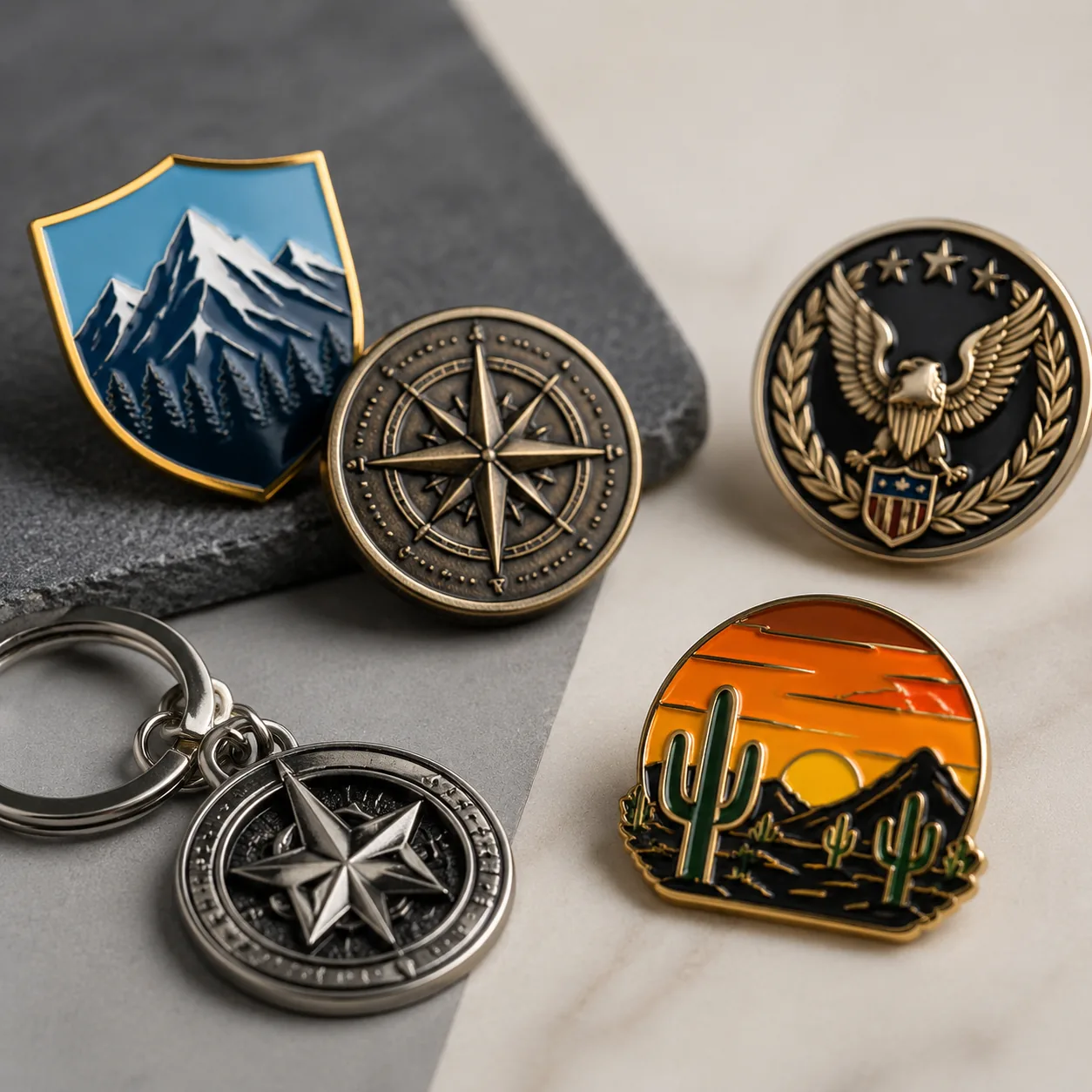
Why mixed-spec promo orders fail
The main mistake is assuming one artwork file can define one manufacturing spec across products that behave very differently in production. A soft enamel pin, a stamped challenge coin, a woven patch, and a printed lanyard may share the same logo, but they do not share the same tooling, tolerance stack, or defect risk. When buyers force one blanket spec across all four, the factory prices to the hardest item and inspects to the strictest failure mode. That usually increases cost without improving consistency.
The process differences are not minor. Metal goods rely on die depth, plating stack control, deburring, and thickness control; textile goods rely on stitch density, print registration, heat cutting, and edge stability. A decorative nickel finish on promo metal is commonly controlled at about 0.05 to 0.15 µm of visible plating stack in the appearance layer, while the base metal and barrier layers carry most of the corrosion protection. By contrast, a lanyard or woven patch is judged on ink migration, edge fray, and alignment, not on surface finish. Treating these as interchangeable hides risk until sample review or final QC.
A useful rule is simple: one spec can cover a brand system, but not every physical SKU in that system. Keep the logo artwork, Pantone target, carton marking, and insert copy shared when possible. Split the technical spec whenever the products use different tooling, different base materials, or different acceptance criteria. That gives the factory a stable target and prevents one weak item from dragging down the whole program.
What should stay shared, and what should split?
Shared specs work best for brand-level decisions: artwork version, PMS references, logo placement, card text, carton marks, and shipment labels. Split specs are needed when the production window changes materially, such as minimum line width, part thickness, backing hardware, relief depth, stitch count, or acceptable color variance. The cleanest structure is one master brand sheet plus one technical sheet per SKU.
This matters most when items look similar but are made differently. A challenge coin and a soft enamel pin can carry the same crest, but they do not use the same die structure, edge profile, or target weight. A coin is commonly 1.8 to 3.2 mm thick, with relief depth around 0.3 to 0.8 mm depending on detail, while a pin is often 1.2 to 1.6 mm thick with tighter line-detail control. Woven patches may hold readable detail at roughly 0.4 to 0.5 mm equivalent thread width, while a metal cutout usually needs more conservative minimum features so burrs and fill issues do not show up in the press.
Buyers get better quotes when they split by process family rather than by product count. The quote becomes clearer, and the QC standard becomes enforceable. If the items share only artwork, keep the artwork shared and split everything else.
| Keep shared | Split separately |
|---|---|
| Artwork version, PMS target, logo placement | Thickness, tooling, and minimum feature width |
| Carton marks and shipping labels | Backing hardware, clasp, magnet, or clip type |
| Brand copy and insert text | Finish stack, stitch density, or print method |
| One master SKU index | Separate tolerance and acceptance criteria |
| One brand approver | Separate technical approver and golden sample |
What procurement should ask before combining items
Before asking for one combined quote, procurement should ask three questions: what must be identical, what can vary, and what is the most expensive failure if it goes wrong. If the answer to the third question is finish mismatch, a shared Pantone target may be enough. If the answer is loose assembly, warped blanks, or hardware failure, the spec should split immediately. That avoids false efficiency turning into rework.
Procurement should also check whether the items can share packing logic. A rigid metal badge and a woven patch should not be forced into the same insert format if one scratches and the other creases. Carton partitions, polybag size, and inner-pack count can be shared only when weight, surface sensitivity, and stack pressure are similar. For mixed programs, a release sheet is usually more useful than a single spreadsheet row: one line per SKU with size, tolerance, finish, packing method, and approval owner.
A practical approval flow looks like this: the brand owner approves the artwork once, then the technical owner approves each SKU against its own sample. That keeps marketing consistency intact while preventing a tooling decision for one item from becoming a standard for all items. It also gives the factory a clear source of truth when a late change request arrives.
What belongs on a split-spec checklist?
Use this checklist before approving a mixed promo order. If any item cannot be confirmed confidently, split that SKU into its own technical sheet instead of blending it into a general spec.
- Confirm exact artwork scale, bleed, and logo placement for each SKU.
- List thickness, size tolerance, and minimum feature width item by item.
- State finish targets separately: plating color, print method, thread count, or coating.
- Define acceptance limits for color, registration, burrs, stitch pull, and surface marks.
- Specify hardware separately: backing type, magnet pull, clasp style, or attachment method.
- Identify the golden sample for each product family and the approver for that sample.
- Write packing rules per SKU: polybag, insert card, carton partition, or bulk pack.
A mixed order becomes much easier to manage when every line item can be checked against one question: does this SKU share the same physical risk as the others? If the answer is no, it deserves its own technical line and its own sign-off.
When does one order need two quotes instead of one?
Two quotes are justified when the factory is pricing two different risk profiles under one line item. That usually happens when the products have different tooling ownership, different plating or print stacks, or different QC thresholds. For example, a flat stamped badge may be inspected to cosmetic AQL 2.5 for minor appearance defects, while a multi-part moving keychain needs tighter control on assembly retention, swing clearance, and finish coverage. Those are not the same risks, so they should not be priced as if they were.
Lead time is another clear trigger. If one SKU can ship in 12 to 15 days after sample approval and another needs 20 to 28 days because of casting, layering, embroidery, or multiple finishing steps, putting them under one quote obscures the critical path. The faster item does not become faster just because it is listed on the same PO. Buyers often lose a week or more by combining orders that should have been released separately.
Split quotes are also useful when MOQ tiers differ sharply. A simple metal pin may price at 100, 300, and 500 pieces per design, while a woven patch may have 300, 500, and 1,000-piece tiers because loom setup is less efficient at tiny quantities. If one item has an MOQ of 100 and another has an MOQ of 1,000, blending them into one quote hides which SKU is carrying the setup burden.
| Keep one quote when | Split into two quotes when |
|---|---|
| Same process family and same QC risk | Different process families or failure modes |
| Shared artwork plus similar thickness and hardware | Shared artwork but different size, thickness, or attachment |
| Lead times are within 3 to 5 days | Lead times differ by more than 7 to 10 days |
| Same packing method and carton protection | Different pack-out, nesting, or anti-scratch needs |
| One technical approver can sign all samples | Each SKU needs a separate golden sample |
How should QC change when specs are split?
Split specs should come with split acceptance criteria. A pin may allow a small plating shade variation, a coin may allow deeper relief tolerance, and a lanyard may allow a different print registration window. If you keep one inspection form for all products, inspectors either overreject the easy item or underinspect the difficult one. The better method is item-specific defect definitions with photo references and measurable limits.
For metal goods, define thickness tolerance, burr height, edge sharpness, plating coverage, and backstamp clarity. A practical tolerance for promotional stamped metal is often ±0.15 to ±0.20 mm on thickness for simple parts, while critical decorative features may need line-width control around 0.25 to 0.30 mm depending on the process and die condition. Burr height is commonly limited to 0.05 to 0.10 mm on visible edges for cosmetic goods. For textile goods, specify weave density, print alignment, sealed-edge quality, and stitch consistency. Woven patches often perform well when the design keeps readable detail above roughly 0.4 mm equivalent thread width, while printed lanyards should call out registration tolerance directly, such as ±1.0 to ±1.5 mm on repeat alignment.
Inspection levels should match the risk. Cosmetic defects on pins, coins, and badges are commonly checked at AQL 2.5 for general appearance, while critical safety or attachment issues may warrant tighter acceptance, such as AQL 1.0 or even 0.65 for load-bearing hardware. A 25-piece random sample at AQL 2.5 is not overcontrol; it is standard practice for moderate cosmetic risk. The point is not to inspect everything. The point is to match sampling to the failure mode, and split specs make that possible.
For mixed sets, also define what is not acceptable by SKU. A plated coin may allow slight tone drift across the field but not exposed base metal on high points. A lanyard may allow small print drift but not text cutoff. A patch may allow a minor thread tail on the reverse but not frayed perimeter yarn. That level of specificity reduces subjective disputes during final inspection.
What pricing traps should buyers watch?
The biggest trap is hidden setup duplication. If you split too aggressively, you may pay for multiple tooling setups, plate changes, print screens, packing runs, and carton labels. If you combine dissimilar items too aggressively, the factory usually adds a risk premium to cover uncertainty. The right split is usually the smallest one that separates process risk, not the smallest one that creates the most line items.
Buyers should ask for FOB pricing by SKU and ask how pricing changes at the next MOQ tier. Typical promo-product breaks might look like 100, 300, and 500 pieces for simple metal items, or 300, 500, and 1,000 pieces for woven or setup-heavy textiles. A straightforward soft enamel pin may land around USD 0.85 to 1.80 FOB at 300 pieces, while a standard challenge coin may run USD 1.40 to 3.20 FOB depending on size, plating, and enamel coverage. Printed lanyards often sit around USD 0.22 to 0.55 FOB at 500 pieces, with woven patches roughly USD 0.35 to 1.10 FOB depending on size and stitch density. Those are working ranges, not quotes, but they show why one blended number can mislead the buyer.
The same logic applies to lead-time cost. A low-MOQ item may look cheap until rush freight, rework risk, or a second sample round is added. Ask what changes if the MOQ doubles, and ask which price element is setup-driven versus unit-driven. If the setup burden is high, splitting the order is often cheaper only when the process risk truly differs. If the item is already process-stable, bundling can be fine.
One useful benchmark is to compare unit price at 300 pieces versus 1,000 pieces. If the price drops by more than 20% at the higher tier, the setup is being spread across a larger run, which is normal. If the quote barely changes between tiers, the item is likely constrained by material or labor instead of setup, so a split may not buy much. That is often the case with woven goods that have stable loom time but slower hand finishing.
What should buyers do before placing the PO?
Rewrite the order into three blocks: shared brand references, item-specific technical specs, and shared logistics terms. Then decide which items can live under one approval sample and which require their own golden sample. If the design team, sourcing team, and receiving team all understand the same sheet, the spec is probably split correctly. If they argue over what “same” means, the documentation is still too blended.
A good final package includes a master quote with separate SKU lines, separate QC criteria, separate lead times in days, and separate FOB prices. Keep one purchase order if that simplifies procurement, but do not force one manufacturing assumption onto every item. For mixed pin, coin, patch, and lanyard programs, that structure usually gives the best balance of brand control and production realism. It also makes vendor comparison easier because each line item is priced on its own technical merit, not hidden inside a bundled average.
Before release, confirm these final control points: the exact tolerances, the AQL plan, the approved artwork version, the golden sample reference, and the packing spec by SKU. If those five items are clear, the order can usually move through production without avoidable disputes. If they are not clear, the buyer should split again before issuing the PO.
Have a project? Send your artwork and target quantity and we’ll reply with a detailed quotation within 12 working hours.
Ready to get this made?
Send your sketch, target quantity and ship-date. Detailed quotation in 12 hours.



