When Printed Metal Badges Beat Enamel: Buyer Decision Rules
1. Decide From Artwork Complexity First
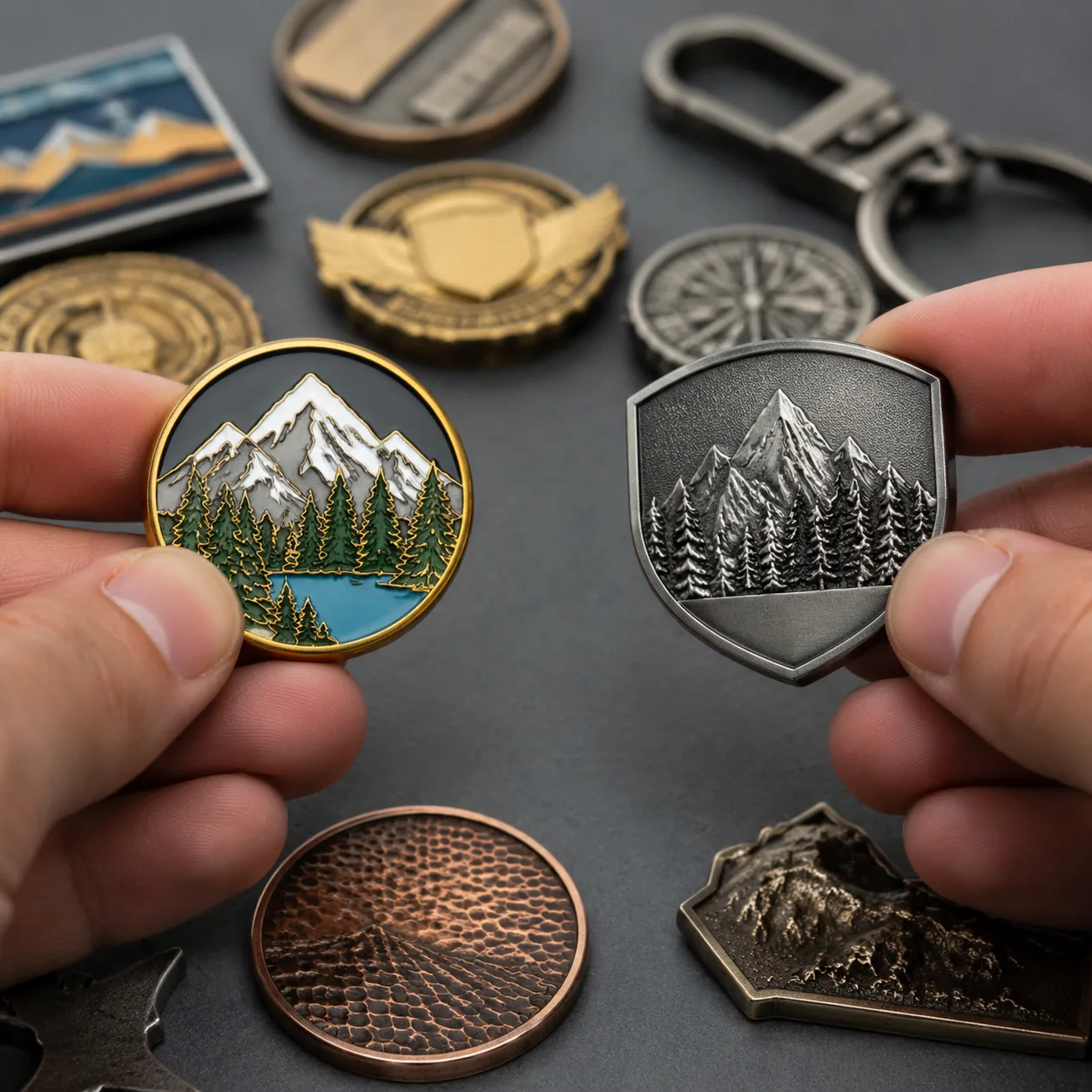
Printed metal badges are the stronger choice when the design is image-led rather than line-led. Enamel works best when each color sits inside raised metal walls. In real production, those walls usually need about 0.10 mm minimum width for soft enamel and 0.12 to 0.15 mm for hard enamel after polishing. Color islands below 0.25 mm can close, bleed, or disappear during polishing. If the badge includes gradients, photographic faces, shadows, halftones, QR-style detail, fine textures, or text below 0.8 mm high, converting it to enamel usually means simplifying the artwork and losing the effect the buyer approved.
A printed metal badge starts with a stamped, cut, etched, or cast blank, followed by plating, printing, and often clear epoxy or lacquer. The print method may be screen, offset, or UV digital. Common base metals are iron, brass, zinc alloy, and stainless steel, normally from 0.8 mm to 2.0 mm thick. For standard 25 to 40 mm promotional pins at 1,000 pieces, printed metal badges commonly quote around USD 0.45 to 1.35 FOB China. Comparable enamel badges often fall around USD 0.60 to 1.90 because enamel filling, drying, polishing, and color-by-color QC add labor and calendar time.
| Artwork condition | Better construction | Production reason | Risk if forced into the other method |
|---|---|---|---|
| Flat logo with 1 to 5 solid Pantone colors | Soft or hard enamel | Metal dividers create a durable dimensional look | Printed badge may look flatter and less premium |
| Gradient, shadow, or photographic image | Offset print with epoxy | CMYK can reproduce continuous tone at 300 dpi or higher | Enamel requires redrawing and loses tonal detail |
| Sponsor names or legal text below 0.8 mm | Screen or UV printed badge | Fine type remains readable when registration is controlled | Enamel walls distort letters or close counters |
| Retail club pin or service award | Hard enamel or die-struck metal | Flush polish and metal weight feel more permanent | Printed surface may look too promotional |
| Ten colorways of one campaign design | UV or offset printed badge | Artwork changes do not require separate enamel filling | Enamel approvals multiply by variant |
2. Choose the Print Process Before Quoting
A generic “printed pin” RFQ is too vague. Screen print, offset print, and UV digital print have different minimums, setup costs, color behavior, and inspection risks. Screen printing fits 1 to 4 solid spot colors, bold logos, and simple text. A practical printed line width is about 0.10 mm, with registration tolerance around ±0.15 mm on stable fixtures. Offset printing fits full-color images, gradients, mascots, and photo badges, but Pantone matching is approximate because colors are built from CMYK process inks. UV digital print is best for short runs, variable names, numbering, or many artwork versions, although it is rarely the lowest FOB unit cost for 5,000 identical pieces.
MOQ should follow the process, not only the buyer’s budget. A realistic starting point is 100 pieces for UV digital, 300 pieces for screen print, and 500 to 1,000 pieces for offset because plates, fixtures, setup waste, and color adjustment become inefficient below those levels. If a company needs 80 staff badges with individual names, UV print is rational even at a higher unit price. If the same full-color mascot will be reordered in 10,000 pieces, offset printing normally gives better consistency and lower repeat cost.
| Print method | Best MOQ range | Typical FOB at 1,000 pcs | Color control | Lead time after artwork approval |
|---|---|---|---|---|
| Screen print on plated metal | 300 to 5,000 pcs | USD 0.48 to 1.20 | Pantone spot color; Delta E 3 to 5 against approved sample is realistic | 10 to 16 days |
| Offset print with epoxy | 500 to 20,000 pcs | USD 0.55 to 1.35 | CMYK visual match; exact Pantone reproduction is not reliable | 12 to 18 days |
| UV digital print with epoxy | 100 to 2,000 pcs | USD 0.70 to 1.80 | Strong for variants and personalization; less economical for mass repeats | 8 to 15 days |
| Printed stainless steel badge | 300 to 5,000 pcs | USD 0.85 to 2.20 | Clean brushed or polished metal; limited plating color options | 12 to 20 days |
3. Match Metal, Thickness, and Badge Size
Printed badges do not need enamel cells, so buyers often try to reduce cost with the thinnest blank. That can work for a 20 to 25 mm campaign pin, but it can bend, rotate, or feel cheap on larger pieces. Use 0.8 mm iron for small indoor pins under 30 mm, 1.0 to 1.2 mm iron or brass for 30 to 45 mm lapel badges, and 1.5 to 2.0 mm brass or zinc alloy for large badges, medals, bag tags, and premium gifts. On a 45 mm badge, the difference between 0.8 mm and 1.2 mm thickness is obvious in hand and usually worth the added cost.
Iron is the lowest-cost base metal and works for indoor promotional distribution, but edges must be fully plated and sealed to reduce rust risk. Brass usually adds about USD 0.10 to 0.35 per piece on common pin sizes, depending on thickness and metal market price, but it resists corrosion better and gives cleaner polished edges. Stainless steel is appropriate for a brushed silver finish without nickel plating, though it limits finish options. Zinc alloy is the better choice for cast 3D relief, thick bodies, curved faces, and irregular outlines; it is not ideal for razor-sharp corners or very thin sheet-style badges.
- Use 0.8 mm iron for low-cost indoor pins below 30 mm.
- Use 1.0 to 1.2 mm brass for retail pins, awards, and collector badges.
- Use stainless steel for brushed silver finishes or nickel-sensitive programs.
- Use zinc alloy for molded depth, recessed logos, or challenge-coin weight.
- Avoid 0.8 mm blanks above 45 mm unless the shape is narrow and the attachment prevents sagging.
4. Specify Epoxy as a Functional Finish
Clear epoxy is common because it protects ink from abrasion and creates a glossy domed surface. A typical dome is 0.3 to 0.6 mm thick at the center. On round or oval badges, edge flow can usually be held within ±0.2 mm. Sharp corners, narrow points, open cutouts, and uneven borders increase epoxy overflow and scrap. For 25 to 40 mm pins, epoxy commonly adds USD 0.05 to 0.18 FOB per piece and 1 to 3 production days because curing needs controlled time, temperature, and dust protection.
Epoxy is not automatically the premium option. It can yellow faster under strong UV exposure, trap dust if workshop control is poor, and reduce the visibility of brushed metal, antique plating, or fine surface texture. For outdoor uniforms, hard daily wear, or matte luxury badges, consider screen print plus clear lacquer, laser marking, etching with paint fill, or hard enamel instead. If epoxy is selected, specify dome or flat coat, gloss or matte, full-surface or partial coverage, and whether it may flow over the metal border.
Inspection criteria should be written before sampling. For standard promotional goods, a practical front-face limit is no bubble or dust speck above 0.3 mm in the main logo area, no epoxy overflow beyond 0.2 mm at the edge, and no exposed printed area along the border. For premium retail badges, use cosmetic AQL 1.0 major and 2.5 minor rather than the common 2.5 major and 4.0 minor. If badges are bulk polybagged, confirm epoxy hardness before packing; under-cured surfaces can imprint against neighboring parts.
5. Control Plating, Borders, and White Ink
Printed badges still rely on metal finishing even when the face is mostly covered by artwork. Common finishes include nickel, black nickel, gold, antique brass, antique copper, dyed black, and brushed stainless steel. For indoor promotional pins, specify 3 to 5 microns plating thickness. For retail packaging, repeated handling, or exposed raised rims, 5 to 8 microns is safer, especially on edges, posts, and attachment points where wear begins first.
The highest finishing risks are the cut edge, the attachment area, and the rim around the print. A 0.3 to 0.5 mm metal border gives the factory room to plate, polish, and print without visible misalignment. Borderless printing can look modern, but it requires tighter cutting tolerance, typically ±0.15 mm, and raises scrap when the artwork has a dark outer stroke. If the artwork has a white background, request a physical pre-production sample under neutral D65-style light. White ink over nickel, gold, or black nickel can shift if opacity is low; on dark plating, a two-pass white base under CMYK is often necessary.
Do not approve color from a screen proof alone. The final appearance depends on ink, plating tone, epoxy thickness, and gloss. The purchase order should state that mass production is judged against the approved physical sample, not only against a PDF. If brand color is critical, define a realistic tolerance such as Delta E 3 to 5 for spot screen print, or a visual CMYK match for offset images where exact Pantone reproduction is not technically dependable.
6. Select Attachment by Weight and Use
Printed badges are often chosen for large full-color artwork, which can make the finished part wider and heavier than a standard lapel pin. A single butterfly clutch is normally acceptable for round or square pins up to 30 mm and under about 8 g. For 35 to 50 mm badges, use two posts spaced 18 to 28 mm apart, a brooch bar, or a magnet depending on fabric and safety requirements. A 45 mm brass badge at 1.2 mm thickness can weigh 12 to 18 g before packaging; one clutch usually allows rotation on jackets, lanyards, or bags.
Rubber clutches feel safer and reduce scratching, but they grip less aggressively than metal butterfly clutches in high-movement use. Brooch bars distribute weight better on large pieces; place the bar slightly above the center of gravity to reduce sagging. Magnets avoid fabric holes, but they are unsuitable for children’s events, medical environments, or thin silk garments where sliding is likely. For retail pins, confirm whether the attachment must pass a pull test. Many factories use 5 to 7 kgf as an internal soldered-post target, but buyer standards vary.
- For pins under 30 mm, use one 8 mm post with butterfly or rubber clutch.
- For badges 35 to 50 mm, specify two posts with 1.0 to 1.2 mm post diameter and 18 to 28 mm spacing.
- For brooch-style pieces, use a 25 to 35 mm bar pin placed above the center of gravity.
- For refrigerator badges, choose ferrite or neodymium magnets by finished weight, not magnet diameter alone.
- For uniforms, test the actual fabric before mass production if the badge exceeds 15 g.
7. Put Printed-Surface Defects in the PO
Printed badge defects differ from enamel defects. Instead of checking underfilled color, uneven enamel level, or over-polished metal lines, inspectors check print registration, cropping, dust under epoxy, scratches, color shift, plating exposure, and attachment strength. For most B2B promotional orders, a workable inspection plan is AQL 2.5 for major defects, AQL 4.0 for minor defects, and 0 critical defects. Critical defects should include sharp burrs, unsafe pins, wrong product identity, restricted-material failure, or packaging that creates a safety risk.
Define major defects before mass production. Major defects should include wrong artwork, wrong plating, unreadable required text, print shift above 0.25 mm, epoxy overflow affecting the front edge, dust or bubbles above 0.3 mm in the main logo area, post misplacement that affects wear, and color outside the approved sample range. Minor defects may include small back-side scratches, slight shade variation within the approved range, tiny solder marks on the back, or packaging scuffs that do not affect the front face.
Dimensional tolerances belong in the purchase order, especially when the badge fits a tray, backing card, or blister. For stamped printed badges, practical tolerances are ±0.2 mm on outside size, ±0.15 mm on print registration for bordered designs, and ±0.2 mm on post position. For epoxy height, ±0.15 mm is realistic on small round pins; larger irregular shapes may need ±0.25 mm. If the badge must sit inside a recessed card slot or retail insert, provide the packaging drawing before tooling starts.
8. Build the RFQ Around Real Production Decisions
A strong RFQ makes the supplier choose from known production conditions instead of guessing. Include size in millimeters, thickness, base metal, plating finish, print method if known, epoxy requirement, attachment, packaging, quantity tiers, target delivery date, and compliance needs such as nickel release, lead, cadmium, REACH, CPSIA, or Prop 65. Send original vector artwork plus raster images at 300 dpi or higher at final size. If the design relies on photographs, gradients, shadows, tiny sponsor names, or many variants, ask for printed metal and enamel quotations side by side.
For budget planning, request tiers at 300, 500, 1,000, and 3,000 pieces. Setup costs spread quickly: simple stamped blank tooling is often USD 30 to 80, print plates or fixtures USD 40 to 120, and complex zinc alloy molds USD 80 to 180. Sampling usually takes 5 to 8 days for UV print and 7 to 10 days for screen or offset print. Mass production normally takes 10 to 20 days after sample approval, excluding freight and third-party testing. Air courier to the U.S. or Europe commonly adds 3 to 7 days; sea freight should be planned in weeks, not days.
If ZheCraft is evaluating the design, the safest approval path is a one-page specification sheet plus one physical pre-production sample. The sample should confirm print method, plating tone, white ink opacity, epoxy gloss, border alignment, attachment strength, and packaging fit. Approving only a digital mockup is where most printed badge problems begin. Printed metal badges beat enamel when the buyer needs photographic detail, many color versions, faster approvals, or lower launch cost—but only when the RFQ defines the production method as precisely as the artwork.
Have a project? Send your artwork and target quantity and we’ll reply with a detailed quotation within 12 working hours.
Ready to get this made?
Send your sketch, target quantity and ship-date. Detailed quotation in 12 hours.



