When a Sample Passes but Production Fails: a 2026 QC Reset
Why approved samples fail once a metal promo order scales
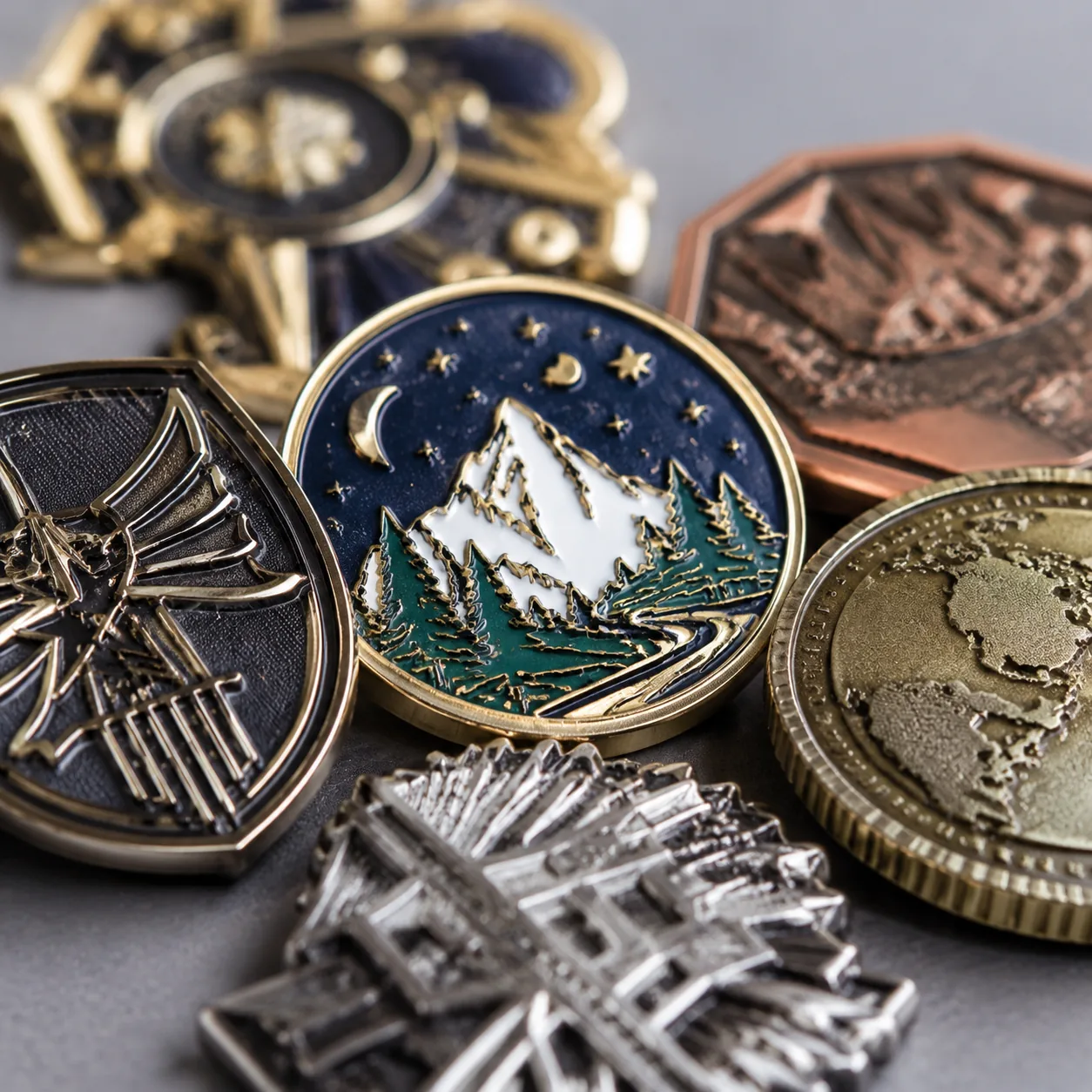
A recurring 2026 failure pattern in custom metal promos is not a bad pre-production sample. It is a good sample followed by uncontrolled drift in bulk. A buyer approves one couriered enamel pin, coin, keychain, medal, or magnet set, then receives 3,000 to 10,000 units with darker or greener plating tone, shallower color fill, weak clutches, off-center magnets, bent split rings, or packaging that scuffs the face during transit.
The root cause is usually not fraud. It is under-specification. A factory can plausibly claim the shipment is 'per approved sample' when the sample was never converted into measurable production criteria. On visual products such as soft enamel pins, imitation hard enamel badges, die-struck coins, zinc alloy keychains, and carded magnets, phrases like 'premium finish,' 'same as sample,' or 'good antique effect' are too subjective to control variation across shifts, lots, subcontracted plating lines, manual enamel filling, and hand pack-out.
The risk rises as orders move from 100 pieces to 1,000+, when finishes change from bright nickel to imitation gold or antique brass, when epoxy domes, custom backing cards, or rigid boxes are added, or when several SKUs are combined in one shipment. Every extra process step changes yield. Plating bath chemistry drifts, polish pressure varies, enamel fill height depends on operator technique, cure windows get shortened to recover schedule, and finished pieces pick up scratches during assembly and carton loading.
The correction is not a vague request for 'better QC next time.' The correction is a reset: define the product in engineering terms, isolate the actual failure mode, and align inspection points to the real process risks. That is what turns a one-off sample approval into a repeatable production standard.
1) Build a defect map before disputing the shipment
Start with evidence, not a broad complaint. For receipts under 5,000 units, inspect at least 32 to 50 pieces across multiple cartons. For 5,000 to 20,000 units, inspect 50 to 80 pieces, ideally pulled from early-, mid-, and late-packed cartons. If cartons carry lot codes, plating dates, assembler IDs, or line numbers, sample across those identifiers. The goal is to determine whether the problem is isolated, carton-specific, lot-specific, or systemic.
Log each defect by type and count: plating tone variance, low enamel fill, pits, exposed base metal, burn marks at edges, post mislocation, weak clutch retention, ring deformation, epoxy bubbles, magnet detachment, wrong card, wrong barcode, count shortage, or transit compression damage. Track units with multiple defects separately so you can distinguish cosmetic fallout from functional fallout.
Use a formal AQL framework even after receipt. For most custom metal promo items, AQL 2.5 for major defects and 4.0 for minor defects is a workable baseline. Premium retail, museum, licensing, or executive gift programs often tighten major defects to AQL 1.5. Functional or safety-related failures should be treated as critical or major, not minor. A detached magnet, broken pin post, exposed sharp burr, split ring that opens under low load, or loose screw-back fitting is not just cosmetic.
Separate design dissatisfaction from true nonconformance. If the drawing specified 28.0 mm overall size and production measures 27.92 to 28.08 mm, the lot may still be inside a realistic tolerance of +/-0.10 mm. But if the design called for a 0.80 mm border and 18% of inspected pieces show 0.50 to 0.60 mm on one side, that is process control failure. Factories can argue preference changes. They have a harder time arguing measured variance against signed specs.
- Record SKU, PO number, carton number, lot/date code, inspected quantity, and defect counts by category.
- Photograph defects beside a caliper, thickness gauge, ruler, or pull gauge where relevant.
- Classify each issue as critical, major, or minor before contacting the supplier.
- Check whether failures cluster by finish, hardware lot, assembly line, or packaging shift.
- Compare received goods against the signed PO, approved artwork revision, spec sheet, and sample log together.
2) Rewrite the spec sheet around measurable risk points
Most sample-pass, production-fail cases start with incomplete specs. A PO that says '30 mm soft enamel pin, gold plating, butterfly clutch' does not control the variables that actually drift in mass production. It says nothing about thickness tolerance, minimum line width, enamel depth, plating target, post location, burr allowance, clutch retention, scratch standard, backing card slot position, or polybag thickness.
For a 30 mm stamped iron or brass pin, a usable control sheet should state values such as: overall size 30.0 mm +/-0.15 mm; thickness 1.50 mm +/-0.10 mm; minimum raised metal line width 0.25 mm; minimum recessed color area width 0.30 mm; soft enamel fill 0.03 to 0.08 mm below metal line; imitation hard enamel polished flush with no pit over 0.15 mm on the front face; post location tolerance +/-0.50 mm; no sharp burr detectable in normal finger sweep; and no visible front-face scratch longer than 1.5 mm when viewed at 30 cm under 800 to 1,000 lux neutral white light.
Plating needs equal discipline. Decorative plating on promo metal goods is thin by jewelry standards, so small process changes create visible shade drift. For standard bright nickel, imitation gold, black nickel, gunmetal, or antique brass, a practical decorative top-layer target is often 0.03 to 0.08 microns over the supplier's normal base system. If corrosion or abrasion resistance matters, specify an added clear e-coat or lacquer and define the acceptable visual result after pack-out. For premium programs, ask the supplier to declare the plating stack rather than relying only on finish names such as 'gold' or 'antique brass.'
Hardware is another common blind spot. A 25 mm split ring that passed on a sample may fail in bulk if wire diameter drops from 1.8 mm to 1.5 mm. A butterfly clutch may look the same but retain more loosely if spring temper changes. Magnets should specify type, grade, dimensions, and bond method. A practical note would read: NdFeB N35, 10 x 1 mm for badge units under 12 g; ferrite 12 x 2 mm for low-cost fridge magnets; epoxy adhesive or specified acrylic foam tape; cure minimum 24 hours before pack-out and 48 hours before pull verification.
| Risk point | Weak sample-only approval | Production-grade respec |
|---|---|---|
| Plating tone | Match approved sample | Match sealed master under 800-1,000 lux; decorative finish target 0.03-0.08 microns; no exposed base metal at 30 cm visual check |
| Soft enamel fill | Looks even | Fill 0.03-0.08 mm below metal line; no pit over 0.20 mm; color boundary shift max 0.15 mm |
| Pin attachment | Standard butterfly clutch | Single post for simple pins under 32 mm; dual posts for >32 mm or anti-rotation shapes; post location +/-0.50 mm; clutch fit check on 20 pcs per lot |
| Coin weight and edge | 45 mm antique brass coin | Diameter 45.0 mm +/-0.20 mm; thickness 3.0 mm +/-0.15 mm; weight 32-36 g depending on alloy; edge pattern continuous with no flat skip over 2.0 mm |
| Keychain hardware | Standard split ring and swivel | Split ring OD 25.0 mm +/-0.30 mm; wire dia 1.8 mm +/-0.10 mm; swivel thickness >=2.0 mm; no ring opening gap over 0.30 mm |
| Magnet assembly | Strong magnet | NdFeB N35 10 x 1 mm or ferrite 12 x 2 mm as specified; adhesive cure >=24 h before packing; pull test threshold defined |
| Packaging fit | Packed individually | Backing card slot position +/-1.0 mm; polybag thickness 0.04-0.05 mm; 80 cm drop test with no front-face scuff from internal contact |
3) Identify whether the failure is drift, substitution, or screening breakdown
The remedy depends on the cause. If dimensions are stable but plating shade varies by carton, the issue is usually process drift: polishing inconsistency, contaminated bath chemistry, poor rack distribution, uneven antique oxidation, or mixed run dates. If key rings bend more easily than the sample, magnets feel weaker, or clutches fit looser, suspect material or hardware substitution. If defects are visually obvious but random, the lot may have suffered from weak final screening rather than upstream process failure.
Each cause leaves different evidence. Process drift usually appears as lot-to-lot visual variation with similar geometry and weight. Substitution often appears as measurable change: lower unit weight, smaller wire diameter, lower pull force, thinner apparent plating after rub exposure, or softer bend behavior. Screening failure usually presents as mostly normal goods mixed with avoidable outliers such as dirty enamel cells, heavy front scratches, missing backs, wrong cards, missing inserts, or parts packed before adhesive fully cured.
Ask the factory for three records: production lot dates, incoming hardware or magnet lot records, and final inspection reports. A competent supplier should be able to show whether one order was split across more than one plating bath, whether clutch backs or rings came from a substitute vendor, and what reject categories were found during in-line and final inspection. If they cannot provide even minimal traceability, that is a future sourcing risk signal.
For custom metal products, a credible final inspection should include appearance checks under fixed light, random dimensional verification with calipers, assembly integrity checks, count verification, and packaging review against an approved pack spec. For magnets, add retention testing. For keychains, add ring opening resistance and swivel rotation checks. For pins, inspect post alignment and clutch fit, not just the front face.
4) Convert the golden sample into a measured master
Too many teams treat the golden sample as a visual token. It should be an instrumented master. That means the approved piece is measured, photographed under fixed lighting, linked to the artwork revision, and paired with a one-page control sheet. The master should record exact finish name, dimensions, hardware configuration, packaging components, and permissible cosmetic variation.
A practical setup is to keep three references: one sealed factory master, one buyer-retained master, and one expendable inspection sample for in-line comparison. On the sealed master file, record overall dimensions, rim and center thickness where relevant, attachment location, plating designation, Pantone references or nearest achievable match, weight range for coins or heavy keychains, backing card orientation, insert revision, and barcode version.
If the original sample contained ambiguous or borderline details, do not preserve the ambiguity. Correct it. If a 45 mm challenge coin was approved as 'antique brass' but stakeholders later disputed whether recessed fields should be darker, lock the target with front and back reference images plus a note such as: 'Recessed fields retain visible oxidation; raised logo polished brighter; overall tone medium-dark antique, not bright brass.' The same method applies to black nickel, rainbow plating, glitter enamel loading, glow enamel brightness, and epoxy dome clarity.
Measured masters matter most on reorders and mixed-SKU programs. Staff turnover, new account managers, and process changes quickly erode memory-based approvals. Once the master is quantified, the next order can be judged against a stable production standard instead of recollections of one old courier sample.
5) Scale QC to order size, SKU complexity, and finish risk
Inspection intensity should follow risk. A 100-piece reorder of a simple die-struck pin does not need the same controls as a 6-SKU event set with pins, coins, keychains, magnets, backing cards, and rigid gift boxes. The more finishes, hand assembly steps, and pack components involved, the more likely it is that a good metal body still becomes a bad shipped product.
A practical stage-gate plan is: incoming material and hardware check before production; first-off approval on 5 to 10 pieces per SKU; in-line inspection at roughly 10% to 20% completion; post-plating and post-color review; pre-pack review after adhesive cure or hardware assembly; then final random inspection to agreed AQL. For orders above about USD 5,000 FOB or above 3,000 total units, these controls usually cost less than one partial remake or one delayed launch.
Lead times also need to reflect process reality. For standard China-based custom metal production in 2026, common MOQ tiers are: enamel pins 100 pcs per design, challenge coins 100 pcs, keychains 100 to 300 pcs depending on mold and hardware, medals 100 pcs, and carded magnet sets usually 300 pcs or more. Typical pre-production sample lead time is 5 to 9 calendar days after artwork confirmation. Bulk production is commonly 10 to 18 calendar days after sample approval for standard quantities. Antique finishing, epoxy domes, gift boxing, manual carding, or mixed-SKU assorting usually adds 2 to 6 more days. If the supplier promises sample in 3 days and mass production in 7 days for a plated, color-filled, carded multi-SKU order, expect shortcuts.
| Order profile | Typical MOQ / FOB price context | Suggested QC plan | Lead-time effect |
|---|---|---|---|
| 100-300 pcs, 1 simple pin SKU | MOQ 100; about USD 0.55-1.10 FOB at 1,000 pcs benchmark, higher at low qty | First-off approval plus final random inspection | Adds 1-2 days |
| 500-2,000 pcs, 1 finish plus carding | MOQ 100-300; custom pack often adds USD 0.08-0.35/pc FOB | First-off, in-line at 20%, final AQL 2.5/4.0 | Adds 2-4 days |
| 2,000-10,000 pcs, mixed SKUs or hardware | Coins often USD 1.20-2.80 FOB at 1,000 pcs; keychains commonly USD 0.85-2.20 depending on hardware and pack | Stage gates by process, packaging-line checks, carton-based final sampling | Adds 3-6 days |
| Premium gift set or deadline launch | Higher labor and sorting cost; 100% visual screening may be justified | Sealed master, tightened major criteria, 100% sort on critical cosmetics | Adds 4-7 days |
6) Match the commercial remedy to the actual defect
Not every failure justifies a full remake. If the issue is a slight plating tone shift on giveaway items needed for an internal event in 10 days, sorting, partial credit, or repacking may be more rational than restarting production. If the issue affects function, safety, brand color, licensed artwork, or customer-facing presentation, replacement is usually justified.
Use a disposition matrix. Accept with discount: light backside scuffs, small carton print variance, or minor polybag wrinkling that does not affect retail presentation. Rework: missing clutch backs, loose rings, card insertion errors, removable contamination, or magnets packed before full cure but still recoverable. Replace: detached posts, off-center hardware drilling or casting, severe front scratches, wrong backstamp, enamel contamination trapped under epoxy, brand color mismatch outside agreed standard, or dimensions beyond tolerance.
Price context matters in negotiation. A 30 mm soft enamel iron pin typically runs about USD 0.45 to 0.90 FOB at 1,000 pcs depending on plating, color count, backing, and packaging. A 45 mm die-struck or zinc alloy coin often runs about USD 1.20 to 2.80 FOB at 1,000 pcs. A metal keychain with swivel, custom card, and polybag can move above USD 1.00 FOB quickly, while premium hardware, spinner structures, or gift boxing pushes it further. On low-unit-cost items, suppliers often resist full remake demands unless the breach is clearly measurable, which is why a quantitative control sheet works better than a general complaint email.
Before demanding compensation, calculate the real commercial path: sort labor, salvageable quantity, local rework feasibility, expedited remake cost, shipping upgrade cost, and event-date risk. Buyers who propose a documented and proportional remedy usually get faster resolutions than buyers who reject a lot without quantified evidence.
7) What the next RFQ and PO must include
If you have just experienced a sample-pass, production-fail order, do not reorder with 'same as last time, but improve QC.' Send a corrective package: defect map, revised control sheet, measured master references, acceptance criteria, and updated inspection plan. That gives the supplier a real production target and gives your receiving team a defensible acceptance standard.
On the RFQ or PO, request MOQ tiers, sample lead time, mass-production lead time, and the cost impact of tighter controls. For example: quote at 100, 300, 500, and 1,000 pcs per SKU; provide sample in 5 to 9 calendar days; bulk in 10 to 18 days after approval; state any surcharge for upgraded plating control, in-line inspection, or 100% visual sorting. If multiple SKUs will be packed together, require a packing mockup, carton assortment plan, and barcode map before production begins.
If you want supplier input rather than simple execution, send the artwork plus use case, target budget, defect sensitivities, and known historical failures. A capable factory can then tell you where to spend tolerance and inspection effort: plating consistency for presentation coins, clutch retention for wearable pins, magnet bond strength for fridge sets, split-ring gauge for keychains, or packaging protection for glossy epoxy items. That is usually the difference between a custom metal program that drifts on every reorder and one that stays stable.
- Create a one-page control sheet for every SKU before mass-production approval.
- Set AQL and define critical, major, and minor defects by end use, not by factory habit.
- Measure and log the approved sample: size, thickness, hardware position, weight, finish, and packaging fit.
- Specify plating target, minimum line widths, enamel tolerance, hardware dimensions, magnet grade, adhesive cure time, and packaging material thickness.
- Use stage-gate inspections for mixed programs instead of relying only on final random checks.
- Quote MOQ tiers, FOB assumptions, and lead-time impact for tighter QC or 100% sorting.
- Keep sealed factory and buyer masters so reorders are judged against the same measured reference.
Have a project? Send your artwork and target quantity and we’ll reply with a detailed quotation within 12 working hours.
Ready to get this made?
Send your sketch, target quantity and ship-date. Detailed quotation in 12 hours.



