When a Promo Set Must Ship Together: Specing Mixed Items
Define the Set Before Defining the Parts
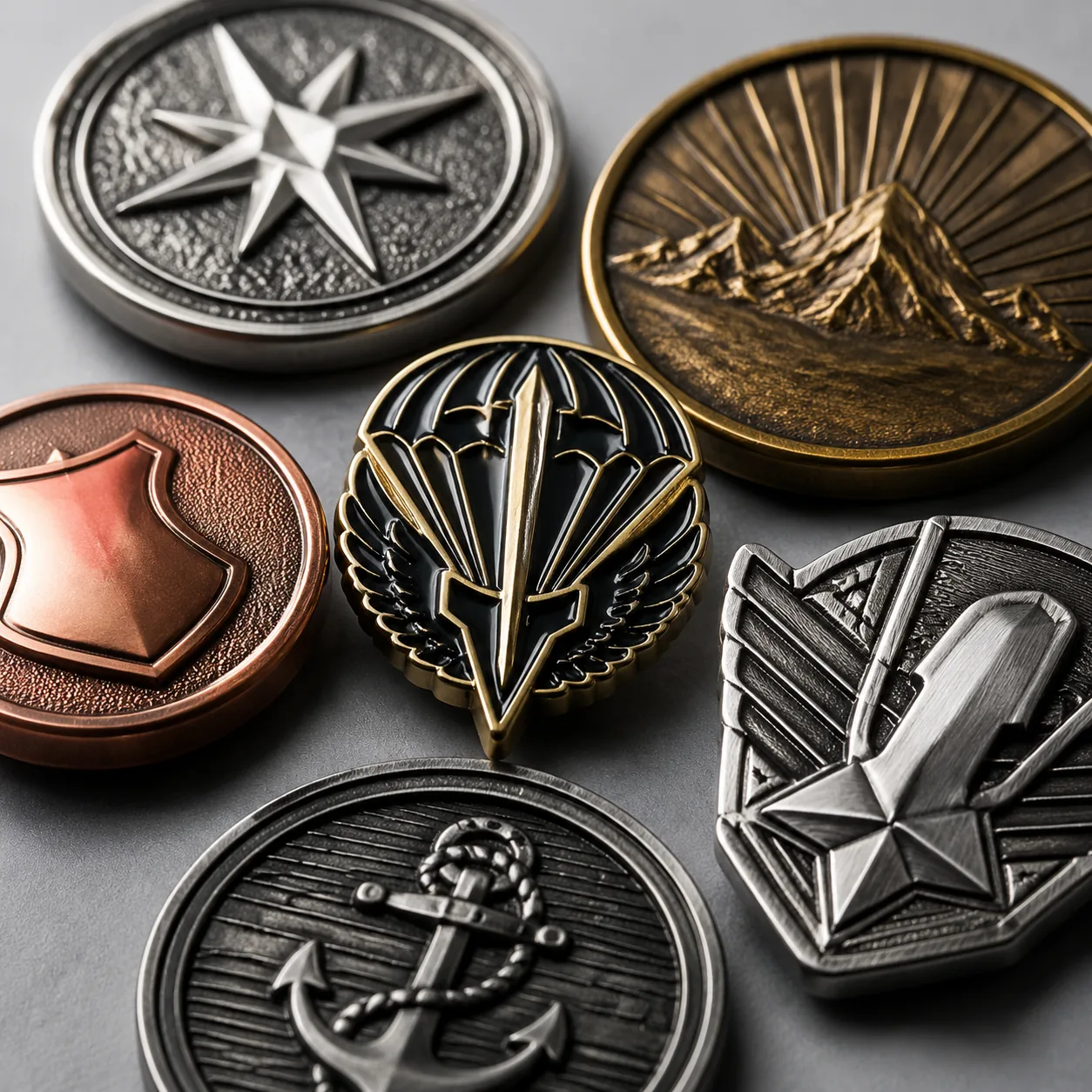
Mixed promo sets usually fail as systems, not as individual products. A 25 mm hard enamel pin can pass inspection, a 45 mm die-struck coin can meet its drawing, and a woven patch can match its thread card, yet the finished box still looks improvised if the gold tone, Pantone blue, logo scale, border weight, and tray clearances were never specified together.
This risk is highest in event merchandise, employee welcome kits, sponsor packs, and retail gift sets where each component is approved on a separate proof. Metal items may run through different stamping and plating lines, patches through a textile line, lanyards through a sublimation or screen-print line, and final packing through an assembly team that has never seen the approved samples. Each item may be “within tolerance,” but the kit can still show color drift, mismatched hardware, loose cavities, or inconsistent branding.
For a 1,000-set order, the cost of failure is rarely the defective component alone. Repeating one plated item can add 10 to 18 days; remaking a custom insert can add 7 to 14 days; repacking 1,000 boxes can add USD 80 to 350 in labor before freight impact. The specification must therefore define the relationship between SKUs, not just the acceptance criteria for each SKU.
Build One Master Spec and SKU Appendices
Start with the intended user experience. Identify the hero item, the support items, the wearable item, the attachment item, and the package role. In many corporate sets, the challenge coin or hard enamel pin carries the highest perceived value, while the lanyard, patch, and box reinforce brand color. That hierarchy determines where tighter tolerances, better plating, and more expensive packaging are justified.
Use one master specification with SKU appendices. The master layer should list shared references: Pantone system, metal finish, logo lockup, background colors, inspection level, package dimensions, barcode format, carton marks, and final assembly method. The appendices should carry item-specific details: pin thickness, coin diameter, patch backing, lanyard width, keychain hardware, tray cavity, and functional tests.
- Use one color standard, such as Pantone Solid Coated, and cite the exact code on every proof
- Approve one physical plating master for metal items; do not rely on names such as shiny gold or antique brass
- Rank visual priority: hero item first, wearable items second, packaging third, concealed parts last
- Define which attributes must match across SKUs and which may vary by substrate or process
- Freeze the final packed size before tooling inserts, sleeves, retail boxes, or master cartons
- State whether overage is allowed as loose spare parts or only as complete assembled sets
Replace subjective instructions with measurable ones. A usable callout is: bright imitation gold plating to approved swatch; visible face free of pits over 0.20 mm; Pantone 286 C target, process-dependent tolerance approved by first article; full set to fit a 180 × 120 × 28 mm box; no component displacement after a 60 cm hand drop on one face and one corner.
Quote the Real Commercial Unit
Mixed-set pricing becomes unreliable when suppliers quote different processes under hidden assumptions. One pin quote may assume soft enamel with epoxy, while another assumes hard enamel without epoxy. A patch may be priced with a merrowed border although the art requires a heat-cut outline. A lanyard quote may assume one-side screen print while the buyer expects two-side dye sublimation, safety breakaway, and a metal lobster hook.
The commercial unit is the complete shippable set, not the lowest MOQ component. Metal items can often start at 100 to 300 pcs, but lanyards usually price more efficiently at 500, 1,000, and 3,000 pcs because webbing, print setup, and waste are spread across the run. Custom printed boxes and trays often start at 500 to 1,000 pcs. If the set must ship complete, the constraint is the highest MOQ, the slowest component, and the packing-line capacity.
| Component | Practical MOQ tiers | Typical USD FOB range | Normal lead time after approval | Spec risk to lock |
|---|---|---|---|---|
| Hard or soft enamel pin, 20–35 mm | 100 / 300 / 500 pcs | USD 0.70–2.60 each | 12–20 days | Plating tone, enamel level, clutch type, epoxy decision |
| Challenge coin, 40–50 mm | 100 / 300 / 500 pcs | USD 1.80–6.20 each | 15–25 days | Edge style, weight, antique depth, capsule fit |
| Woven or embroidered patch, 60–90 mm | 100 / 300 / 500 pcs | USD 0.40–1.75 each | 10–18 days | Thread color, border method, backing adhesion |
| Printed lanyard, 15–20 mm wide | 500 / 1,000 / 3,000 pcs | USD 0.30–1.25 each | 10–18 days | Print registration, hook finish, breakaway strength |
| Metal or PVC keychain | 100 / 300 / 500 pcs | USD 0.80–3.10 each | 12–22 days | Ring pull strength, logo alignment, plating match |
| Rigid or paperboard set box | 500 / 1,000 / 2,000 pcs | USD 0.45–2.80 per set | 12–25 days | Insert clearance, scuffing, assembly labor |
Request tooling, mold, print setup, packaging, assembly, inspection, and spare-part charges as separate lines. A coin quoted at USD 2.10 FOB at 500 pcs may also carry USD 80 to 180 in die cost. A custom EVA or paperboard insert can add USD 0.25 to 0.90 per set. Manual assembly commonly adds USD 0.08 to 0.35 per set depending on SKU count, labels, and polybagging. These numbers matter when comparing suppliers and when planning reorders.
Set Process-Based Tolerances
A Pantone callout does not guarantee identical color across enamel, polyester webbing, woven thread, PVC, paperboard, and ink. Each material reflects light differently, and metallic finishes shift under warm or cool lighting. The correct target is controlled visual harmony. For brand-critical colors, approve one physical first article for each process and review the assembled set under the same light source, ideally D65 daylight or a controlled 4000K to 6500K lamp.
For stamped metal, define thickness, relief, recess, and surface limits numerically. Common enamel pins are 1.2 to 1.8 mm thick; heavier premium pins may be 2.0 mm. Challenge coins are typically 2.5 to 4.0 mm thick depending on diameter and edge style. Practical dimensional tolerance is usually ±0.20 mm for small pins and ±0.30 mm for larger coins, unless the item must sit in a tight molded tray. Avoid enamel-separated strokes below 0.20 to 0.25 mm because plating bridges, clogged recesses, and enamel bleed become likely.
For textile and print items, use process-specific limits. Woven patches reproduce finer detail than embroidery, but strokes below 0.30 mm and small text under 4 to 5 mm height can still close up. Embroidered patches may vary ±1.0 mm on irregular outlines. Lanyard logo registration of ±1.0 to 1.5 mm is common over long webbing; if the logo must sit near a buckle, specify the distance from the clip fold to the first repeat and the allowable offset.
| Attribute | Control point | Typical tolerance or limit | Reason |
|---|---|---|---|
| Brand color | Physical swatch plus Pantone code | Delta E under 2–3 where measurable; visual approval for metallics | Controls visible drift across substrates |
| Metal dimensions | Pin, coin, and keychain drawings | ±0.20–0.30 mm on critical dimensions | Protects tray fit, weight, and perceived value |
| Minimum line width | Vector art before tooling | 0.20–0.25 mm for enamel; 0.30 mm for woven detail | Prevents filled gaps and lost text |
| Patch outline | Merrowed, embroidered, woven, or heat-cut edge | ±1.0 mm typical on textile shapes | Keeps patches centered in cards and trays |
| Tray clearance | Actual production item plus cavity | 0.5–1.5 mm per side depending on material | Prevents rattle without crushing surfaces |
| Flat print registration | Cards, sleeves, labels, and lanyards | ±0.5 mm flat print; ±1.0–1.5 mm webbing | Keeps logos and barcodes clean |
Schedule Sampling, Fit, and Release Gates
A mixed set needs one master timeline with different gates by process. Artwork approval can run in parallel, but first article approval must check each production method: enamel fill and plating on the pin, edge detail and relief on the coin, stitch density on the patch, print repeat on the lanyard, ring strength on the keychain, and cavity fit in the package. A rendered mockup is not a production sample.
For a straightforward set using an existing box size, a realistic schedule is 3 to 5 days for artwork cleanup, 7 to 12 days for metal and textile samples, 3 to 5 days for buyer comments, and 15 to 25 days for mass production after approval. Custom rigid packaging, molded pulp, PET trays, or EVA inserts can add 7 to 14 days because actual product thickness must be checked before production. A complete program commonly lands at 28 to 45 days after final artwork approval, excluding international transit and customs clearance.
The safest sequence is master artwork lock, material and finish confirmation, individual first articles, full-set packaging fit sample, mass-production release, in-process check, pre-shipment inspection, and final packing release. If the launch date is fixed, reduce complexity rather than deleting a gate. Using one plating family, standard lanyard hardware, stock box dimensions, or a paperboard insert can save more time than skipping the fit sample and finding the problem at final packing.
- Issue one signed approval file listing every SKU, revision date, dimension, finish, and package requirement
- Inspect the highest-risk item first, usually custom metal or custom packaging
- Perform the fit test with final item thicknesses, not only printed dielines
- Reserve 3–5 days for buyer review after physical samples arrive
- Set the ship date from the slowest approved component, not the first completed SKU
- Define air, sea, and split-shipment rules before production if timing is critical
Inspect the Assembled Relationship
AQL inspection is useful but incomplete for kits. A common baseline is ANSI/ASQ Z1.4, General Inspection Level II, with AQL 2.5 for major defects and 4.0 for minor defects. Premium retail or executive sets may need AQL 1.0 for major visual defects, plus 100% checks for missing components, wrong labels, mixed plating, non-functioning clasps, incorrect barcodes, or unsafe sharp edges.
The inspection plan should include both SKU-level checks and set-level checks. SKU checks verify dimensions, finish, function, quantity, and workmanship. Set checks compare all components side by side under the same light source. The inspector should place the pin, coin, keychain, patch, lanyard, and packaging together and assess color temperature, metal tone, logo scale, border thickness, orientation, and retail presentation.
Packaging needs its own acceptance criteria. A cavity 1 mm too small can scratch enamel, bend a patch, or crease a card. A cavity 2 mm too large can let a coin rattle and damage adjacent items. For assembled kits, close the box, shake lightly, reopen it, and confirm that no item moved, rubbed a plated surface, or compressed a textile item. For export cartons, confirm inner pack count, gross weight, carton dimensions, carton burst strength if specified, moisture protection, and PO markings.
- Compare all metal items against the approved plating master before packing
- Measure critical dimensions with calipers on parts and tray cavities
- Check pin backs, split rings, hooks, breakaways, magnets, and patch backing adhesion
- Review printed, woven, and enamel colors under the same light source
- Confirm every retail set contains the exact SKU mix, card, label, barcode, and spare part if required
- Hold shipment if the assembled set fails fit, color harmony, or count, even when single SKUs pass
Specify Packaging as an Engineered Component
Packaging controls assembly speed, product protection, and perceived value. The insert must fit the tallest item, protect the most fragile surface, and hold soft goods without wrinkles. A box designed around a thin pin may leave a keychain loose. A box designed around a bulky keychain may make the patch look undersized and the lanyard look randomly folded.
The packaging spec should state outer dimensions, board grade, paper weight, lamination, insert material, cavity size, product orientation, fold direction, label position, barcode size, and whether the set is retail-facing or transit-only. EVA foam, PET trays, molded pulp, and folded paperboard behave differently. EVA grips metal well but can scuff bright plating if the cavity is tight. Paperboard is lower cost and more recyclable, but it needs crease control and can deform under heavier coins.
Use actual dimensions when designing cavities. A folded 20 mm lanyard with a metal hook may need an 85 to 120 mm pocket depending on fold style. A 45 mm coin in an acrylic capsule may need a 6 to 8 mm recess depth, while a loose 3 mm coin needs less depth but better anti-scratch separation. If protective film, tissue, polybags, or sleeves are allowed, include them in the fit sample because they change both labor and appearance.
Cost moves quickly with packaging decisions. A printed tuck box may add USD 0.20 to 0.60 per set at 1,000 pcs. A rigid box with EVA or paperboard insert may add USD 0.80 to 2.80 per set before assembly. If the program is for internal distribution rather than retail sale, a labeled inner pack inside a master carton may reduce cost, damage, and packing time while still keeping the kit organized.
Freeze Ownership Before the Purchase Order
Before issuing the purchase order, freeze the item list, set quantity, approval owner, and revision process. Mixed sets become expensive when marketing, procurement, and events approve different details. The supplier should receive one controlled master file with final artwork, finish references, quantity by SKU, packaging drawings, inspection requirements, ship-to details, and split-shipment instructions. Every later change should carry a revision number and date.
The purchase order must state whether the supplier is responsible for complete assembled kits or only individual goods. If the supplier assembles the set, define acceptable overage, spare-part handling, missing-component liability, packing sequence, and final carton configuration. “1,000 complete sets plus 2% spare pins” is different from “1,020 pins, 1,000 patches, and 1,000 boxes.” Extra units of one SKU do not solve a shortage in another when the deliverable is a complete kit.
The final test is simple: a buyer should be able to open one finished box and see one coherent brand system. That result comes from physical references, numeric tolerances, realistic lead times, and a QC plan that inspects the relationship between items. In mixed promo sets, coherence is not a style preference; it is the specification that protects the launch date.
Have a project? Send your artwork and target quantity and we’ll reply with a detailed quotation within 12 working hours.
Ready to get this made?
Send your sketch, target quantity and ship-date. Detailed quotation in 12 hours.



