When a Custom Pin Order Fails Drop Test: 2026 Respec Plan
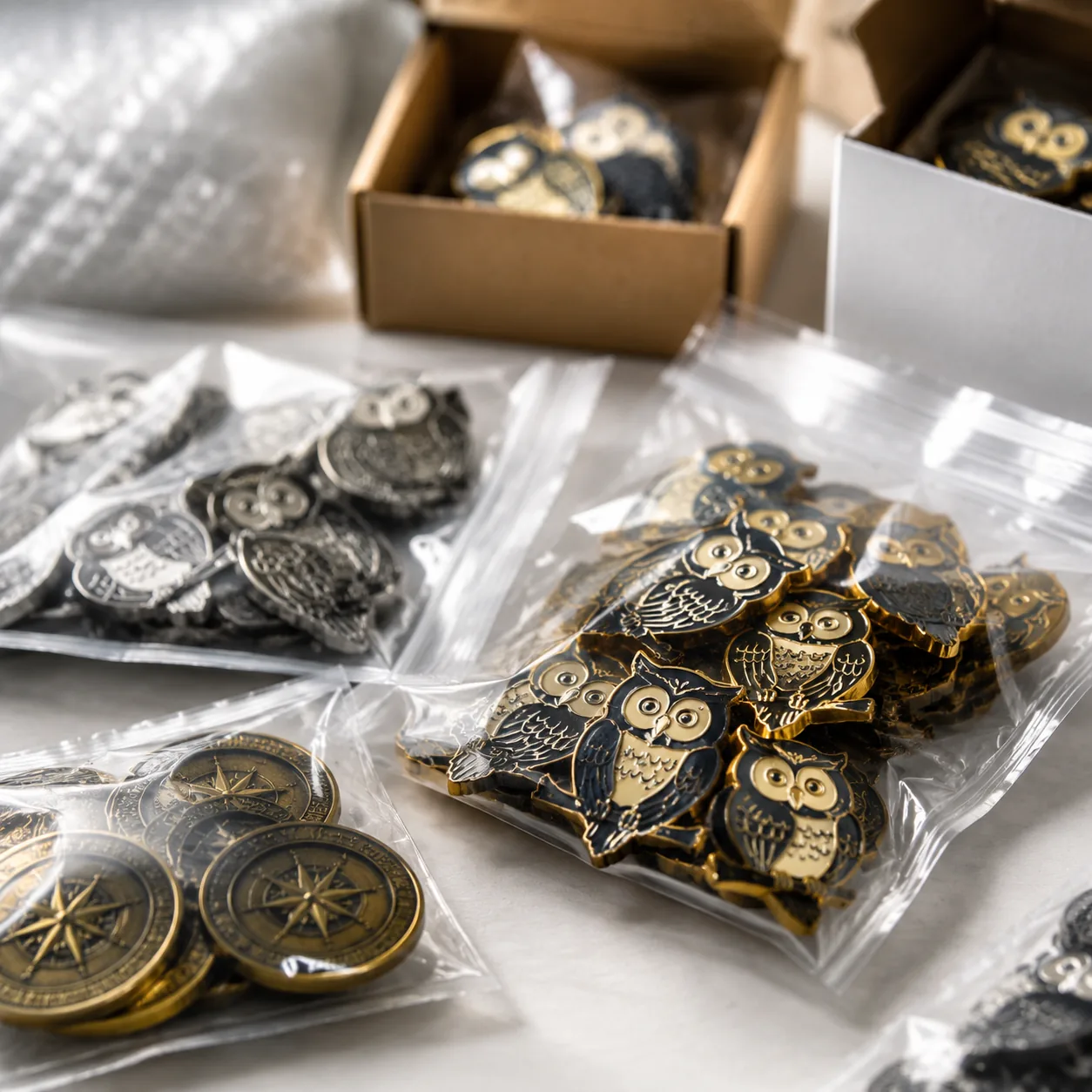
The field failure: 8,000 event pins looked approved, then failed in wear
A distributor ordered 8,000 soft enamel pins for a three-day conference. Pre-shipment approval focused almost entirely on appearance: Pantone match was within the approved range, logo lines were readable, enamel fills looked clean, and bright nickel plating appeared even under standard inspection lighting. Two weeks after delivery, user complaints started. Posts bent during normal fastening, butterfly clutches loosened after repeated wear, enamel chipped at exposed corners after pocket-height drops onto concrete, and some pins rotated on lightweight shirting because the single post sat too close to the center of mass.
This is a common gap between visual QC and functional QC. AQL alone can catch wrong color, plating blemishes, missing hardware, and obvious scratches, but it does not predict whether a pin will survive real use. A pin can pass AQL 2.5 major / 4.0 minor and still fail after three fastening cycles or one drop onto a hard floor. For 2026 sourcing programs, better buyers are rewriting RFQs around failure modes first: retention, solder integrity, post stiffness, chip resistance, edge geometry, and fabric stability.
The underlying problem is usually product mismatch. A collectible pin sold on a backing card can tolerate one post, sharper geometry, lighter clutch retention, and finer but more fragile relief. A conference giveaway handled by thousands of attendees cannot. If the use case changes but the collectible-pin spec stays in place, returns are not random; they are engineered in.
Why the original pin spec was vulnerable
The original build was a standard low-cost quote: 32 mm soft enamel iron pin, 1.2 mm body thickness, one butterfly clutch, die-struck outline, bright nickel plating, no epoxy, individually polybagged. At 5,000 to 10,000 pieces, a realistic 2026 FOB China range for this build is about USD 0.38 to 0.48 each for 2 to 4 enamel colors, with 5 to 7 days for a pre-production sample and 15 to 18 calendar days for bulk production after approval.
No single choice was automatically wrong. The problem was the stack-up. At 32 mm overall size, a 1.2 mm iron base with broad recessed enamel fields is easier to flex, especially along long unsupported edges. If the artwork also includes metal bridges below 0.30 to 0.35 mm in iron, outer borders below 0.35 mm, or pointed enamel corners at the perimeter, impact loads concentrate at the rim and chipping risk rises. For practical factory repeatability, a minimum raised metal line width of 0.30 to 0.35 mm is safer in iron; brass can usually hold 0.25 to 0.30 mm more consistently.
Attachment was the weakest part of the original design. A single central post may be acceptable for a 20 to 25 mm lightweight pin, but it is marginal for a 32 mm event pin worn on woven shirts, jackets, or tote bags. Economy posts are often only 0.7 to 0.8 mm in diameter. If post length is 10 mm or more, leverage increases and bend risk rises. If the solder pad is small or the solder fillet is incomplete, the post may wobble before it detaches. If no retention grade is specified, the factory will usually install whichever butterfly clutch is standard stock, not the tightest lot.
The purchase order also described appearance, not abuse performance. There was no written drop test, no attachment-cycle requirement, no minimum solder pad diameter, no acceptance rule for solder fillet coverage, and no reject threshold for front-edge chips. When a supplier receives only cosmetic criteria, the factory naturally optimizes for visual yield and low cost rather than durability.
Respec from the failure data, not from opinion
Before changing the drawing, classify the returns by actual failure mode and count them. Use categories such as post detachment, bent post, loose clutch, enamel edge chip, face scratch, plating rub-through, and rotation on fabric. The ranking matters because the highest-frequency defect should drive the first spend.
In this case, field reports showed roughly 7% clutch looseness, 3% post bending or wobble, 2% enamel chipping after drops, and frequent user complaints about rotation on lightweight shirts. That points to three immediate priorities: attachment retention, anti-rotation stability, and edge protection. It does not justify spending first on heavier decorative plating, upgraded backing cards, or premium gift-box packaging.
A better 2026 RFQ line is specific about use: 'For conference distribution; worn on shirts, jackets, and tote bags; expected wear period 1 to 7 days; may be dropped from pocket height onto concrete; must withstand at least 10 attach/remove cycles without clutch loosening or post wobble.' That single sentence gives the supplier more engineering context than the artwork file alone.
| Failure mode | Likely root cause | 2026 respec action | Typical FOB impact |
|---|---|---|---|
| Clutch falls off | Low-retention economy butterfly; post dia too small; variable spring temper | Specify tight butterfly, rubber clutch, or locking clutch; set post diameter 0.9 to 1.0 mm | USD 0.02 to 0.08/pc |
| Post bends or wobbles | 1.2 mm body flex; post too long; weak solder pad or poor fillet | Increase base to 1.5 to 1.8 mm; set post length 8 to 9 mm; solder pad 4.5 to 5.0 mm | USD 0.04 to 0.10/pc |
| Enamel chips at corner | Sharp outside corners; rim too narrow; enamel too close to perimeter | Round corners to R0.3 to R0.5 mm; widen rim to 0.35 to 0.45 mm; keep metal 0.10 to 0.15 mm above enamel | USD 0.02 to 0.07/pc |
| Pin rotates on fabric | Single post too near center on 32 mm format | Use two posts spaced 16 to 22 mm center-to-center | USD 0.03 to 0.07/pc |
| Front scratches in transit | Pins rubbing in inner packs; high points unprotected | Keep individual polybag or glassine sleeve; inner packs of 50 to 100 with separators | USD 0.01 to 0.04/pc |
The revised build that usually fixes a 32 mm event pin
For this size and use case, the most effective correction is structural. Soft enamel can remain if budget matters, but the body and attachment need to be upgraded. For most event programs, 1.5 mm iron is the minimum sensible default. If the artwork contains fine die-struck lines, small text below about 1.2 mm cap height, or narrow bridges, 1.5 mm brass is often safer because it stamps more cleanly and resists edge distortion better. At 8,000 pieces, realistic 2026 FOB China pricing for a 32 mm soft enamel pin with 2 to 4 colors is usually USD 0.45 to 0.62 in iron and USD 0.58 to 0.78 in brass, bright nickel or imitation gold plating, standard polybag included.
The highest-value change is moving from one post to two. For a 32 mm pin, specify two posts spaced 16 to 22 mm center-to-center, positioned as far apart as the back geometry permits without breaking through fine front features. Set post diameter at 0.9 to 1.0 mm and post length at 8 to 9 mm. Longer posts increase leverage and bend risk. Specify a solder pad diameter of at least 4.5 mm, preferably 5.0 mm if back area allows. Require a continuous visible solder fillet around at least 270 degrees of each post base when checked at 3x to 5x magnification.
For hardware, two tight butterfly clutches are usually acceptable for budget-driven giveaways. If the user group will be highly active, wearing uniforms, or fastening through thicker fabric, a deluxe locking clutch is worth the extra cost. Rubber or PVC clutches can improve grip consistency and user comfort, especially on tote bags, but some buyers still prefer metal clutches for appearance. If the artwork absolutely requires a single post, add an anti-rotation spur or nub, but on a 32 mm pin that remains a compromise rather than a real fix.
Edge protection should be engineered into the drawing. Round outside corners to R0.3 to R0.5 mm wherever branding permits. Keep the outer raised metal border at least 0.35 to 0.45 mm wide. Avoid exposing enamel directly at pointed perimeter tips. A practical soft-enamel target is for the raised rim to stand about 0.10 to 0.15 mm above the enamel fill. If enamel is flush or proud at the edge, it becomes the first point of impact and chip rates rise sharply. For rough-use distribution programs, a clear epoxy dome can reduce scuffing and minor edge damage, but it softens fine detail visually and can mute color slightly. Typical epoxy add-on cost at 32 mm is USD 0.04 to 0.10 per piece and usually adds 1 to 2 days for curing and handling.
What to test before approving the revised sample
Do not approve the revised build from one hand-finished hero sample. Request 10 to 20 process-made samples produced with the actual die, plating line, enamel fill process, and soldering method intended for bulk production. Hand-tuned samples often hide the variation that later appears in solder quality, post alignment, clutch fit, and enamel edge finish.
For this use case, the test plan can stay simple and still be meaningful. Run a 1.2 m drop test onto smooth concrete or an equivalent hard surface, three drops per pin: one face impact, one edge impact, and one random orientation. A reasonable sample size is 10 pieces from the process-made lot. After test, reject any sample with post detachment, visible post wobble, clutch release caused by impact, crack through raised metal, or any front-face or front-perimeter enamel chip larger than 0.30 mm measured at its widest point. Back-side scuffs may be accepted as minor if that is written clearly in the PO.
Then run an attachment-cycle check. On at least 5 samples, attach and remove each clutch 10 times. After the 10th cycle, the clutch must still seat fully and require deliberate hand force to remove. Any clutch that slips off under light shaking, pocket handling, or normal finger contact should fail. Also mount two samples on lightweight woven shirting around 120 to 150 gsm and two on heavier tote or canvas around 240 to 350 gsm for a one-day wear simulation. Check for rotation, post print-through, discomfort, and clutch loosening.
Decorative plating should be specified realistically. On custom pins, bright nickel is decorative, not heavy jewelry plating. In many factories, the bright decorative top layer is only about 0.03 to 0.08 microns over copper and nickel undercoats, and variation by line is normal. If humidity exposure or storage life matters, ask for the full plating stack and whether a clear lacquer topcoat is available. Heavier decorative plating may improve appearance retention slightly, but it will not solve drop failures, bent posts, or loose clutches.
- Require 10 to 20 process-made samples, not one hand-finished approval sample
- Write the drop test into the PO: 1.2 m height, 3 drops per pin, concrete or equivalent hard surface
- Reject any front-face or front-perimeter enamel chip over 0.30 mm
- Specify post geometry: 0.9 to 1.0 mm diameter, 8 to 9 mm length, solder pad minimum 4.5 mm
- Inspect solder fillet completeness at 3x to 5x magnification; require at least 270 degrees coverage
- Run 10 attachment/removal cycles and fail any clutch that loosens excessively afterward
- Check two-post spacing on real shirt and tote fabrics, not only on backing cards
QC language that links sample approval to mass production
Most preventable pin disputes come from vague wording. 'Attachment should be firm' is subjective and weak. Better language is measurable: 'No visible post wobble under normal hand mounting force; no detached post; no cracked or incomplete solder joint; no clutch disengagement during incoming inspection or cycle test; no burr capable of catching skin or fabric.' For event-use pins, a loose clutch is a major defect. A sharp burr or needle-like edge should be treated as critical.
For this scenario, a tighter but still workable inspection plan is AQL 0.65 for critical, 1.0 for major, and 2.5 for minor defects. Critical defects can include sharp burrs, detached posts, missing hardware, wrong SKU, unsafe point exposure, or mixed artwork in one lot. Major defects can include bent posts, loose clutches, enamel voids visible at 30 cm, exposed base metal on the front, front-edge chips over 0.30 mm, severe plating pits, or color deviation outside the approved standard. Minor defects can include light reverse-side scratches, slight back plating haze, or packaging marks that do not affect wear.
Dimensional tolerances should also be written into the PO. For a 32 mm pin, outside dimensions of plus or minus 0.20 mm are reasonable on simple shapes; thickness tolerance of plus or minus 0.10 mm is common; post position tolerance of plus or minus 0.50 mm is usually workable; post perpendicularity should be controlled visually and by fit check so the post does not lean enough to impair clutch seating. If the design contains fine detail, specify minimum raised metal widths at 0.25 to 0.30 mm for brass and 0.30 to 0.35 mm for iron, and avoid recessed enamel channels below about 0.30 mm if repeatable fill is required.
To keep factory, buyer, and inspector aligned, lock both a golden sample and a one-page photo defect guide. That guide should show pass/fail examples for enamel edge chips, solder fillet coverage, post alignment, plating marks, burrs, and reverse-side scratches. Without a shared visual standard, the same lot may pass at the factory and fail during third-party inspection.
Cost, MOQ, and lead-time impact of a durability respec
Most durability fixes do not double the unit cost. On an 8,000-piece run, moving from an economy 1.2 mm one-post build to a 1.5 mm two-post event-ready build usually adds about USD 0.07 to 0.18 per piece, depending on metal, clutch grade, and whether epoxy is added. Even at the high end, that increase is cheaper than replacing 5% of a distributed order after freight, customer service labor, and reputation costs are counted.
MOQ is usually not the main barrier. Many factories quote 100 to 300 pieces for sampling economics, 500 pieces for short runs, and better price breaks at 1,000, 3,000, 5,000, and 10,000 pieces. For a respec of an existing item, tooling often remains usable if changes are limited to thickness, post count, and hardware. If the outer geometry must change to widen borders or round corners, a die revision fee around USD 50 to 120 is typical for a simple pin; complex cutouts, layered relief, or multi-level designs can run higher.
Lead time usually extends only slightly. A normal schedule is 5 to 7 days for a revised sample and 15 to 18 days for bulk production after approval. Adding two posts, tighter solder inspection, and written abuse testing may push production to 18 to 22 days. Epoxy usually adds 1 to 2 days. If the clutch type is not standard stock, confirm whether hardware is inventory material or special-purchase material, because that alone can add 3 to 5 days.
| Spec area | Original build | Respecified build | Typical lead-time effect |
|---|---|---|---|
| Body thickness | 1.2 mm iron | 1.5 mm iron or 1.5 mm brass | +1 to 2 days |
| Attachment | 1 post + economy butterfly | 2 posts + tight butterfly / rubber / locking clutch | +0 to 1 day |
| Post geometry | Approx. 0.7 to 0.8 mm dia, length unspecified | 0.9 to 1.0 mm dia, 8 to 9 mm length | No material change |
| Edge geometry | Sharp corners, narrow rim | R0.3 to R0.5 mm corners, rim 0.35 to 0.45 mm | No change if art revision is simple |
| Protection | No epoxy | Optional clear epoxy for rough-use programs | +1 to 2 days |
| QC plan | Visual approval only | Visual + drop + retention + solder checks | +1 day planning |
When this respec is not the right answer
Not every custom pin should be thickened, double-posted, and epoxy-coated. A premium collector pin sold in a presentation box may benefit more from brass, sharper die detail, and tighter plating consistency than from heavy-duty hardware. If the pin is under 20 mm and very light, a second post may add user frustration without meaningful performance gain. If the artwork depends on micro text, miniature channels, or very fine recessed lines, switching from brass to lower-cost iron may hurt legibility more than it helps durability.
There is also a point where a metal lapel pin is simply the wrong product format. If the campaign targets children, heavy outdoor movement, repeated impacts on hard surfaces, or long wear on thin fabrics, a molded PVC badge, woven patch, silicone emblem, or keychain may deliver lower complaint rates at equal or lower total cost. A capable supplier should say that directly instead of over-engineering the wrong product.
The practical next step is simple: take one previous order with field complaints and rewrite the RFQ as a use-case document, not just an artwork file. Include size, base thickness, post count and spacing, post diameter and length, solder pad size, plating finish, packaging, drop-test rule, clutch cycle test, chip threshold, dimensional tolerances, and AQL levels on one sheet. Then ask the supplier to confirm each line item in writing. If the factory hesitates to commit to a tolerance, hardware grade, or test condition, that is useful information before mass production starts.
For 2026 event-distribution pins, a strong default starting point is 25 to 35 mm overall size, 1.5 mm body thickness, two posts when width exceeds 28 mm, corners softened to at least R0.3 mm where design permits, and a written retention plus drop-check standard. The fastest way to reduce returns is not a prettier approval sample. It is a process-made sample built to the real spec and tested the way the product will actually be used.
Have a project? Send your artwork and target quantity and we’ll reply with a detailed quotation within 12 working hours.
Ready to get this made?
Send your sketch, target quantity and ship-date. Detailed quotation in 12 hours.



