When a Campaign Needs 4 Promo Items to Match
The brief that causes most rework
A common procurement problem is not choosing one product, but making four different promo items feel like one campaign. A marketing team may want enamel pins, challenge coins, woven patches, and lanyards to share the same logo, colors, finish, and delivery date, yet each item behaves differently in production. If you do not lock the shared specs early, the pin may match the Pantone reference while the lanyard print shifts, the patch border thickens, and the coin plating arrives warmer than expected. The result is a set that looks assembled from separate vendors rather than a coordinated program.
This scenario is especially sensitive when the items will be distributed together at an event, used in a brand kit, or ordered again later by regional teams. The right approach is to treat the set as one system with shared rules, then define where each product is allowed to differ. That means deciding which details are fixed across all items, which are item-specific, and which tolerances are acceptable without triggering rework. ZheCraft sees the cleanest projects when the buyer writes the campaign spec before asking for quotes, not after samples are already in progress.
Start with the item that sets the visual anchor
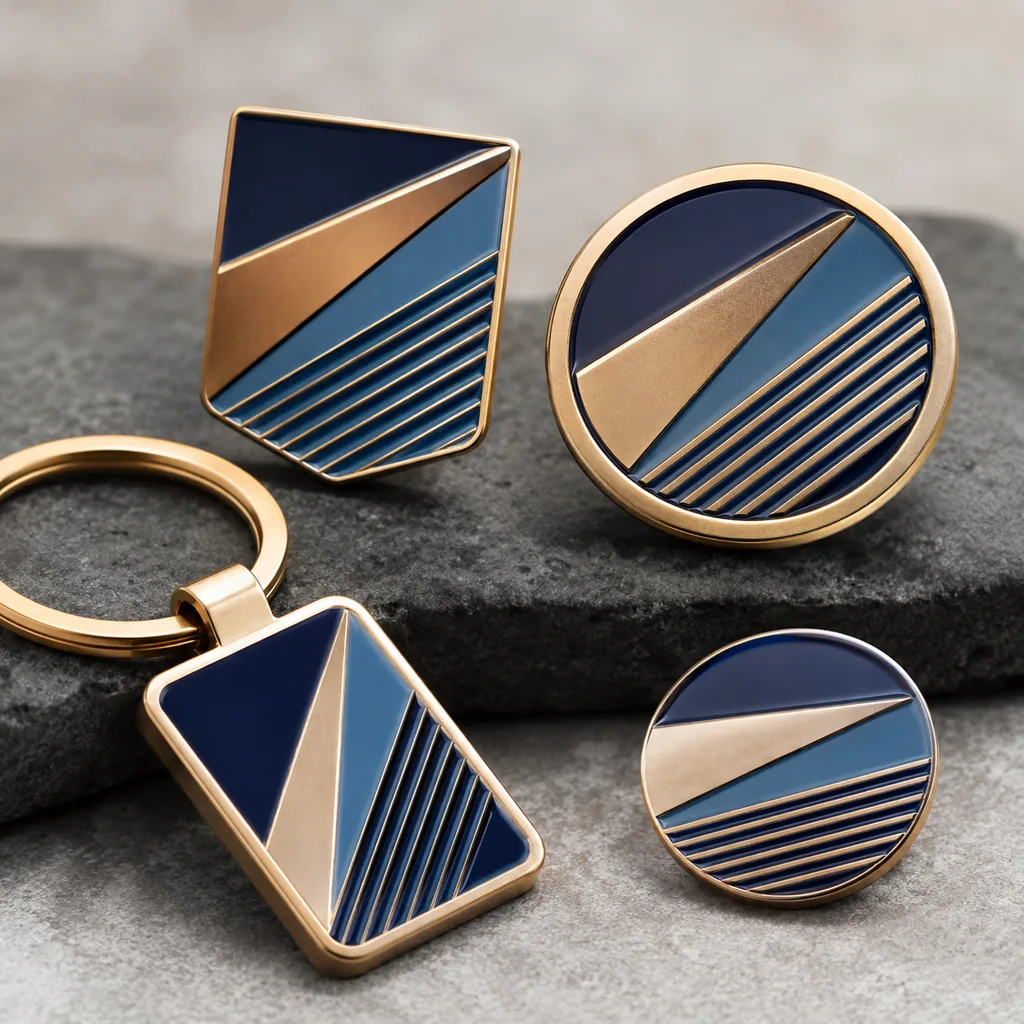
In mixed promo sets, one product should act as the visual anchor. Usually that is the enamel pin or challenge coin because both can carry sharp logo edges, metal finish, and controlled color. For most campaigns, a pin around 25 to 35 mm or a coin around 40 to 45 mm gives enough space for the core logo without crowding fine lines. If the anchor item is too small, every other product gets forced to simplify, and the set loses brand clarity.
For the anchor product, lock the following before anything else: outer dimensions, base metal, plating family, enamel type, and primary Pantone references. If the logo has thin strokes under 0.25 mm, do not let multiple items interpret those lines independently; define a minimum reproduced line width of 0.30 to 0.35 mm for metal items and a slightly looser rule for woven textile. For hard enamel, confirm whether the buyer wants flush-fill polishing or a slightly domed hand feel, because that changes the perceived color depth and edge crispness. A good anchor spec reduces the number of design decisions left for the other three products.
If the campaign has a premium emphasis, the challenge coin often becomes the anchor because it tolerates finer relief and more complex edge treatment. If it is a youth, retail, or pop-culture campaign, the pin may be the better anchor because buyers read it first as a collectible. ZheCraft typically recommends choosing the anchor based on where the brand needs the strongest detail control, not simply on unit price. The cheapest item is rarely the one that should define the whole set.
Lock the shared brand rules before quoting
A multi-item quote is only useful when all suppliers are quoting against the same visual rules. The most common failure is sending one logo file and assuming every item will interpret color, border, and texture identically. For a reliable RFQ, define one master artwork, one approved Pantone set, one metal tone family, and one packaging direction. Then specify what is allowed to vary, such as emboss depth on a coin or weave density on a patch.
Shared rules should be written in plain production language, not just marketing language. Example: gold-plated items should use a bright gold family rather than antique brass; red enamel should match Pantone 186 C within a ΔE target agreed by the buyer and factory; black textile should be yarn-dyed or printed consistently across the set; all items should present the same logo orientation and text spellings. If one item uses a cutout shape, the others should either echo that geometry or clearly opt out. Inconsistent geometry is one of the fastest ways to make a set look unplanned.
- Use one master artwork file with locked fonts and spellings.
- Specify one Pantone list and one acceptable color tolerance policy.
- State whether the set must feel premium, casual, or utility-focused.
- Define which products must match exactly and which can translate the design.
- Confirm whether packaging or backing cards are part of the visual system.
Compare the four product families side by side
Each product in a campaign has different tolerance behavior, minimum detail, and cost sensitivity. Metal items can hold fine geometry but have tooling costs and plating variables. Textile items are softer visually and more forgiving on large shapes, but they lose precision on tiny text. Lanyards are the most length-dependent and print-sensitive, so a color that looks right on a pin can drift on woven or sublimated tape.
| Item | Typical buyer spec to lock | Practical tolerance | Common risk |
|---|---|---|---|
| Enamel pin | 25-35 mm, 1.2-1.5 mm thickness, 0.25-0.30 mm line minimum | ±0.3 mm on outer size | Color chips or over-thin text |
| Challenge coin | 40-45 mm, 2.5-3.5 mm thickness, 0.3-0.4 mm relief | ±0.2 mm on diameter | Relief too shallow after polishing |
| Woven patch | 70-90 mm, 12x12 to 14x14 stitches per cm equivalent | ±1.0 mm on cut shape | Small text becoming unreadable |
| Lanyard | 15-20 mm width, sublimation or jacquard depending artwork | ±2-3 mm on printed repeat length | Logo repeat drifting or color shift |
This comparison is why a campaign should not be judged only by unit price. A woven patch may be the least expensive item, but if the weave cannot carry the logo legibly, the whole set looks downgraded. Likewise, a coin can look superb in sample form but still fail if the relief is too deep for the intended antique finish. The quote should compare not just price, but the risk of losing brand fidelity at production scale.
Build one approval path, not four separate ones
The cleanest approvals happen when the buyer uses one decision sequence for all items: artwork approval, material and finish approval, pre-production sample approval, then mass production release. If each item follows its own informal path, the project becomes hard to manage and easy to delay. The buyer should also nominate one internal approver for visual issues and one for commercial issues, because mixed feedback from marketing, procurement, and event teams often causes late changes. One version-controlled spec sheet is worth more than ten email threads.
For sample control, ask the factory to label each item with the same campaign name, revision number, and date. Keep sample notes specific: surface gloss, border thickness, color deviation, attachment fit, and packaging print accuracy. AQL for general inspection can commonly sit around 2.5 for standard promo goods, but critical-to-brand details should be treated more strictly in the approval stage. If a pin is approved with a gloss level that differs from the coin’s plating tone, the mismatch becomes obvious only when the full set is laid out together.
ZheCraft often recommends approving the set in one physical lineup, not as separate isolated samples. Seeing the products side by side exposes problems that individual samples hide, especially with warm golds, cool silvers, and black-on-black artwork. If the buyer cannot attend the review, request one photo set under the same lighting and one neutral white background. The goal is to judge the campaign as a system, not as four unrelated SKUs.
Where mixed sets usually fail in production
Most production failures in promo sets come from translation loss, not major manufacturing defects. The logo is correct on every item, but the line weight, border style, or tone changes just enough that the set feels inconsistent. Metal items may pass dimension checks while the textile item loses negative space. Or the lanyard may use a slightly different red because the print process requires a different ink build than the enamel fill.
Another common problem is over-specifying one item and under-specifying the others. Buyers sometimes give the pin a complete technical brief but describe the patch only as 'match the pin.' That is not enough. A patch needs stitch density, border method, backing choice, and acceptable text simplification; a lanyard needs width, closure hardware, print method, and repeat length. If those decisions are not made early, the factory has to guess, and guessing is where rework starts.
This is also where lead time can quietly blow up. A typical mixed promo set may need 15 to 25 days for sampling and 20 to 35 days for production, depending on tooling, plating, and packaging complexity. If the buyer changes the shared logo after the first sample, every item may need a new approval cycle. The cheapest way to save time is to make the first spec accurate enough that the second round is unnecessary.
Cost logic for one campaign, not four invoices
When buyers compare quotes, they often look at each item in isolation and miss the system cost. A low quote on the pin may be offset by higher packaging setup, a more expensive patch backing, or a lanyard print method that needs extra color matching time. For this reason, compare the campaign as landed unit cost plus coordination cost, not just FOB line items. On a mixed order, a small improvement in spec clarity can save more than a small reduction in unit price.
Typical FOB ranges can vary widely by order size and finish, but rough buyer-side expectations are useful. Simple enamel pins may start in the low single dollars at smaller MOQs, coins often sit slightly higher due to weight and finishing, patches can be lower per piece depending on size, and lanyards can be very competitive at higher runs. The real cost question is whether the set can be produced with one artwork family and one approval path. If not, the hidden cost is management time and schedule risk.
| Decision | Lower-cost choice | Higher-control choice |
|---|---|---|
| Logo reproduction | Simplified artwork on all items | Item-specific spec for each format |
| Color control | Best-effort matching | One master Pantone set with tolerance notes |
| Packaging | Generic polybag or standard card | Coordinated backing card or gift box |
| Sampling | Approve items separately | Approve the full set together |
| Reorders | Requote each time | Locked master specs for repeat orders |
A campaign can be affordable and still be poorly controlled. The cheapest approach is to minimize decision-making, but that usually creates inconsistency. The better approach is to spend a little more attention on the anchor spec, then let the factory translate that spec efficiently into each format. ZheCraft’s recommendation is simple: pay for clarity once, not for correction twice.
What to do next before you place the order
Before issuing the PO, assemble a one-page campaign brief that includes the master artwork, all item dimensions, material and finish choices, color references, tolerances, packaging, and reorder expectations. Decide which item is the visual anchor, then write the shared rules around that anchor. Ask the factory to quote the whole set against the same revision, not against four separate interpretations. If one item is intended to carry more detail than the others, say so explicitly and make that the exception rather than the assumption.
If you want the safest path, request one combined pre-production review with all items laid out together. Check color harmony, scale, attachment quality, text legibility, and packaging consistency in one pass. For campaigns that will be reordered, store the approved spec as the master reference and freeze it before production. That is the simplest way to keep the second order from drifting away from the first.
Have a project? Send your artwork and target quantity and we’ll reply with a detailed quotation within 12 working hours.
Ready to get this made?
Send your sketch, target quantity and ship-date. Detailed quotation in 12 hours.



