What to Ask Before Ordering Custom Metal Promo Sets
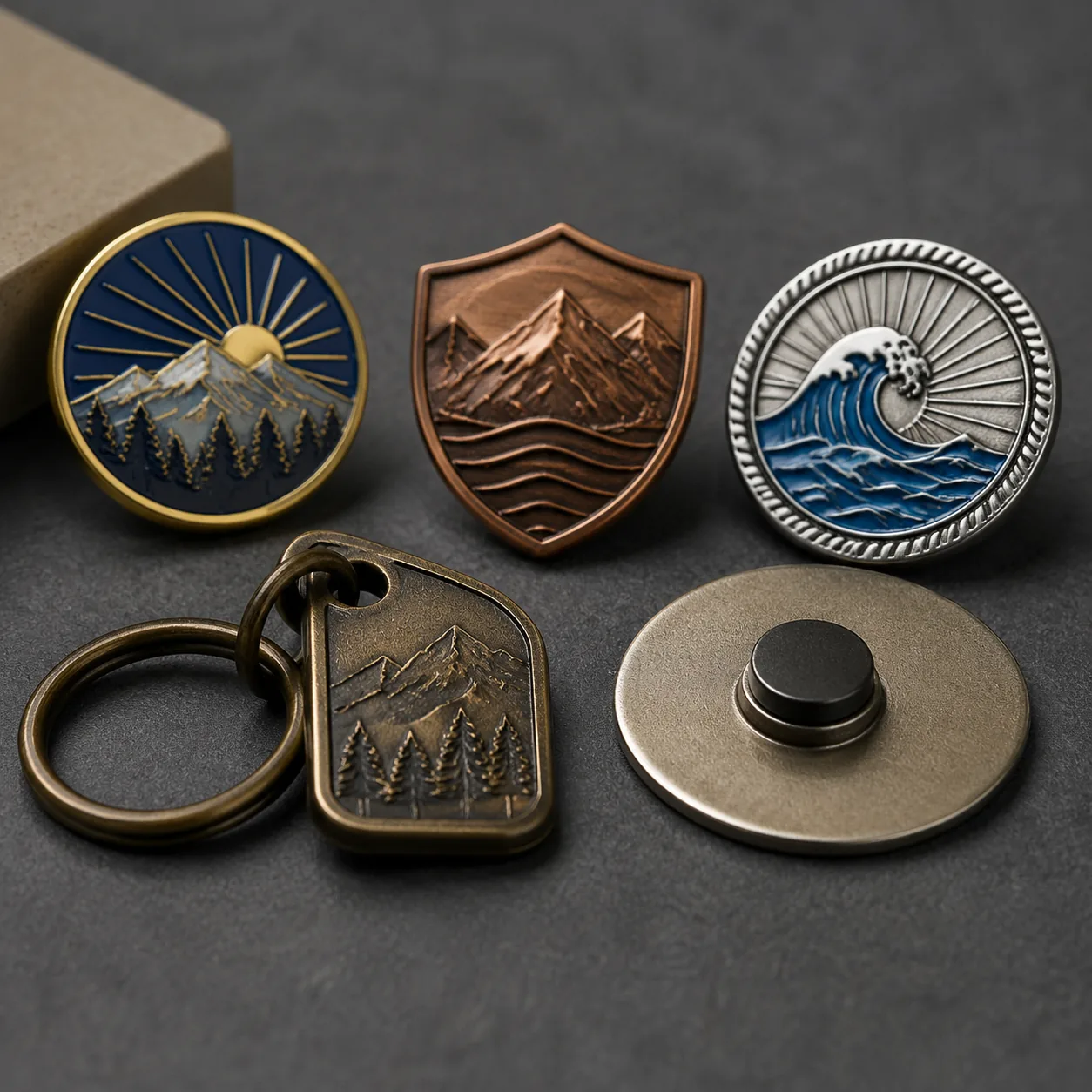
What problem does this solve?
Custom promo sets fail most often at the interfaces: the pin matches the drawing, the coin passes inspection, and the lanyard prints cleanly, but the finished kit still looks inconsistent because the red shifts between substrates, the plating families clash, or one component misses the ship date and blocks assembly. The set only works when every item is designed and approved as one program, not as four separate purchase orders.
This guide is for procurement teams, distributors, and marketing buyers ordering mixed kits for events, membership packs, employee recognition, or retail gifting. The goal is to lock the system before tooling starts: one master artwork file, one Pantone list, one packaging structure, one sample approval sequence, and one shipment plan. That is where most avoidable rework is prevented.
For custom metal promo sets, the brief should be detailed enough to remove guesswork from the factory floor. Specify dimensions in millimeters, plating thickness in microns, print or enamel tolerances, packaging counts, and the approval gate for each component. A precise brief is the cheapest quality control you can buy.
Q: When should I order a promo set instead of separate items?
Order a set when the buyer experience depends on presentation and visual consistency more than on the standalone value of each item. Conference welcome kits, donor gifts, internal recognition packs, and retail bundles all benefit from one design language and one unboxing moment. If the items are judged together, they should be spec’d together.
Do not force a set when each item has a different user, different shelf life, or different logistics. A lanyard, a desk coin, and a retail pin may belong in separate production plans if the deadlines, packing format, or finish requirements diverge. Separate sourcing can reduce risk when one part is custom-dyed, one is electroplated, and one needs blister packaging.
A practical rule: if two or more components must match visually at first glance, keep them in one brief. If they share only a logo and not the same display context, quote them separately and assemble later. That keeps lead times, pricing, and approvals easier to control.
Q: What specs must be shared across all items?
The most common failure mode is letting each item interpret the brand differently. That creates visible inconsistency even when each component technically passes inspection. A set needs one master spec sheet controlling color, finish, dimensions, artwork version, and packaging format across all line items.
At minimum, share the same Pantone references, plating family, and approval method. If the pin uses Pantone 186 C in hard enamel with nickel plating, the coin border, patch thread, and printed insert should reference that same red unless a contrast is intentional. For mixed sets, this reduces disputes at pre-production and improves reorder consistency.
| Shared spec | Buyer instruction | Practical tolerance / note |
|---|---|---|
| Brand color | Use one master Pantone list for the full set | Approve against a master reference; expect material-specific appearance shifts |
| Metal finish | Use one plating family across the set | Typical plating thickness: 30-50 μm for nickel, brass, copper, or antique silver |
| Dimensions | Specify every item in mm | Common tolerance: ±0.2 mm on small metal parts; ±1.0 mm on soft goods |
| Artwork | Use one source file and one revision number | Keep text and logo placement within a 1-2 mm safe margin |
| Packaging | Define insert size and backer card spec early | State cavity depth, fold lines, and pack count before sampling |
| Approval order | Approve the full set before mass production | Do not release bulk production until the complete set is signed off |
If a supplier cannot quote line by line, the brief is too loose. Ask for each item to list size, finish, process, MOQ, unit price, packing method, and approval status. That is the easiest way to compare offers without hiding one expensive component inside a bundle price.
Q: How do I prevent color drift between items?
Color drift happens because metal, enamel, print, and fabric behave differently. Hard enamel reads denser than printed artwork, woven patches mute saturated tones, and plated metal changes color perception under different light. One Pantone number is a starting point, not a guarantee of identical appearance.
Approve the most visually sensitive surface first, then map that reference to the other materials. In many kits, the printed insert or backer card works best as the color intent master because it is easiest to control. From there, document the allowed visual shift for enamel, thread, and lanyard print instead of pretending every substrate will match perfectly.
Use neutral lighting for sample checks, ideally D65. Warm office lighting can make reds look deeper and blues look duller. If the set includes glossy epoxy, matte enamel, woven thread, and coated paper, ask for a single side-by-side board so the color relationship is judged in one pass.
- Use one master Pantone reference for the entire set
- Confirm which item is the color master
- Approve samples under D65 or equivalent neutral light
- Ask the supplier to document material-specific color shift
- Avoid mixing glossy epoxy, matte enamel, and woven yarn without a side-by-side test
For procurement language, ask for an agreed visual delta rather than a vague promise to “match closely.” A workable standard is no visible mismatch at arm’s length under neutral light, with any known variance written on the sample approval sheet.
Q: How should I compare items inside the same set?
Compare the set by role, not just by style. Each item should have a job: hero item, support item, or carrier. If two components compete for attention, the set feels expensive but unfocused. If nothing leads, the kit looks assembled from leftovers.
A useful benchmark is visual hierarchy. The hero item should carry roughly 20-30% more visual weight than the support pieces, while the secondary components reinforce the theme without overpowering it. In practice, the coin or pin usually leads, the patch or lanyard supports, and packaging carries the story.
| Item type | Best role in set | Typical FOB price range (USD) | Key risk |
|---|---|---|---|
| Custom pin | Small hero accent | 0.25-1.20 | Crowded artwork can disappear at small sizes |
| Challenge coin | Premium centerpiece | 1.20-4.80 | High relief, edge treatment, and weight increase cost quickly |
| Patch | Apparel or bag add-on | 0.30-1.80 | Backing choice affects durability and usability |
| Lanyard | Carrier and brand banner | 0.35-1.50 | Print visibility drops on narrow widths |
| Fridge magnet | Desk or home display item | 0.20-1.10 | Loose packing can cause transit damage |
Those FOB bands assume typical factory-level production, not retail markup. A 1.5-inch soft enamel pin with epoxy usually lands near the low end, while a 2-inch hard enamel coin-style piece with black nickel and glitter fill lands higher. Challenge coins move with diameter, relief depth, edge treatment, and antique finish. If a quote sits far outside these ranges, ask what is driving the delta before comparing suppliers.
To avoid apples-to-oranges quotes, ask every supplier to break out tooling, unit price, packing, and any assembly charge separately. A low unit price can hide expensive packaging or a separate assembly fee that appears only after deposit.
Q: What checklist should I use before confirming a set?
Use a checklist to catch the errors that usually appear only after the sample is already in transit. If any answer is vague, the factory will fill in the gap, and that is where mismatches begin. Clear answers cost less than rework.
- Confirm one master artwork file and one revision number
- Lock each item’s size in millimeters, not approximate terms
- Specify plating, print method, and finish for every component
- State whether packaging includes insert card, foam, sleeve, or tray
- Define which sample is approval-critical: full set or individual parts
- Confirm whether reorder must match the first order exactly
- Ask for carton count, inner pack count, and gross weight per set
- State tolerance expectations for print alignment, assembly, and plating
For metal components, add finish and tolerance language. Ask for plating thickness in microns, enamel fill height, and acceptable surface defects. For example, a soft enamel pin might specify nickel plating at 30-40 μm, enamel fill flush to 0.1-0.2 mm below the metal line, and no exposed base metal in filled areas except where designed.
For soft goods and printed items, specify practical tolerances. A woven patch may hold ±1.0 mm overall, with thread density around 7-9 stitches per mm depending on size and detail. A lanyard print should define width, repeat length, and color placement so the artwork does not slide during production.
Q: What packaging rules matter most?
Packaging is part of the product spec, not decoration. A promo set with mismatched inserts or loose internal movement looks unfinished even if the components are perfect. Define the pack structure early, especially if the order ships by air or will be displayed on a retail shelf.
For most mixed sets, the strongest setup is a fitted insert with fixed cavities, a clear outer sleeve, and one backer card that names every item. If the set includes plated metal parts, keep the insert non-abrasive and prevent direct metal-to-metal contact. For heavier kits, ask for both standard export cartons and reinforced master cartons so you can compare damage risk against freight cost.
A practical packaging spec should state cavity dimensions, board thickness, and pack count. Typical retail-style insert board is 1.0-1.5 mm card, EVA foam is commonly 2-5 mm depending on item depth, and printed sleeves often use 250-300 gsm coated stock. If the set is gift-grade, ask for a drop-safe pack test target, such as no visible damage after a 60 cm carton drop on the longest edge.
Do not ignore carton math. If a finished set weighs 180-250 g, a master carton may hold 40-80 sets depending on pack style and freight limit. That affects both air cost and warehouse handling.
Q: What lead times and MOQ should I expect?
Lead time depends on whether the set uses existing tooling or needs new molds, print plates, and packaging dies. A simple mixed set using standard shapes can often ship in 15-25 days after sample approval. A fully custom set with new packaging, new dies, and multiple processes usually needs 25-40 days. If components are sourced from different workshops, the schedule stretches further because the slowest item becomes the critical path.
MOQ is usually set by component, not by the set as a whole. In practice, small metal pins may start at 100-300 pieces, challenge coins at 100-200 pieces, woven or printed patches at 200-500 pieces, and lanyards at 200-500 pieces depending on width and print method. Ask the supplier to quote each line item separately, then confirm whether assembly starts only when all parts are complete or whether partial stocking is allowed.
| Procurement question | Good answer | Red flag |
|---|---|---|
| Can one set sample represent all items? | Yes, with item-specific approval notes | No, every component must be guessed later |
| Is tooling shared across reorders? | Only if artwork and dimensions are frozen | Tooling is still changing after approval |
| Can items ship separately if needed? | Yes, with a clear staging plan | No backup plan if one item runs late |
| Is MOQ based on set or component? | Component-level MOQ stated clearly | Set MOQ hides one expensive part |
| Can packaging be reordered alone? | Yes, if the insert and print remain stable | Packaging only exists as part of the first order |
If you need a pricing anchor, ask for three tiers: sample, MOQ, and 5,000-piece production. For example, a custom pin may sample at USD 35-80 for setup, land at USD 0.35-0.95 at 300 pieces, and drop to USD 0.25-0.70 at 5,000 pieces depending on size and finish. That tiering makes supplier comparison far more reliable than a single number.
What to do next
Before requesting quotes, turn your idea into one master set brief with artwork, dimensions, colors, finishes, packaging, and approval order. Send the same brief to every supplier and ask them to quote each line item separately plus final assembly and packing. That makes comparison possible and exposes where one factory is quietly cutting corners on finish, carton protection, or sample control.
The cleanest buyers ask for a full set sample before mass production and reject any quote that cannot state its tolerance, packing, and lead-time assumptions in writing. A disciplined brief now prevents three rounds of confusion after deposit. If helpful, the next step is to build a one-page RFQ template your team can reuse across pins, coins, patches, and lanyards.
Have a project? Send your artwork and target quantity and we’ll reply with a detailed quotation within 12 working hours.
Ready to get this made?
Send your sketch, target quantity and ship-date. Detailed quotation in 12 hours.



