Variant Planning for Custom Pins Without Cost Blowouts
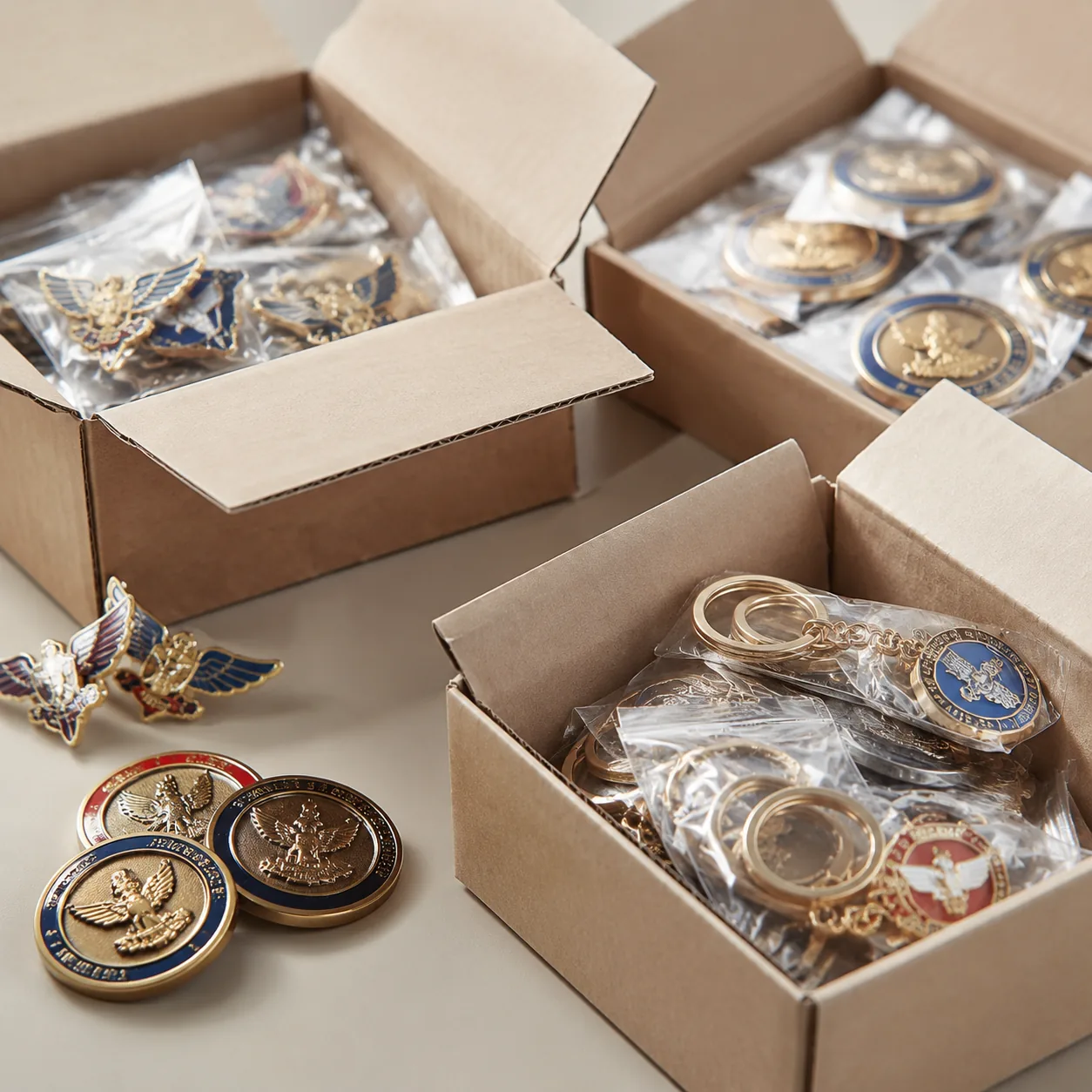
Start with the real decision: one product or a variant family
The most expensive mistake in a multi-design order is treating every version as a separate custom product. A buyer asks for 12 city pins, 8 employee badges, or 20 event keychains, then gets 20 mold charges, 20 setup lines, and a packing plan that warehouse staff cannot verify. Before requesting a quote, decide whether you are buying independent SKUs or a controlled variant family.
A variant family works when the products share the same outer shape, thickness, attachment, plating finish, and packaging format, with changes limited to enamel colors, printed text, backstamp text, or small artwork inserts. It stops working when each version has a different silhouette, cutouts, metal relief, or hardware. For die-struck or soft-enamel pins, a practical rule is that at least 70% of the visible surface should be shared across variants; below that, tooling savings usually disappear into setup and inspection time.
Use a family structure when you need brand consistency, faster approvals, and lower tooling cost. Use separate SKUs when each design must have a distinct outline, different functional hardware, or different safety requirements. The decision affects mold count, sampling time, inspection plan, carton labels, and reorder accuracy, not just unit price.
| Element | Best locked across variants | Can vary with low risk | Usually creates new tooling or setup |
|---|---|---|---|
| Outer silhouette | Same outline within ±0.15 mm | Minor internal artwork only | Different edge shape or openwork |
| Thickness | Same 1.2, 1.5, 1.8, 2.0, or 3.0 mm spec | Rarely worth changing | Different weight class or casting flow |
| Plating | One finish across family | Selective antique wash if pre-approved | Gold, nickel, black nickel mixed in one run |
| Enamel colors | Same color map preferred | Color swaps in same cavities | New cavities, gradients, or transparent areas |
| Attachment | Same clutch, magnet, brooch, ring, or lobster clasp | None recommended for retail sets | Different backs require separate packing and QC |
| Packaging | Same bag, backing card, or box size | Printed SKU sticker | Different inserts or box dimensions |
Lock the mechanical spec before discussing color
The first lock should be the mechanical specification. For pins and badges, fix size, base metal, thickness, plating, attachment, and edge style before talking about variant artwork. A common corporate pin family might use zinc alloy or iron, 30 mm width, 1.5 to 1.8 mm body thickness, 0.8 mm raised metal lines, and nickel or black nickel plating at 3 to 5 microns. Clutches are usually butterfly or rubber, with a post length of 8 to 10 mm and a post diameter around 0.9 to 1.0 mm.
For coins and keychains, the locked elements are usually more demanding because weight and hardware affect freight and durability. A coin family may share a 45 mm diameter, 3.0 mm thickness, antique brass plating, 2D relief, and a 2.0 mm raised rim. A keychain family may share a 40 mm charm, 2.0 mm thickness, a 25 mm split ring, and an 8 mm jump ring with 0.8 to 1.0 mm wire diameter. If a coin will be handled often, specify edge tolerance at ±0.2 mm and flatness within 0.3 mm across the face to avoid rocking on display.
If the outer profile changes, tooling usually changes. If only enamel colors change inside existing metal walls, tooling often stays the same. If printed names, QR codes, or serial numbers change, tooling can stay the same, but print setup and inspection must be controlled by SKU. For printed areas, ask for a minimum text height of 1.2 mm on pins under 30 mm; anything smaller becomes unreadable after plating and varnish.
Choose the variant method, not just the artwork
There are four common ways to create variants. The cheapest is a colorway change: the metal mold stays identical and only enamel Pantone colors change. The next is a printed overlay change, where names, numbers, small logos, or QR codes are printed on top of plated metal or cured enamel. A third method is an interchangeable center panel, useful for medals, challenge coins, and large badges. The most expensive is a full unique mold per design.
Colorway changes work best when each enamel area is at least 0.35 mm wide for soft enamel and 0.4 mm wide for hard enamel polishing allowance. If you need tiny text, keep strokes above 0.15 mm and avoid reversing light text out of a dark field unless the panel is at least 6 mm wide. Printed overlays can handle finer copy, but buyers should not specify text below 4 pt on pins under 30 mm or QR codes below 12 x 12 mm unless scanning is tested on a physical sample.
Interchangeable panels need a visible border or rim, typically 0.8 to 1.2 mm, so the shared base does not look like a compromise. Full unique molds are justified when the silhouette is part of the collectible value. Tourism sets, mascot sets, and limited-edition artist pins often sell better when every outline is different. In those cases, the right cost control is not forcing mold sharing; it is standardizing thickness, plating, clutch, backing card, and carton structure.
| Variant method | Typical MOQ per variant | Typical tooling impact | FOB unit range at 500 pcs per variant | When to choose it |
|---|---|---|---|---|
| Colorway change | 100 to 300 pcs | One shared mold, color setup per SKU | $0.55 to $1.25 for 25 to 35 mm soft-enamel pins | Same design, different teams, cities, seasons, or levels |
| Printed overlay change | 100 to 300 pcs | Shared mold plus print film or digital setup | $0.65 to $1.60 for 25 to 35 mm pins | Names, dates, QR codes, small text, sponsor versions |
| Shared base with center insert | 300 to 500 pcs | Base mold plus insert tool or print setup | $1.20 to $2.80 for 40 to 50 mm coins or badges | Award tiers, event series, challenge coin programs |
| Unique mold per SKU | 100 to 500 pcs | Separate mold for every design | $0.80 to $2.20 for pins; $2.00 to $5.50 for coins | Collectibles where silhouette and relief drive value |
Set MOQ tiers from process reality, not wishful thinking
A factory MOQ is not only about machine capability; it is about setup time, color mixing, plating batch control, and inspection efficiency. For enamel pins, a practical floor is often 100 pcs per variant when variants share a mold, but pricing becomes much healthier at 300 pcs per variant. For unique molds, 100 pcs is possible, but the tooling charge may exceed the product value for small giveaways.
For patches and lanyards, variant economics behave differently. Woven or embroidered patches can support 50 to 100 pcs per variant if the border and backing are fixed, but thread changes and small text still add checking time. Sublimation lanyards can carry many artwork variants, yet each layout still needs proofing; a practical MOQ is 100 pcs per design for stable pricing, with 20 mm width and 900 mm finished length being common event specs. For woven lanyards, ask for weave resolution around 80 to 120 denier equivalent so small logos do not blur.
When you have a long tail of low-volume variants, group them into tiers. For example, order 1,000 pcs each for the top 3 SKUs, 300 pcs each for mid-volume SKUs, and 100 pcs each for rare SKUs. This keeps the line efficient while avoiding dead stock in slow-moving versions. It also makes reorder pricing predictable: if a design becomes a repeat seller, you already know what its 300-piece and 1,000-piece breaks look like.
- Ask suppliers to quote by SKU tier: 100 pcs, 300 pcs, 500 pcs, and 1,000 pcs, not only one blended total.
- Separate mold charge, setup charge, packaging charge, and unit price in the quote.
- Confirm whether MOQ is per variant, per mold, per plating finish, or per total order.
- Do not mix rush and non-rush variants in one approval batch unless shipment can be split.
- For reorders, specify whether the factory may combine variants to reach plating or enamel batch minimums.
Control tooling and sampling so one late SKU does not stop all
Multi-variant orders often fail at approval because one artwork version has a tiny issue and the buyer holds the entire family. A better approach is to approve the shared master first: outline, thickness, plating, attachment, packing, and the most difficult color or print detail. Then approve variant sheets against that master. This separates design risk from production risk.
For pins and keychains, normal tooling and pre-production sampling at ZheCraft is usually 7 to 10 days after artwork approval for standard zinc alloy or iron items, and 10 to 14 days for more complex 3D coins or moving parts. Mass production is commonly 12 to 20 days after sample approval for 500 to 5,000 pcs total, and 20 to 30 days when there are many enamel colors, individual packaging, or mixed cartons. Air shipment adds about 4 to 8 days; sea shipment is longer but can be economical for heavy coins or boxed sets.
Set an approval rule in writing. For example: if the shared master is approved and 10 of 12 variants are approved, production may begin on the 10 approved variants while the remaining two wait. This prevents a misspelled city name or one sponsor logo from delaying the whole launch. If your launch date is fixed, require a signed approval sheet with a freeze date 5 working days before mass production starts.
Prevent SKU mixing with physical controls
Variant orders need more than normal workmanship inspection. They need identity control. A perfectly made pin is still defective if it goes into the wrong backing card, the wrong retail box, or the wrong carton for a regional distributor. The right control is a simple, visible code chain from artwork to carton.
Use a SKU code that appears on the artwork file, production order, backing card proof, inner bag label, carton mark, and packing list. Keep the code short enough for operators to read, such as `PIN-25-NY-GD` instead of a 30-character ERP string. For individual polybags, a white label of 20 x 30 mm is usually enough for SKU, quantity, and barcode; for cartons, use at least 80 x 100 mm labels. If you have more than 12 variants, add a color dot or secondary code to the bag label so line workers can sort by sight before they scan.
Inspection should include both workmanship and assortment accuracy. For general promotional products, buyers commonly use AQL 2.5 for major defects and AQL 4.0 for minor defects. For SKU mixing, many importers specify zero tolerance in the sampled cartons because one mixed case can create downstream fulfillment costs far above the pin value. A practical spec is: no mixed SKU in any carton, no missing backing card, and no more than one wrong label per 200 cartons checked.
- Require one sealed golden sample or approved photo sheet per variant at the packing line.
- Use separate WIP trays or bins for each SKU; do not allow loose mixed parts before final bagging.
- Check plating color under the same light source when variants use similar finishes such as nickel and black nickel.
- Count finished goods per SKU before combining them into export cartons.
- Ask for carton photos showing SKU labels, quantity, gross weight, net weight, and carton dimensions before shipment.
Use price blending carefully
A blended unit price is convenient for procurement, but it can hide where money is being spent. If you ask for one price for 18 variants, the factory may average tooling, setup, and labor across all SKUs. That is simple for a purchase order, but it makes future reorders confusing when you only need three variants.
For repeat programs, request both a blended project price and a line-item price per SKU tier. A typical 30 mm soft-enamel pin with shared mold, nickel plating at 3 to 5 microns, one clutch, and an individual OPP bag may quote around $0.55 to $0.95 FOB at 1,000 pcs per variant, $0.75 to $1.25 at 300 pcs, and $1.10 to $1.80 at 100 pcs, excluding initial tooling. A unique mold may add roughly $40 to $120 per pin design depending on size, relief complexity, and whether a cutting die is needed. For 45 mm challenge coins, FOB often lands around $1.80 to $3.80 at 500 pcs, with plated-edge and epoxy options pushing higher.
Do not choose the lowest blended price if the supplier cannot explain the reorder price. The first order may look cheap because tooling is spread across all variants, but a later 300 pc reorder of one SKU can become unexpectedly expensive. For distributors, this is a margin trap because the client expects the same price for replenishment.
Pack by sales channel, not by factory convenience
The correct packing plan depends on how the variants will be used. For internal corporate distribution, bulk by SKU may be enough: 50 or 100 pcs per inner bag, one SKU per inner carton, and export cartons under 15 kg for pins and under 18 kg for coins. For retail or event kits, every variant may need a backing card, barcode, warning text, and exact facing direction.
Backing cards create a common source of rework. If the same card is used across variants, leave a blank SKU area for a sticker or use a universal barcode only if your sales system allows it. If each card has unique artwork, treat the card as its own printed component with proof approval, color tolerance, paper weight, and quantity overage. A practical card spec for pins is 55 x 85 mm, 300 gsm SBS or coated stock, with two 1.2 to 1.5 mm holes spaced to match the posts. For heavier keychains, 350 gsm or a 0.3 mm PET insert gives better stiffness.
For keychains, cards are often 70 x 100 mm with a hang hole and OPP bag. If the item is heavy, such as a 50 mm coin keychain, test whether the card bends during transit before committing to retail packaging. For blister or window-box packs, request a drop test to 1.0 m and a carton compression target of at least 5 layers if the shipment will move through parcel networks.
| Channel | Recommended packing | Inspection focus | When not to use |
|---|---|---|---|
| Internal giveaway | Bulk by SKU, 50 to 100 pcs per inner bag | Count, finish, attachment security | Not ideal when recipients choose designs at random |
| Event registration kit | One item on card, sorted by kit version | Correct SKU in correct kit | Avoid if final attendee list changes daily |
| Retail display | Backing card, barcode, hang hole, individual bag | Facing direction, barcode scan, card condition | Poor choice for heavy coins without stronger card |
| Distributor inventory | SKU label on bag and carton, master packing list | Carton assortment and reorder codes | Do not mix SKUs in unmarked cartons |
What to do before you request quotes
Prepare a variant matrix before sending artwork. Each row should be one SKU, with columns for quantity, shared mold group, size, plating, enamel colors, print details, attachment, packaging, barcode or SKU label, and delivery destination. This single document reduces back-and-forth more than a long email thread with many file attachments.
Send suppliers two quote scenarios: one optimized for lowest first-order cost and one optimized for easy reorders. For example, ask for shared mold plus colorway changes, then ask for unique molds for the top-selling variants only. A good factory should tell you where mold sharing saves money and where it damages the design. It should also state lead time in days, FOB currency, MOQ per variant, and whether sample approval resets the production clock.
If you want ZheCraft to review a multi-SKU project, send the variant matrix, AI or PDF artwork, target launch date, shipping country, and expected reorder plan. We can mark which variants can share tooling, which need separate molds, and where packaging or SKU control will add cost. The goal is not to force every design into one production method; it is to build a variant program that can be made, inspected, shipped, and reordered without surprises.
Have a project? Send your artwork and target quantity and we’ll reply with a detailed quotation within 12 working hours.
Ready to get this made?
Send your sketch, target quantity and ship-date. Detailed quotation in 12 hours.



