UV Printed vs Enamel Pins for Detailed Logos
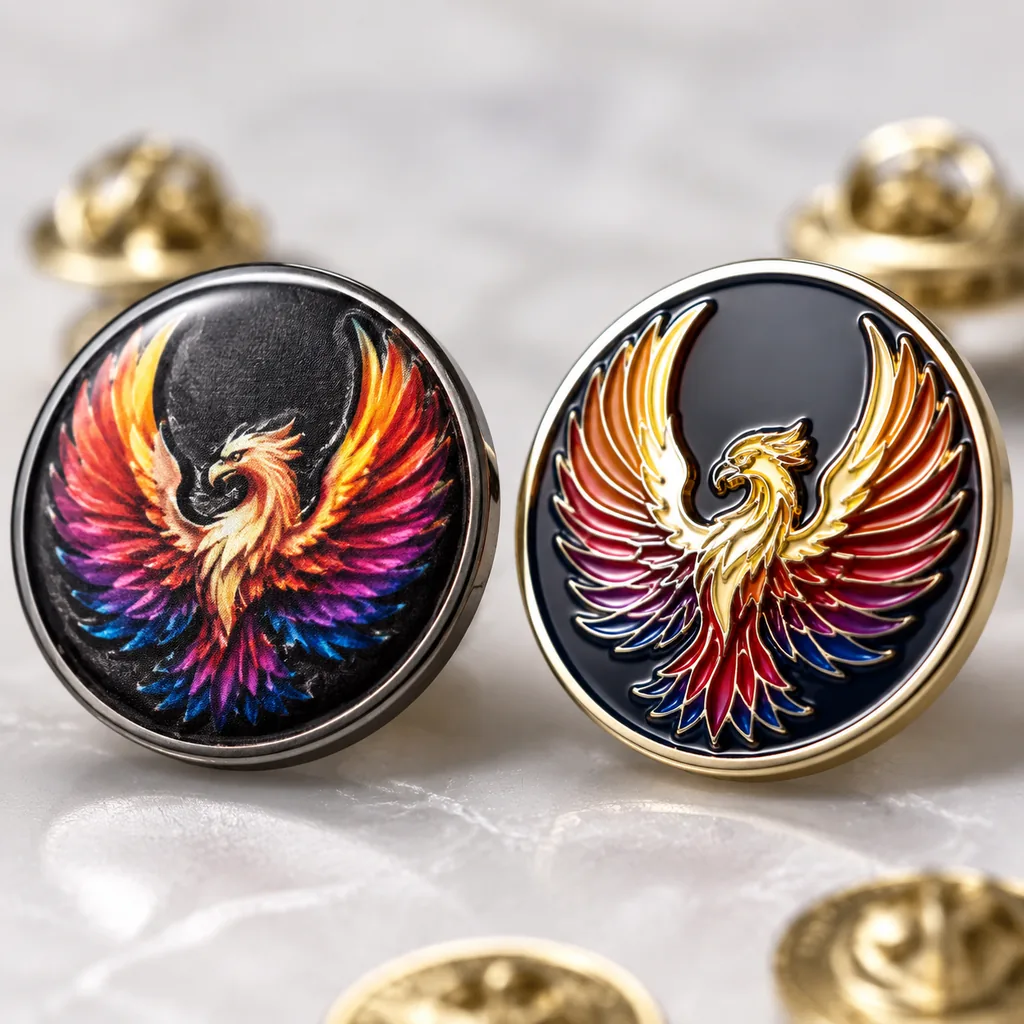
Start with the manufacturing constraint: artwork density
Most failed custom pin projects do not fail because the buyer chose the wrong base metal. They fail because the approved screen artwork contains more detail than a 20 to 35 mm metal product can hold. A 25 mm lapel pin may look clear in a PDF at 400% zoom, but the same design can lose legibility when a 1.2 mm slogan, four sponsor logos, a gradient mascot face, and a plated border are compressed into a physical part inspected under production light.
The practical choice is not simply "premium enamel" versus "cheap print." UV printed pins and enamel pins solve different decoration problems. UV printing applies CMYK ink, usually over a white ink base, onto plated or coated metal and cures it with ultraviolet light. The print is then left exposed, sealed with a flat varnish, or covered with a 0.6 to 1.2 mm epoxy dome. Enamel pins use recessed metal cells filled with colored enamel. Soft enamel remains slightly recessed; hard enamel is filled, baked, ground, and polished flush with the raised metal lines.
This guide focuses on B2B custom metal pins, badges, small medals, and promotional accessories from 20 to 45 mm, with order volumes from 100 to 10,000 pieces. The decision logic also applies to keychains and magnets, but pins have less surface area and tighter viewing conditions. On a pin, 0.10 mm of line loss, 0.20 mm of print shift, or one dust particle under epoxy can be visible on the focal logo area.
Process comparison with production specs
Use the table as a manufacturability screen before paying for tooling. It is most useful for artwork with small text, gradients, skyline detail, character art, maps, sponsor clusters, QR-style graphics, or more than eight adjacent color areas.
| Specification | UV printed metal pin | Soft or hard enamel pin |
|---|---|---|
| Best fit | Full-color logos, gradients, small sponsor marks, mascot art, event posters, simulated photos | Bold logos, separated spot colors, traditional lapel pins, premium corporate badges |
| Common finished size | 20 to 50 mm; fine detail becomes safer at 30 mm and above | 18 to 45 mm; most corporate logo pins are 22 to 32 mm |
| Minimum readable text | 1.2 mm for high-contrast uppercase print; 1.5 mm safer for bulk | 2.0 mm for raised metal text; 2.5 mm safer when enamel surrounds letters |
| Minimum line width | 0.10 to 0.15 mm printable; 0.20 mm recommended for brand-critical strokes | 0.20 to 0.25 mm raised metal line; 0.30 mm safer for hard enamel polishing |
| Color system | CMYK UV ink with white underprint on metal; Pantone simulation only | Pantone-mixed enamel for solid colors; strongest for flat brand palettes |
| Gradients and shadows | Suitable if sampled; dark tones may gain 5 to 10% visually under epoxy | Not suitable unless redrawn into solid color bands |
| Surface feel | Flat print, 15 to 30 micron clear coat, or 0.6 to 1.2 mm epoxy dome | Recessed texture for soft enamel; smooth polished face for hard enamel |
| Plating role | Border can be minimal; print may cover most of the face | Metal lines define color cells and must remain visible |
| Decorative plating thickness | Typically 0.03 to 0.08 micron over nickel or copper strike | Similar range; hard enamel polishing exposes weak plating control faster |
| Registration tolerance | ±0.15 to ±0.25 mm depending on fixture, pass count, and print area | Die outline about ±0.20 mm; fill and metal-line variation ±0.10 to ±0.20 mm |
| MOQ guidance | 100 pcs possible; 300 pcs stable; 500 to 1,000 pcs better for unit cost | 100 pcs possible; 300 pcs economical; 500 pcs reduces mold and color setup impact |
| FOB China price at 300 pcs, 25 mm | USD 0.75 to 1.45 with epoxy, standard clutch, and polybag | Soft enamel USD 0.65 to 1.35; hard enamel USD 0.95 to 1.80 |
| Lead time after approval | Sample 5 to 8 days; bulk 10 to 16 days | Sample 7 to 10 days; bulk 12 to 18 days for soft enamel; 14 to 22 days for hard enamel |
| Main QC risk | Ink adhesion, registration shift, dust under coating, epoxy bubbles, edge abrasion | Low fill, color bleed, weak metal lines, polishing scratches, plating inconsistency |
Detail limits: text, lines, QR codes, and borders
UV printing can reproduce thinner visual detail because it does not require metal walls between colors. On a 30 mm badge, a 0.15 mm dark line on a pale background can be visible, and a 1.2 mm uppercase word may read if the font is open, not condensed, and printed at high contrast. For repeatable bulk production, keep critical brand strokes at 0.20 mm or wider. Clear coat thickness, dust, fixture movement, and multi-pass registration can soften details that looked sharp in the digital proof.
Enamel requires physical separation. Each color sits inside a recessed cell, so every color boundary needs a raised metal line. If that line is below 0.20 mm, it can break in the die, fill with plating, or round off during polishing. For hard enamel, 0.30 mm is the safer production minimum because the surface is filled, baked, ground, and polished. A thin metal stroke may pass on a hand-selected sample but vary across 1,000 pieces.
Small text creates the most disputes. A 1.5 mm printed slogan can pass if it is black on white and protected with a flat clear coat. The same slogan in enamel usually needs to become simplified raised metal text at 2.0 to 2.5 mm high, or move to the backing card. If legal copy, website text, or sponsor names must be readable, do not force them into enamel at lapel-pin scale.
QR codes need a separate decision. A decorative QR-style pattern can print at 18 to 20 mm, but a scannable code should usually be at least 22 to 25 mm wide on the finished surface, tested from a physical sample with common phones. Epoxy can create glare and edge distortion, so a flat clear coat is often safer for codes than a high dome.
Color behavior: CMYK print versus Pantone enamel
Enamel is stronger when the buyer needs a solid brand color. Liquid enamel can be mixed to Pantone references, filled into the metal recess, cured, and checked against an approved sample under D65 or neutral white light. For most promotional orders, acceptance is a close visual match rather than a lab delta E value because plating reflection, enamel depth, and viewing angle change perceived color.
UV print behaves more like a miniature printed label. It normally uses CMYK inks, with a white ink layer under the image when printing on gold, nickel, black nickel, antique metal, or dyed black. Pantone colors can be simulated, but saturated orange, royal blue, neon green, fluorescent colors, and metallic tones are difficult to match exactly. If color compliance matters, request a printed color strip or pre-production sample. Do not approve critical brand color from a PDF alone.
Gradients, shadows, photo effects, and full-color campaign art are the strongest reasons to choose UV print. Enamel cannot produce a continuous gradient. The artwork must be converted into stepped bands of solid color, which changes the design language. A mascot with facial shading, a miniature city skyline, or an event poster usually looks more accurate as UV print with protective coating.
Top coating changes color perception. A clear epoxy dome makes colors appear deeper and glossier, but it also increases glare and can magnify dust, banding, or slight registration errors. A flat varnish gives a more restrained corporate finish and keeps QR codes easier to scan, but it provides less abrasion protection. Approve the exact top finish during sampling, not after bulk production starts.
Durability, finish, and inspection standards
For occasional lapel use, both processes can perform well. The difference appears when the item rubs against keys, zippers, bag fabric, display trays, or retail packaging. Exposed UV print is vulnerable at edges and raised points. For a jacket pin, a 15 to 30 micron clear coat may be acceptable. For a keychain, bag charm, zipper pull, or luggage accessory, specify a 0.6 to 1.2 mm epoxy dome or choose enamel.
Epoxy improves abrasion resistance and gives printed art more depth, but it adds thickness and a casual glossy profile. It can trap small bubbles near sharp cutouts, narrow corners, and recessed borders. A practical promotional-grade standard is to reject visible bubbles, dust, or black specks over 0.30 mm in the main logo area, while allowing smaller particles outside the focal area if they are not obvious at normal viewing distance.
Enamel has different risks. Soft enamel is normally 0.10 to 0.30 mm below the raised metal line, so the surface has texture and can collect dust in recessed valleys. Hard enamel is polished flush and feels more premium, but excessive polishing can create hairline scratches, rounded borders, low spots, or uneven plating reflection. Designs with many tiny cells raise the risk of color bleed and incomplete fill.
For commercial inspection, use AQL general inspection level II with AQL 2.5 for major defects and AQL 4.0 for minor cosmetic defects unless the buyer has a stricter standard. For UV print, add cross-cut adhesion and tape-pull checks after full curing, plus visual inspection after 24 hours before packing. For enamel, specify no visible cracking, pinholes, severe low fill, color bleeding, or front-face plating gaps.
Cost, MOQ tiers, and lead time planning
UV print is not automatically cheaper. It becomes cost-effective when the artwork has many colors, gradients, or small zones that would be expensive or impossible to separate into enamel cells. For a simple two-color logo, soft enamel can be cheaper because the UV setup, white underprint, color calibration, and epoxy coating may cost more than filling two enamel colors.
For a 25 mm pin at 300 pieces, typical FOB China pricing is USD 0.65 to 1.35 for soft enamel, USD 0.95 to 1.80 for hard enamel, and USD 0.75 to 1.45 for UV print with epoxy, standard butterfly clutch, and individual polybag. At 100 pieces, unit prices are often 25 to 60% higher because mold, sampling, machine setup, and QC time are spread across fewer units. At 500 pieces, many designs stabilize. At 1,000 pieces, the same specification may fall another 8 to 18% if packaging remains simple.
MOQ tiers also affect design risk. At 100 pieces, factories may run semi-manual handling, which can make registration and epoxy consistency more variable. At 500 pieces, fixtures and process controls are usually more stable. At 5,000 to 10,000 pieces, ask for a sealed golden sample, first-article approval, and in-process inspection rather than relying only on a final random inspection.
Lead time should be counted from final artwork and sample approval, not the first inquiry. UV printed samples usually take 5 to 8 days, with bulk production at 10 to 16 days after sample approval. Soft enamel samples normally take 7 to 10 days, with bulk at 12 to 18 days. Hard enamel often needs 14 to 22 days for bulk because of repeated filling, baking, grinding, and polishing. Add 2 to 5 days for backing cards, retail bags, multiple designs, or strict color matching.
Buyer checklist: choose the safer route
The best process is the one that protects the part of the design the audience will actually notice. Use this checklist before issuing a purchase order or approving a manufacturing drawing.
- Choose UV print for gradients, shadows, photographic effects, small sponsor logos, QR-style graphics, maps, or more than eight close color areas.
- Choose soft enamel for bold separated colors, tactile recessed texture, and cost-sensitive promotional runs.
- Choose hard enamel when the pin must feel smooth and premium, and the artwork can tolerate 0.30 mm metal lines.
- Move text to the backing card if critical wording is below 1.2 mm for print or below 2.0 mm for enamel.
- Use flat clear coat instead of domed epoxy when scannable QR codes or low-glare corporate badges are required.
- Use epoxy over UV print for keychains, bag charms, zipper pulls, or items expected to rub against hard surfaces.
- Request a physical pre-production sample for orders above 1,000 pieces, strict brand colors, retail launches, or any scannable code.
- Ask the supplier to redraw one print-faithful version and one enamel-safe version before tooling if the artwork is complex.
Mixed programs are common and technically sound. A brand may use hard enamel for the core corporate logo pin and UV print for a limited event pin with detailed campaign art. That is not inconsistency; it is matching the decoration method to the artwork.
Purchase order specs that prevent disputes
A clear purchase order should define the manufactured version, not just attach the artwork file. For UV printed pins, specify base metal, finished size, plating, white ink requirement, print area, top protection, attachment, packing, and registration tolerance. Use ±0.20 mm as a normal registration tolerance, and ±0.15 mm for tight borders, small text, or multi-pass alignment. State whether the epoxy is domed or flat, and whether the edge remains plated or is printed to the edge.
For enamel pins, specify soft or hard enamel, Pantone references, minimum metal line width, fill standard, plating finish, attachment, and packing. Soft enamel should have a consistent recessed fill, usually 0.10 to 0.30 mm below the metal line. Hard enamel should be flush after polishing, without obvious low spots, color bleeding, or heavy scratches. Decorative plating thickness numbers help, but they do not fully define tone; approve a physical finish sample for black nickel, antique gold, rose gold, or two-tone plating.
Inspection criteria should follow the likely failure mode. For UV print, inspect registration, color density, adhesion, dust, bubbles, scratches, and edge coverage. For enamel, inspect fill height, color accuracy, metal-line clarity, plating coverage, polish marks, and back-stamp legibility. For both, check attachment strength, clutch fit, pin alignment, sharp edges, carton labeling, and mixed-design counts. Carton labels should show item code, PO number, design name, quantity, gross weight, net weight, and carton count.
A strong RFQ is specific: quote this 30 mm pin in two versions, UV print with flat clear coat or epoxy, and soft enamel with Pantone colors. Ask for mold charge, sample cost, sample lead time, bulk lead time, FOB price at 300, 500, and 1,000 pieces, and required changes to line width, text height, or color separations. If a supplier quotes both versions at the same price and lead time without flagging artwork risk, request a manufacturability review before paying for tooling.
Have a project? Send your artwork and target quantity and we’ll reply with a detailed quotation within 12 working hours.
Ready to get this made?
Send your sketch, target quantity and ship-date. Detailed quotation in 12 hours.



