Uniform Patches That Survive Washing: A Buyer Scenario
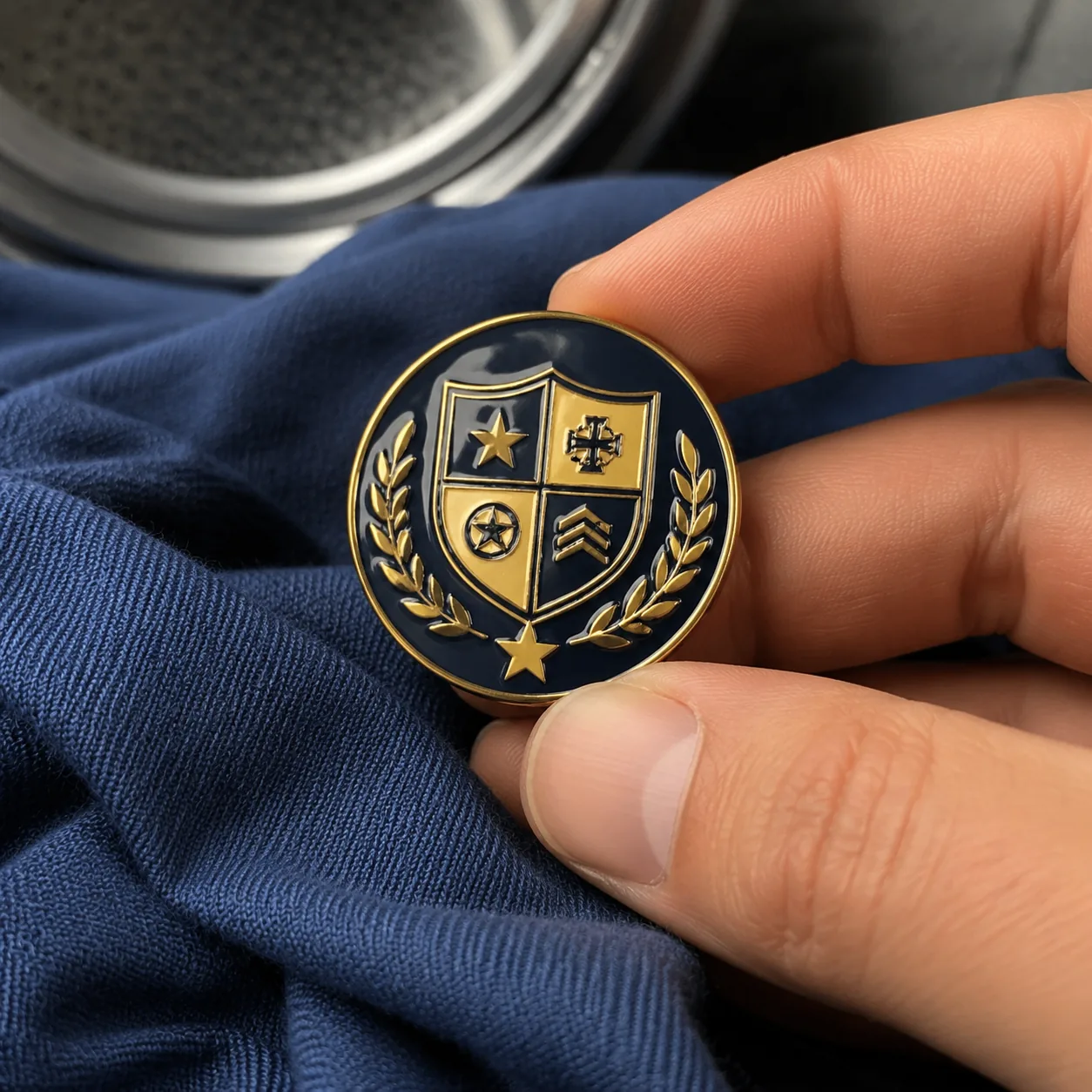
Buyer Scenario: 3,300 Uniform Patches With No Room for Laundry Failure
A hotel group is opening three properties in 10 weeks. Procurement needs 3,000 sleeve patches for housekeeping, engineering and front-desk uniforms, plus 300 spare pieces for later hires. The patch must read clearly on dark navy fabric, survive commercial laundering, and arrive sorted by department so the garment vendor can sew directly from labeled cartons.
This is not a giveaway patch order. A promotional patch can accept a lighter backing, looser edge stiffness and limited wash validation. A uniform patch is a functional textile component: it needs controlled dimensions, stable yarn color, a backing that does not bubble, and an attachment method matched to the garment fabric and laundry process.
The first factory questions should be technical, not decorative: fabric composition, fabric weight in gsm, wash temperature, dryer setting, patch placement, seam allowance, sewing machine type and whether the patch will be heat-positioned before stitching. For this case, assume a 65/35 polyester-cotton uniform fabric at 200 to 220 gsm, weekly washing at 40 to 60 degrees Celsius and tumble drying on medium heat.
Patch Construction: Choose by Detail, Drape and Wash Risk
The buyer’s artwork includes a crest, a 2.2 mm border line, small department text and a metallic gold accent. At a 75 mm finished width, that combination is near the limit for standard embroidery. A supplier should flag this before sampling because a clean digital mockup can become unreadable when thread builds up on twill.
For washable uniforms, woven and embroidered patches are usually safer than soft PVC when the patch will be sewn to fabric. PVC can be washed, but it is heavier, less breathable and stiffer on sleeves. It is better suited to outerwear, bags or tactical gear where raised relief matters more than drape.
| Patch Type | Best Use in This Scenario | Specs to Request | Avoid When |
|---|---|---|---|
| Woven polyester patch | Small text, thin crest lines, one design across all departments | 75 mm x 62 mm finished size, minimum line 0.35 mm, minimum letter height 3.0 mm, heat-cut edge tolerance +/-0.5 mm | Buyer wants raised thread texture or a heavy heritage look |
| Embroidered twill patch | Bold crest, larger department name, traditional uniform look | 0.30 to 0.35 mm twill base, 75D or 120D polyester thread, 65% to 85% embroidery coverage, merrowed or satin edge | Text is below 4.0 mm high or the logo has gradients |
| Soft PVC patch | Outerwear, bags, rain jackets or removable ID branding | 2.0 to 2.5 mm thickness, recessed color channels, sew channel at least 3.0 mm wide | Soft shirts, hot tumble drying or low-profile sleeve placement |
| Sublimated fabric patch | Photographic detail, gradients or multi-tone artwork | Sublimated polyester face, overlocked or embroidered border, optional white base layer | High abrasion areas or buyers needing a raised premium texture |
For the hotel program, the lowest-risk specification is a woven patch for all departments. It preserves the crest, keeps small text legible and reduces SKU variation. If the engineering team needs a heavier workwear appearance, use embroidery only after confirming the department text is at least 4.5 mm high and the logo has been simplified for stitch production.
Production Artwork: Convert Brand Files Into Measurable Specs
A PDF brand guide and PNG logo are not enough for production. The factory needs vector artwork in AI, EPS, PDF or SVG format, with fonts outlined and the final patch size stated in millimeters. For this order, the approved target is 75 mm wide by 62 mm high, with finished size tolerance of +/-1.0 mm after edge finishing.
Small details should be simplified before sampling. For woven patches, specify minimum letter height of 3.0 mm, minimum stroke width of 0.35 mm and minimum gap between color areas of 0.30 mm. For embroidered patches, specify minimum letter height of 4.0 to 5.0 mm, satin stitch width above 1.0 mm and no isolated stitch islands smaller than 1.5 mm.
Color also needs a textile standard. Pantone coated references are useful, but polyester yarn and embroidery thread do not reflect light like ink on coated paper. A practical RFQ should ask for nearest stock thread or yarn references first, then custom dyeing only if the brand requires tighter control. For most uniform orders, approval by physical swatch under D65 light is more reliable than promising a perfect Pantone match from a screen image.
Metallic gold should be handled carefully. Metallic thread can add shine but reduces abrasion resistance and may feel scratchy on a sleeve. A safer option for frequent laundering is a matte golden-yellow polyester yarn matched to the brand within an approved swatch range. If metallic thread is mandatory, limit it to non-structural accents and test it through the same wash cycle as the main patch.
Backing and Attachment: Prevent Bubbling, Peeling and Curling
The hotel buyer originally asks for iron-on backing because it sounds fast. For commercial uniforms, adhesive alone is usually the wrong default. Heat-seal backing can help position the patch before sewing, but relying on adhesive as the only attachment is risky when garments face detergent, agitation, 40 to 60 degrees Celsius wash water and tumble drying.
For 180 to 240 gsm polyester-cotton uniforms, the safest construction is a sew-on patch with a light heat-seal positioning layer. The garment vendor presses the patch for alignment, then stitches around the edge. This reduces shifting during sewing without treating adhesive as the permanent bond.
| Backing Option | Thickness Added | FOB Cost Impact | Lead Time Impact | Main Risk |
|---|---|---|---|---|
| Plain sew-on backing | 0.10 to 0.20 mm | Base price | No extra days | Best wash durability, but alignment is slower during sewing |
| Heat-seal positioning backing | 0.15 to 0.25 mm | Add USD 0.02 to 0.05/pc | Add 1 to 2 days | Works well only when the patch is still sewn after pressing |
| Full iron-on backing | 0.20 to 0.35 mm | Add USD 0.03 to 0.08/pc | Add 1 to 2 days | Can peel or bubble after industrial laundry if not sewn |
| Hook backing | 1.50 to 2.00 mm including hook tape | Add USD 0.12 to 0.35/pc | Add 2 to 4 days | Bulky on soft uniforms; loop panel must be sewn to garment |
If the buyer insists on iron-on application, the RFQ must state press temperature, pressure and dwell time. A common starting point is 150 to 160 degrees Celsius for 12 to 18 seconds at medium pressure, but the correct setting depends on garment fabric, adhesive film and press type. Samples should be applied to the actual uniform fabric, not factory scrap cloth.
Sampling and Validation: Approve the Patch After Garment Testing
Photo approval is not enough for a uniform patch. Drape, edge stiffness, face distortion, backing feel and real color shift are difficult to judge from images. A practical pre-production sample set should include at least 5 pieces: 2 untouched references, 2 applied to the actual uniform fabric and 1 for destructive wash or peel testing.
Typical sample lead time is 5 to 8 days after artwork confirmation for woven or embroidered patches using stock yarn or thread. Custom-dyed yarn adds 4 to 7 days. Changing size, edge type or backing after sampling resets the schedule because it affects the loom setup, embroidery program, cutting path or adhesive lamination.
The approval sheet should record measurable limits: finished size 75 mm x 62 mm, border width 3.0 mm, backing type, edge type, department color references, acceptable bowing below 1.0 mm across the long side, no skipped edge stitches, and no loose thread longer than 2.0 mm on the face. Buyer and factory should each retain a sealed golden sample before mass production.
A realistic wash validation for this order is 5 home-laundry equivalent cycles at 40 degrees Celsius for front-desk and housekeeping patches, plus a separate 5-cycle test at 60 degrees Celsius if engineering uniforms go through heavier laundering. After washing, reject samples with shrinkage above 2.0%, dye bleeding onto the garment, edge lift above 2.0 mm, adhesive bubbling, severe curling or visible text distortion from 50 cm viewing distance.
MOQ, FOB Price and Lead Time: Quote by SKU, Not Just Total Quantity
MOQ depends on construction, color count and whether each department version is treated as a separate SKU. Practical MOQ tiers are usually 100 pieces per design for woven or embroidered patches, 300 pieces for PVC patches and 500 pieces when custom-dyed yarn, metallic thread or special backing is required. Lower quantities may be possible, but unit cost rises because setup time does not shrink much.
The hotel order is 3,300 pieces: 1,500 housekeeping, 900 front desk and 900 engineering, including spares. If all versions share the same shape, size, edge and backing, and only department text or one color changes, the factory can often group production to reduce setup waste. If each version has a different border, backing or size, inspect and price them as separate SKUs.
| Quantity per Design | Woven Patch FOB Range | Embroidered Patch FOB Range | Mass Production Lead Time |
|---|---|---|---|
| 100 to 299 pcs | USD 0.78 to 1.45/pc | USD 0.85 to 1.60/pc | 8 to 12 days after sample approval |
| 300 to 999 pcs | USD 0.42 to 0.95/pc | USD 0.48 to 1.10/pc | 10 to 15 days after sample approval |
| 1,000 to 4,999 pcs | USD 0.22 to 0.58/pc | USD 0.26 to 0.72/pc | 12 to 18 days after sample approval |
| 5,000 pcs and above | USD 0.16 to 0.42/pc | USD 0.19 to 0.55/pc | 16 to 24 days after sample approval |
These FOB ranges assume polyester yarn or thread, size up to about 80 mm, standard edge finishing and bulk export packing. Metallic thread, individual polybags, hook backing, very dense embroidery, oversized patches or urgent production can add USD 0.03 to 0.35 per piece. International express or air freight should be quoted separately because chargeable weight, carton volume and destination change the landed cost.
Incoming Inspection: Catch Defects Before the Sewing Line
The worst time to find a patch defect is after 3,000 uniforms are already on sewing tables. Incoming inspection should happen before garment application. For a uniform order, a practical default is AQL General Inspection Level II, with Critical 0, Major 2.5 and Minor 4.0 unless the buyer’s internal standard is stricter.
Critical defects include wrong logo, wrong department name, contaminating stains or unsafe sharp debris. Major defects include finished size outside tolerance, visibly wrong color versus the approved sample, loose backing, skipped edge stitching, adhesive on the face, severe curling, unreadable text or patches mixed between departments. Minor defects include slight edge fuzz, a short loose thread under 2.0 mm or tiny yarn slubs not visible at normal viewing distance.
- Measure finished size on a random sample: target 75 mm x 62 mm, tolerance +/-1.0 mm unless otherwise approved.
- Compare production colors to the sealed sample under D65 light or a consistent daylight booth, not under mixed warehouse lighting.
- Check edge security by light manual pulling; merrowed, satin and heat-cut edges should not unravel during normal handling.
- Apply 3 to 5 patches to real garment fabric before bulk sewing to confirm alignment, stiffness and sleeve comfort.
- Wash at least 3 applied samples for 5 cycles at the buyer’s normal laundry setting before approving bulk application.
- Verify carton labels show PO number, SKU, department, size, quantity, batch number, gross weight, net weight and carton count.
For higher-risk programs, add pre-shipment wash testing. A factory-level test should record wash temperature, detergent type, drying method, starting dimensions and final dimensions. If the buyer uses industrial laundry at 60 degrees Celsius or chlorine-based products, disclose that before sampling because thread, backing and adhesive selection may need to change.
Packing and Handoff: Make Sewing Efficient and Traceable
Bulk mixed packing may save a few cents but can create labor cost and errors at the garment vendor. For this scenario, specify 50 pieces per inner polybag, 10 inner bags per master bag and one SKU per export carton. That lets sewing teams pull one department at a time without re-sorting 3,300 pieces.
Cartons should stay below 12 to 15 kg gross weight to avoid crushing and manual-handling issues. A common carton size is about 40 cm x 30 cm x 30 cm, adjusted to patch thickness and packing count. Polyester patches normally do not require desiccant, but cartons should stay dry, upright and away from heavy compression during transit.
Carton labels should match the commercial invoice and packing list exactly. Each label should include buyer PO, SKU, department name, patch size, quantity, gross weight, net weight, production batch and carton number such as 1 of 7. If the garment vendor is in another country, inconsistent labels can cause customs, warehouse or line-feeding delays.
Order Timeline: Lock the Technical Facts Before Price Negotiation
Before asking for the lowest unit price, freeze the garment facts: fabric composition, fabric weight, wash temperature, dryer use, patch placement and attachment method. These details control the recommended patch type and backing. A supplier who quotes without asking about washing or application is treating the order like a promotional item, not a uniform component.
A production-ready RFQ should include vector artwork, quantity by department, target size, edge type, backing, packing method, inspection level, required arrival date and whether the patch will be sewn, heat-applied or both. Ask the supplier to quote sample lead time, mass production lead time, FOB unit price, setup charges and cost changes for each backing option.
For the hotel scenario, a safe schedule is 5 to 8 days for sampling, 2 to 3 days for buyer testing and approval, 12 to 18 days for mass production and 4 to 10 days for international express or air shipment depending on destination. That creates a realistic 25 to 39 day working window before garment sewing. If the opening date is fixed, approve construction early and avoid late changes to size, backing or department colors.
Have a project? Send your artwork and target quantity and we’ll reply with a detailed quotation within 12 working hours.
Ready to get this made?
Send your sketch, target quantity and ship-date. Detailed quotation in 12 hours.



