Two-Tone Plating Specs for Custom Pins and Coins
When Two-Tone Plating Is Worth Specifying
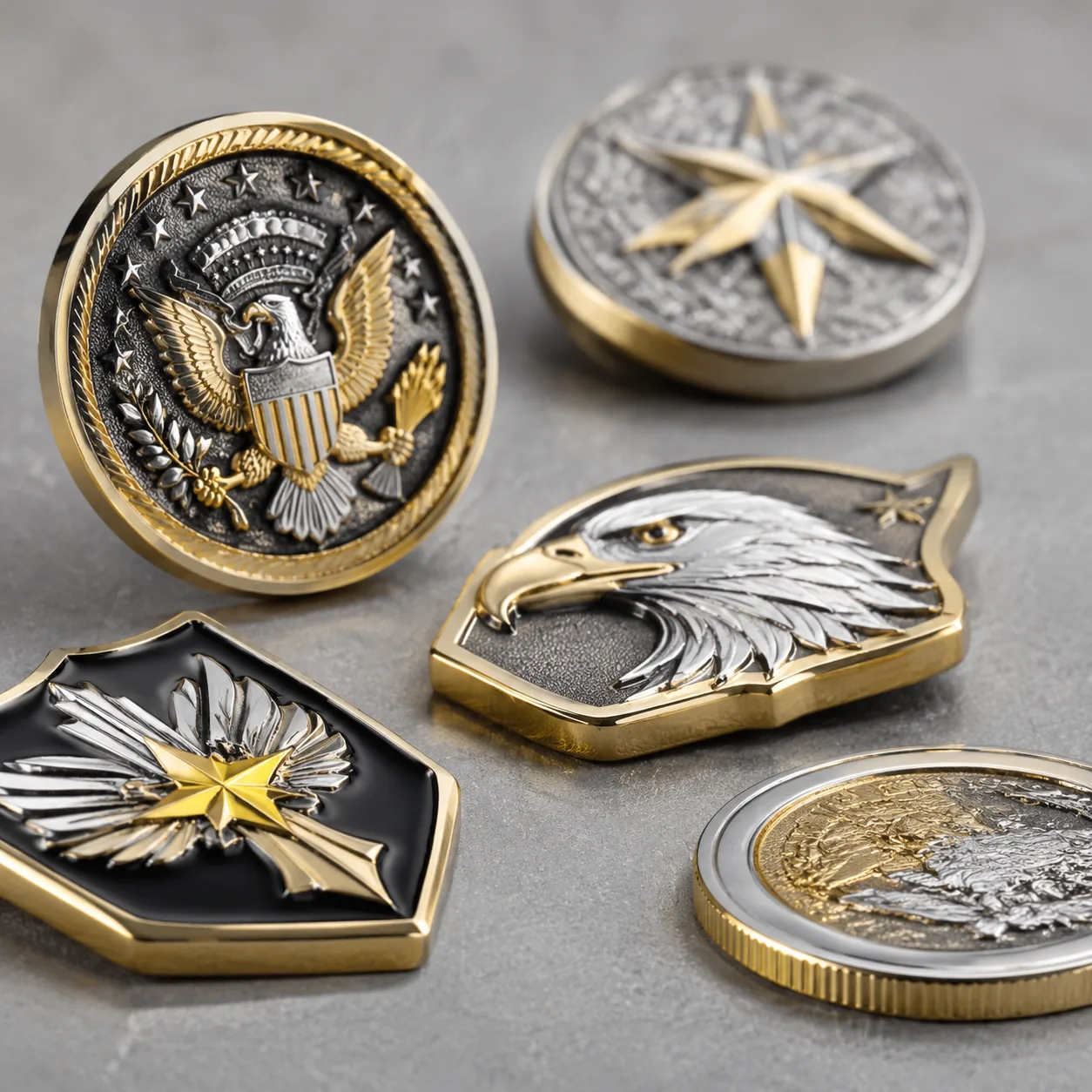
Two-tone plating solves a real design problem when one metal finish cannot carry the brand hierarchy. A black nickel badge can look premium but may hide 1.5 mm raised text. A bright gold coin can feel ceremonial but make a mascot, rim and background look flat. Using two finishes lets the buyer separate a logo, rim, recessed field or border without filling every area with enamel.
The specification cannot stop at a visual note such as "gold logo on silver background." A factory needs to know which areas are raised, which are recessed, whether masking is possible, which finish is plated first, and how much boundary shift is acceptable at QC. Without those details, the sample may look acceptable in a photo but fail when viewed at 30 cm under angled light.
At ZheCraft, we recommend two-tone plating when the artwork has clear physical separation: a raised emblem against a recessed field, a defined coin rim, a large isolated crest, or text that sits on one finish only. If the design uses adjacent metal lines below 0.25 mm, many scattered islands, sharp internal corners or small reversed text, a single antique finish, enamel color blocking or a two-piece emblem is usually more stable and less expensive.
Select the Right Construction Method
Two-tone plating is not one process. It can be produced by selective plating, antique plating with polishing, enamel separation, or mechanical assembly of two metal parts. Each route has different tolerances, labor content and risk. The right choice depends on size, relief depth, order quantity, finish contrast and whether the second finish is decorative or functional.
Selective plating gives the cleanest true two-metal appearance. One finish is applied first, selected areas are masked or protected, and a second finish is plated onto exposed areas. Antique plating plus polishing is simpler: the whole item receives an antique finish, then raised areas are polished to create bright highlights. Enamel separation uses colored enamel as the visual divider between metal finishes. Two-piece assembly creates the sharpest contrast but adds tooling, alignment and bonding risk.
| Method | Best Use | Practical Detail Limit | Typical MOQ | FOB Price Impact | Main Trade-Off |
|---|---|---|---|---|---|
| Selective two-tone plating | Raised logo, rim or large recessed field | 0.30 mm gap between finishes; 0.50 mm preferred | 300 pcs pins; 100 pcs coins | +US$0.08-0.25 per pin; +US$0.25-0.80 per coin | True contrast, but masking variation is visible |
| Antique plating plus polishing | Coins, medals and 3D relief badges | Raised highlight at least 0.20 mm above background | 100 pcs | +US$0.03-0.10 per piece | Vintage effect, not a clean color split |
| Enamel used as separator | Pins with colored zones between metal areas | Metal divider 0.25-0.30 mm minimum | 100 pcs | +US$0.05-0.18 per piece depending on color count | Good separation, but enamel changes the look |
| Two-piece assembly | Premium coins, badges and separate center emblems | Inserted part normally 8 mm or larger | 100 pcs | +US$0.40-1.50 per piece | Sharpest contrast, highest tooling and assembly risk |
Define Plating Pair, Thickness and Order
Not all finish pairs behave the same. Bright gold over nickel is common and predictable. Black nickel with bright gold can look sharp, but dark shadowing may remain in tight corners. Rose gold is more sensitive because its warm tone shifts if the deposit is thin or the nickel underlayer is uneven. Antique brass, antique copper and gunmetal also vary more by bath age, polishing pressure and rack position than bright nickel or bright silver.
A practical commercial specification should name the finish and target build, not rely on photos alone. Decorative gold or rose gold flash on custom pins is commonly 0.03-0.08 microns over nickel. Nickel underplate is often 3-8 microns for pins and 5-10 microns for challenge coins. Black nickel or gunmetal decorative layers are commonly 0.05-0.12 microns. These are promotional-product targets, not jewelry plating. If the item will be retailed, handled daily or used as a keychain, consider thicker nickel, protective lacquer, epoxy dome or a different base material.
Plating order is part of the RFQ. For bright gold raised letters on a black nickel recessed field, a reliable route may be nickel underplate, gold over the full piece, masking on the raised letters, then black nickel on the exposed field. That costs more than black nickel with polished highlights, but the gold looks intentional and the raised text remains readable. For antique silver with polished gold highlights, polishing may be enough if the buyer accepts a softer vintage split.
- State the exact pair: bright gold plus nickel, antique silver plus polished gold, black nickel plus bright silver, rose gold plus nickel, or another named finish.
- Confirm whether the required effect is clean selective plating, antique polishing, enamel-separated metal, or two-piece assembly.
- Provide a physical swatch or approved prior sample when shade match matters, especially for rose gold, antique brass and black nickel.
- Avoid combining fine selective plating, heavy epoxy and tiny raised text in the same area unless a sample proves the construction.
- Require the supplier to state the process route and plating order before approving the quote.
Design Rules That Prevent Boundary Defects
Most failures happen at the boundary between finishes. The factory is managing metal flow, plating build-up, masking film, polishing pressure, rack marks and manual handling. A 0.10 mm line that looks clean in vector artwork will not plate cleanly on a 25 mm pin, and a sharp inner corner that looks premium on screen can trap solution and dry darker than the surrounding field.
For stamped iron or brass pins, use raised metal dividers of at least 0.25 mm for normal enamel designs and 0.30-0.35 mm when the divider also separates two plated finishes. Keep recessed fields at least 0.15 mm below raised areas; 0.20-0.30 mm is safer on coins. For die-cast zinc alloy badges, allow larger radii because corners below R0.20 mm often collect plating residue or polishing compound.
A realistic boundary tolerance for selective plating is ±0.15 mm on simple geometry and ±0.25 mm on complex curves, textured fields or small relief. If two metal colors meet around raised text below 1.8 mm high, expect bleed, shadowing or rework. Enlarge the text, keep it in one finish, add enamel behind it, or convert the area to antique polishing.
| Feature | Recommended Production Spec | Avoid Two-Tone When |
|---|---|---|
| Raised logo border | 0.30 mm minimum metal width; 0.40 mm safer with black nickel contrast | Border is below 0.20 mm or has sharp internal corners |
| Recess depth | 0.15-0.30 mm depending on item size and relief | Separation depends only on color, not physical height |
| Small text | 1.8 mm minimum height for selective plated raised letters | Letters are 1.2 mm or smaller and must remain readable |
| Coin rim | 1.5-3.0 mm rim width for a clean split | Rim includes micro notches, waves or thin rope detail |
| Texture field | Sandblast or fine pebble texture allowed after sampling | Texture must remain mirror-bright and spotless |
| Cutouts near boundary | 0.50 mm metal wall minimum after piercing | Cutout leaves bridges below 0.40 mm |
Cost, MOQ and Lead-Time Planning
Two-tone plating is usually expensive because of labor, not metal value. Masking, re-racking, extra bath control, polishing and inspection add handling steps. A simple 25 mm soft enamel pin in one finish may quote around US$0.45-0.85 FOB at 500 pcs, depending on size, colors, back attachment and packaging. The same pin with selective two-tone plating commonly adds US$0.08-0.25 per piece and 2-4 production days.
For 45-50 mm challenge coins, a standard antique finish may fall around US$1.80-3.80 FOB at 300 pcs, depending on thickness, edge style, enamel, numbering and packaging. Clean selective two-tone plating can add US$0.25-0.80 per coin. Two-piece assembly can add US$0.40-1.50 per piece because it may require separate tooling, insertion, adhesive or mechanical locking, and alignment inspection.
MOQ should be set by process complexity, not only by the supplier's catalog minimum. Simple selective two-tone pins can start at 300 pcs, but 500 pcs spreads masking setup more efficiently. Coins can start at 100 pcs, although the premium is higher; 300 pcs usually gives a more practical unit price. Typical production after sample approval is 15-22 days for pins and 18-28 days for coins. Add 5-7 days for a pre-production sample and 3-8 days for international express freight, depending on destination and customs clearance.
| Order Scenario | Practical MOQ | Sample Time | Mass Production After Approval | FOB Unit Range Example |
|---|---|---|---|---|
| 25 mm soft enamel pin, one finish | 100-300 pcs | 5-7 days | 12-18 days | US$0.45-0.85 at 500 pcs |
| 25 mm pin, selective two-tone | 300-500 pcs | 6-8 days | 15-22 days | Base price + US$0.08-0.25 |
| 45-50 mm antique challenge coin | 100-300 pcs | 7-10 days | 18-25 days | US$1.80-3.80 at 300 pcs |
| 45-50 mm selective two-tone coin | 100-300 pcs | 8-12 days | 20-28 days | Base price + US$0.25-0.80 |
| Two-piece premium coin or badge | 100-300 pcs | 10-14 days | 22-32 days | Base price + US$0.40-1.50 |
Approve Samples With Measurable Checks
A digital proof cannot validate two-tone plating. Any design with critical color separation should have a pre-production sample or at least a plated strike sample. Inspect it under neutral office light, daylight if available, and angled light. Boundary haze, over-polishing, pinholes and shadowing often appear only when the piece is tilted.
Measure the finish boundary at three to five locations with calipers, a loupe scale or a measuring microscope if the feature is small. For promotional orders, ±0.15 mm is a reasonable pass limit on simple boundaries; ±0.25 mm may be acceptable on complex curves if the logo shape remains correct. If the buyer expects jewelry-level consistency, the RFQ must say so before quoting because normal promotional AQL pricing does not cover that rejection rate.
Do not approve a sample from one front photo. Request a straight front view, back view, 45-degree angle view, close-up of the finish boundary and a short rotating video. Keep one signed golden sample at the buyer's office and ask the factory to retain the same reference. For reorders, state whether the new batch must match the golden sample closely or only follow the same general finish family.
- Compare gold, silver, rose gold, black nickel or antique areas against the approved finish swatch or golden sample.
- Check corners for dark bleed, cloudy masking edges, exposed base metal, over-polished highlights and polishing compound residue.
- Confirm attachment strength after plating, including clutch posts, magnets, key rings, bottle-opener edges and spinner parts.
- Rub the boundary with a dry white cotton cloth for 20 cycles to check for loose residue or unstable surface film.
- Measure size and thickness against the drawing; common commercial tolerance is ±0.2 mm for thickness and ±0.3 mm for outside size.
- Approve in writing only after finish, boundary, backstamp, attachment, packaging and carton marks are confirmed.
Set Shipment QC and Packing Rules
For most B2B promotional orders, AQL 2.5 for major defects and AQL 4.0 for minor defects is realistic. For retail resale, museum shops or luxury brand programs, consider AQL 1.5 major and 2.5 minor, with the understanding that stricter inspection increases cost and may require extra production allowance. Two-tone plating should be listed as its own inspection item, not hidden under general appearance.
Major defects include the wrong plating pair, reversed finish placement, peeling, flaking, exposed base metal on the front face, missing enamel that changes the finish boundary, unsafe burrs, or boundary shift that alters the logo shape. Minor defects include isolated pinholes below 0.20 mm, slight shade variation within the approved sample range, or polishing marks not obvious at 30 cm viewing distance. Functional failures such as loose brooch pins, weak magnets, broken key rings or sharp bottle-opener edges should be classified separately and normally treated as major.
Packing must prevent metal-to-metal contact. Use individual OPP bags for basic pins, backing cards plus OPP bags for mirror-polished pins, and capsules, velvet pouches or separated trays for bright challenge coins. Bulk packing can create hairline scratches before the goods leave the factory, especially on broad nickel, gold or black nickel fields.
| Inspection Item | Suggested Rule | Defect Level |
|---|---|---|
| Plating pair | Must match written spec and approved sample | Major if wrong |
| Boundary shift | ±0.15 mm simple shapes; ±0.25 mm complex shapes | Major if logo shape is affected |
| Pinhole on front | No clusters; isolated dot below 0.20 mm may pass | Minor unless on focal logo area |
| Peeling or flaking | None allowed after sample-basis tape pull check | Major |
| Polishing mark | Not obvious at 30 cm viewing distance | Minor |
| Sharp burr | None on edge, cutout or attachment area | Major or functional |
| Packaging contact | No metal-to-metal contact on polished faces | Major if scratches are likely |
When to Choose a Simpler Finish
Two-tone plating is not always the premium answer. If the order is a fast event giveaway with a 10-day delivery requirement, a single finish with enamel color blocking is safer. If the artwork contains many tiny islands, internal cutouts, thin bridges or small text, selective plating may create more scrap than value.
It is also the wrong choice when the buyer expects perfect jewelry consistency at promotional pricing. Decorative plating is made in batches, and shade differences between racks can occur, especially with rose gold, antique brass, antique copper and black nickel. If exact uniformity matters more than contrast, reduce the number of finishes and spend the budget on cleaner base metal, better polishing, tighter inspection and protective packaging.
For outdoor use, heavy handling, children's items or regulated programs, function should come before finish contrast. Nickel-free requirements, salt-spray targets, pull-force testing, CPSIA considerations and sharp-edge control may be more important than a second metal color. In those cases, stainless steel, PVC, woven patches, single-plated zinc alloy with epoxy, or one antique finish may be the better manufacturing choice.
Before requesting a quote, convert the concept into a production spec: mark each finish area on vector artwork, name the plating pair, define the process route, state acceptable boundary tolerance, and include size, thickness, base metal, attachment, packaging, quantity and required delivery date. With that information, a factory can give useful feedback on which lines are too narrow, which plating order is safest, whether a sample is mandatory, and where a simpler construction will save cost without weakening the brand effect.
Have a project? Send your artwork and target quantity and we’ll reply with a detailed quotation within 12 working hours.
Ready to get this made?
Send your sketch, target quantity and ship-date. Detailed quotation in 12 hours.



