Two-Tone Plating Specs for Custom Metal Giveaways
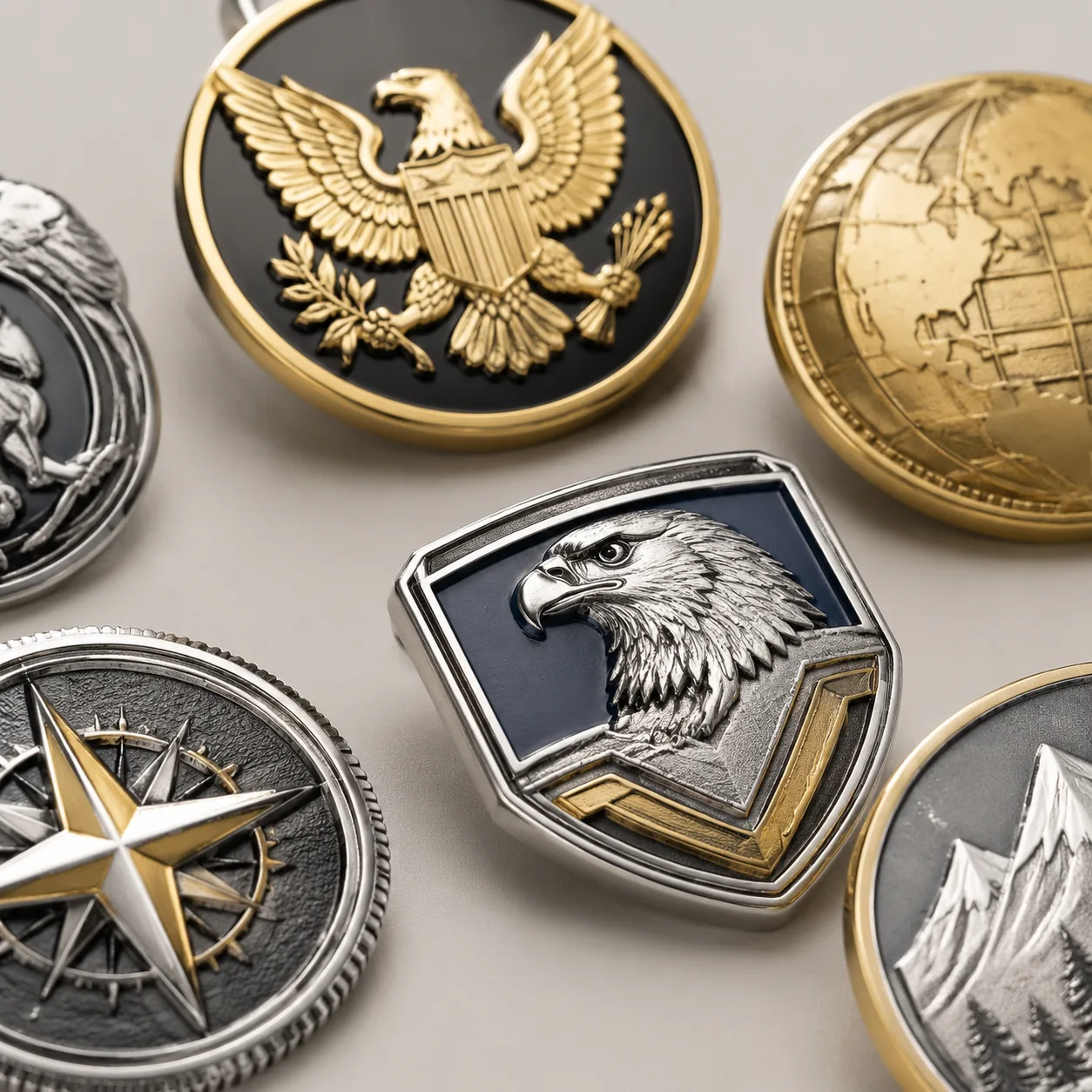
Why two-tone plating quotes vary so much
A buyer sends the same artwork to three factories: a silver challenge coin with gold highlights, or a black nickel pin with polished rose-gold lettering. One quote is 8% above single plating, another is 45% higher, and a third supplier approves the artwork but later says the border cannot be held after the sample is already late. The difference is usually not dishonesty. It is that “two-tone plating” can mean antique wash and polishing, selective chemical darkening, masked plating, hand touch-up, or a full second plating pass.
Each route has a different cost base. Antique wash plus polishing adds little line time. Masked selective plating adds cleaning, resist application, a second bath, stripping of masking, extra polishing control, higher scrap, and slower inspection. On small parts, one worker may spend more time protecting a 0.4 mm raised logo edge than the press spends striking the blank.
For procurement teams, the risk is broader than price. Poorly defined two-tone plating can produce fuzzy metal boundaries, thin plating on raised corners, darkening residue in recesses, or tarnish where the nickel barrier is weak. Reorders are also exposed: the same artwork may return with a warmer gold, lighter black nickel, or different antique depth if the original plating stack and process route were never locked.
This guide explains how to specify two-tone plating for custom pins, challenge coins, keychains, brooches and metal badges so factories quote the same build and can repeat it. ZheCraft handles die striking, casting, polishing, plating, enamel filling and final inspection in-house in Yiwu, so the recommendations below reflect the decisions required before we can issue a reliable FOB quotation.
Choose the right two-tone construction
Two-tone plating works best when the second metal color sits on raised, clearly separated features: coin rims, large numerals, simple logos, text strokes above 0.35 mm, or badge frames with at least 0.40 mm spacing from enamel fields. It is much less reliable on hairline borders, deep undercuts, rough 3D textures, tiny recessed dots, or lettering that needs a different bright metal color inside narrow grooves.
For soft enamel pins, the safest route is usually plating first, then enamel fill. The second metal tone should stay on raised metal zones that do not require enamel to touch both sides of a fragile divider. For hard enamel pins, two-tone metal is harder because enamel leveling and polishing can expose high points and reduce plating uniformity. If mirror polish is required on both colors, expect slower sampling and higher reject rates.
Challenge coins are the most forgiving format because their larger 38-50 mm diameter gives room for antique wash, selective polishing and clean separation between raised and recessed relief. Keychains can also work well, but daily abrasion changes the finish choice: black nickel, gunmetal or antique nickel usually survive key contact better than very thin imitation gold flash.
| Item type | Good two-tone use | Avoid two-tone when | Practical design limit |
|---|---|---|---|
| Soft enamel pin, 20-35 mm | Raised logo, border, text or outer frame | Second color crosses many small enamel islands | Raised divider 0.30-0.40 mm minimum |
| Hard enamel badge, 20-40 mm | Large raised frame or simple icon | Both colors require mirror polish after leveling | Keep second tone on broad metal fields |
| Challenge coin, 38-50 mm | Antique silver base with polished gold highlights | Fine recessed lettering must be bright gold | Use relief height of 0.25-0.50 mm |
| Metal keychain, 35-60 mm | Two-tone front face with plain plated back | Hardware must match both tones exactly | Specify wear-resistant finish on edges |
| Brooch or badge, 30-55 mm | Decorative rim or raised motif | Thin openwork needs color changes on inner walls | Avoid color changes inside narrow cutouts |
Specify the plating stack in microns
A two-tone finish is not two colors sprayed onto metal. It is a sequence: degreasing, acid activation, copper or nickel underplating, first decorative plating, masking or resist where needed, second plating or chemical darkening, polishing, cleaning, and sealing if required. If the stack is not specified, one factory may quote a decorative flash while another quotes a thicker, more corrosion-resistant finish.
For zinc alloy and iron giveaways, a practical base stack is copper strike 2-4 microns plus nickel barrier 3-5 microns before decorative plating. On brass or copper base metal, the copper strike may be reduced, but the nickel barrier still matters for handling resistance and color stability. On stainless steel, pretreatment and adhesion control are more important than copper thickness, and not every promotional plating line handles it consistently.
Decorative gold flash for promotional pins is commonly 0.03-0.08 microns. For handled coins and keychains, specify 0.08-0.15 microns minimum if gold color must last beyond a short campaign. Thicker gold is possible, but the cost rises quickly because the metal value becomes material to the quote. Bright nickel and imitation rhodium finishes are usually more economical for larger surfaces. Black nickel, antique brass, antique copper and gunmetal are more sensitive to bath chemistry and polishing pressure, so the approved sample must become the color master.
- State the base metal: iron, zinc alloy, brass, copper or stainless steel.
- State underplating: copper strike 2-4 microns and nickel barrier 3-5 microns where needed.
- State decorative thickness: for example gold flash 0.08 microns minimum on daily-use keychains.
- State the two colors by process name: bright nickel, imitation gold, rose gold, black nickel, gunmetal, antique silver or antique brass.
- Confirm whether clear lacquer or electrophoretic coating is allowed; it improves tarnish resistance but softens metal contrast.
- Require a retained physical sample for repeat orders, not only a photo or plating name.
Control the color boundary tolerance
The most common failure in two-tone plating is the border between colors. Selective plating and masking are not printing processes; they have real mechanical tolerance. On flat raised surfaces, a boundary tolerance of +/-0.15 mm is realistic for many pins, badges and coins. On curved 3D relief, inner cutouts, rough textures or narrow sidewalls, +/-0.25 mm is more honest. If the brand logo cannot accept that drift, revise the design before sampling.
Do not place a two-tone boundary on a knife-edge ridge. A 0.15 mm ridge may look sharp in vector artwork but can disappear after die striking, tumbling, polishing and plating. For most custom metal giveaways, specify a minimum raised divider of 0.30 mm for short simple shapes and 0.40 mm for long boundaries over 20 mm. For large coins or retail badges, 0.50 mm gives better repeatability and easier inspection.
If enamel sits beside the plated boundary, allow at least 0.20 mm enamel setback from the metal divider. This reduces overflow, grinding marks and color contamination during cleaning. For very fine metallic contrast, consider antique plating plus polishing instead of true two-tone plating. An antique silver coin with polished high points can create strong silver-dark contrast without masking a second metal color; it is cheaper, more repeatable and better for detailed relief, though it will not deliver a distinct gold-silver brand effect.
Budget MOQ, FOB price and lead time
Two-tone plating raises cost because it adds handling steps, plating line time, masking labor and scrap risk. The premium is small when the second tone is achieved by antique wash and polishing. It is much higher when selective gold or rose-gold plating must be masked on small parts with tight boundaries. Pricing also depends on base metal, thickness, attachment, packaging, enamel count and whether one or both sides need treatment.
As a practical FOB range, a 25 mm soft enamel pin at 300 pieces may cost USD 0.55-1.20 per piece with single plating, depending on clutch, carding and enamel colors. A true two-tone version commonly adds USD 0.10-0.35 per piece. A 45 mm die-struck challenge coin at 300 pieces may cost USD 1.80-4.20 per piece in single antique plating; selective two-tone plating can add USD 0.25-0.80 per piece, especially if both faces require clean separation.
MOQ also changes. Simple two-tone pins can be produced from 100 pieces, but 300 pieces is the more economical tier because setup and plating trial losses are spread across more units. For coins and keychains, 100 pieces is workable for sampling or small campaigns; 300-500 pieces usually lowers the unit cost enough to justify the larger run.
| Two-tone method | Typical MOQ | Added lead time | FOB premium range | Best use |
|---|---|---|---|---|
| Antique wash plus polishing | 100 pcs | 0-2 days | USD 0.03-0.15 per pc | Coins, badges, textured keychains |
| Bright base plus selective darkening | 100-300 pcs | 2-4 days | USD 0.08-0.25 per pc | Black details on nickel or gold bases |
| Masked selective plating, one side | 300 pcs | 3-6 days | USD 0.15-0.50 per pc | Raised gold or rose-gold logos |
| Two-tone on both sides | 300-500 pcs | 5-8 days | USD 0.25-0.80 per pc | Premium coins and retail keychains |
| Hard enamel with two-tone metal | 300 pcs | 4-7 days | USD 0.20-0.60 per pc | Simple badges with large metal areas |
Match durability to the use case
Two-tone plating is not always the most durable construction. A collector coin kept in a capsule, a uniform pin worn twice a month, a lanyard charm handled all day and a keychain rubbing against keys require different specifications. If the item sees daily abrasion, specify thicker decorative plating, rounded raised edges and avoid thin gold flash on high-contact corners.
For keychains, nickel, black nickel, gunmetal and antique finishes usually outperform very thin imitation gold in daily use. If gold is required, ask for at least 0.08 microns decorative gold on exposed raised areas and consider clear lacquer or electrophoretic coating. Coatings improve tarnish resistance but can slightly reduce the crispness of engraved lines, 3D relief and antique recesses.
For humid or outdoor exposure, do not rely on the plating name alone. Low-cost promotional metal parts are not engineered like marine hardware. A reasonable buyer specification might require no red rust on iron-based parts after 24 hours neutral salt spray, or use zinc alloy, brass or copper base metal where rust risk is unacceptable. For retail programs, ask whether the supplier can support 48-hour salt spray on the proposed stack before the price is locked.
Inspect before shipment using clear AQL rules
Two-tone plating requires visual inspection under consistent lighting because photos can hide color shifts, thin edges and residue. Inspect against the approved physical sample under neutral white light, typically 5000-6500K. Many promotional orders use AQL 0 for critical defects, 2.5 for major defects and 4.0 for minor defects, but retail-facing programs often need tighter cosmetic sorting.
Critical defects include sharp burrs that can cut skin, loose attachments, wrong logo, missing plating process or exposed hazardous contamination. Major defects include wrong metal color, missing second tone, visible peeling, bubbling, exposed base metal, corrosion before packing, or plating bleed over the agreed tolerance, commonly 0.30 mm at logo edges. Minor defects include slight polishing haze, small color variation within the approved range, or boundary drift inside tolerance on non-logo areas.
Do not approve mass production from a studio photo alone when the order is high value, repeatable or retail-facing. Request a physical pre-production sample. For urgent event orders, request close-up video under fixed lighting, photos beside the retained sample, and confirmation of the plating stack in writing; then recognize that remote approval is still weaker than holding the part in hand.
- Check color match against the approved physical sample, not a screen image.
- Measure boundary drift at logos and text with a 0.1 mm scale or microscope where needed.
- Rub high points with a white cotton cloth for 20 cycles to detect loose darkening residue.
- Inspect holes, jump rings, clasps and pin posts because plating often thins near hardware joints.
- Open inner polybags from different cartons to confirm the finish did not shift between plating batches.
- Reject peeling, bubbling, sharp burrs, green oxidation, red rust or exposed base metal on visible surfaces.
Write an RFQ that factories can repeat
A good RFQ removes ambiguity before the supplier calculates price. Include vector artwork with separate layers for each metal tone, a drawing showing raised and recessed areas, target size, thickness, base metal, attachment, packaging and intended use. If the item has both enamel and two-tone plating, state the priority: crisp metal contrast, perfect enamel surface, faster lead time or lowest unit cost.
Ask the factory to state the proposed process route in the quotation. The answer should say whether the effect is antique wash, selective darkening, masked plating, selective polishing or another method. If the quote only says “two-tone plating included,” it is not specific enough for a repeatable B2B order. Also ask for sample lead time, production lead time and price tiers at 100, 300, 500 and 1,000 pieces; for most custom metal items, sampling takes 5-8 days after artwork approval and mass production takes 12-20 days after sample approval, before international freight.
For reorders, lock the die number, base metal, plating stack, decorative thickness targets, enamel Pantone references, attachment, packaging, approved sample date and inspection standard. ZheCraft can build these into a reorder spec sheet for distributors managing annual campaigns, franchise programs or multi-branch uniform badges. The earlier these details are fixed, the less time is spent debating color, cost and defects after the goods are already plated.
Have a project? Send your artwork and target quantity and we’ll reply with a detailed quotation within 12 working hours.
Ready to get this made?
Send your sketch, target quantity and ship-date. Detailed quotation in 12 hours.



