Tourist Fridge Magnet Packaging: Shelf Impact and Freight Protection
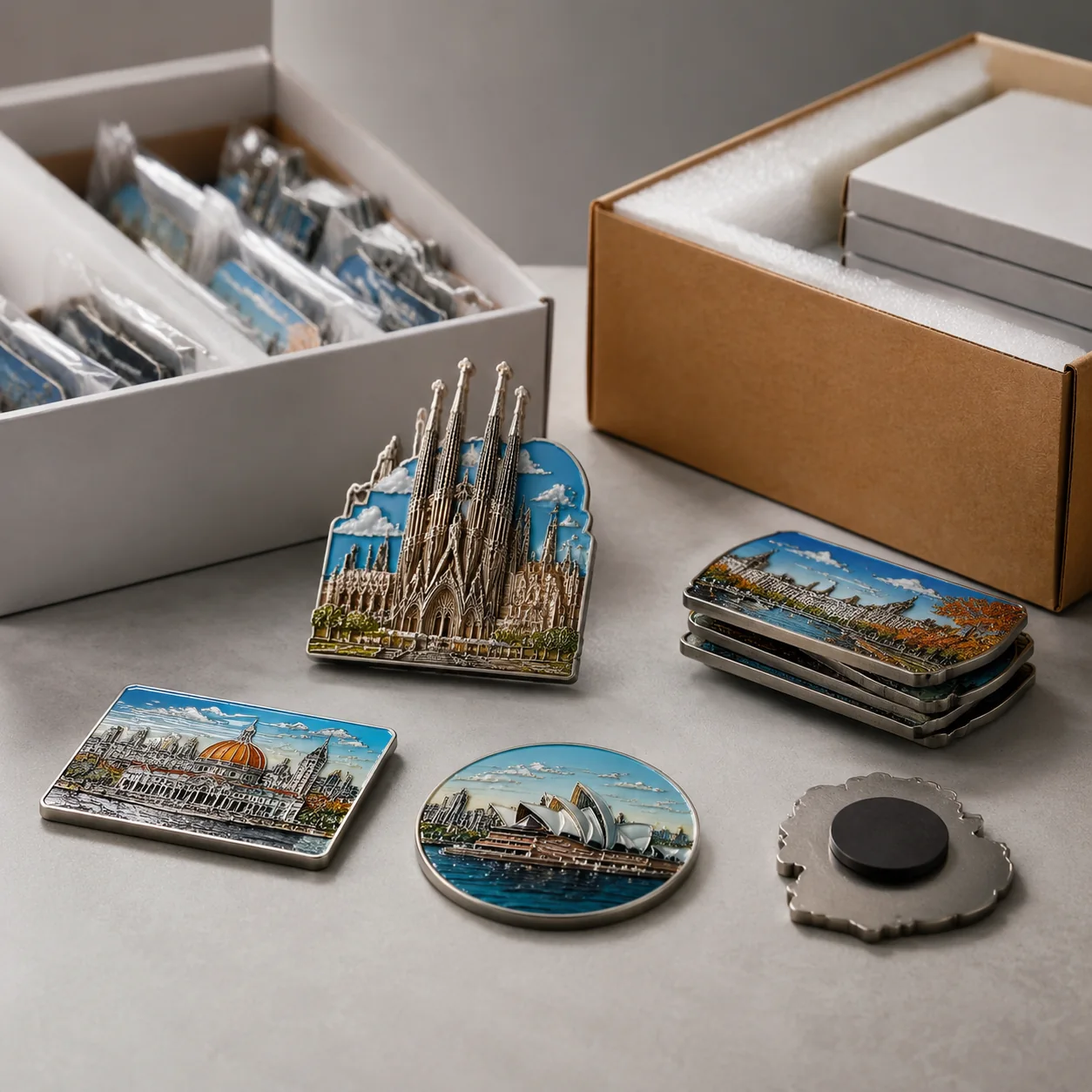
Choose a 40-100 mm tourist magnet with a silhouette that reads as the destination at a glance, then select backing and retail presentation based on the shelf and freight route. Glued flexible magnet sheet is the standard backing, while an inset neodymium disc is the premium option. Standard ferrite is the default strength, and neodymium suits thick fridge doors or multi-page hold. Use the default poly-bag where loose-unit presentation is acceptable, and specify an optional hangtag or retail header card when the item must sell from a display.
Define the Shelf Signal Before Selecting Packaging
A tourist magnet is bought first as a recognizable reminder of a place, then handled as an item that must arrive in sellable condition. Start with one clear destination silhouette. The supported format choices are rectangle, round, and custom die-cut, in a typical 40-100 mm size range. A custom die-cut makes the outline part of destination recognition, but its less regular profile means the display and packing decisions should be written together rather than treating shape as artwork alone.
Color should reinforce the silhouette rather than compete with it. The available product information identifies resin dome magnets as photo magnets and notes their magnified photo artwork in photo-gift services, so image legibility is especially important for that family. It does not state a color-matching standard, printing tolerance, minimum line rule, or proof-approval process. Retain the approved visual reference with the artwork package and request any additional color controls explicitly instead of assuming they are included.
- Select a typical overall size between 40 mm and 100 mm before choosing the retail presentation.
- State whether the destination outline is rectangle, round, or custom die-cut.
- Treat the silhouette and color reference as one approved artwork decision.
- Identify whether the finished unit will use the default poly-bag, an optional hangtag, or an optional retail header card.
Choose the Material Family for the Retail Role
The material family should follow the selling role, not just the lowest quoted piece price. PVC soft rubber is identified for tourist souvenirs, resin dome for photo magnets, die-cast metal for premium gifting, and printed tin for low-cost promotion. This makes it possible to define the product position before discussing packaging: a photo-led city souvenir is a different retail proposition from a low-cost event giveaway, even when both use the same general fridge magnet category.
| Material family | Fact-supported use fit | Stated MOQ | Buying implication |
|---|---|---|---|
| PVC soft rubber | Tourist souvenirs | 300 pcs | Suited to the core tourist-souvenir role, with a higher stated MOQ than resin or die-cast metal. |
| Resin dome | Photo magnets and photo-gift services | 100 pcs | Use where magnified photo artwork is central to the destination offer. |
| Die-cast metal | Premium gifting | 100 pcs | Use where the retail or gifting position is premium rather than low-cost promotional. |
| Printed tin | Low-cost promo | Not stated | Confirm MOQ before comparing it with the other three material families. |
The stated category price range is $0.10-$1.80 per piece FOB. It establishes the broad commercial range, but it should not be used to predict the final cost of a particular material, size, shape, magnet backing, or retail pack. The facts also identify fridge magnets as a high-volume, low-margin product, with most buyers ordering 1,000-20,000 pieces. At those volumes, packaging choices that are unclear at quotation stage can affect the usefulness of a price comparison.
There is a practical assortment trade-off. The product narrative says the economics work best when a buyer commits to a single design so tooling can keep running, while visual variety within a product line encourages repeat retail purchase. A destination retailer should therefore decide whether the next order prioritizes one volume design or several visually distinct destination SKUs, then request a separate commercial comparison for each approach.
Set Magnet Backing and Placement With the Shape
Backing is part of both product performance and the back-of-unit presentation. The standard configuration is a glued flexible magnet sheet. The premium configuration is an inset neodymium disc. For magnet strength, standard ferrite is the default, while neodymium is available for thick fridge doors or holding multiple pages. All four fridge magnet families have neodymium magnet strength options, so the strength choice can be evaluated alongside the selected material family.
Do not treat magnet placement as an unstated production detail. The supplied facts identify the two backing types but do not specify the number of magnets, disc dimensions, exact location, glue coverage, holding-test method, or acceptance threshold. For a custom die-cut silhouette in particular, include a placement reference in the buyer's specification and obtain confirmation of the proposed configuration. That distinguishes a controlled decision from an assumption about how the rear of the magnet will be built.
- Use standard ferrite when the default strength is suitable for the intended application.
- Specify neodymium when thick fridge doors or multi-page hold are part of the intended use.
- Name glued flexible magnet sheet or inset neodymium disc in the purchase specification.
- Attach a rear-view placement reference because no standard location is stated in the product facts.
Match Unit Packaging to the Selling Environment
The stated default for fridge magnet packaging is a poly-bag. Hangtags and retail header cards are optional. These options should be selected based on how the destination retailer intends to present the item: a loose unit, an item intended for hanging display, or a unit that needs a more defined retail-facing presentation. The unit-pack decision should be made early enough that artwork, silhouette, and display method remain compatible.
A retail header card is the stated optional card format. Do not use the broader term backing card as though it were a defined standard without describing the required card size, artwork area, attachment method, and barcode or retail-label need. The product facts do not provide those details. Similarly, they do not say whether a hangtag or header card is included in the quoted range, so those options should be named as separate requirements during commercial comparison.
The packaging information identifies unit-level options only. It does not specify cartons, inserts, dividers, inner-box counts, master-carton counts, carton dimensions, drop-test criteria, or whether units are packed by SKU. A poly-bag can be the default unit pack without answering the larger freight-protection question. Freight-safe packaging therefore requires a documented carton plan rather than an assumption that the unit pack alone controls transit risk.
- Use poly-bag when the default unit presentation meets the retail need.
- Use a hangtag when the planned fixture requires a hanging presentation.
- Use a retail header card when a more defined retail-facing pack is required.
- Request carton packout details separately because no carton configuration is stated.
Make Carton Protection a Stated Procurement Requirement
For international procurement, carton protection should be treated as a buyer-defined requirement. The supplied product facts provide a 10-20 day lead time and identify the unit-pack choices, but they do not establish a standard freight carton or an in-transit protection method. Ask for the proposed units per inner pack, units per master carton, product orientation, separation between units, carton dimensions, gross weight, and SKU segregation. These are the details needed to assess whether an irregular custom silhouette, a retail card, or a photo-led resin dome unit has an appropriate route to the store.
The same discipline applies to quality control. No inspection standard, AQL, defect classification, magnetic holding threshold, adhesive test, or transit-test result is supplied. Do not present those controls to internal stakeholders as standard product features. Instead, define the receiving condition that matters to the retailer, such as correct SKU, visible artwork, correct unit-pack format, intact card where used, and the specified magnet backing. Then require the proposed inspection and carton method to be confirmed before the order is released.
Use This Fridge Magnet Packaging Checklist
Use this checklist as the approval gate before requesting a final quote or releasing production:
- Select PVC soft rubber, resin dome, die-cast metal, or printed tin based on the intended retail role.
- Set the typical finished size between 40 mm and 100 mm.
- Specify rectangle, round, or custom die-cut silhouette.
- Provide the approved destination artwork and its color reference.
- Choose standard ferrite or neodymium based on the intended holding condition.
- Specify glued flexible magnet sheet or inset neodymium disc.
- Include a rear-view reference for magnet placement.
- Choose the default poly-bag, optional hangtag, or optional retail header card.
- Match the requested quantity against the stated 300-piece PVC MOQ or 100-piece resin and metal MOQ.
- Confirm printed tin MOQ because it is not stated in the supplied facts.
- Plan against the stated 10-20 day lead time without assuming any unstated shipping duration.
- Request the unit, inner-pack, and master-carton configuration required for freight planning.
- Define inspection and acceptance requirements because no standard QC method is supplied.
Turn the Decision Into a Comparable RFQ
Prepare one RFQ line for each destination SKU with the material family, 40-100 mm finished size, outline type, artwork reference, magnet strength, backing type, unit pack, quantity, and desired delivery date. Add a separate request for carton packout and the proposed inspection method, because neither is defined by the supplied product facts. For custom tourist fridge magnets, compare quotes only after every supplier is responding to the same silhouette, magnet, retail-pack, and carton-protection requirements. This gives the procurement team a meaningful basis for balancing shelf recognition against freight exposure.
Ready to get this made?
Send your sketch, target quantity and ship-date. Detailed quotation in 12 hours.