Top 5 Sustainable Material Swaps for Custom Promo Items
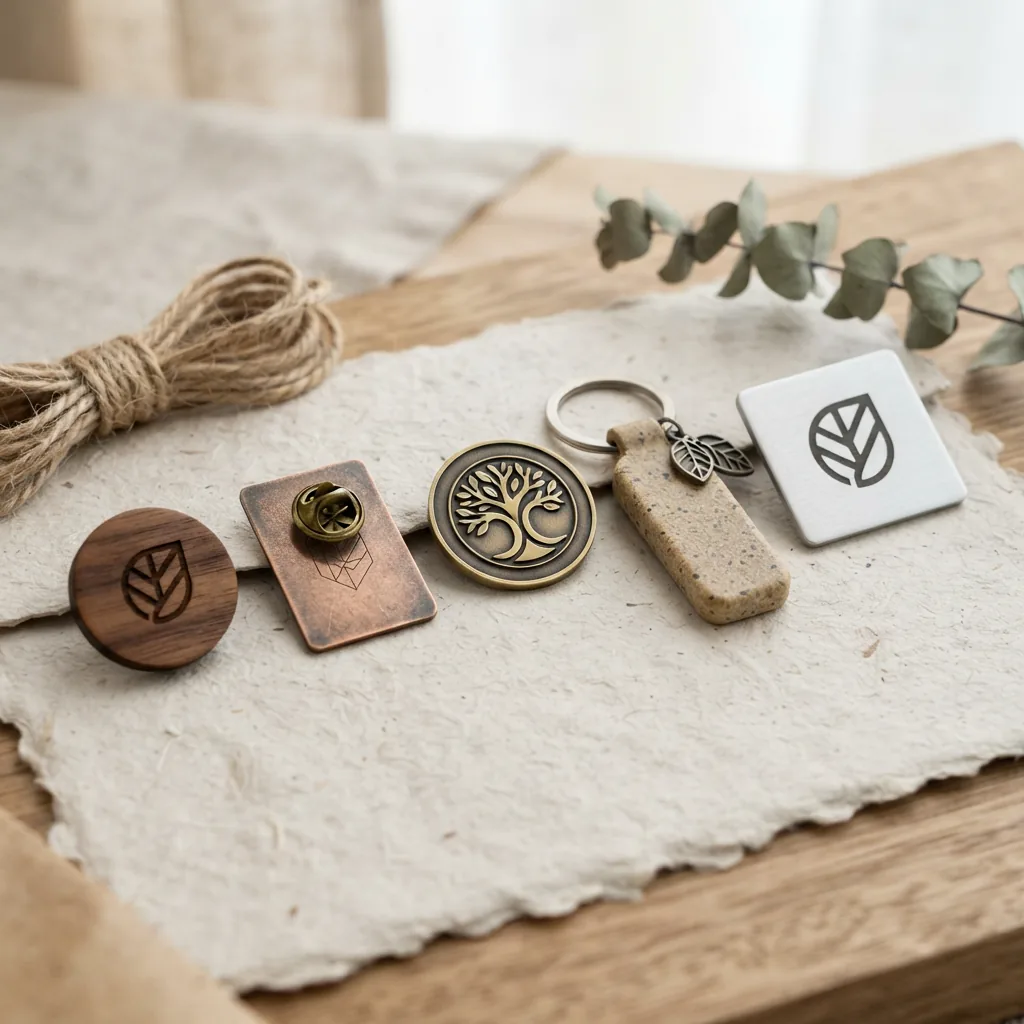
When buyers ask for "eco-friendly" but still expect standard quality, cost, and repeatability
The sourcing problem is not finding a greener claim. It is finding a material change that does not trigger rework, color disputes, plating failures, weak adhesion, transit damage, or a unit-cost jump that kills the program. Most custom promo items still need to land inside practical FOB windows at standard factory volumes: about USD 0.22-0.75 for basic lanyards, USD 0.45-1.20 for standard lapel pins, USD 0.70-2.80 for keychains and coins, and USD 0.30-1.10 for patches.
There is no zero-impact option in this category. Buyers are usually balancing four constraints at once: reducing virgin material, keeping the product visually close to brand standards, maintaining reorder consistency over 6-12 months, and avoiding process changes that add hidden labor, scrap, or QA burden. In practice, the best swap is usually the one that keeps the existing tooling, print method, sewing logic, plating line, or pack-out method largely intact.
That is why a procurement comparison is more useful than broad sustainability language. What changes in MOQ, lead time, tolerance, inspection method, durability, and cost? The five swaps below are ranked for practical B2B use in 2026 based on conversion ease, reorder stability, and commercial viability, not marketing appeal.
Top 5 lower-impact material swaps ranked by sourcing practicality
| Rank | Material swap | Best-fit products | Typical MOQ | Bulk lead time after approval | FOB range at 1,000 pcs | Main technical watchout |
|---|---|---|---|---|---|---|
| 1 | Recycled polyester (rPET) instead of virgin polyester | Lanyards, woven labels, patch bases, ribbon parts | 1,000 pcs | 10-18 days | USD 0.22-0.68 | Shade drift by yarn lot; verify tensile strength, print holdout, and breakaway performance |
| 2 | Recycled-content zinc alloy, brass, or iron instead of all-virgin metal | Pins, badges, coins, keychains, medals, magnets | 100-300 pcs | 12-20 days | USD 0.45-2.80 | Content traceability varies by melt stream and plating subcontractor |
| 3 | Paper-first packaging instead of OPP bags and PVC/PET packs | Pins, patches, coins, keychains, gift sets | 500-1,000 sets | 7-12 days | USD 0.06-0.38 | Lower scuff protection unless a glassine sleeve, tissue wrap, or insert is added |
| 4 | Recycled twill or rPET felt instead of virgin synthetic patch base | Patches, badge holders, sewn accessories | 500 pcs | 12-18 days | USD 0.30-1.10 | Less forgiving for tiny text, laser-cut edges, and exact shade matching |
| 5 | Bamboo or cork panel instead of full-plastic body or insert | Keychains, magnets, coasters, notebook badges, gift sets | 500-1,000 pcs | 15-25 days | USD 0.55-2.20 | Natural variation, moisture movement, edge chips, and fine-detail limits |
Bioplastics do not make the top five for most custom promo programs. PLA and starch blends can work for selected molded pieces, but they still bring higher risk in hot-car storage, brittleness at clips or loop points, and less stable repeat runs when wall thickness drops below roughly 1.5-2.0 mm. For buyers who need predictable reorders, the five swaps above are usually easier to quote, inspect, and repeat.
1. rPET is still the best first move for lanyards and textile-heavy SKUs
For event lanyards and other textile-based items, rPET is usually the cleanest first substitution because it reduces virgin plastic without changing the product architecture. Standard widths remain 10 mm, 15 mm, 20 mm, and 25 mm. A common finished loop length is 900 mm, with a 45-55 mm tail added where a buckle is used. Sublimation webbing is commonly 110-130 gsm; woven constructions feel firmer and show less fine detail. A workable production tolerance is +/-1 mm on width and +/-10 mm on finished length.
At 1,000 pieces, a 20 mm rPET sublimation lanyard with safety breakaway, detachable buckle, and metal swivel hook typically lands at USD 0.28-0.46 FOB. A simpler 15 mm version with split ring is usually USD 0.22-0.34. At 3,000 pieces, the same 20 mm build normally drops by USD 0.02-0.05 per unit if hardware stays standard. Sample lead time is often 3-5 days for digital layout confirmation and 5-7 days for a physical pre-production sample. Bulk production is usually 10-15 days, extending to 16-18 days if custom attachments, woven labels, or individual retail packing are added.
Performance is generally close to virgin polyester when the yarn denier and webbing construction are controlled. For artwork, keep positive text above 1.0 mm cap height, reverse text above 1.2 mm, and line thickness above 0.20 mm. If woven construction is required, MOQs often rise to 2,000-3,000 pieces and fine logo edges soften versus sublimation. For breakaway lanyards, specify a release range of 8-12 kgf for general event use so factories do not substitute closures that are too weak or too hard to release.
The main watchout is color consistency. Recycled yarn lots can drift slightly, especially on dark navy, saturated red, and some greens. If color matters, approve a physical strike-off under D65 light and request Delta E control where the mill can support it. Delta E below 2.0 is realistic for many major brand colors on a stable sublimation run, but it should not be assumed across every lot. A practical inspection plan is AQL 2.5 major / 4.0 minor, checking print clarity, webbing fray, stitch security, hardware attachment, breakaway function, odor, and carton count accuracy.
2. Recycled-content metal is the safest premium-looking option for pins, coins, and keychains
For lapel pins, badges, challenge coins, and keychains, the most workable lower-impact approach is usually to keep the standard metal construction and specify recycled-content alloy where the feed stream is stable. In practice, that means stamped brass for fine lines and flat faces, die-struck iron for lower-cost badge programs, and die-cast zinc alloy for cutouts, thicker bodies, and 3D relief. This preserves the weight, polish, and premium feel buyers expect.
Typical build specs do not need to change. Stamped pins usually run 1.2-1.5 mm thick, challenge coins 3.0-4.0 mm, and die-cast keychains 2.0-4.0 mm body thickness before hardware is added. Tolerance should usually stay at about +/-0.15 mm on stamped parts and +/-0.20 mm on die-cast parts, depending on profile complexity. For soft enamel, keep metal lines at least 0.20 mm wide and recessed color areas above 0.35 mm to reduce underfill, color flooding, and polishing loss. If an epoxy dome is added, expect total thickness to increase by roughly 0.25-0.40 mm.
At 1,000 pieces, a 30 mm stamped brass soft-enamel pin with butterfly clutch commonly lands at USD 0.45-0.85 FOB. A 50 mm die-cast zinc alloy keychain with split ring is often USD 0.88-1.65. A 45 mm challenge coin typically runs USD 1.35-2.80 depending on plating, edge detail, epoxy, and whether both sides carry artwork. Low-MOQ orders are still possible, around 100 pieces for a standard pin and 300 pieces for a more complex keychain, but below 500 pieces the tooling charge pushes unit cost up sharply. Typical sample lead time is 5-7 days; bulk production is usually 12-18 days after sample approval.
The technical risk is usually not the recycled metal itself. It is downstream process stability. Decorative plating on promo items is thin: bright nickel often runs about 0.03-0.08 microns, imitation gold about 0.03-0.05 microns, and black nickel in a similar decorative range. These finishes are cosmetic, not heavy engineering coatings, so adhesion, base polishing quality, and anti-tarnish treatment matter more than headline material claims. Buyers should ask for a cross-hatch or tape adhesion check, a 24-hour salt-spray test where humidity exposure is relevant, and a rub test on raised areas. On silver-tone and imitation-gold items, clear lacquer is worth specifying if stock may sit in humid storage for more than 60-90 days.
If a supplier claims recycled metal, ask whether the claim refers to pre-consumer alloy scrap, post-consumer scrap, or an average melt stream from the foundry. Documentation quality varies much more than manufacturing difficulty in this category. That is why recycled-content metal ranks second: it preserves appearance and value well, but exact percentage proof is less consistent on smaller custom orders.
3. Paper-first packaging is the fastest cross-SKU change with the lowest engineering risk
If a buyer wants one immediate change across pins, patches, coins, and keychains, packaging is usually the fastest place to act. A printed paper card in 300-400 gsm coated board or kraft board can replace default OPP presentation on many programs. Common card sizes are 55 x 85 mm, 90 x 54 mm, and 70 x 70 mm. For more protection, a glassine sleeve, paper envelope, molded pulp tray, or rigid paper drawer box can replace PVC or PET presentation packaging.
At 1,000 units, a simple 4C printed pin card typically costs USD 0.06-0.12 FOB, a folded kraft envelope about USD 0.08-0.16, a molded pulp insert around USD 0.10-0.22, and a small rigid paper box roughly USD 0.18-0.38 depending on dimensions, wrapped finish, and insert structure. Lead time is normally 7-10 days for flat printed cards and 10-12 days for boxes or pulp inserts after artwork approval. MOQ is generally 500-1,000 sets, though custom die-cuts, foil stamping, embossing, or inside print can increase it to 2,000 sets.
The strength of this swap is speed. There is no metal tooling change, no fabric change, and usually no effect on the product itself. But paper is not a universal replacement for protective packaging. Mirror-polish coins, black-plated keychains, and epoxy-coated pins can scuff if packed loose against a printed card. In those cases, the better build is paper card plus glassine, recycled tissue, or a paper wrap band rather than forcing a paper-only presentation that increases complaints and returns.
Pack-out needs to be specified, not assumed. A packaging change can fail if export cartons are overloaded or inner packs are mixed carelessly. A practical export spec is 500-1,000 units per master carton depending on SKU size, with gross weight kept below 12 kg for easier manual handling. For courier-heavy programs, ask for carton edge-crush performance, a basic drop check on packed masters, and clear inner-pack quantities such as 50 or 100 units per inner so mixed-SKU fulfillment does not create abrasion in transit.
4. Recycled patch bases work well, but artwork and backing specs matter more
For embroidered and woven patches, switching from virgin polyester twill or felt to recycled twill, rPET felt, or recycled backing fabric is practical when the artwork is not overly intricate. Typical patch widths remain 50-90 mm for uniforms, clubs, and event programs. Merrow border width is usually 2.5-3.5 mm. Laser-cut edges suit irregular outlines, but some recycled fabrics are less forgiving during edge sealing, so narrow points, tiny inner cutouts, and highly jagged silhouettes should be avoided.
At 1,000 pieces, a 70 mm embroidered patch on recycled twill with iron-on backing commonly lands at USD 0.30-0.58 FOB. A woven patch with finer logo detail is more often USD 0.42-0.78. MOQ is usually 500 pieces per design, though mixed-size assortments become efficient only at higher combined volume. Sample lead time is typically 4-6 days; bulk production is 12-18 days after artwork approval and backing confirmation. Hook-and-loop sets usually add USD 0.08-0.18 per piece depending on patch size and whether both hook and loop are included.
The main limitation is design tolerance. Recycled base cloth can slightly reduce edge crispness and dark-fill saturation compared with premium virgin twill. For embroidery, text below about 4 mm letter height is risky; for woven patches, detail is better, but very thin borders, metallic threads, and exact Pantone matches still require a physical pre-production sample. If heat-seal backing is specified, request the bonding temperature window, commonly around 150-170 degrees C for 10-15 seconds depending on fabric and press conditions, rather than relying on a generic 'iron-on' claim.
QC should cover size, edge uniformity, stitch density, thread coverage, backing area, and color drift under standard light. A reasonable finished-size tolerance is +/-2 mm for embroidered patches and +/-1.5 mm for woven patches. For iron-on versions, define minimum backing coverage and request a peel test after application to a standard cotton twill panel. If the patch is intended for repeated washing, ask the supplier to state a realistic washability range, for example 20-30 home laundry cycles at 40 degrees C for a sew-on build, rather than using a vague durability claim.
5. Bamboo and cork add visible natural content, but only with the right geometry and QC limits
Bamboo and cork work best when the natural material is used as a visible panel, not the entire structural body. In promo, that usually means keychains, magnets, coasters, notebook badges, or gift-set inserts paired with standard hardware such as a 25 mm split ring, zinc alloy frame, or ferrite magnet. Typical cork thickness is 2-4 mm, bamboo panel thickness 3-6 mm, and laser engraving is usually more reliable than fine full-color printing on either surface.
At 1,000 pieces, a bamboo-faced keychain commonly runs USD 0.75-1.60 FOB, a cork-and-metal key fob USD 0.55-1.20, and a bamboo magnet USD 0.48-0.95 depending on size, magnet grade, finish, and whether individual sleeves are included. MOQ is usually 500-1,000 pieces. Lead time is longer than standard plastic or plain metal builds, commonly 15-25 days, because sheets need sorting, cutting, sanding, sealing, and extra visual grading before assembly. A custom die-cut shape with drilled hole or metal frame usually adds 3-5 days versus a simple rectangle or circle.
The trade-off is natural variation. Grain direction, pores, color shift, and edge chips need defined acceptance standards. On bamboo, engraved lines below roughly 0.15 mm can burn closed or appear uneven; practical engraved depth is often 0.10-0.20 mm. On cork, aggressive die-cuts can create crumbly corners, especially on narrow tabs or inside radii below 1.5 mm. Flatness can also move more than on molded plastic if parts are stored in humid conditions. If magnets are used, specify grade and pull expectation. For example, a 0.8-1.0 mm ferrite sheet may be enough for a light fridge magnet, but a heavier memo-holder build may require a 1.5-2.0 mm ferrite disc or NdFeB insert.
Use this swap when tactile differentiation matters and slight lot-to-lot variation is acceptable. Do not use it for high-gloss corporate programs that require exact color uniformity, for thin impact-prone hanging parts, or for tiny logos where every line must reproduce identically. For inbound QC, define warp limits such as maximum 1.5 mm bow across a 50 mm part, allowed chip size, surface sealing method, and engraving depth in writing so inspection remains objective.
Buyer checklist: how to compare sustainable swaps without vague supplier answers
- Ask exactly what is changing: body material, fabric, backing, insert, packaging, or only the claim language.
- Request MOQ by option, not one headline MOQ. rPET webbing, paper boxes, and bamboo inserts often have different breakpoints.
- Confirm sample lead time and bulk lead time separately in calendar days, and ask whether the clock starts after artwork approval or sample approval.
- Keep the original performance spec visible: size, thickness, hardware, pull strength, magnet grade, washability, plating finish, or backing type.
- For metal items, ask whether the swap changes tooling, alloy flow, polishing time, rejection rate, or plating adhesion risk.
- For textile items, approve a physical strike-off or pre-production sample if brand color or hand feel matters.
- Set QC in advance, such as AQL 2.5 major / 4.0 minor, and name the top defect categories you will actually reject for.
- Define tolerance numerically: width, length, thickness, warp, print shift, plating coverage, or edge variation.
- If packaging is changing, specify inner-pack and master-carton pack-out so transit damage does not cancel out the sustainability gain.
- Ask for the unit FOB delta versus the current spec, not only a standalone eco quote. That determines rollout feasibility.
How to build a 2026 sustainable range without slowing sourcing down
The fastest low-risk path is to start with swaps that preserve existing manufacturing logic: rPET for lanyards and paper-first packaging for suitable SKUs. Those two changes usually reduce virgin plastic fastest while keeping artwork, tooling, and assembly stable. If the range also includes premium metal items, lock the standard construction first, then discuss recycled-content alloy options only after size, thickness, attachment, plating, and pack-out are fixed.
For mixed programs, create a one-page comparison sheet per SKU with six fields: current material, proposed swap, MOQ impact, lead-time impact, unit FOB delta, and top quality risk. That format shows quickly which ideas are commercially workable. For example: 20 mm rPET sublimation lanyard, 900 mm loop, safety breakaway, black nickel swivel hook, MOQ 1,000 pcs, bulk lead time 12 days, FOB delta +USD 0.03 versus virgin polyester. Or a 30 mm stamped brass pin on a 350 gsm printed paper card replacing an OPP bag, MOQ 1,000 sets, lead time unchanged, packaging delta +USD 0.07, lower plastic use, and stronger presentation.
If you are requesting quotes, send artwork together with the non-negotiables: size, thickness, hardware, packaging format, target FOB, inspection level, approved tolerance, and whether natural variation is acceptable. Sustainable sourcing usually fails when the concept is approved but the physical standard is not. Lock the measurable expectation first, then choose the material swap your product, budget, and deadline can actually support.
Have a project? Send your artwork and target quantity and we’ll reply with a detailed quotation within 12 working hours.
Ready to get this made?
Send your sketch, target quantity and ship-date. Detailed quotation in 12 hours.



