Top 5 Shipping Modes for Custom Pins and Keychains in 2026
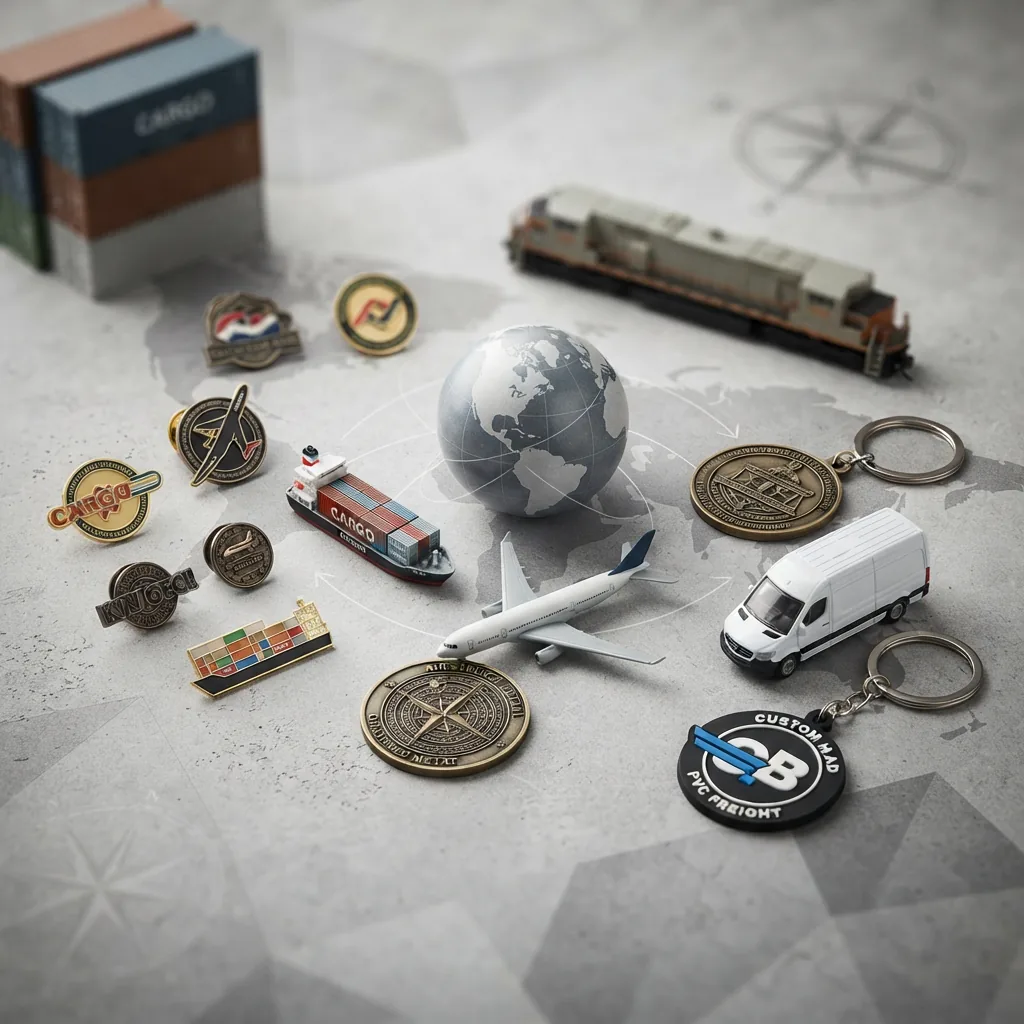
Why freight mode changes the true landed cost of small metal goods
For custom pins, keychains, challenge coins, and badges, the quoted factory price only covers part of the buy. Freight mode, customs handling, carton construction, and packaging density often decide whether an FOB quote is actually competitive. This matters most on mixed programs, where dense metal parts share space with low-density retail packaging. A PO for 3,000 soft enamel iron pins, 2,000 zinc alloy keychains, 1,000 printed backing cards, and 500 rigid gift boxes may look compact on paper, but it ships as two very different cargo types.
Typical packed weights show why. A 38 to 45 mm stamped iron pin with butterfly clutch, card mount, and 0.03 to 0.05 mm OPP bag usually packs at 12 to 18 g per piece. A 50 mm zinc alloy die-cast keychain with 30 mm split ring and bag commonly packs at 28 to 42 g. A 44.5 mm challenge coin in capsule or velvet pouch often lands at 45 to 75 g. The metal items themselves move efficiently by actual weight. Backing cards, EVA inserts, acrylic cases, and presentation boxes do not. Air freight and courier networks bill on whichever is higher: actual or volumetric weight, commonly using a 6,000 cm3/kg divisor for express and 5,000 to 6,000 cm3/kg depending on lane.
In practical sourcing terms, freight mode can shift landed cost by 10 to 28 percent on standard promo-metal orders, and by more than 35 percent on gift-set formats with bulky packaging. The right question in 2026 is not simply air versus sea. It is which mode fits the approved packed specification: total gross weight, total cbm, carton count, carton dimensions, destination terms, and latest acceptable in-hands date. Buyers who choose freight by piece count alone often end up paying for air rescue shipments, storage, rework, or customs delays later.
The five modes that matter for pins, keychains, and coins
For most sourcing teams, five freight modes cover nearly all custom metal accessory orders. The ranking below reflects what usually matters in practice: landed cost, transit reliability, customs workload, damage risk to plated parts, and the shipment size where each option starts to make economic sense.
| Rank | Freight mode | Best for | Typical transit | Typical freight range | Practical shipment size |
|---|---|---|---|---|---|
| 1 | Air DDP express consolidation | Urgent small and mid-size orders with simple customs handling | 5-9 days door to door | USD 6.80-10.80/kg chargeable | 15-300 kg |
| 2 | Air freight plus buyer-controlled clearance | Dense bulk orders where importer has broker or IOR setup | 4-8 days airport to airport plus 2-5 days clearance/delivery | USD 4.30-7.20/kg plus origin and destination charges | 100-800 kg |
| 3 | Sea DDP LCL consolidation | Cost-sensitive replenishment with flexible schedule | 24-40 days door to door | USD 95-180/cbm plus DDP margin, often equal to USD 0.90-2.30/kg on dense cargo | 0.3-8 cbm |
| 4 | Rail plus truck for Europe | Europe-bound cargo needing a middle option between sea and air | 18-28 days door to door | USD 1.90-3.90/kg equivalent depending on lane and density | 100-1000 kg |
| 5 | Courier parcel by account | Samples, approvals, shortage replacements, and very small cartons | 3-6 days | USD 20-38/kg billed weight or account tariff | 0.5-20 kg per parcel |
There is no universal best mode. A 12 kg revised sample set, a 180 kg event order, and a 1.6 cbm replenishment should not move the same way. For most pin and keychain programs, air DDP consolidation remains the most forgiving default because it balances speed with low management overhead. Sea DDP LCL usually delivers the lowest freight cost, but only when the shipment is large enough, the cartons are sea-ready, and a delay of 7 to 14 days is commercially tolerable.
1. Air DDP express consolidation: best overall balance for most promo orders
For shipments below roughly 300 kg chargeable weight, air DDP express consolidation is usually the safest all-round choice. Typical transit is 5 to 9 days door to door after cargo handover, with one commercial invoice, one packing list, and limited consignee setup. It is the default lane for launch kits, distributor packs, employee gifts, retailer programs, and event merchandise where the delivery date matters but the buyer does not want to manage customs directly.
It performs best when master cartons stay within common parcel-network handling limits: about 45 x 35 x 30 cm up to 55 x 40 x 35 cm, with 8 to 18 kg gross weight per carton. Larger or inconsistent cartons are more likely to be reweighed, repacked, or surcharged. For plated goods such as bright nickel, imitation gold, black nickel, and antique silver with polished raised areas, require individual OPP bags at 30 to 50 microns and tissue or 1 to 2 mm foam interleaving every 50 to 100 pieces per inner stack. Without that, abrasion during sortation is routine.
This mode fits common MOQ bands: 300 to 500 pieces per design for stamped iron or brass pins, 100 to 300 pieces per design for zinc alloy keychains, and 50 to 100 pieces per design for challenge coins with higher unit value. As a 2026 pricing reference, standard 1.2 mm iron soft enamel pins at 38 to 45 mm often quote around USD 0.28 to 0.65 FOB each at 500 to 3,000 pieces, while 50 mm zinc alloy keychains with one-side design and standard plating commonly land around USD 0.85 to 1.80 FOB each at 300 to 2,000 pieces. At these order sizes, freight speed usually matters more than squeezing the last few cents out of per-kilo cost.
QC has to be completed before dispatch because DDP consolidation gives the buyer little control once cargo enters the forwarder network. AQL 2.5 for major defects and AQL 4.0 for minor defects is a workable baseline for custom metal accessories. Useful production tolerances should be written into the PO: plus or minus 0.15 mm on stamped pin outlines, plus or minus 0.20 mm on die-cast zinc outlines, plus or minus 0.10 mm on epoxy dome diameter, and plus or minus 0.10 mm on attachment-hole position. For decorative plating, standard nickel or imitation gold is often around 0.03 to 0.08 microns; 0.10 to 0.20 microns should be quoted separately because it adds cost and can extend production by 1 to 3 working days.
2. Air freight with buyer-controlled clearance: better economics once volume is real
Once the shipment reaches roughly 100 kg and the cargo is dense, direct air freight often beats express DDP on unit freight cost. This is common on challenge coins, die-struck badges, thicker iron pins, and zinc alloy keychains packed without oversized retail sets. Airport-to-airport transit is usually 4 to 8 days, but buyers should add 2 to 5 days for customs entry, duty payment, terminal handling, truck booking, and warehouse receipt.
The savings only appear when shipment size is large enough to absorb fixed charges. Air waybill fees, terminal handling, customs broker charges, exams, and local trucking can make a 50 to 80 kg shipment more expensive than DDP consolidation. Above about 150 kg, especially at densities above 180 kg/cbm, direct air starts to look stronger. For example, a 220 kg shipment of zinc alloy keychains packed into 0.9 cbm may quote at USD 4.80 to 6.20/kg line-haul, but the landed comparison only makes sense after adding origin docs, destination handling, duty, and truck delivery.
This route suits importers with a broker, importer-of-record setup, and a receiving warehouse that can take pallets. Palletization should be specified in advance. For premium-plated goods, require export pallets with corner boards, top sheet, stretch wrap, and maximum stack height of 1.1 to 1.2 m. For dense metal cargo, gross pallet weight of 250 to 500 kg is common. Palletized air freight usually reduces carton crush and random abrasion compared with parcel channels.
Invoice accuracy matters more here than on DDP lanes. Generic descriptions such as metal crafts or gift items are weak and often trigger questions. Better invoice lines are specific: custom zinc alloy keychains with iron split rings, non-battery promotional accessories, packed in polybags; custom iron soft enamel lapel pins with butterfly clutches. HS classification should be confirmed by the importer or customs broker, not guessed by the factory, because duty treatment varies by country and by whether the item is treated as jewelry, accessory hardware, or promotional article.
3. Sea DDP LCL: lowest freight cost when volume and timing support it
Sea DDP LCL is usually the lowest-cost option once packed volume reaches roughly 0.3 cbm, and it becomes materially more efficient above about 0.8 cbm. Typical door-to-door transit is 24 to 40 days depending on origin port, destination, feeder schedule, and deconsolidation speed. This is the right lane for replenishment orders, evergreen SKUs, and non-seasonal programs where a late arrival by 7 to 14 days will not break a launch plan or retailer reset.
The freight advantage is real, but so is the handling intensity. LCL cargo is loaded, unloaded, staged, and reconsolidated more times than air freight, so carton construction matters. For sea shipments, use double-wall export cartons, minimum 5-ply and often 7-ply for very dense cargo, with gross carton weight capped at 18 to 20 kg. A practical spec for pins and keychains is burst strength around 175 to 200 psi, edge crush test at 32 to 44 ECT depending on stacking, and waterproof tape on all seams. For mixed orders with paper inserts or backing cards, add 10 to 20 g desiccant per carton and seal inner bags to reduce moisture pickup.
Sea LCL is a weak fit for mirror-polished coins, jewelry-style keychains, or bright-plated pieces packed only in loose polybags. Those need tissue wrap, foam sleeves, tray separation, or sealed inner boxes to prevent rub marks, oxidation, and plating transfer. It is also a poor choice for event-critical programs. A lower freight rate is not a real saving if a 10-day delay forces split delivery or an emergency air shipment.
From a costing standpoint, sea makes sense when the shipment is genuinely bulky. A 1.2 cbm replenishment at 320 kg actual weight may quote around USD 115 to 160/cbm plus DDP margin, which often lands well below air on a per-kilo basis. By contrast, a 0.18 cbm shipment usually does not save enough to justify the extra 3 to 5 weeks in transit. Production lead time also needs to be factored in: standard pin and keychain runs are often 12 to 18 days after artwork approval, while sea freight adds another month. That full cycle only works for planned replenishment, not reactive buying.
4. Rail plus truck for Europe: the practical middle lane for EU buyers
For Europe-bound orders, rail plus truck often sits in the most useful middle ground between sea and air. Typical transit is 18 to 28 days door to door, with freight above sea but well below air. For buyers moving pins, badges, keychains, patches, or lanyards into Germany, the Netherlands, Poland, France, Belgium, and nearby markets, it can be the best compromise when sea is too slow and air is too expensive.
It works best on dense cargo in stable carton formats. Buyers should lock carton dimensions with a tolerance of plus or minus 10 mm, target gross weight of 12 to 18 kg, and durable outer labels showing PO number, SKU, carton number, country of origin, and consignee code. Multimodal routes involve more handoffs than direct air, so poor tape, weak adhesive labels, and mixed carton sizes create more mis-sort risk than many buyers expect.
Commercial terms must be checked carefully before approval. Confirm whether the quote is DDP, DAP, or terminal only; whether customs handling and VAT prepayment are included; and whether final delivery is parcel, line-haul truck, or booked warehouse appointment. A rail quote that looks cheaper can quickly lose its advantage once brokerage, unloading, and last-mile delivery are added back in.
From a planning standpoint, rail usually starts to make sense around 100 kg and becomes more compelling from 200 to 800 kg on Europe lanes, especially when shipment density is high and the required delivery date still allows a 3- to 4-week transit window. For many EU importers, it is the lane that protects margin on replenishment orders without forcing the inventory lead time of sea.
5. Courier parcel by account: right for samples and shortages, wrong for production bulk
Courier services such as DHL, FedEx, and UPS remain the correct tool for pre-production samples, revised samples, plating swatches, urgent shortage replacements, and small corrective shipments. A typical approval pack with five pin designs, three keychain variants, color cards, and finish chips usually moves as a 1 to 3 kg parcel and arrives in 3 to 6 days. Tracking is detailed, pickup is simple, and delivery exceptions are visible quickly.
The mistake is using courier as a production strategy. Once an order is split into multiple parcels, per-kilo cost rises sharply, packaging waste increases, and customs treatment can become inconsistent across boxes. Event kits are especially exposed: the pins may clear first while backing cards or gift boxes are held, leaving the buyer with incomplete packs at destination.
As a working rule, courier is suitable for sample approvals, top-up cartons under about 20 kg, and immediate corrective replacements. It is usually the highest-cost production mode once billed weight, fuel surcharge, remote-area fees, and special-delivery surcharges are added. On small parcels, that premium is acceptable because the shipment value is usually approval speed rather than freight efficiency.
How to choose the right mode from shipment data, not assumptions
Start with four numbers from the approved packing specification: total gross weight, carton count, total cbm, and required in-hands date. Then review product density and packaging format. Pins in 1.2 to 1.5 mm iron or brass with standard OPP bag packing are dense and freight-efficient. Zinc alloy keychains are denser still. By contrast, backing cards larger than about 90 x 140 mm, EVA inserts, blister packs, acrylic cases, and rigid presentation boxes push the shipment toward sea or rail earlier than many buyers expect.
- Choose air DDP express when the shipment is about 15-300 kg, delivery is needed in under 10 days, and customs simplicity matters more than the absolute lowest freight rate.
- Choose direct air freight when the shipment is above about 100 kg, cargo density is high, and the buyer already has a customs broker or importer-of-record setup.
- Choose sea DDP LCL when packed volume is at least 0.3 cbm, the schedule can absorb 24-40 days transit, and export cartons have been upgraded for moisture and stacking stress.
- Choose rail plus truck for Europe when sea timing is too slow, air is too expensive, and the quote clearly states customs scope and last-mile terms.
- Choose courier only for samples, urgent replacements, or top-up parcels where speed and tracking matter more than freight efficiency.
- Ask every supplier for the same carton-level data: carton count, exact dimensions, gross weight per carton, total cbm, and the recommended mode on the approved packing spec.
Before approving any lane, compare suppliers on the same trade basis. FOB from one supplier and DDP from another is not a valid cost comparison. Also ask for production lead time in working days, not vague terms such as fast or ready soon. On standard custom metal goods, artwork proofing is often 1 to 3 days, sampling 5 to 7 days, and mass production 12 to 18 days after approval, with another 1 to 3 days if upgraded plating, epoxy dome, or complex carding is added.
What to lock into the PO before you approve shipment
Before placing the order, request three logistics scenarios on the exact same packed specification: fast, balanced, and lowest cost. Each quote should state transit in days, chargeable-weight or cbm basis, carton count, carton dimensions, gross weight per carton, and whether duty, customs clearance, and final delivery are included. That forces assumptions into the open and makes supplier comparisons credible.
Then lock packaging and inspection requirements into the PO. For pins, keychains, badges, and coins, specify bag thickness, tissue or foam interleaving where needed, plating protection requirements, master-carton wall grade, desiccant if sea freight is possible, and carton gross-weight cap. If the order is date-critical, also lock the latest ship date, approved carton dimensions, and inspection standard such as AQL 2.5/4.0. Freight decisions only hold up when packaging, quality, and schedule assumptions are written with the same level of precision.
In 2026, the best shipping mode is the one that matches the actual packed shipment, the buyer's import capability, and the commercial cost of being late. Buyers who choose from carton data instead of assumptions usually spend less in total, avoid emergency freight, and miss fewer launch dates.
Have a project? Send your artwork and target quantity and we’ll reply with a detailed quotation within 12 working hours.
Ready to get this made?
Send your sketch, target quantity and ship-date. Detailed quotation in 12 hours.



