Top 5 Pin Packaging Setups for Events, Retail and Mailers
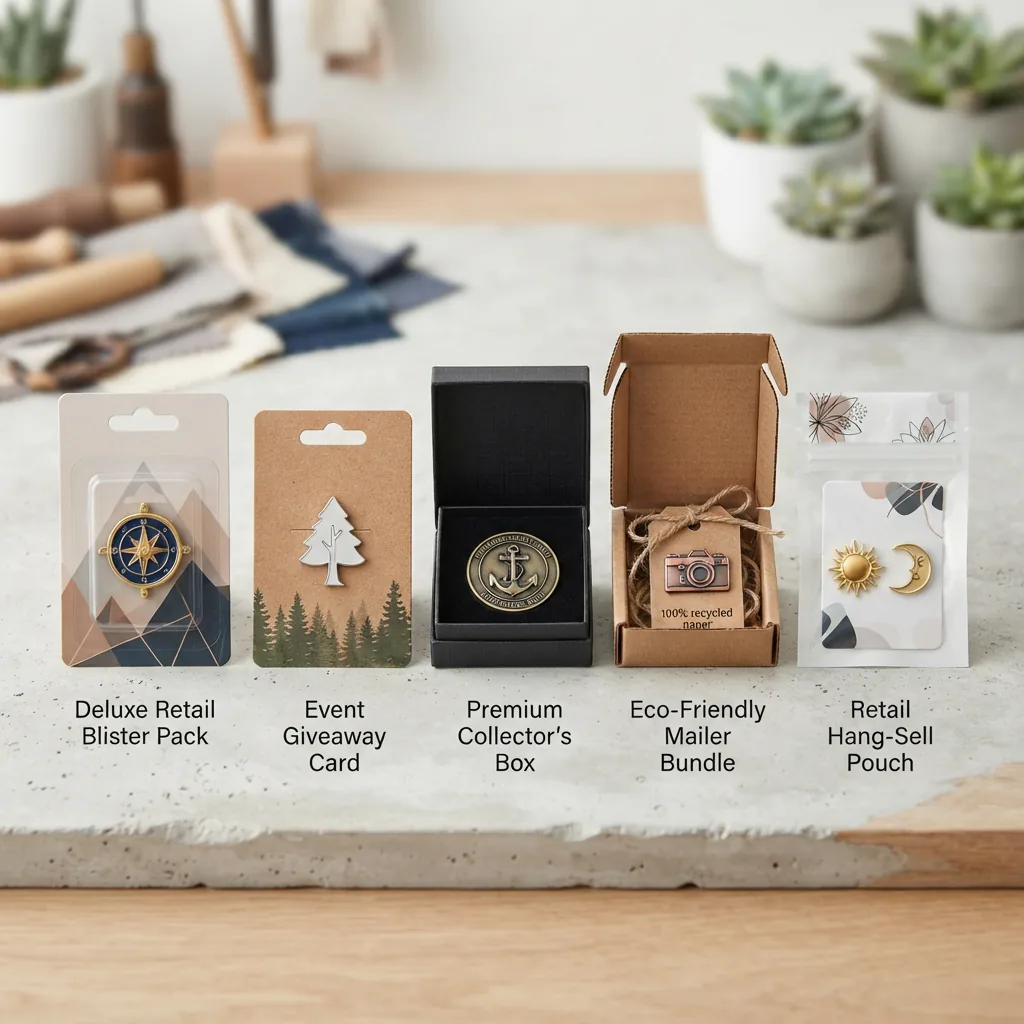
The 5 packaging formats that cover most commercial pin programs
Packaging failures usually start at quotation stage, not at final packing. The pin gets approved first, then packaging is added as a low-cost afterthought. That is when predictable problems surface: a 42 mm die-struck badge rotates because it has only one post, a rubber clutch prints through a thin mailer card, a retail buyer asks for a Euro slot after the card die line is locked, or a rigid-box insert is cut for a butterfly clutch but production changes to a locking back. At that point, packaging is no longer a styling choice. It becomes a tooling revision, sample delay and margin issue.
For most custom soft enamel pins, hard enamel pins, die-struck badges and small brooch programs in the 20 to 45 mm range, buyers do not need dozens of concepts. Five setups cover most real demand: backing card with polybag, backing card with sealed OPP sleeve, folded paper card, rigid paper box, and acrylic or clear plastic display case. The right choice depends on selling channel, target FOB, protection requirement, information area and hardware depth. If the pin will be handed out at an event, the packaging job is cost control and fast assembly. If it will sit on a peg wall for 90 days, shelf presentation and scuff resistance matter more. If it will ship parcel post, clutch protection and mailer fit become critical.
The practical ranking criteria are straightforward: unit add-on cost, assembly speed, tolerance for different backs, resistance to crush and abrasion, export-carton efficiency, and whether the pack supports the selling story. The most attractive pack is not automatically the best commercial choice. On large event runs and distributor programs, the best format is usually the one that keeps rejects below 1.5 percent, fits standard master cartons efficiently and avoids extra handwork at packing.
Comparison table: MOQ, FOB add-on, lead time and protection
| Rank | Packaging setup | Best for | MOQ guideline | Typical FOB add-on per unit | Lead time after artwork approval | Protection level | Main trade-off |
|---|---|---|---|---|---|---|---|
| 1 | Backing card plus polybag | Events, giveaways, distributor packs, low-cost promo | 100 to 300 pcs | USD 0.03 to 0.08 | 5 to 7 days | Low to medium | Lowest cost, but limited crush and scratch protection |
| 2 | Backing card plus sealed OPP sleeve | Retail peg display, souvenir shops, licensed gift | 300 to 500 pcs | USD 0.05 to 0.12 | 6 to 8 days | Medium | Cleaner shelf presentation, but still a flat pack |
| 3 | Folded paper card | Museum pins, story cards, e-commerce mailers | 300 to 500 pcs | USD 0.10 to 0.20 | 7 to 10 days | Medium to good | More assembly steps and larger carton cube |
| 4 | Rigid paper box with EVA, sponge or flock insert | Collector editions, executive gifts, anniversary sets | 500 pcs and up | USD 0.35 to 0.95 | 10 to 15 days | High | Packaging can exceed pin cost on basic designs |
| 5 | Acrylic display box or PVC/PET clear case | Visible premium display, commemoratives, coin-plus-pin sets | 500 pcs and up | USD 0.45 to 1.20 | 12 to 18 days | High if packed correctly | Scratch control and freight volume need tighter management |
For most volume orders, rank 1 remains the default because it solves the highest number of buying constraints at once. A 300 to 400 gsm SBS or C1S card in a 40 to 60 micron polybag is inexpensive, fast to print and easy to standardize across multiple SKUs. It also nests well in export cartons. That matters when one order contains several designs with the same outer dimensions but different pin shapes.
At the premium end, boxes and clear cases only make commercial sense when the selling price or gift value supports them. If a standard 25 to 30 mm soft enamel pin costs USD 0.55 to 0.90 FOB and the rigid box adds USD 0.55 to 0.85, packaging becomes the dominant line item. That can be correct for a collector launch, service award or commemorative release. It is usually the wrong fit for charity runs, campus giveaways or broad promotional distribution.
Best overall for volume: backing card plus polybag
For trade shows, onboarding kits and mass promotional runs, the safest specification is still a printed backing card in a loose polybag. Standard card stock is 300 to 400 gsm SBS, C1S or coated art card. Practical finished card sizes are 55 x 85 mm for pins under 30 mm, 70 x 90 mm for 30 to 35 mm pins, and 70 x 100 mm for 40 to 45 mm badges. Typical bag film is 40 to 60 micron LDPE or OPP. CMYK print is standard. Aqueous varnish is the lower-cost finish, while matte lamination usually adds about USD 0.01 to 0.02 per unit and gives better scuff resistance.
The main technical issue is hardware stability. A 20 to 25 mm pin with one butterfly clutch is usually acceptable on a flat card. Once the piece reaches about 35 mm width, weighs more than 8 to 10 g, or has uneven mass from cutouts, danglers or layered metal, two posts are the safer specification. Hole-position tolerance should stay within plus or minus 0.5 mm. Wider variation slows assembly and produces visible skew on the finished pack. For heavier pieces above roughly 12 g, 350 to 400 gsm card materially reduces tear-out around the post holes compared with 300 gsm stock.
Protection is adequate for controlled handling but limited for premium finishes. This format works well for handouts, inner-carton retail replenishment and distributor shipment. It is less suitable for mirror gold, polished nickel, glitter enamel or high-relief edges that can rub adjacent units. A practical export configuration is 50 to 100 individually bagged units per inner polybag, then into a 5-ply corrugated master carton with a gross weight kept below 12 kg for easier manual handling. Typical inspection is AQL 2.5 major and 4.0 minor, but the visible card face should also define cosmetic limits for bent corners, print offset, lamination bubbles and obvious scratches.
Best for retail peg display: backing card plus sealed sleeve
This format is a controlled upgrade of the basic card pack. Instead of a loose outer bag, the printed card is inserted into a clear OPP sleeve with an adhesive flap or heat seal. Typical card stock is 350 to 450 gsm with matte lamination for better shelf-life scuff resistance. A Euro slot or round hang hole is built into the die line, so peg presentation is cleaner and more consistent than a loose bagged card. Typical FOB add-on stays modest, which is why this format is common in souvenir retail, visitor centers and licensed gift programs.
Sizing discipline matters more than many buyers expect. The sleeve must clear the pin body and back hardware without telegraphing the clutch through the film. For a 30 mm pin on a 70 x 90 mm card, a sleeve around 76 x 110 mm is a normal working size. If the unit uses deluxe clutches, rubber backs or a brooch bar, an extra 2 to 4 mm of depth is often needed. If the sleeve is undersized, the clutch creates a pressure bulge, the card starts to curl, and shelf appearance deteriorates after a few weeks in a warm retail environment. A flap seal should also be positioned so adhesive does not mark the printed face under pressure.
This remains a flat pack, so its limits are clear. It does not absorb compression well and is not ideal for long brooch pins, deep 3D relief above about 2.0 mm, or hardware standing proud of the card by more than 4 mm. It is also worth specifying film clarity and seal quality up front. On retail-facing units, buyers commonly require no obvious wrinkles, fish-eyes or split side seals on the front panel when viewed at 50 cm under standard indoor lighting.
Best for e-commerce and story-led retail: folded paper card
A folded card becomes useful when the package must do more than hold the pin. Museum shops, tourism programs, cause campaigns and branded collections often need space for origin notes, artist credits, compliance text, collection numbering, QR codes or bilingual copy. Typical stock is 300 to 350 gsm art card or SBS, scored and folded to a finished size around 80 x 100 mm or 90 x 120 mm. For larger die-cast pieces or units above 12 g, 350 gsm is usually the better starting point.
Structurally, the folded format solves several recurring shipping problems. The clutch sits inside the fold instead of pressing directly against the outside surface, which reduces snagging in kraft mailers and minimizes print-through on thin cartons. It also lowers metal-to-metal contact between neighboring units in transit. That matters for polished gold, black nickel and antique silver finishes, where rub marks show quickly. For direct-to-consumer shipping, many buyers pair a folded card with a 1.5 to 2.0 mm E-flute mailer or a 250 to 300 gsm kraft envelope plus board stiffener. For a 35 mm pin with two posts, that combination usually passes normal parcel handling better than a flat single card.
The trade-off is assembly time and QC complexity. Every fold, glue point or insert step adds labor and creates another tolerance to control. Before approval, buyers should confirm whether the card is pre-glued, machine-scored or hand-assembled. Useful measurable checks include fold-center deviation within plus or minus 1.0 mm, no open glue edge longer than 5 mm, and card bow under 3 mm across the longest side after 24 hours at normal room conditions. Those numbers are more useful than vague instructions such as neat fold or firm adhesive.
Best for collector sets and gifting: rigid paper box
When the packaging is part of the item value, a rigid box is the most reliable format. Standard construction is 1.5 to 2.0 mm greyboard wrapped with 120 to 157 gsm printed art paper, commonly finished with matte lamination, soft-touch film, foil stamping or spot UV. The insert is usually EVA foam, sponge, flock blister or die-cut paperboard. Common single-pin box sizes start around 70 x 70 x 25 mm. Two-piece or book-style boxes for two to three pins often move to 100 x 100 x 30 mm or 120 x 90 x 30 mm.
This format provides the strongest control over hardware protection and presentation. It is well suited to service awards, dealer recognition pieces, anniversary gifts and coin-plus-pin sets where the item must arrive with no bent post, no pressure mark from the clutch and minimal plating abrasion. Insert cavity tolerance should generally stay within plus or minus 1.0 mm. If the cavity is too loose, the item rattles in transit and can mark the finish. If it is too tight, the recipient may bend a post or detach a delicate part during removal. For EVA inserts, a cavity depth that leaves 1 to 2 mm of controlled compression usually gives the cleanest hold.
The drawback is cost and freight cube. A rigid setup can add 60 to 140 percent to the FOB value of a mid-range pin and sometimes more on simple designs. Carton efficiency also drops sharply. A project that fits 1,000 flat card packs in one master carton may fit only 180 to 250 rigid boxes at a similar carton footprint before reaching practical volume limits. For premium programs that increase is acceptable. For routine promotional buying, the same budget is often better spent on heavier card stock, anti-scratch finish and stronger export packing.
Best for visible premium display: acrylic or clear plastic case
Clear packaging is used when the product must be visible before opening or when the package doubles as a reusable display piece. Typical versions include 0.3 to 0.5 mm PVC or PET folding boxes and 1.5 to 2.5 mm acrylic snap-lid cases. This format is common for commemorative pins, membership awards, collector launches and coin-plus-pin combinations where front-face visibility is part of the perceived value.
The main challenge is cosmetic control. Clear materials reveal dust, haze, glue marks, scratches and chipped edges immediately. In practice, that means the visible face usually needs a tighter cosmetic standard than the rest of the order. A common approach is AQL 2.5 major and 4.0 minor overall, plus a front-panel rule of no obvious scratch, haze, sink mark or glue smear at 50 cm under 800 to 1000 lux indoor lighting. Protective film on acrylic should remain in place until final assembly where possible, because early removal materially increases handling damage.
Freight efficiency is the second issue. Clear cases rarely ship as efficiently as folded board formats, and some structures require dividers, tissue or individual sleeves to prevent case-to-case rubbing. On orders below 1,000 pcs, buyers should ask for packed carton dimensions before approving the format. In many projects, the landed-cost increase comes less from the empty case itself than from the additional carton volume and protective dunnage needed to keep the clear surfaces saleable.
Specification checklist before artwork or sample approval
- State finished pin size, metal thickness and approximate unit weight before packaging layout starts. A 25 mm soft enamel pin at 1.2 mm thickness behaves very differently from a 45 mm die-cast badge at 2.0 mm thickness and 15 g weight.
- Confirm attachment type and quantity: single post, double post, butterfly clutch, rubber clutch, locking back, brooch bar or magnet. Hardware changes affect hole spacing, insert depth and total pack thickness.
- Define materials by measurable spec, such as 350 gsm SBS with matte lamination, 1.5 mm greyboard, 50 micron OPP or 0.4 mm PET. Avoid vague wording such as thick card or clear case.
- Set finished packaging dimensions and tolerance, for example 70 x 90 mm card plus or minus 0.5 mm, or 100 x 100 x 30 mm box plus or minus 1.0 mm.
- Specify orientation points: pin centered, logo upright, hardware hidden inside fold where required, barcode position, hang-hole location and any visible series numbering.
- Set inspection criteria early. AQL 2.5 major and 4.0 minor is common, but premium retail packs usually need a tighter visual rule on the customer-facing panel.
- Define export packing details, including units per inner bag, units per carton, carton board grade such as 5-ply corrugated, and whether parcel-drop resistance is required for e-commerce.
- Approve one fully assembled production-style sample inside the actual mailer or retail shipper before mass production. Components reviewed separately do not expose fit, pressure and handling problems.
How to choose by channel and cost target
Start with the sales channel, then set a hard packaging ceiling as a percent of pin FOB. For event handouts and low-cost promotional runs, packaging should usually stay within 8 to 12 percent of pin FOB, which keeps the backing card plus polybag format in the lead. For peg retail, a sealed sleeve is usually justified when packaging lands around 10 to 18 percent of pin FOB and shelf presentation matters. For museum retail, tourism programs and e-commerce shipments that need more copy space or better hardware management, a folded card is often the cleanest middle ground at roughly 15 to 30 percent of pin FOB.
Rigid boxes and clear cases should be reserved for programs where packaging is part of the retail value, gift function or collector expectation. In those cases, packaging at 40 percent or more of pin FOB can still be commercially correct because the box or case contributes to display, gifting and perceived permanence. The cleanest buying process is to issue one packaging brief at quotation stage covering pin size, thickness, hardware, target FOB, package dimensions, stock grade, print finish, export packing method and inspection standard. That discipline prevents the most common late-stage failures: torn card holes, undersized insert cavities, distorted sleeves, revised die lines and approved unit packs that no longer fit the export carton.
Have a project? Send your artwork and target quantity and we’ll reply with a detailed quotation within 12 working hours.
Ready to get this made?
Send your sketch, target quantity and ship-date. Detailed quotation in 12 hours.



