Top 5 Pin Packaging Formats for Mailers, Events and Retail
Why low unit cost is the wrong starting point
Pin packaging is often quoted as a small add-on, but it directly affects defect rate, barcode compliance, postage class, labor efficiency and claim exposure. On a typical custom enamel pin order, the visible FOB difference between two package formats may be only $0.03 to $0.15 per set. That saving disappears quickly if thin cards tear around the posts, polished nickel rubs during transit, bag seals fail in humid conditions, or finished thickness pushes an ecommerce order out of a large-letter or flat-mail profile into parcel pricing.
The technical issue is usually not the package itself but the interaction between pin geometry and the pack. A 30 mm pin with two posts, 1.5 to 2.0 mm metal thickness and 10 to 14 g net weight behaves very differently from a 45 mm die-cast pin with a spinner, chain or rhinestones at 22 to 30 g. Once weight rises above about 18 g, single-wall carded formats see more post breakout, clutch marks and skew. Once packed thickness rises from roughly 5 mm to 8 mm, carton cube can increase by 20 to 35 percent depending on nesting and master-carton count, which matters immediately on air freight and courier shipments.
A better buying question is: which format protects the finish, fits the channel, carries the required print, and still meets landed-cost targets? The five formats below are ranked against the criteria that matter in production, not in sample photos: abrasion control, puncture resistance, retail compliance, parcel durability, carton efficiency, MOQ realism and added lead time beyond the pin itself.
Assumptions, tolerances and inspection baseline
The comparison below assumes one custom pin at 30 mm overall size, iron or zinc alloy base, soft or hard enamel, with one or two butterfly clutches. Standard backing-card print is 4C offset on coated stock. FOB ranges reflect common Zhejiang and Guangdong sourcing for order bands of 500, 1,000 and 3,000 assembled sets. Heavy castings, layered pins, moving parts and accessory bundles will move both cost and packaging choice materially.
Packaging defects are frequently under-specified, so the numbers only matter if inspection criteria are fixed before sampling. A workable baseline is AQL 2.5 for major defects and AQL 4.0 for minor defects. Major defects typically include unreadable barcode, torn card, missing clutch, cracked PET, open seal, badly skewed mounting or visible damage to the pin face caused by the package. Minor defects usually include light bag wrinkles, small print specks, slight off-center mounting and cosmetic marks outside the primary display area.
For alignment-sensitive packs, post-hole position on cards should normally hold within plus or minus 0.3 mm for two-post pins and within plus or minus 0.5 mm for single-post novelty shapes. Card stock below 300 gsm is rarely stable enough for heavy pins. Barcode areas should stay flat, with a quiet zone of at least 2.5 mm on each side and a practical print area of about 25 x 38 mm minimum for small retail cards. Unless a buyer defines these numbers in the RFQ, the factory will default to what is easiest to run, not what is safest to ship.
| Format | Best use | Typical spec | MOQ | Added lead time | FOB packaging cost per unit | Protection |
|---|---|---|---|---|---|---|
| Printed backing card + polybag | Events, mailers, inserts, budget multi-SKU programs | 85 x 55 mm or 90 x 55 mm card, 300-400 gsm C1S/C2S, 40-60 micron LDPE/PP bag | 300-500 | 3-5 days | 500 pcs: $0.08-$0.16 | 1,000 pcs: $0.05-$0.12 | 3,000 pcs: $0.04-$0.09 | Low to medium |
| Backing card + sealed OPP bag | Retail-ready low-budget programs | 90 x 55 mm or 100 x 70 mm card, 350-400 gsm, 80-100 micron self-seal or heat-seal OPP | 500 | 4-6 days | 500 pcs: $0.10-$0.18 | 1,000 pcs: $0.07-$0.15 | 3,000 pcs: $0.06-$0.12 | Medium |
| Velvet, microfiber or PU/PVC pouch | Gift presentation, recognition, memberships | 70 x 90 mm to 80 x 100 mm pouch, stock black or custom color, optional foil logo | 500 per color | 5-8 days stock | 8-12 days custom | 500 pcs: $0.24-$0.52 | 1,000 pcs: $0.18-$0.45 | 3,000 pcs: $0.15-$0.36 | Medium |
| Rigid paper box + EVA/sponge insert | Premium ecommerce, executive gifts, boxed sets | 80 x 80 x 20 mm or 100 x 100 x 25 mm, 1200 gsm greyboard, 157 gsm wrap, 38-45 Shore C EVA | 500 | 7-10 days | 500 pcs: $0.58-$1.30 | 1,000 pcs: $0.45-$1.10 | 3,000 pcs: $0.38-$0.92 | High |
| Clear PET or acrylic display box | Collector retail, museum and licensed drops | 55 x 55 x 25 mm to 75 x 75 x 30 mm, PET 0.4-0.6 mm or acrylic 0.8-1.0 mm | 1,000 | 8-12 days | 1,000 pcs: $0.55-$1.30 | 3,000 pcs: $0.48-$1.08 | High |
1. Printed backing card plus polybag is still the best commercial default
For most B2B pin programs, a printed backing card inside a plain polybag remains the best all-around choice. It is fast, inexpensive, easy to localize by SKU or region, and highly efficient in master cartons. A sound default build is 300 to 400 gsm coated card at 85 x 55 mm or 90 x 55 mm, with 3 mm corner radius to reduce edge curl and snagging during bagging. Matte film lamination at 18 to 25 micron is useful when glare reduction matters for photography or scan zones; gloss gives stronger color but shows scratches faster on dark solids.
The technical success point is the puncture layout. Post holes should be about 0.8 to 1.0 mm larger than the actual post diameter, with center-to-center tolerance held within plus or minus 0.3 mm on two-post pins so the product sits square to the artwork. If finished pin weight exceeds 15 g, upgrade to 350 to 400 gsm card and consider a folded support card or retention patch behind the clutch area. For the outer bag, 30 micron is common but too light for mixed export handling; 50 to 60 micron PP or LDPE is a more dependable minimum because it reduces corner splits and wrinkling during hand pack.
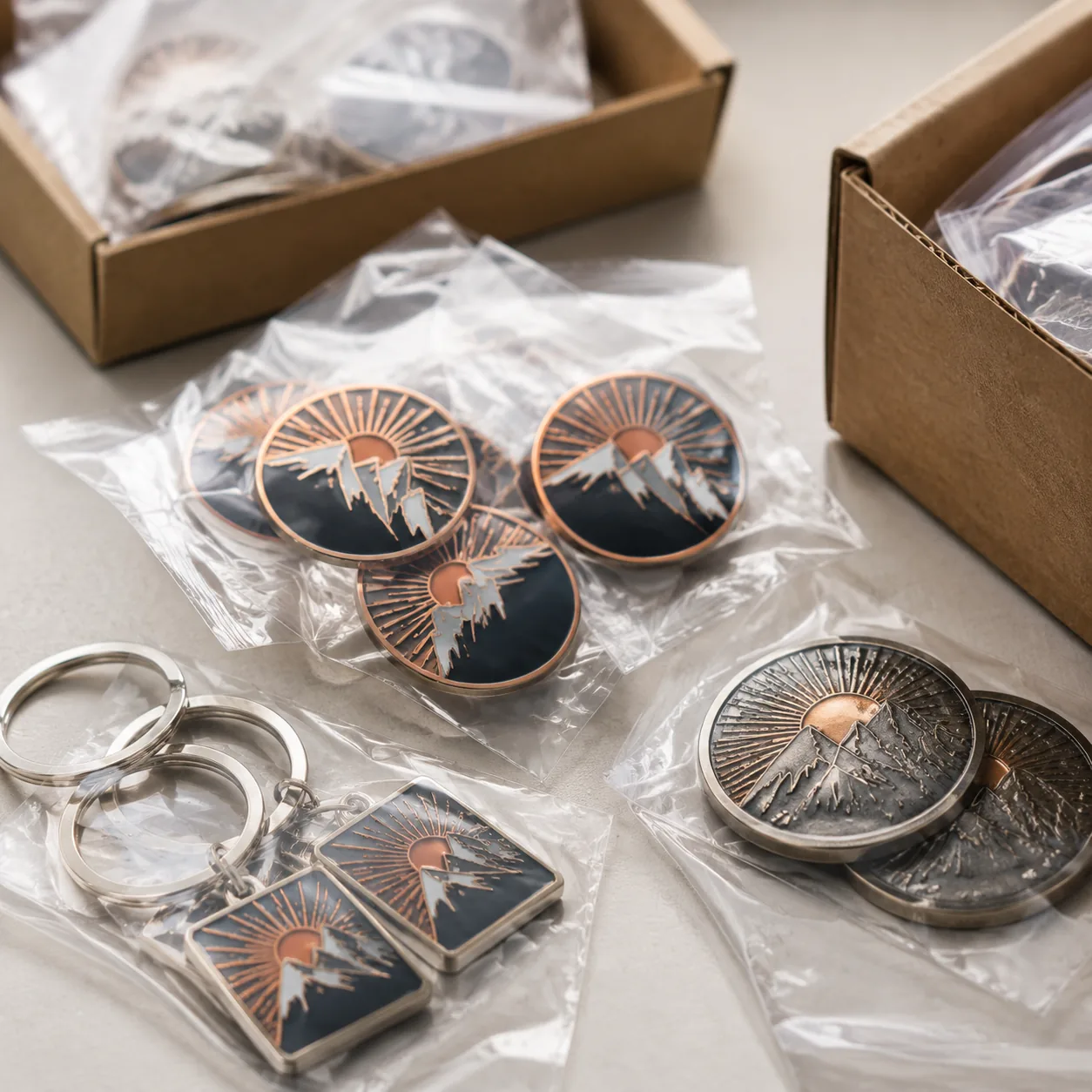
This format fits event giveaways, direct-mail inserts, subscription add-ons and low-cost retail where the pin is not expected to survive parcel handling as the only protective layer. At 1,000 pieces, assembled FOB packaging usually lands around $0.05 to $0.12 per set with only 3 to 5 days added lead time. Its weakness is abrasion control: the bag keeps off dust, but it does not isolate polished plating or protect raised metal from clutch rub. For single-unit ecommerce, it should be treated as inner presentation only, not final ship-safe packaging.
2. Sealed OPP bags improve retail consistency and barcode reliability
A sealed OPP bag with backing card costs slightly more than a loose polybag pack, but it performs better where shelf presentation and compliance matter. The card sits flatter, the pack looks cleaner on a peg, and the sealed edge provides light tamper evidence. Standard construction is 350 to 400 gsm card paired with 80 to 100 micron OPP. For euro-slot display on a 90 x 55 mm card, the slot is typically placed 12 to 15 mm below the top edge to preserve enough board above the hang point and reduce tearing after repeated handling.
This format also gives more predictable print real estate. UPC or EAN barcode, country of origin, age warning, importer address and SKU can all be held on the back panel without the shifting common in loose sleeves. Reserve at least 25 x 38 mm for the code and keep clutches out of the scan zone, since raised metal behind the board can distort the surface and reduce first-pass scans. If artwork frames the pin shape or lines up with a die-cut opening, print registration should stay within plus or minus 0.3 mm and die-cut tolerance within about plus or minus 0.5 mm.
Protection is still moderate rather than high. OPP resists dust, finger marks and light contact, but it is not a compression package. Pins with danglers, spinner features, chains or heavy cast relief usually need an inner spacer, blister support or partitioned carton to avoid edge marks and movement. At 1,000 units, typical FOB packaging cost is $0.07 to $0.15 with 4 to 6 days added lead time, which makes this a strong option for museum stores, licensed merchandise, tourist retail and other low- to mid-price peg programs.
3. Pouches work for presentation, but they add operational constraints
Velvet, microfiber, PU and soft PVC pouches are selected mainly for perceived value. They work well for employee recognition, alumni and membership pins, hospitality gifts and commemorative issues where the opening experience matters more than display visibility. For one standard 30 to 40 mm pin, 70 x 90 mm is common. For a two-pin set or a pin with a message card, 80 x 100 mm is safer. Stock black velvet usually gives the shortest lead time and lowest reject risk; custom dyed microfiber and PU add setup variables that need real control.
At 1,000 pieces, stock velvet pouches often land around $0.18 to $0.28 FOB, while custom microfiber or PU with foil logo more often runs $0.35 to $0.45. Stock-color production is usually 5 to 8 days; custom dye, foil or stitching generally extends that to 8 to 12 days. MOQ is commonly 500 pieces per color, which matters if the same pin program is split across regions or departments. Logo placement tolerance on textile pouches is rarely tighter than plus or minus 2 mm, so buyers expecting rigid-box precision are usually disappointed unless they approve realistic production limits in advance.
The main drawback is not looks but workflow. A pouch hides the product, offers almost no built-in space for barcode or warning copy, and gives less control over product position during shipping. If retail compliance is required, the pouch typically needs a hangtag, belly band or pressure-sensitive label. Those labels must be tested on actual fabric or PU because textured surfaces can cause skew, edge lift or label creep after 24 to 48 hours under compression. Pouches are best when the pack is hand-delivered or inserted into a secondary gift box, not when it must carry the full burden of retail communication.
4. Rigid paper boxes are the most reliable premium and parcel-safe format
For premium gifting and ecommerce, rigid paper boxes are usually the most technically dependable option. A standard build uses 1200 gsm greyboard wrapped with 157 gsm printed art paper and an EVA insert in the 38 to 45 Shore C range, although lower-cost sponge inserts are still common. Typical box sizes are 80 x 80 x 20 mm for a single pin and 100 x 100 x 25 mm for a set that also includes a patch, coin or note. Insert cavity tolerance should generally stay within plus or minus 1.0 mm so the pin remains centered and does not rotate under vibration.
This is the strongest format for protecting plated surfaces. The face of the pin is isolated from the clutches, posts can be anchored into the insert, and the package handles small-parcel shock much better than any flat card solution. It is especially useful for hard enamel, mirror-finish plating, antique finishes with polished highlights, and heavier pins above 20 to 25 g. At 1,000 pieces, FOB packaging usually falls between $0.45 and $1.10 depending on structure, foil stamping, spot UV, ribbon pull and magnet closure. Typical added lead time is 7 to 10 days.
The trade-off is freight density. A 100 x 100 x 25 mm rigid box can consume roughly three to five times the carton volume of a bagged carded unit. That penalty shows up immediately on courier, air and pick-pack economics. In practical terms, rigid boxes make sense when the pin has meaningful gift value, when past claims data shows unacceptable scuffing or bending in lighter formats, or when the buyer needs an unboxing experience that justifies the added cube.
5. Clear PET or acrylic display boxes are justified only when visibility sells
Clear display boxes rank fifth because they are specialized, not because they are poor. They make sense when the product must remain visible through the package: collector editions, licensed drops, museum retail and premium souvenir lines. PET folding boxes commonly use 0.4 to 0.6 mm sheet, while acrylic display cases are more often 0.8 to 1.0 mm. Most still need an inner card, blister or formed support to keep the pin centered and prevent rattle marks on the clear walls.
The sales benefit is immediate shelf visibility with better crush resistance than a simple bagged card. The quality-control burden is also much higher because clear material exposes every defect. Buyers should define acceptable scratch level, haze, seal lines, dust inclusion and film-removal condition during sample approval. A workable fit tolerance is plus or minus 1.0 mm, but even when the dimensions are correct, poor handling on the assembly line can leave visible scuffs that would be irrelevant on printed board. That is why transparent packs need cleaner workstations and tighter visual standards.
MOQ flexibility is also weaker. Many suppliers price PET and acrylic efficiently only at 1,000 units and above, with sub-500 runs carrying disproportionate setup cost. At 1,000 pieces, FOB packaging typically ranges from $0.55 to $1.30 depending on whether the structure is folded PET, glued PET or rigid acrylic with insert. Unless product visibility directly lifts conversion or collector value, most buyers get better economics from a sealed OPP retail card or a rigid paper box.
RFQ checklist and approval points to lock before production
The cleanest way to avoid late packaging changes is to quote it as a technical specification, not as an informal accessory. State the pin size in mm, unit weight in g, post count and spacing, clutch type, target packed thickness, display channel, maximum FOB packaging budget and whether the assembled set must pass mailer, shelf or parcel handling. For retail, also specify barcode type, scan direction, origin marking, warning copy and any shelf dimension limit. For ecommerce, ask for assembled unit dimensions, carton pack quantity and estimated master-carton gross weight before approval.
- Lock exact package dimensions, board grade or plastic thickness, bag micron, insert material and print finish in the RFQ.
- Specify puncture layout tolerance: plus or minus 0.3 to 0.5 mm for carded packs and about plus or minus 1.0 mm for insert cavities.
- Define inspection limits up front: AQL 2.5 major and AQL 4.0 minor is a common baseline for pin packaging programs.
- Reserve a barcode quiet zone and confirm orientation on approved artwork, especially on 85 x 55 mm and 90 x 55 mm cards.
- Request one fully assembled pre-production sample using the actual finished pin, not a substitute blank or digital mock-up.
- Check packed thickness, post alignment, clutch retention, bag seal quality, visible scuffing and carton count before sign-off.
- Run a basic handling test: about 60 cm drop for carded packs and 80 cm for boxed packs, plus a top-load compression check for parcel shipments.
- For mixed kits, validate the full pack-out with patch, coin, keychain or insert card included; component-only approvals are not enough.
For most buyers, the ranking is straightforward. Use backing card plus polybag when speed, cost and carton efficiency matter most. Use sealed OPP when low-cost retail readiness and barcode consistency matter. Use pouches when gift presentation outweighs display needs. Use rigid boxes when the pin must arrive premium and parcel-safe. Use clear PET or acrylic only when seeing the product through the package is part of the sales case. That framework keeps packaging decisions tied to damage risk, channel requirements and freight economics rather than sample-room aesthetics.
Have a project? Send your artwork and target quantity and we’ll reply with a detailed quotation within 12 working hours.
Ready to get this made?
Send your sketch, target quantity and ship-date. Detailed quotation in 12 hours.



