Top 5 Pin Display Packaging Options for 2026 Orders
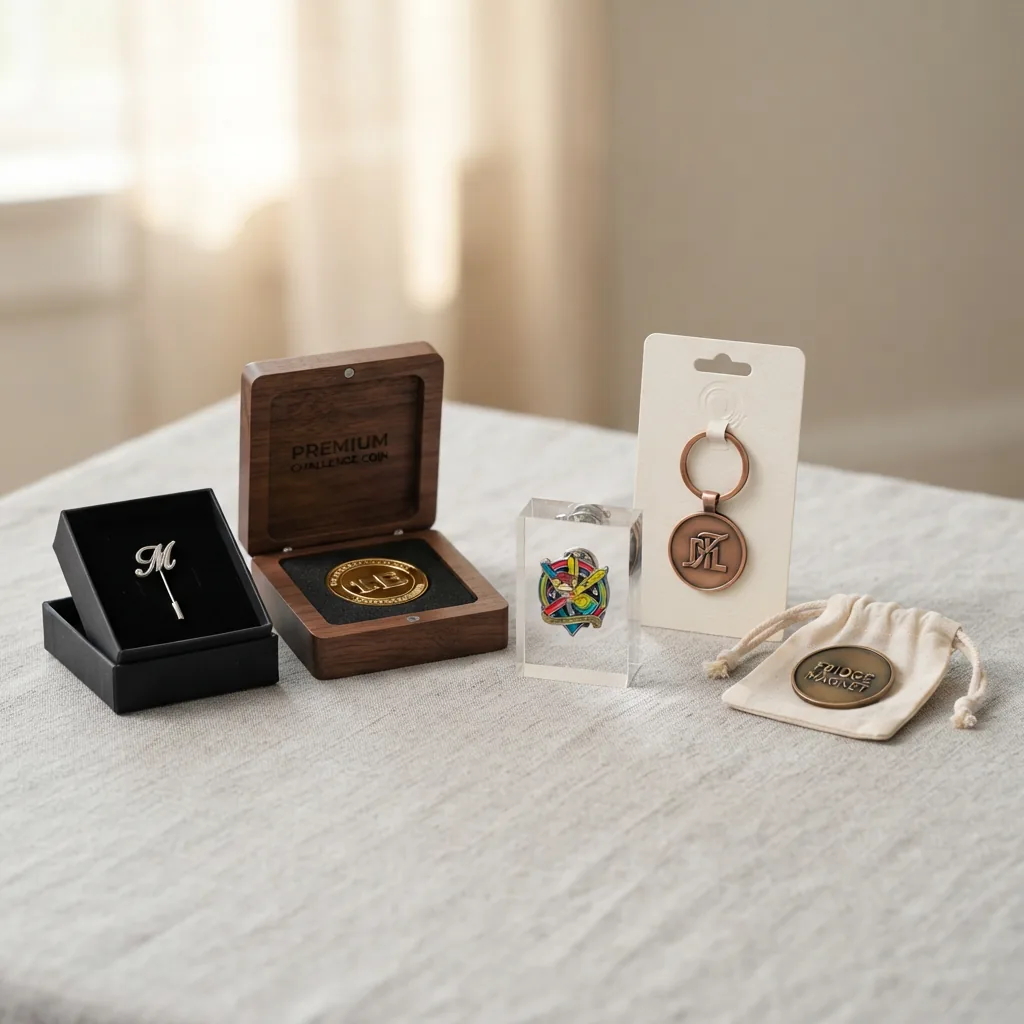
A frequent failure point in pin programs is not the metal badge but the last 5% of the job: packaging, insertion and pack-out. A hard enamel pin can pass plating, Pantone match, epoxy, post solder and clutch checks, then still arrive with bent posts, rubbed metal faces, split plastic boxes, bowed cards or a retail pack that hangs off-center. For enamel pins, medals, brooches and commemorative badges, packaging directly affects assembly labor, final FOB, carton density, dimensional freight, retail readiness and damage rate at destination.
For 2026 orders, most practical pin programs still fall into five packaging formats: paper backing card, polybag plus card, clear PET box, rigid paper gift box and acrylic display case. The right format depends on retail price, channel, shipping method and whether the package needs to function only in transit or also as part of the product experience. A pin retailing at USD 4.99 to 9.99 usually needs a lean, freight-efficient pack. A museum issue, anniversary badge or serialized collector release at USD 15 to 40+ can absorb a more complex structure. The comparison below stays focused on the variables buyers actually approve: MOQ tiers, FOB add-on, lead time in days, protection level, carton yield, QC criteria and rework risk.
Cost Drivers and Buyer Benchmarks
For cost-led programs, paper backing card remains the best baseline. A common build is 300 to 400 gsm C1S or C2S board in 90 x 55 mm, 100 x 70 mm or 120 x 80 mm format, with a euro slot centered 8 to 10 mm below the top edge. For one 25 to 35 mm hard enamel pin secured with a butterfly clutch, workable MOQ is usually 500 sets, while sharper pricing normally starts at 1,000 and improves again at 3,000 to 5,000 sets. Standard CMYK cards can usually ship in 5 to 8 calendar days after artwork approval; matte lamination, hot foil or spot UV generally extends lead time to 7 to 10 days. Typical FOB add-on is USD 0.03 to 0.08 per set at 1,000 pieces and around USD 0.025 to 0.06 above 5,000 pieces when the die-line is standard.
Polybag plus card ranks next on cost while adding basic dust, scratch and loose-clutch control. Standard specification is a 0.04 to 0.06 mm OPP self-seal bag with a 300 to 350 gsm printed insert card. At 1,000 sets, FOB add-on is commonly USD 0.05 to 0.12 per set, with 5 to 8 days lead time for stock sizes and 7 to 9 days if warning text, suffocation labels or bag dimensions must change. The format stays freight-efficient because the pack remains mostly flat, but it adds a manual insertion step and can become slow on orders with multiple loose accessories.
A useful control metric is packaging-to-product cost ratio. If the pin FOB is USD 0.45 and packaging is USD 0.20, packaging represents about 31% of total packed FOB. That is still workable for many retail programs. If packaging rises to USD 0.85 on the same pin, the packaging cost exceeds the metal item and the economics move into collector or gift territory. For non-premium runs, many buyers treat 30% to 40% of packed FOB as the point where the package must clearly justify itself through higher sell-through, lower breakage or less destination rework.
| Rank | Packaging option | Best use case | Typical MOQ tiers | FOB add-on per set | Lead time |
|---|---|---|---|---|---|
| 1 | Paper backing card | Promotions, event merch, museum add-ons, low-price retail | 500 / 1,000 / 3,000+ | USD 0.03 to 0.08 | 5 to 10 days |
| 2 | Polybag plus backing card | E-commerce, fan merch, subscription packs, distributor kits | 500 / 1,000 / 3,000+ | USD 0.05 to 0.12 | 5 to 9 days |
| 3 | Clear PET box | Gift shops, tourist retail, licensed merch needing visible product face | 1,000 / 3,000+ | USD 0.18 to 0.35 | 7 to 12 days |
| 4 | Rigid paper gift box with insert | Corporate gifts, commemorative issues, award sets, museum premium SKUs | 500 / 1,000 / 3,000+ | USD 0.45 to 1.20 | 10 to 18 days |
| 5 | Acrylic display case | Collector editions, desk display, serialized commemorative releases | 500 / 1,000+ | USD 0.70 to 1.80 | 12 to 20 days |
Paper Backing Card: Lowest Cost and Highest Throughput
Paper backing card is still the default for high-volume, low-complexity programs because it inserts quickly, prints well and gives the strongest carton efficiency. In export loading, a single 100 x 70 mm carded pin can often achieve 800 to 1,200 sets per master carton depending on pin thickness, clutch type and whether units are stacked face-to-face or separated by tissue. That density matters: compared with boxed formats, carded pins usually produce the lowest cubic volume per 1,000 sets and the fewest manual handling steps.
The main risk is display distortion. Problems start when finished pin weight exceeds roughly 18 to 22 g, when the post is too close to the card edge, or when two posts are not centered across the card width. Buyers should lock card size tolerance at plus or minus 1.0 mm, print registration at plus or minus 0.5 mm, euro-slot position at plus or minus 0.5 mm and assembled card bow at no more than 3 mm across the longest side after 24 hours resting at ambient conditions. For cards above 120 x 80 mm or for heavier two-post badges, 400 gsm board is usually safer than 300 to 350 gsm.
Board grain direction is not a minor detail. A 350 gsm C1S board with grain running vertically often holds flatter in peg display than the same board cut cross-grain. Matte lamination can further stabilize humidity response and reduce print rub during bulk handling. In practical terms, a vertically grained 400 gsm laminated card often costs only fractions of a cent more than a thinner unlaminated card, but it can eliminate bowed-card rejects at retail.
Polybag Plus Card: Better for Mixed Fulfillment
Polybag plus card is the practical middle option when the buyer needs low unit cost but better control of scuffing, dust and loose parts. The OPP bag reduces card-to-card abrasion in mixed-SKU cartons and helps retain spare rubber backs, mini inserts or barcode stickers. It is especially useful for e-commerce, subscription packs and distributor assortments where multiple designs are packed together and handled several times before final sale.
The bag spec should reflect the hardware. A 0.04 mm OPP bag can work for one small 25 mm pin with a butterfly clutch, but it is often too light for long posts, locking clutches or sharp badge edges. For heavier items, 0.05 to 0.06 mm usually performs better and materially reduces punctures, split seams and rebagging at destination. If the product will ship through parcel networks or be kitted into mailers, the extra film thickness is usually worth the added USD 0.005 to 0.015 per set.
Typical QC points are bag seal integrity, warning label accuracy, insert-card orientation and hole or puncture count. Practical inspection standards are no open seams, no bag punctures over 1 mm, no wrinkles obscuring the front design and no foreign debris visible from 30 cm. If the buyer needs retail compliance, barcode location and age-grade copy should also be fixed on the artwork proof instead of left to factory interpretation.
Clear PET Box: Retail Visibility Without Full Premium Cost
A clear PET box becomes the better choice when the product face must stay visible and the pack needs more structure than a flat card. Typical single-pin spec is 0.25 to 0.35 mm PET in tuck-end, lock-bottom or auto-bottom style, often around 70 x 70 x 20 mm, 80 x 60 x 20 mm or 90 x 70 x 25 mm depending on pin size and insert card. PET is generally preferred over PVC because it has better clarity, better cold-crack resistance and fewer odor concerns in packed consumer goods. On many 2026 sourcing programs, the price gap between PET and PVC is now small enough that PET is the safer default.
This format works well when the pin is over 1.5 mm thick, above about 18 g, or includes protruding elements such as layered metal, dangling charms or long posts. Compared with a card-only pack, the box reduces face abrasion, better protects the post during shelf handling and raises perceived value without jumping straight to rigid gift packaging. That makes it a common choice for tourist retail, licensed merchandise and souvenir shops where the buyer wants both visibility and a more finished presentation.
The weak points need to be written into the PO. Material below 0.25 mm dents too easily for most export shipments. Fold lines can whiten, glue tabs can release under compression and front panels scratch under store lighting. Buyers should specify film thickness, box style, glue-tab width, whether protective film is required and packaging AQL. For standard retail runs, AQL 2.5 major and 4.0 minor is common. Major defects should include cracked corners, split seams, detached glue tabs, front-panel scratches visible at 30 cm under 800 to 1,000 lux and severe fold whitening on the primary display face.
Freight density is the trade-off. A flat 100 x 70 mm carded pin may fit roughly 1,000 units per carton, while a 70 x 70 x 20 mm PET box may cut loading to about 350 to 600 units depending on shipper dimensions and void fill. For courier-heavy programs, that means the packaging adds cost twice: first in FOB and again in dimensional freight.
Rigid Gift Box and Acrylic Case for Premium Releases
A rigid paper gift box earns its cost when the package is expected to remain with the product after purchase. Typical construction is 1000 to 1200 gsm greyboard wrapped in 120 to 157 gsm art paper, with EVA, flocked EVA, satin-covered foam or folded paperboard insert. A one-pin presentation box often falls in the 80 x 80 x 25 mm to 100 x 100 x 30 mm range. Factories experienced in hand-made rigid packaging can usually hold lid alignment and wrap positioning within plus or minus 1.5 mm. FOB add-on typically runs USD 0.45 to 1.20 depending on size, magnet closure, foil, insert material and hand assembly content.
Insert fit is the technical point most buyers under-specify. For a 30 to 40 mm pin, the insert cavity should usually limit lateral movement to about 1.0 to 1.5 mm total. More movement allows the piece to rotate and scuff. Less movement slows packing and can stress the post or clutch. A practical approval test is a 60 to 80 cm drop on one corner and one flat face with no lid opening, no visible board burst and no pin displacement.
Acrylic display cases are usually the highest-cost option but can solve both premium presentation and after-sale display. Standard material is 2.0 to 3.0 mm clear acrylic, either laser cut and bonded for custom low-volume runs or injection formed for repeat tooling programs. Common single-item sizes run from 60 x 60 x 20 mm up to 100 x 100 x 30 mm. FOB add-on usually starts around USD 0.70 and can exceed USD 1.80 when the case includes magnets, UV print, internal risers, stepped bases or custom geometry.
Cosmetic QC must be tighter here because defects are immediately visible. Many buyers move to AQL 1.5 major and 2.5 minor on hero surfaces, with explicit rejection criteria for edge chipping, polishing haze, glue marks, bubble trails and scratches visible at 20 to 30 cm under 1,000 lux. In most cases, rigid box is the better premium choice when tactile opening and branded print matter most; acrylic is stronger when the package also needs to function as a permanent display object.
PO Specifications That Prevent Rework
Most packaging disputes begin with vague PO language such as standard card, normal clear box or acrylic case as per sample. That is not enough. Packaging should sit in the BOM as its own line item with measurable dimensions, materials, finish, assembly method and defect criteria so the supplier, assembler and inspector are working to the same standard.
- State exact external size in mm, plus insert cavity size and depth where applicable.
- Lock material grade and thickness, such as 350 gsm C1S board, 0.30 mm PET or 2.5 mm acrylic.
- Define print method and finish: CMYK, Pantone match, matte lamination, gloss varnish, foil or spot UV.
- Specify assembly method: pin through card, fixed into EVA insert, or loose inside case.
- Record clutch and post orientation, including whether clutches are pre-installed or packed separately.
- Fix regulatory copy positions: barcode, SKU, suffocation warning, age grade and country of origin.
- Set AQL for packaging defects and list major/minor defect definitions in writing.
- Confirm pack-out: units per inner, units per master, carton dimensions and gross-weight limit.
- Call out transit protection such as tissue wrap, scratch film, polybag or corner protection.
Responsibility also needs to be explicit. If one vendor produces the pins and another produces the packaging, the PO should identify who performs final insertion and who owns final packed appearance. That handoff is where scratched plating, missing clutches and bent posts often occur. A packed golden sample is far more useful than separate approvals of the pin and the package because it shows hang angle, insert tension, closure fit and real shelf appearance in one review.
Sampling, QC and Carton Planning for 2026 Orders
Sample review should be a handling test, not only a visual approval. Mount and remove the pin three to five times if the package is intended to be reusable. Hang carded formats on a standard peg. Stand PET, rigid and acrylic formats upright if they are meant for shelf or counter display. Then place the packed sample inside the actual inner box or mailer planned for shipment. For cards, check whether the board bows and whether the pin hangs level within 2 to 3 degrees. For PET and acrylic, inspect under direct light from multiple angles because minor scratches that look acceptable on a bench often fail at retail distance.
Tolerance checks should stay realistic. Plus or minus 1.0 mm is typical for simple cards and folding plastic boxes; plus or minus 1.5 mm is more realistic for many hand-made rigid boxes unless a sleeve or insert requires tighter control. On assembled packs, run count audits for loose clutches, protruding sharp posts, detached glue tabs and carton labels that do not match the SKU mix. For standard orders, pre-shipment inspection at AQL 2.5 major and 4.0 minor is generally adequate. For collector packaging, tighten the standard because the package itself carries part of the product value.
Carton planning should be quoted early, not after artwork approval. As a guide, carded pins may load around 800 to 1,200 sets per export carton, polybagged card sets around 700 to 1,000, PET boxes around 250 to 500, rigid boxes around 120 to 250 and acrylic cases around 80 to 200 depending on dimensions and protective wrap. Gross carton weight is usually best kept below 12 to 15 kg for hand-packed premium goods to reduce crush and handling damage. One extra packed-sample round almost always costs less than replacing export stock with cracked boxes, scratched acrylic or retail packs that must be rebuilt at destination.
Choosing the Right Format for 2026 Orders
Start with five filters: target packed FOB, ship mode, retail display requirement, gift requirement and after-use value. Then quote at least two packaging formats before locking the structure. If the team prefers a rigid box, also quote a PET box and a carded version. Compare packaging add-on, carton loading, dimensional freight and expected shelf presentation side by side. That comparison usually makes the decision clearer than debating aesthetics in isolation.
The channel rule remains straightforward. For event merch, promotions and low-ticket retail, paper backing card is still the best default. For e-commerce and mixed-SKU fulfillment, polybag plus card usually gives the best cost-to-protection balance. For visible shelf retail, clear PET box is often the strongest middle-ground option. For museum, corporate or commemorative gift programs, rigid paper box is usually justified. For serialized collector releases or display-led products, acrylic case can be worth the premium if resale price and margin support it.
The most useful RFQs separate pin cost from packaging cost, quote MOQ tiers such as 500, 1,000 and 3,000 sets, include carton loading estimates and provide either packed sample photos or one packed golden sample. That exposes the trade-offs early, before artwork, inserts and packing-line decisions lock the order into the wrong cost structure.
Have a project? Send your artwork and target quantity and we’ll reply with a detailed quotation within 12 working hours.
Ready to get this made?
Send your sketch, target quantity and ship-date. Detailed quotation in 12 hours.



