Top 5 Pin Backing Cards for Retail, Events and Mailers
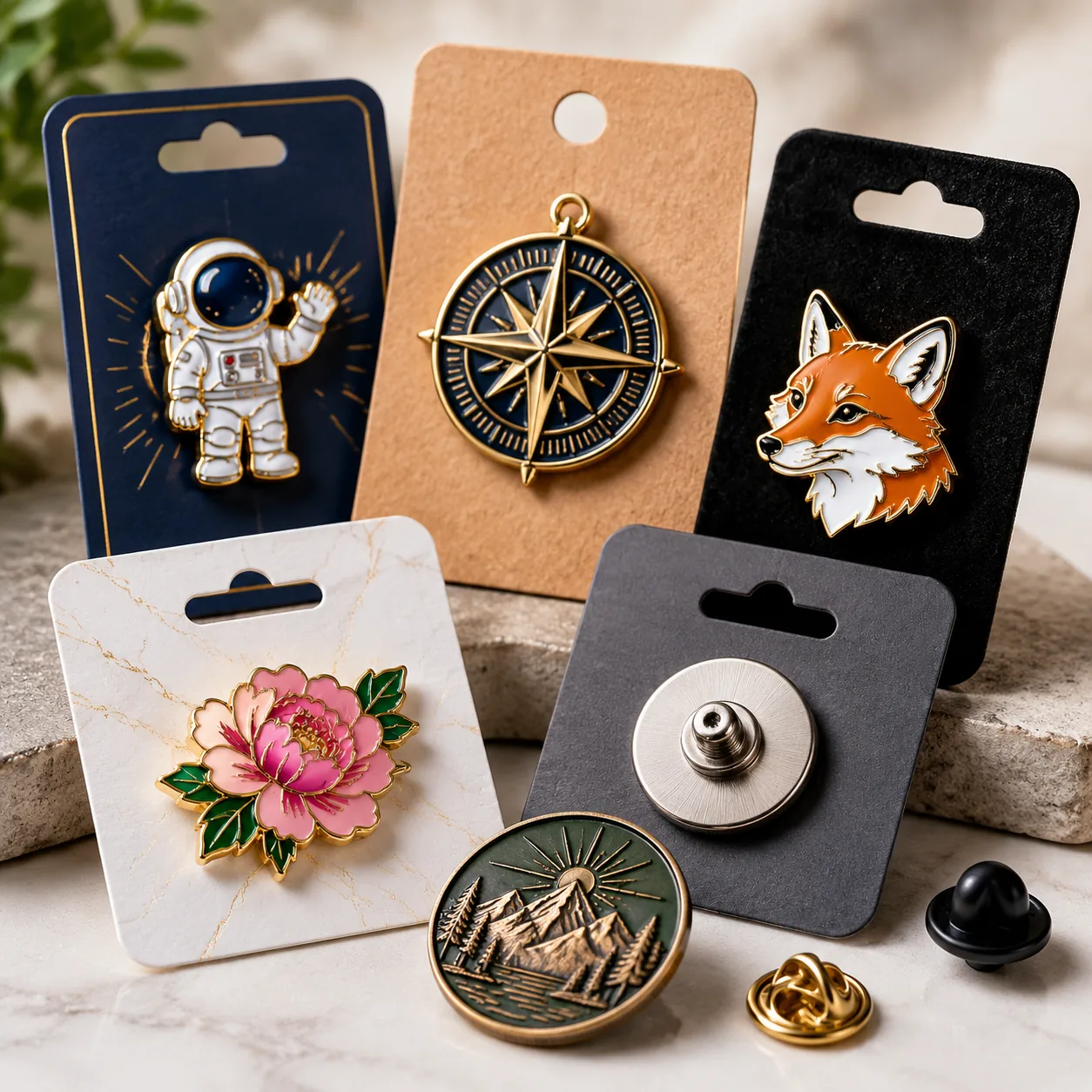
The wrong backing card quietly creates returns, bent pins and weak sell-through
Buyers usually focus on the pin and treat the backing card as a cheap afterthought. That is where problems start: cards that crease in courier bags, holes that tear under a 25–35 g badge, coatings that crack at the slit, or oversized cards that push parcel rates into the next bracket. In practice, a $0.03 to $0.12 card choice can decide whether the final pack looks retail-ready or arrives looking like sample-room leftovers.
For 2026, the most useful comparison is not glossy versus matte. It is which card structure fits the actual use case: event handout, retail peg display, e-commerce mailer, multi-pin set, or premium gift pack. Below are the top 5 options we see buyers choosing, ranked by how often they solve real B2B packaging problems across enamel pins, brooches, keychains and small badge sets.
How the top 5 options are ranked
The ranking below is based on five buyer criteria: protection in transit, print quality, compatibility with common pin posts and clutches, landed cost, and packing efficiency. We also factor in minimum practical order quantity, because a solution that works only at 5,000 sets is not the best choice for a 300-piece launch.
For reference, the typical single pin in this comparison is 25–40 mm diameter, 1.2–1.5 mm thick iron or brass, with one or two 0.8–1.0 mm diameter posts and butterfly or rubber clutch. Card tolerances matter: pin-hole position tolerance should usually stay within ±0.5 mm, card size tolerance within ±1.0 mm, and print-to-cut registration within ±1.0 mm if branding has a border or centered logo.
- Ranking gives more weight to function than appearance.
- FOB card-only prices assume standard CMYK print, no barcode, no assembly into polybag.
- AQL commonly used for backing cards is 2.5 major and 4.0 minor for print and die-cut inspection.
- For assembled pin-plus-card orders, buyers often request AQL 2.5 overall with drop-test spot checks on packed units.
Top 5 backing card options at a glance
| Rank | Card option | Best use case | Typical spec | MOQ | FOB price USD | Lead time |
|---|---|---|---|---|---|---|
| 1 | 350 gsm C1S card with euro slot | Retail hanging display and general-purpose use | 0.38–0.45 mm thick, single-sided coated, die-cut, 2 post holes | 300 pcs | $0.05–$0.09 each | 5–8 days |
| 2 | 400 gsm matte laminated art card | Premium event gifts and direct handouts | 0.42–0.50 mm, matte lamination both sides, rounded corners optional | 300 pcs | $0.08–$0.14 each | 6–10 days |
| 3 | 300 gsm kraft card | Eco-style branding and low-glare presentation | 0.35–0.40 mm, uncoated brown stock, 1–2 color print preferred | 500 pcs | $0.04–$0.08 each | 5–7 days |
| 4 | Duplex card with blister or poly sleeve support | E-commerce mailers and higher transit risk | 350–400 gsm card plus OPP sleeve or blister front | 500 sets | $0.10–$0.22 each | 8–12 days |
| 5 | Fold-over tent card or booklet card | Storytelling, instructions, multi-pin sets | 300–350 gsm, scored fold, 4–8 printed panels | 500 pcs | $0.12–$0.28 each | 7–12 days |
These prices are realistic for standard sizes like 55 x 85 mm, 70 x 90 mm or 90 x 120 mm. Very small cards under 50 x 70 mm may save only a little because die-cutting, setup and hand assembly still drive cost. If you add spot UV, foil stamping, embossing, barcodes, individual polybags, or custom inserts, expect another $0.02 to $0.12 per unit depending on process and volume.
1) Best overall: 350 gsm C1S card with euro slot
For most distributors and brand teams, this is the safest default because it balances print quality, rigidity and cost. C1S means coated one side, so the front takes clean CMYK branding while the back stays slightly less slick for readable batch notes or SKU labels. With a euro slot, the same card can work for retail hooks, event boards or warehouse stock bins.
The practical sweet spot is 350 gsm at about 0.40 mm thick, card size 55 x 85 mm or 60 x 90 mm for one standard lapel pin. Two-post pins should have post-hole center tolerance held to ±0.5 mm, especially if the pin outline is horizontal and visually needs to sit level. For heavier badges above about 35 g, move up to 400 gsm or add a second support point; otherwise the card can bow during display.
This option is ranked first because failure rates are low when the spec is basic and controlled. At ZheCraft, when buyers need one backing card format that can be reused across pin collections with minimal rework, this is usually the format we recommend first. It is not the most premium option, but it is the least likely to create avoidable packaging issues.
2) Best for premium feel: 400 gsm matte laminated art card
If the buyer goal is perceived value in hand, matte lamination gives the strongest upgrade for the lowest added cost. The card feels denser, resists scuffing better than unlaminated stock, and photographs well for launch content. On premium corporate gifts, museum merchandise and commemorative sets, this often lifts the presentation more effectively than upgrading the pin box on its own.
The trade-off is that lamination can crack on aggressive folds or very tight slits if the die line is badly designed. Keep slit width at least 0.5 mm, avoid placing slits closer than 3 mm to the edge, and use rounded card corners (e.g., 3 mm radius) if the item will be handed out loose at events. Typical FOB uplift versus standard C1S is around $0.02 to $0.05 each at 500–1,000 pieces.
Do not choose matte laminated cards if you need a strongly eco-positioned uncoated look, or if you expect end users to write notes on the card. Pen performance on laminate is poor unless you add an uncoated writable panel. For metallic foil logos, check adhesion after die-cutting, especially near pin-hole areas. A peel test at 90° angle on a sample of 10 cards should show no delamination.
3) Best low-glare eco-style option: 300 gsm kraft card
Kraft cards work well for brands that want a natural, less polished presentation. They hide fingerprints, reduce glare under retail lighting and suit outdoor, artisan, food, nonprofit and eco-themed campaigns. They are also relatively cost-efficient when the print design is simple, such as black, white or one spot color over brown stock.
The downside is color accuracy. If a buyer needs exact Pantone matching (e.g., within ΔE < 2), kraft is the wrong substrate because the brown base shifts every printed color. Fine white text below 6 pt can also lose legibility, and large solid ink areas can show unevenness more readily than on coated card.
Structurally, kraft should not be assumed stronger just because it looks rugged. Many 300 gsm kraft boards are only around 0.35–0.40 mm thick and can tear more easily around pin holes than laminated art card. For larger brooches or keychains mounted on card, ask for a tear test on the slot or hole area before mass production: a 5 N force applied to the edge of the hole should not propagate a tear.
4) Best for e-commerce and mailers: duplex card with sleeve support
When orders will be mailed individually, the problem is no longer only presentation. You need the pin to stay on-card, the card to stay flat, and the pack to survive sorting pressure inside courier bags and carton corners. A standard backing card alone often passes visual inspection at the factory but reaches the customer with bent corners or detached clutches.
A practical fix is a 350–400 gsm backing card inserted into a clear OPP sleeve, or a card paired with a blister front if retail visibility matters. This adds modest cost but greatly improves unit handling, barcode application and surface protection. For single-pin e-commerce orders, many buyers use a 60 x 90 mm card in a 70 x 100 mm sleeve, then place that into a rigid mailer or corrugated insert.
This is ranked fourth only because it is more of a system than a card type, so costs and assembly time rise. If you skip sleeve thickness control, cheap film can wrinkle and make the product look lower grade than a plain open card. A reasonable OPP sleeve thickness is about 0.04–0.06 mm for light items; thinner film (e.g., <0.03 mm) tears too easily during insertion. For heavier pins (e.g., >40 g), use a sleeve of at least 0.05 mm.
5) Best for storytelling and sets: fold-over tent card or booklet card
This format is useful when the buyer needs more than a logo and product name. Subscription drops, collector series, charity campaigns and licensed programs often need room for story text, care notes, edition numbers, multilingual copy or QR placement without cluttering the front. A scored fold-over card also hides clutches and posts, which improves the retail face of the pack.
Typical builds use 300–350 gsm stock, one central score line, and either a tuck-in or simple fold with adhesive dot if a closed format is needed. Multi-pin sets often use 120 x 90 mm folded to 60 x 90 mm, but once the card becomes too large relative to the pin, postage and carton efficiency suffer. Keep an eye on total packed thickness if the set is entering standard letter-mail channels: aim for <5 mm total thickness to avoid surcharges.
This option ranks fifth because it solves communication problems, not cost or speed problems. It is slower to print, score, assemble and inspect, and mis-registration becomes more visible when artwork spans multiple panels. Use it when the insert content is doing real work, not just because it feels more premium in a meeting.
Spec details buyers should lock before approving artwork
Most backing card mistakes are not graphic-design mistakes. They are specification gaps between the pin drawing, the card dieline and the final pack-out method. A buyer who locks seven or eight small details early will avoid most rework, especially on repeat orders split across multiple SKUs.
- Card size in mm, with tolerance, e.g., 60 x 90 mm ±1.0 mm.
- Paper grade and gsm, e.g., 350 gsm C1S or 400 gsm matte laminated art card.
- Actual thickness target in mm if rigidity matters, not gsm alone (e.g., 0.40 mm ±0.02 mm).
- Post-hole count, diameter (e.g., 3.0 mm), and center-to-center spacing (e.g., 20.0 mm) matched to approved pin artwork.
- Whether euro slot (e.g., 5 x 30 mm), hang hole, rounded corners (e.g., 3 mm radius), or barcode area are required.
- Front and back print colors, finish, and whether backside needs writable uncoated space.
- Assembly method: open card, OPP sleeve, polybag, blister, or card inserted into gift box.
- Carton pack quantity and orientation, especially if cards must ship flat without curl (e.g., 500 cards per carton, stacked flat with interleaving).
For heavier products like zinc alloy keychains (e.g., >50 g), challenge coins with card mounts, or brooches above about 45 mm, ask for a simple retention test. The factory should mount the item on-card, place 20–30 assembled units in a polybag or inner box, shake and drop from about 80–100 cm onto a hard surface, then check for hole tearing, detached clutches and edge damage. This is basic but catches weak card structures early.
What to do next: choose by channel, not by taste
If the product will hang in retail, choose the 350 gsm C1S euro-slot card first and only upgrade if the brand needs a more premium touch. If the product will be handed out at conferences or included in executive gift packs, the 400 gsm matte laminated card is usually worth the extra few cents. If the brand positioning is eco-natural and color precision is less critical, kraft is a sensible choice.
For e-commerce, do not approve a backing card in isolation. Approve the whole unit pack: card, clutch retention, sleeve or bag, and outer mail protection together. For collector programs or campaigns with real storytelling needs, test a fold-over card but keep panel count low (e.g., 4 panels max) unless the content genuinely requires it.
The fastest path for buyers is to send three things together: pin artwork, target sales channel, and packing method. From there, a factory like ZheCraft can usually recommend 2–3 card structures with dieline size, paper grade, MOQ, assembly cost and lead time in one round, which is much better than redesigning the card after the pins are already sampled.
Have a project? Send your artwork and target quantity and we’ll reply with a detailed quotation within 12 working hours.
Ready to get this made?
Send your sketch, target quantity and ship-date. Detailed quotation in 12 hours.



