Top 5 Low-MOQ Custom Metal Giveaways for 2026
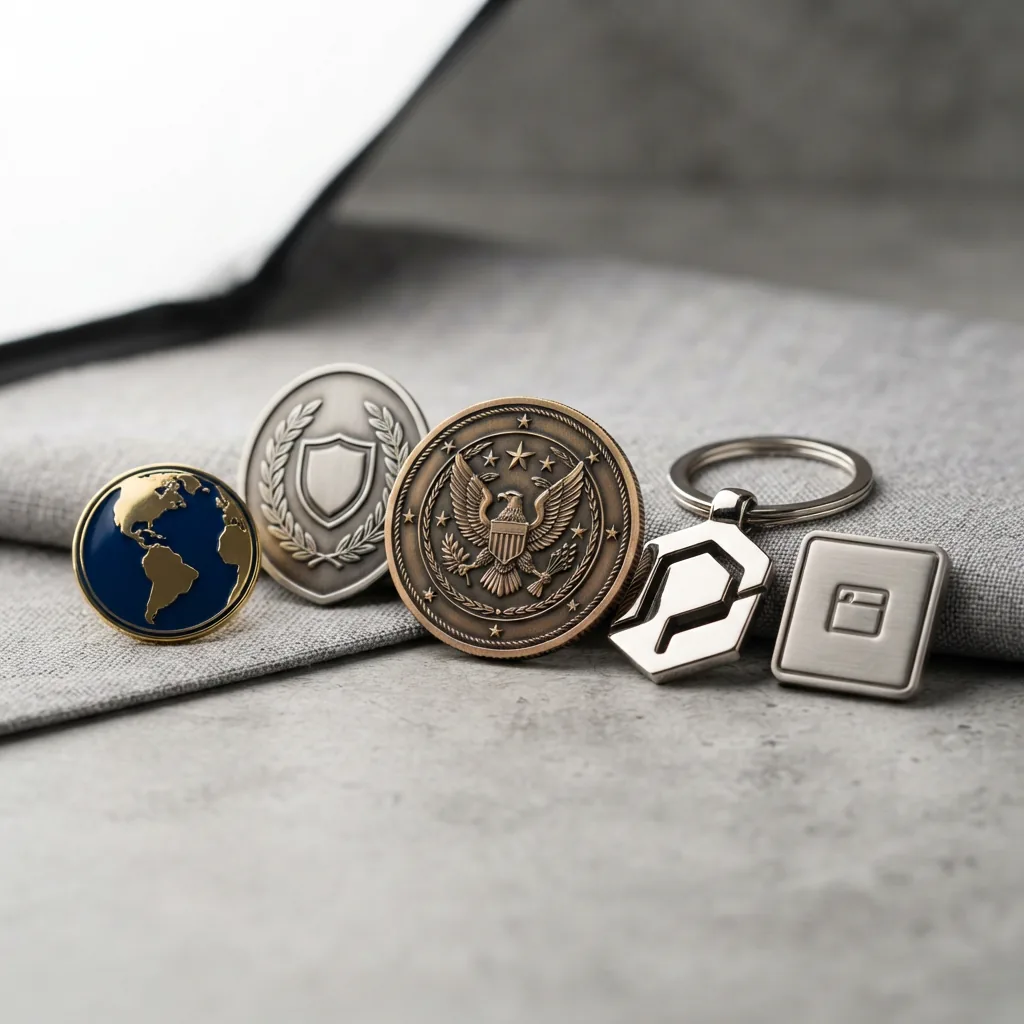
Start with process capability before artwork approval
The most common low-volume sourcing mistake is approving a visual concept before confirming that the product family can reproduce it at the target cost and lead time. At 100 to 300 pieces, setup cost dominates. A logo that looks simple on screen may still require a new die, extra enamel fills, separate print films, hand assembly, or a higher scrap allowance once it is converted into metal. That is how a program budgeted at USD 0.85 FOB becomes USD 1.35 FOB, or how a nominal 12-day schedule stretches to 18 to 24 calendar days.
For 2026 buying cycles, the practical low-MOQ band for custom metal promo items remains 100 to 300 pieces. Some suppliers will quote 50 pieces, but below 100 the economics usually deteriorate fast because die cost, plating setup, color matching, and inspection labor are spread over too few units. The right first screen is not style preference. It is process fit against five variables: minimum economical quantity, tooling charge, decoration tolerance, assembly risk, inspection exposure, and reorder repeatability.
That process-first approach matters most when one supplier can quote multiple constructions from the same artwork package. If the same factory group can handle stamping, die casting, plating, screen or offset printing, PVC molding, and lanyard sewing, the buyer can compare real trade-offs before paying tooling. At small volume, choosing the right construction usually saves more than negotiating a few cents off the wrong item.
What actually makes an item low-MOQ friendly
This ranking uses five buyer-side criteria: setup cost per order, realistic MOQ, proofing complexity, production lead time, and defect exposure at final inspection. For most promo programs in this range, an ANSI/ASQ Z1.4 single-sampling plan at General Inspection Level II with AQL 2.5 for major defects and AQL 4.0 for minor defects is a workable baseline. On a 125-piece lot, that is usually enough to catch functional defects and visible cosmetic issues without creating disproportionate sorting cost.
Low-MOQ-friendly products usually share four traits. They run on standard material gauges such as 0.8 mm, 1.0 mm, 1.2 mm, 1.5 mm, 2.0 mm, or 3.0 mm rather than custom thicknesses. They avoid moving parts or multiple attachments. Their artwork stays within normal process limits, such as plus or minus 0.15 mm on stamped outlines, minimum raised metal line width of 0.25 mm, minimum recessed enamel cell width of 0.30 mm, and text no smaller than about 1.2 mm cap height for legibility after plating and fill. They also rely on standard hardware such as butterfly clutches, split rings, jump rings, swivel hooks, or common hook backing rather than custom fittings.
When a product falls outside those conditions, the quoted MOQ may still look low, but the usable cost per piece rises through scrap, rework, hand sorting, and delayed approvals. In practice, the best small-run item is rarely the cheapest one on paper. It is the one that absorbs setup cost cleanly and can be reproduced six months later without color drift, plating mismatch, changed hardware, or a full reproof cycle.
| Rank | Product type | Best MOQ band | Typical FOB at 100 pcs | Typical tooling | Lead time after approval | Why it ranks here |
|---|---|---|---|---|---|---|
| 1 | Die-struck soft enamel pin | 100 to 300 pcs | USD 0.65 to 1.10 each | USD 50 to 90 | 10 to 15 days | Lowest setup burden, compact freight, low assembly risk, stable repeat orders |
| 2 | Zinc alloy keychain, printed or enamel-filled | 100 to 250 pcs | USD 1.10 to 2.10 each | USD 80 to 150 | 12 to 18 days | Higher perceived value and shape flexibility, with moderate hardware risk |
| 3 | 2D challenge coin | 100 to 200 pcs | USD 1.95 to 3.60 each | USD 90 to 160 | 12 to 18 days | Strong award value, but heavier freight and more finish exposure |
| 4 | PVC patch with hook backing | 100 to 300 pcs | USD 0.90 to 1.70 each | USD 60 to 120 | 10 to 16 days | No plating risk, good field durability, acceptable mold cost |
| 5 | Dye-sublimated lanyard with metal hook | 100 to 300 pcs | USD 0.70 to 1.30 each | USD 0 to 30 | 8 to 14 days | Very low setup cost, but only strong when tied to real event use |
1. Die-struck soft enamel pins remain the safest first order
For most buyers under 300 pieces, a die-struck soft enamel pin is still the most forgiving option. The standard build is stamped iron or brass, 1.2 mm to 1.5 mm thick, with soft enamel recessed below raised metal lines and a butterfly clutch or black rubber clutch. The most efficient size band is 25 mm to 35 mm, with 30 mm the market standard for low-MOQ programs. To keep yield stable, hold raised lines at 0.25 mm or wider, recessed color cells above 0.30 mm, and text at about 1.2 mm cap height or larger. A 30 mm pin with up to four spot colors and one clutch is the most common low-risk configuration.
The economics are difficult to beat. A simple 30 mm iron pin with one front color, nickel or imitation gold plating, and one butterfly clutch typically lands around USD 0.65 to 0.90 FOB at 100 pieces, USD 0.58 to 0.78 at 200 pieces, and USD 0.52 to 0.72 at 300 pieces. Tooling is commonly USD 50 to 90 for a standard outline. Decorative plating thickness is usually about 0.03 to 0.05 micron for bright nickel or imitation gold. That is sufficient for appearance on a promo item, but it is not a wear-resistant specification for constant key-pocket abrasion or rough uniform use.
Pins also carry relatively low defect exposure. There is no chain assembly, no heavy edge mass, and packed volume is small. Typical defects are underfilled enamel, dust in color, minor plating marks, burrs on the back, bent posts, and loose clutches. Those are easier to control than coin edge dents or keychain hardware failures. Reorders are also easier because die files, Pantone references, and plating records are straightforward to retain, which helps keep later batches of 100 to 500 pieces visually consistent.
Pins become less attractive when the artwork depends on gradients, halftones, mirror-flat fields, or ultra-fine text. In those cases, offset print under epoxy, UV print, or hard enamel may look cleaner, but the small-run cost usually rises once stricter polish, doming, and protection requirements are added. For a first order, soft enamel remains the best balance of unit cost, recognizable branding, and acceptable reject rate.
2. Zinc alloy keychains add hand-feel, but hardware determines yield
If a pin feels too light for the program, a zinc alloy keychain is usually the next logical step. The common low-MOQ format is die-cast zinc alloy, 3.0 mm to 4.0 mm thick, 40 mm to 60 mm on the long side, with a 25 mm or 30 mm split ring and either a short chain or direct connector. Typical finished weight is 18 g to 35 g depending on thickness and open areas. At this size, printed epoxy-top designs and enamel-filled recessed designs are both workable.
At 100 pieces, FOB pricing is typically USD 1.10 to 2.10 each, with tooling around USD 80 to 150. A plain 45 mm one-sided keychain with standard bright nickel plating usually sits near the low end, while a 55 mm double-sided piece with enamel fill, cutout areas, and swivel hardware can push toward the top. Lead time is generally 12 to 18 calendar days after artwork approval because the route includes casting, gate removal, grinding, polishing, plating, front decoration, and hardware assembly. Outline tolerance is usually plus or minus 0.20 mm, and finished thickness tolerance is commonly plus or minus 0.15 mm.
The main caution is assembly risk. Every jump ring, swivel, chain link, spinner, or bottle-opener insert creates another failure point. Scratches during assembly are also more common than on pins because plated parts contact one another during handling and bulk packing. For better field durability, split ring wire diameter should generally stay in the 1.6 mm to 1.8 mm range. Thinner rings reduce cost but tend to generate deformation complaints. For direct-mail programs, confirm packed weight early: a 50 mm zinc alloy keychain can weigh five to eight times more than a 30 mm pin once hardware is included.
Keychains are strongest when the buyer needs a functional item with a collectible feel. They are weaker when the brand identity relies on very fine text, tight logo tolerances, or strict parcel-weight thresholds. In low-MOQ programs, a one-piece body with direct ring attachment usually yields better than decorative connector chains, even if the concept looks less elaborate in the rendering.
3. Challenge coins work when recipient value matters more than distribution volume
A 2D challenge coin performs well at low volume when the purpose is recognition rather than broad giveaway distribution. The most practical spec for 100 to 200 pieces is 38 mm to 45 mm diameter, 2.0 mm to 3.0 mm thick, in zinc alloy, iron, or brass, with 2D relief and no more than one or two enamel colors. Antique nickel, antique brass, and antique copper usually deliver more consistent appearance in small batches than bright mirror plating, which shows hairlines and handling marks more clearly.
Expect FOB pricing of about USD 1.95 to 3.60 each at 100 pieces, depending on diameter, thickness, whether both sides are decorated, and whether custom edge details are required. Tooling generally falls between USD 90 and 160. Diameter tolerance is typically plus or minus 0.15 mm and thickness tolerance plus or minus 0.10 mm. Those numbers are fine for loose-packed coins, but they matter if the coin must fit acrylic capsules, EVA foam cutouts, or rigid presentation boxes with tight cavities.
Coins rank below pins and keychains because their weight and finish exposure increase total risk. A 44 mm by 3.0 mm coin can weigh about 28 g to 40 g depending on alloy, which raises freight cost quickly. Edge nicks are more visible on bright finishes, and dense packing can create contact marks during transit. Antique finishes hide those marks better and are often the smarter choice below 200 pieces. If the buyer wants mirror polish on both sides, it is worth requesting an approved pre-production sample rather than relying only on digital artwork.
Choose coins when the item is meant to be kept, displayed, or awarded: service anniversaries, distributor recognition, military-style morale items, executive events, or internal achievement programs. Do not choose them as a default trade-show giveaway unless the budget can absorb both higher unit cost and higher freight per usable piece.
4. PVC patches outperform metal in rough-use conditions
Although this list focuses on metal giveaways, PVC patches deserve a place because they often outperform metal in the same MOQ band when the use case is rough. Standard specs are soft PVC in 2D molded relief, 2.5 mm to 4.0 mm overall thickness, with hook backing, sew border, or plain heat-cut edge. Typical size runs 50 mm to 80 mm. Mold charges are usually USD 60 to 120 for simple shapes, with MOQ commonly starting at 100 pieces.
At 100 pieces, FOB pricing usually ranges from USD 0.90 to 1.70 each, depending on size, color count, glow additives, and backing type. Overall size tolerance is typically plus or minus 1.0 mm, which is looser than stamped metal. That makes PVC a poor fit for geometric logos with tight registration or text below roughly 1.5 mm cap height, but a strong fit for mascots, badge shapes, outdoor insignia, and utility marks. Because there is no plating layer, there is no tarnish risk, and abrasion resistance is generally better in field use than decorative plated metal.
This option is especially practical for uniforms, workwear, sports teams, tactical programs, outdoor clubs, and equipment bags. It handles sweat, repeated flexing, and bag contact better than plated badges or pins. Where it loses is brand tone. If the campaign requires a jewelry-like look, a crisp metallic outline, or executive gifting, PVC usually reads too utilitarian. The right comparison is not premium versus cheap. It is formal presentation versus use-phase durability.
5. Dye-sublimated lanyards are efficient only when they solve a real job
Lanyards rank fifth because their setup cost is excellent, but their branding value depends heavily on actual use. The standard low-MOQ build is polyester, 15 mm or 20 mm width, single-side dye sublimation, about 900 mm flat length, with a swivel hook, trigger clasp, or badge clip. A safety breakaway or buckle release can be added, but each extra sewn component increases unit cost and raises the chance of seam variation.
At 100 pieces, FOB price usually lands around USD 0.70 to 1.30 each, with setup charges often minimal or waived for repeat artwork. Lead time can be 8 to 14 calendar days after approval. Sewing tolerance is broader than on metal products: total length may vary by about plus or minus 10 mm, width by about plus or minus 1 mm, and print position can shift at seam points. Metal hook plating is decorative only, often around 0.03 to 0.05 micron, and should not be treated as corrosion-proof for repeated outdoor exposure.
Lanyards are a good choice for trade shows, school events, venue access, staff IDs, plant visitor control, and membership programs where the item solves a same-day operational need. They are weak as keepsakes. Buyers often overvalue the low unit price and undervalue retention rate. If recipients will not use the item after the event, a cheaper lanyard can still deliver worse value than a slightly more expensive pin that gets kept or worn.
A practical RFQ checklist for 100 to 300 pieces
For small-run sourcing, ask suppliers to quote the same artwork across two or three suitable product types instead of forcing one predetermined format. Include quantity tiers of 100, 200, and 300 pieces, required in-hands date, destination market, packaging requirement, and any non-negotiable specs such as nickel-free finish, individual polybagging, barcoded labels, or magnet-free packing. Also request tooling charge, pre-production sample cost, mass-production lead time in calendar days, and carton estimate in both kilograms and cubic meters.
A disciplined approval package should state material, finished size, thickness, plating, attachment hardware, print or fill colors, packaging method, and inspection standard. Ask the supplier to flag small-volume risk in the artwork itself: text below 1.2 mm, lines under 0.25 mm, multiple attachments, custom backing cards, mixed plating, transparent enamel effects, or unusually tight Pantone matching. On a 100-piece order, five rejected units already equal 5 percent of the lot, so preventable defects matter more than they do on a 5,000-piece run.
- Choose a soft enamel pin when the target budget is under USD 1.00 FOB at 100 to 200 pieces and the artwork can be simplified to metal lines of 0.25 mm or more.
- Choose a zinc alloy keychain when hand-feel and perceived value matter, but keep to one-piece bodies or simple direct connectors to reduce assembly rejects.
- Choose a challenge coin only when recognition value justifies roughly USD 2.00 to 4.00 FOB each and the extra freight weight is acceptable.
- Choose a PVC patch when the item must survive abrasion, sweat, flexing, or outdoor exposure better than plated metal.
- Choose a dye-sublimated lanyard when the product has a real operational use on event day, not just post-event branding intent.
- If the order is below 150 pieces, stay with one front design, one plating color, and standard hardware; every added variable increases setup cost faster than the unit price suggests.
- Always request quote breaks at 100, 200, and 300 pieces. The true economical quantity often appears at those tiers, even when the live requirement is 150 pieces.
- Ask the supplier to confirm carton count, gross weight, and packed cube before approval if the program will ship by air or parcel, because freight can erase a nominal unit-price advantage.
Have a project? Send your artwork and target quantity and we’ll reply with a detailed quotation within 12 working hours.
Ready to get this made?
Send your sketch, target quantity and ship-date. Detailed quotation in 12 hours.



