Top 5 Factory Quote Terms First-Time Buyers Misread
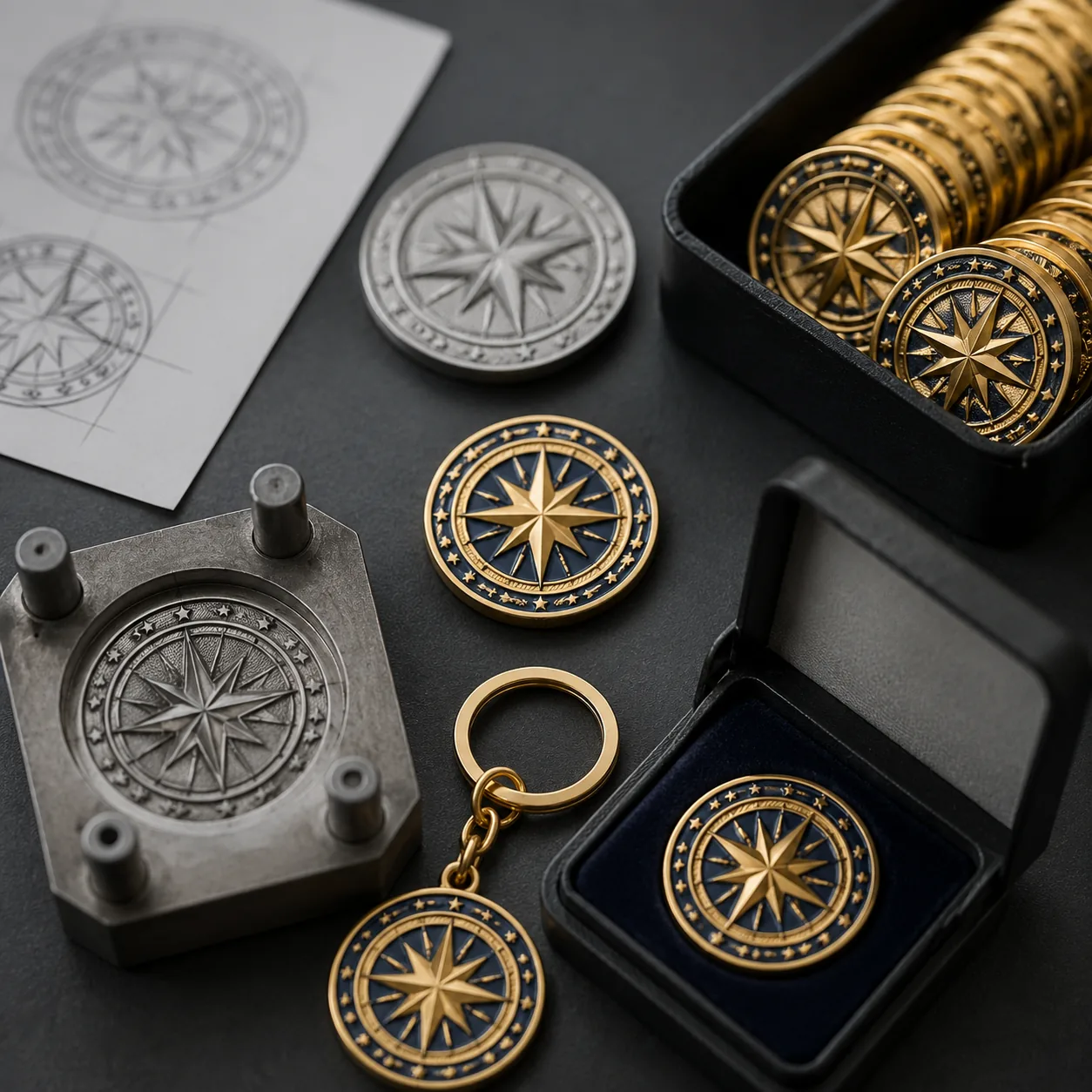
The 5 quote lines that create the most expensive rework
First-time buyers usually compare custom metal quotes by unit price, then learn after deposit that the factories were not pricing the same product. One quote is for 1.0 mm stamped iron, another for 1.5 mm die-cast zinc alloy, a third includes one butterfly clutch instead of two black rubber clutches, and none uses the same packing or inspection basis. The quote sheets look comparable because the commercial wording is short. The production specification is not.
In custom pins, coins, badges, keychains and magnets, the biggest quoting failures are usually not fraud. They are gaps between sales shorthand and manufacturing requirements. A line such as bright gold plated, soft enamel, individual polybag still leaves open the base metal, body thickness, plating stack, lacquer protection, post quantity, backing card spec, carton gross-weight limit, AQL level and sealed-sample rule. Once tooling is cut or the pre-production sample is signed off, several of those gaps become expensive to reopen.
For 2026 sourcing teams buying enamel pins, brooches, challenge coins, keychains, magnets, patches or lanyards, the practical way to read a quote is to rank terms by correction cost after approval. Some look minor but actually control tooling route, reject rate, freight cube, wear resistance and complaint rate. The five terms below create the most avoidable rework because they change the physical product, not just the paperwork.
Risk ranking for first-time buyers
| Rank | Quote term buyers misread | What it really controls | Typical FOB cost impact | Typical lead-time impact |
|---|---|---|---|---|
| 1 | Material plus thickness | Weight, rigidity, process route, plating behavior, tooling choice | +$0.08-$0.45 per pc | 0-5 days |
| 2 | Process plus color fill | Relief definition, artwork limits, polishing route, reject risk | +$0.05-$0.32 per pc | 2-7 days |
| 3 | Attachment and accessory count | Wearability, pull strength, assembly labor, complaint rate | +$0.03-$0.35 per pc | 0-3 days |
| 4 | Packing basis | Labor, carton count, volumetric weight, retail readiness | +$0.02-$0.80 per pc | 1-4 days |
| 5 | Inspection and finish standard | Acceptance criteria, sorting time, dispute risk, return exposure | +$0.00-$0.12 per pc | 0-3 days |
This ranking reflects four buyer risks: impact on unit price, impact on calendar lead time, probability of shipment dispute and difficulty of correction after approval. Material and process rank highest because changing from stamped iron to die-cast zinc alloy, or from soft enamel to imitation hard enamel, often means new tooling, a new sample round or both.
On low-value giveaway items under 30 mm, some ambiguity may be commercially tolerable. On retail merchandise, employee awards, collector coins and licensed products, vague quote language creates false savings. The more visible the item and the tighter the cosmetic standard, the more the quotation needs to translate sales terms into measurable specs.
1. Material plus thickness: the line that silently changes the product
A quote that says custom pin, 40 mm, gold plated does not define the metal. In practice, the factory may be pricing stamped iron, stamped brass, die-cast zinc alloy or stainless steel. Each behaves differently in forming, edge definition, plating adhesion and perceived weight. Thickness matters just as much. A 45 mm badge in 0.8 mm iron can meet outline dimensions and still flex on fabric. A 1.5-2.0 mm zinc alloy body with two posts feels more rigid and usually reads as a higher-value item in hand.
Typical 2026 FOB ranges show why this line is often misread. At 1,000 pcs for a 40 mm soft enamel pin FOB China, stamped iron at 1.0-1.2 mm often lands around $0.38-$0.62 per pc. Stamped brass at 1.2 mm is more commonly $0.55-$0.90. Die-cast zinc alloy at 1.5-2.0 mm, especially with pierced cutouts or 3D relief, is often $0.72-$1.20. For 50 mm challenge coins, moving from 2.0 mm stamped iron to 3.0 mm die-cast zinc alloy can add $0.25-$0.70 per pc and increase net piece weight by roughly 20-40 percent, which changes both perceived value and freight cost.
Material choice also defines what geometry is realistic. Stamped iron or brass suits cleaner 2D outlines and raised metal borders. Zinc alloy handles deeper relief, undercuts, irregular edges and thicker cross-sections more reliably. If the artwork includes openwork with bridge widths under 1.2 mm, multiple internal cutouts, or relief depth above about 0.6 mm, zinc alloy is usually the safer route. For detail control, many factories work to minimum raised line width of 0.20-0.25 mm, recessed gaps of at least 0.20 mm and text height above 0.8 mm to reduce fill bleed and polishing loss.
A stronger RFQ line states the base metal, nominal thickness and tolerance directly. Example: zinc alloy, die-cast, nominal body thickness 2.0 mm +/-0.10 mm before plating; finished size 45.0 x 38.0 mm +/-0.15 mm. If the item will be handled repeatedly, define the finish stack as well. Decorative imitation gold or nickel on promotional items is commonly around 0.03-0.08 microns over a nickel undercoat. That is usually adequate for appearance, but not for abrasion resistance by itself, so buyers often specify a clear lacquer topcoat for parts that will be touched often, packed loose or sold at retail.
2. Process plus color fill: one word can change quality and reject rate
Buyers often read soft enamel, hard enamel, imitation hard enamel, print fill and epoxy dome as design styles. Factories read them as different production routes with different fill heights, oven cycles, polishing steps and inspection risks. If a quote says enamel pin without defining the route, it does not tell you whether the metal lines sit above the color, whether the top surface polishes flat, or whether fine typography will survive production cleanly.
The process should match the artwork. A 30 mm badge with six Pantone colors, two cutouts and copy at 1.2 mm cap height can work in soft enamel if raised metal lines stay near 0.20-0.25 mm and recessed cells are not too narrow. The same art in imitation hard enamel usually needs cleaner separation, tighter die control and more polish allowance because the enamel is filled high, baked and polished flat. Lead time commonly moves from 12-16 calendar days after artwork approval for soft enamel to 16-22 days for imitation hard enamel, depending on queue, color count and sample revisions.
The price spread is usually smaller than the quality spread. At 500 pcs for a 30-35 mm pin FOB China, soft enamel may quote at $0.55-$0.95 per pc, soft enamel plus epoxy at $0.62-$1.05, imitation hard enamel at $0.78-$1.22, and offset print plus epoxy at $0.60-$1.00. Epoxy is useful over printed graphics because it protects the surface and smooths the feel, but it also adds gloss, slightly rounds edge definition and can trap microbubbles or dust if process control is weak. It is not a substitute for cleaner die lines on a premium pin.
Two details should always be written into the quote when artwork is tight. First, define the color reference, usually Pantone Solid Coated numbers or an approved physical sample. Second, define manufacturable minimums. A practical baseline is text no smaller than 0.8 mm high, raised strokes no thinner than 0.20 mm and isolated fill pockets no narrower than about 0.30 mm. If those limits are ignored at quote stage, the sample round becomes a redesign discussion instead of a production confirmation.
3. Attachment and accessory count: small parts that trigger large complaint rates
Attachments look cheap on a quotation, so first-time buyers often underweight them. In practice, post count, magnet quantity, chain length, jump-ring gauge and clasp type determine whether the product is stable, wearable and return-resistant. A 60 mm name badge with one magnet set often rotates on lightweight fabric. The same badge with two magnet sets spaced near the ends holds more securely, but needs a stiffer body and higher assembly cost.
For pins and brooches, one clutch included is incomplete language. Buyers should specify post quantity, post diameter, post position and clutch type. On badges wider than about 45 mm, two posts or a brooch bar are usually preferred to prevent rotation. For keychains over 50 mm overall length, the jump-ring wire diameter and split-ring thickness matter because light hardware distorts under repeated pull. A 25 mm split ring made from 1.4 mm wire is not equivalent to a 30 mm ring made from 1.8 mm wire with a 25 mm curb chain.
Typical 2026 adders are modest per unit but material across a run. Upgrading from a butterfly clutch to a rubber clutch may add $0.01-$0.03 per pc. Adding a second post and clutch may add $0.04-$0.08. Moving from a standard 25 mm split ring to a heavier 30 mm ring plus 25 mm chain may add $0.06-$0.15. Two-pair magnet sets for larger badges can add $0.18-$0.35 depending on magnet size, backing plate design and assembly method.
Functional details should be quoted dimensionally, not descriptively. Example: 2 posts, 0.9 mm diameter, center-to-center spacing 24 mm +/-1 mm, with 2 black rubber clutches. Or: 30 mm split ring, 1.8 mm wire dia, 8 mm jump ring, 25 mm chain, nickel finish. That level of detail prevents a common first-order failure mode where the decoration passes inspection but the hardware feels weak, rotates in use or arrives misaligned.
4. Packing basis: the quote line that changes landed cost
A low unit price is not comparable unless the same packing basis is included. One supplier may quote OPP bag only, 100 pcs bulk inner, export carton only. Another may include backing card insertion, barcode sticker, silica gel, inner boxes and carton gross-weight control. Those are not small differences. They affect packing labor, carton dimensions, warehouse handling time, volumetric freight and whether the goods are actually ready for retail or event distribution.
For a 35 mm pin, simple OPP bagging often adds only $0.01-$0.03 per pc. A printed backing card with manual assembly can add $0.05-$0.18 depending on card size, slot style and print spec, typically 300-350 gsm C1S or C2S board with one- or two-side CMYK. Coin packaging is a larger jump. Velvet pouch packing may add around $0.12-$0.25, while a rigid coin box can add $0.35-$0.80 and materially increase carton cube, especially on air shipments where volumetric weight is billed on dimensions rather than net metal weight.
The quote should define both piece-level packing and carton-level limits. Example: each pin mounted on 350 gsm backing card, inserted into OPP bag, 50 pcs per inner bag, export carton max 12 kg gross, outer carton 45 x 32 x 28 cm max. That gives procurement, warehousing and freight teams enough information to calculate realistic landed cost. Without it, a buyer can choose the lowest FOB piece price and lose the savings later in labor, relabeling or airfreight surcharges.
Carton discipline matters even more on mixed accessory programs. Couriers and airfreight forwarders often surcharge oversize or overweight cartons more aggressively than first-time importers expect. For small metal goods, keeping export cartons around 8-12 kg gross and controlling outer dimensions is usually more useful than chasing a one-cent saving on primary packaging.
5. Inspection and finish standard: where preventable disputes start
The most common quality mistake is assuming good quality means the same thing to every factory. It does not. Unless the quote or PO defines the inspection basis, many suppliers will ship to their normal outgoing standard, often a general visual check under factory lighting with consumer-promo AQL such as Major 2.5, Minor 4.0. That may be acceptable for event giveaways. It is often too loose for branded retail merchandise, service awards or collector coins.
Finish language needs the same precision. Gold plated may mean bright imitation gold over nickel. Black metal may mean black nickel plating, electrophoretic coating or painted black finish, each with different tone, edge coverage and abrasion behavior. If your brand standard requires no visible plating pits from 30 cm on the front face, no exposed base metal on raised borders, and consistent card orientation, those conditions need to be written before mass production starts.
A practical baseline spec for many custom metal items is: AQL Major 2.5, Minor 4.0; visual inspection under 5000-6500K neutral white light; viewing distance 30 cm for the front face and 50 cm for the back face; critical size tolerance +/-0.15 mm for parts under 50 mm unless otherwise noted. For tighter programs, buyers often move to Major 1.0, Minor 2.5 or require sealed-sample comparison for plating tone, color placement and assembly orientation. The additional control cost may be only $0.02-$0.12 per pc, which is usually cheaper than claims, replacements and expedited rework.
Sample approval wording matters as much as the AQL. Pre-production sample approved is too loose if the sample differs from the shipment in plating tone, hardware gauge or card assembly. A better clause is: mass production must match approved sealed sample for front appearance, plating tone, attachment configuration and retail packing method. That closes a common gap where the sample is acceptable but the shipment is built to a looser internal standard.
Rewrite the quote before paying deposit
- State product type, base metal, nominal thickness and finished size in mm, for example zinc alloy, 2.0 mm body, 45 x 38 mm finished size.
- State the process route completely, for example die-cast, polished, soft enamel fill, no epoxy, sandblast background, bright gold plating.
- State plating and protection clearly, including finish type, decorative plating thickness range if relevant, and whether clear lacquer is required.
- State every attachment and accessory with quantity and size, for example 2 posts with 2 rubber clutches, or 30 mm split ring plus 8 mm jump ring plus 25 mm chain.
- State packing basis per piece and per carton, including backing card material, bagging method, inner-pack quantity, outer-carton dimensions and carton gross-weight limit.
- State inspection standard, AQL level, viewing distance and cosmetic rules such as no exposed base metal on the front face.
- State sample stage and approval rule, including whether mass production must match the approved pre-production sample or sealed sample.
- State quoted incoterm and port, such as FOB Ningbo or FOB Shanghai, so freight comparisons are made on the same basis.
Normalize every RFQ before comparing price
Before asking suppliers to revise price, mark every vague noun in the quote: pin, plating, clutch, package, quality. Each usually needs at least one more engineering line. That exercise often turns a three-line quote into an eight- to twelve-line specification. That is not overkill. It is the level of detail production, QC and freight teams need if the approved price is supposed to match the shipped product.
For first-time sourcing, ask every factory to requote on the same normalized basis: same base metal, same thickness, same process, same attachment count, same packing basis, same AQL and same incoterm. Then compare four numbers only: tooling charge, unit price by MOQ tier, sample lead time and bulk lead time in calendar days from artwork approval. For a 35-40 mm pin, a realistic tier pattern may be $1.20-$1.80 at 100 pcs, $0.78-$1.15 at 300 pcs, $0.55-$0.95 at 500 pcs and $0.38-$0.78 at 1,000 pcs, depending on metal and process. Typical pre-production sample lead time is 5-8 days after artwork approval, with bulk production commonly 12-18 days for soft enamel and 16-22 days for imitation hard enamel.
The same discipline applies beyond pins. A 50 mm die-cast zinc alloy keychain may quote at 100 pcs MOQ with a higher unit price but lower tooling complexity than a stamped brass version with multiple soldered hardware points. A 45 mm challenge coin may require a 3D mold surcharge of $60-$150 and an extra 2-4 days if relief depth exceeds standard 2D tooling. If those conditions are not normalized across quotes, the comparison is commercial noise.
For repeat programs across pins, coins, keychains, magnets, patches and lanyards, keep one RFQ template and require each supplier to fill the same fields. Then quote comparison becomes procurement work instead of guesswork. A factory with integrated metal production, accessory sourcing and packaging coordination can shorten clarification cycles, but even then the quotation still has to be technically complete. The price you approve should describe the exact product that will be sampled, inspected, packed and shipped.
Have a project? Send your artwork and target quantity and we’ll reply with a detailed quotation within 12 working hours.
Ready to get this made?
Send your sketch, target quantity and ship-date. Detailed quotation in 12 hours.



