Top 5 Enamel Pin Attachment Backings Compared for B2B Buyers in 2026
Why Backing Choice Drives Returns, Rework, and Wear Performance
For bulk enamel pin programs, the backing is not a cosmetic detail. It affects retention on the garment, assembly yield, pack-out efficiency, user comfort, and the claim rate after distribution. In factory CAPA logs, backing-related complaints usually cluster around six failure modes: clutch loosening after repeated use, bent posts after transit, weak solder at the post root, backing mismatch versus PO, visible damage on fine fabric, and user difficulty attaching or removing the pin without help.
Those issues are usually created upstream. Buyers often lock plating, color fills, and carding details, then leave the backing as a generic line item. That is a mistake, especially for 2026 programs where pins are increasingly worn on recycled polyester suiting, 1.0-1.8 mm wool-blend lapels, fine-gauge knitwear, hospitality uniforms, and lanyards rather than heavy cotton jackets alone. A backing that is acceptable on 10-12 oz canvas may rotate, mark, or detach on finer apparel.
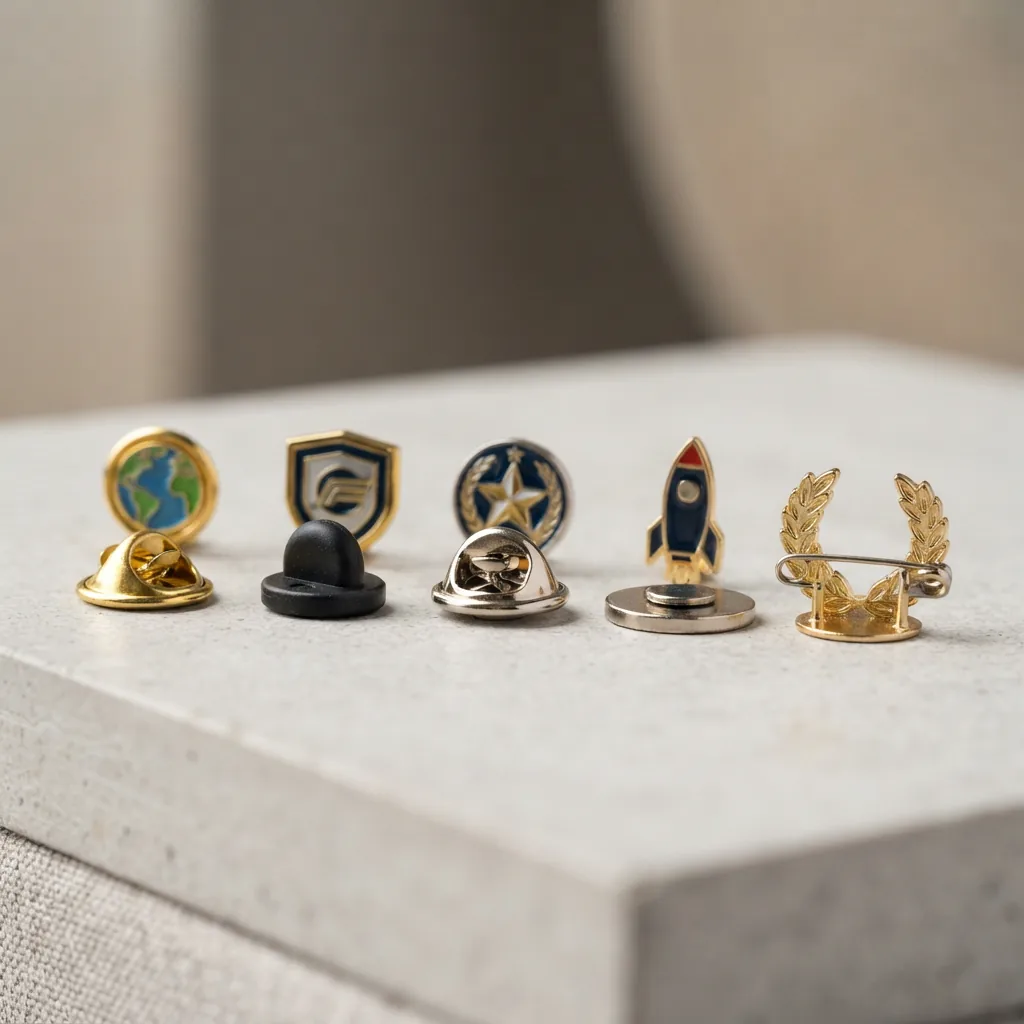
The right sourcing question is not simply which backing is cheapest or strongest. It is which hardware meets the required wear time, acceptable fabric risk, presentation standard, and FOB target with stable production control. For most B2B orders, the five practical options remain butterfly clutch, rubber clutch, magnetic backing, safety pin, and tie tack. They are not interchangeable from a quality-cost standpoint.
Reference Order, Cost Model, and QC Baseline
Use one realistic sourcing case for comparison: 5,000 soft enamel lapel pins, finished size 25 mm, die-struck iron base, 1.2-1.5 mm body thickness, polished nickel plating, one centered post, and individual OPP bag packing. In East China or South China, a standard FOB target for this build in 2026 is typically USD 0.78-1.10 per unit with basic backing and export carton packing. Normal production timing after signed artwork approval is 22-30 calendar days: 5-7 days for tooling and die sampling, 7-10 days for stamping and polishing, 3-5 days for enamel and plating, 1-3 days for assembly, and 2-4 days for final inspection and packing.
The intended use also has to be explicit. In this case, the pin must stay attached through an 8-10 hour workday on a blazer or uniform lapel, must not leave visible damage on fine wool or recycled polyester, and should feel appropriate for executive gifting. That end use changes the hardware decision more than many buyers expect.
A sensible inspection plan is ANSI/ASQ Z1.4, General Inspection Level II, with AQL 2.5 for major defects and 4.0 for minor defects. On a 5,000-piece lot, that typically means a code letter L and a sample size of 200 pieces for general visual and workmanship inspection. For backing-specific functional checks, many buyers also pull a focused sub-sample of 20-32 finished units for retention, post straightness, and attach-remove cycling because loose hardware defects are not always visible.
Major defects should include detached post, cold solder, wrong backing type, exposed base metal on visible surfaces, magnet polarity mismatch, post offset beyond plus or minus 0.3 mm from centerline, or retention below the approved minimum. Minor defects should include light burrs on non-visible edges, slight clutch-tone mismatch, or moderate variation in engagement feel that still passes the functional range. For post diameter, a practical spec is 0.95-1.00 mm with plus or minus 0.03 mm; for usable post length, 8.5-9.0 mm with plus or minus 0.3 mm is tighter and more reliable than the broad tolerances many factories quote by default.
Butterfly Clutch: Lowest Unit Cost for Standard Promotional Wear
Butterfly clutch remains the default because it is cheap, globally familiar, and easy for factories to source in nickel, gold, black nickel, and antique finishes. Standard construction is a brass or iron post paired with a stamped steel or brass spring clutch, usually 10-11 mm outside diameter. For a 25 mm pin, the common post spec is 0.9-1.0 mm diameter with 8-9 mm usable length. Better factories can hold post straightness within 0.3 mm and burr height below 0.05 mm after plating, which matters because burrs accelerate clutch wear.
MOQ is usually 300-500 pieces, so at 5,000 units there is effectively no MOQ constraint. The hardware add-on versus bare post is typically USD 0.015-0.035 FOB per unit, with little or no schedule impact if the plating tone is stock. On standard production, extra lead time is usually 1-2 days at most.
In use, a new butterfly clutch often measures about 3-5 N pull-off force on a correctly plated 1.0 mm post. After repeated cycling, the internal spring tabs relax and the force can drop below 2.5 N. In practice, buyers should expect 30-80 attach-remove cycles before noticeable loosening, depending on clutch metal hardness, post smoothness, and plating build-up. This is acceptable for event distribution, school pins, and short-cycle promotions, but less reliable for daily employee wear over several months.
The exposed post tip is another drawback. It increases the risk of skin pricks during handling and can snag delicate fabric when the pin is removed carelessly. For designs wider than 30 mm, tall vertical shapes, or off-center silhouettes, one post is often not enough; two posts reduce rotation and lower the common complaint that the pin turns sideways after a few hours.
For B2B buyers, butterfly clutch is the best fit when unit economics matter more than premium feel. It is still the right answer for mass promotional runs, basic uniform programs on heavier twill or suiting, and any project where low FOB cost and fast replenishment are the main priorities.
Rubber Clutch: Better Comfort and Fabric Protection, but More Sensitive to Tolerance
Rubber clutch is usually a molded cap that grips the post by friction while covering the sharp point. In purchasing language, however, "rubber back" is too vague. Buyers should specify silicone if they want stable elasticity and better aging performance. Soft PVC is cheaper, but it can harden, deform, or lose grip after prolonged exposure to 45-50 C during summer storage or container transit.
Typical dimensions are 8-9 mm diameter and 5.5-7.0 mm height, usually paired with a 0.9-1.0 mm post and 8-9 mm usable length. MOQ is commonly 500-1,000 pieces. Because black and yellow silicone caps are normally stock items, extra lead time is often 0-1 day. FOB add-on cost is usually USD 0.010-0.025 per unit, so the hardware is often slightly cheaper than butterfly clutch.
The trade-off is retention consistency. On a correct post, rubber backs commonly test around 2.0-3.5 N pull-off force. That can be enough for conference wear, welcome kits, youth programs, and short-term hospitality use, but the holding power is far more sensitive to post diameter drift. If the finished post comes in undersize by 0.05-0.08 mm, grip can drop quickly and create sporadic field losses that are difficult to diagnose after distribution.
This sensitivity makes process control more important than the low price suggests. Buyers should request a pre-production sample built on the actual plated post, not on a raw hardware sample. A practical receiving spec is to reject any lot where retention falls below 1.8 N minimum on the approved fabric test. Buyers should also watch colorfastness and oil migration if non-silicone material is offered as a substitute.
Commercially, silicone clutch is often the best budget choice when comfort, easier handling, and covered post tips matter more than maximum security. It also reduces complaints about scratched fingers and snagged garment linings. The limitation is image: on premium gifting or luxury retail uniforms, rubber hardware can look less formal unless the front-side design and packaging carry the presentation standard.
Magnetic Backing: Best No-Hole Option, Highest BOM and Process Complexity
Magnetic backing is the cleanest solution when the garment cannot be pierced. Instead of a post passing through the fabric, the pin body uses a flat rear plate or bonded magnet cup and a separate counter-magnet on the inside of the garment. Most factories use neodymium magnets in grades N35 to N42. For a 25 mm iron soft-enamel pin weighing roughly 7-10 g, a common specification is an 8 x 2 mm or 8 x 3 mm N38 or N40 magnet pair, though the real requirement depends on garment thickness, lining slip, and rear contact area.
The hardware cost jump is significant. Standard MOQ is usually 1,000-2,000 pieces for stock magnet sizes, and custom housings or unusual plate formats can push the MOQ to 3,000 plus. FOB add-on cost at 5,000 pieces is typically USD 0.14-0.30 per unit. Extra lead time is usually 4-7 days because magnets require sourcing, polarity control, adhesive cure or mechanical fixing, and more careful pack-out to prevent parts attracting each other in bulk.
On thin to medium suiting, holding force is strong enough for premium wear. In practical tests, buyers often see the equivalent of about 4-7 N resistance on 1.0-1.8 mm compressed fabric thickness. Performance declines on thicker melton, padded uniforms, or stacked layers above roughly 2.5-3.0 mm compressed thickness. This is why quoting only magnet grade is inadequate. N42 on a small contact area may perform worse than N38 on a larger optimized plate.
Process risk is higher than with post-based hardware. Common defects include reversed polarity in mixed lots, off-center bonding, weak adhesive after plating contamination, and part-to-part attraction that scuffs finished pins during packing. For this category, many buyers require 100 percent polarity orientation control during assembly and a 24-hour adhesive cure before final handling. If the rear plate is glued rather than mechanically fixed, a simple peel or shear verification on a sample set is worthwhile.
Magnetic backing is usually the strongest commercial fit for executive gifts, luxury retail staff pins, fine-garment hospitality uniforms, and any program where needle holes are unacceptable. The drawbacks are clear: higher BOM cost, thicker profile, slower packing, and workplace restrictions in environments with medical-device or magnet-safety policies. It is also the backing most likely to require a real wearer trial before mass production approval.
Safety Pin and Tie Tack: Narrower Hardware for Specific Use Cases
Safety pin backing is closer to badge hardware than classic lapel jewelry, but it remains useful where secure fastening matters more than fabric preservation. Typical hardware is a 15-20 mm nickel-plated steel pin with 1.0-1.2 mm wire diameter, attached to a rear plate by soldering or rivets. MOQ is commonly 500-1,000 pieces, with FOB add-on cost around USD 0.06-0.12 per unit and 2-4 extra production days depending on assembly method.
Its strength is practical security. Once closed, accidental release is uncommon, and the wider attachment footprint helps larger badge-style pieces sit flatter than a single post. The weakness is obvious: it punctures fabric, can leave visible holes, and looks less refined on blazers or dress uniforms. It is better suited to bags, sashes, outerwear, workwear, and event badges than premium lapel use.
Tie tack hardware is often quoted imprecisely, so buyers need to confirm the exact construction. In some factories, it means a heavier single post with a formal securing element; in others, it refers to a classic tie-tack set with chain and bar for neckwear. MOQ is usually 1,000-2,000 pieces, FOB add-on cost is about USD 0.10-0.22 per unit, and extra lead time is typically 3-5 days for matching hardware, plating coordination, and assembly.
Tie tack is a niche option, but it has value when the program is truly formal. It gives better orientation control on ties, scarves, or ceremonial garments than a standard clutch and can elevate perceived value for club, hospitality, or commemorative use. It is not the efficient choice for broad employee distribution across mixed garment types.
| Attachment Type | Typical MOQ | Extra Lead Time | FOB Add-On / Unit | Typical Retention | Key Specs | Best Use |
|---|---|---|---|---|---|---|
| Butterfly clutch | 300-500 | 1-2 days | USD 0.015-0.035 | 3-5 N new; often under 2.5 N after wear cycling | Post 0.9-1.0 mm dia; usable length 8-9 mm; clutch OD 10-11 mm | General promotions, standard uniforms, cost-driven bulk orders |
| Rubber clutch (silicone) | 500-1,000 | 0-1 day | USD 0.010-0.025 | 2.0-3.5 N; highly tolerance-sensitive | Cap 8-9 mm dia, 5.5-7.0 mm height; post 0.9-1.0 mm | Conference giveaways, youth programs, comfort-first wear |
| Magnetic backing | 1,000-2,000 | 4-7 days | USD 0.14-0.30 | Approx. 4-7 N on 1.0-1.8 mm fabric | N38-N40 common; 8 x 2 mm or 8 x 3 mm; adds 2-4 mm thickness | Executive gifts, luxury retail, no-hole applications |
| Safety pin | 500-1,000 | 2-4 days | USD 0.06-0.12 | High in-use security when closed | Wire 1.0-1.2 mm; pin length 15-20 mm | Outerwear, bags, sash badges, workwear |
| Tie tack / formal hardware | 1,000-2,000 | 3-5 days | USD 0.10-0.22 | Moderate to high depending on set design | Formal tack or chain-bar assembly matched to plating | Ceremonial, club, tie and scarf programs |
PO Checklist and Recommended Selection for a 5,000-Piece Conference Order
- State the post spec in the PO, for example: 0.98 mm diameter x 8.8 mm usable length, tolerance plus or minus 0.03 mm on diameter and plus or minus 0.3 mm on length.
- Call out the backing material and finish explicitly. Do not accept generic terms such as rubber back or metal clutch without material confirmation.
- Set QC standard as ANSI/ASQ Z1.4, General Level II, AQL 2.5 major / 4.0 minor, plus a functional retention sub-test on finished goods.
- Define major defects to include detached post, cold solder, wrong backing type, post offset above 0.3 mm, magnet polarity error, and visible base-metal exposure on visible hardware.
- For magnetic orders, specify garment type and compressed fabric thickness range in millimeters; magnet grade alone is not a usable performance spec.
- For silicone backs, require retention verification on the plated production post and state a minimum pull-off requirement appropriate to end use, such as 1.8 N minimum.
- Use two posts for pieces above 30 mm wide, top-heavy shapes, or asymmetrical silhouettes to reduce rotation and field complaints.
- Approve pre-production samples on the actual target garment or equivalent fabric before releasing mass production, especially for premium or fabric-sensitive programs.
For the 5,000-piece corporate conference order described above, magnetic backing is the best technical match if the garment is a fine blazer or premium hospitality uniform and the program can absorb the extra hardware cost. A 25 mm soft enamel pin that lands around USD 0.78-0.95 FOB with butterfly clutch often moves to roughly USD 0.94-1.18 with a standard magnetic assembly, which can still fit the target budget if the front-side artwork is not too color-heavy and packaging remains simple.
If the budget cannot support magnetic hardware, silicone clutch is usually the next best commercial option because it covers the post tip and is gentler on fabric and skin than butterfly clutch. Butterfly clutch remains the volume default for a reason, but on fine garments and executive-facing wear it carries more complaint risk than many buyers assume. The fastest approval path is practical rather than theoretical: sample two builds on the real substrate, one magnetic and one silicone, then choose based on wearer trial, retention data, and final landed cost.
Have a project? Send your artwork and target quantity and we’ll reply with a detailed quotation within 12 working hours.
Ready to get this made?
Send your sketch, target quantity and ship-date. Detailed quotation in 12 hours.



