Top 5 Custom Pin Styles by Use Case in 2026
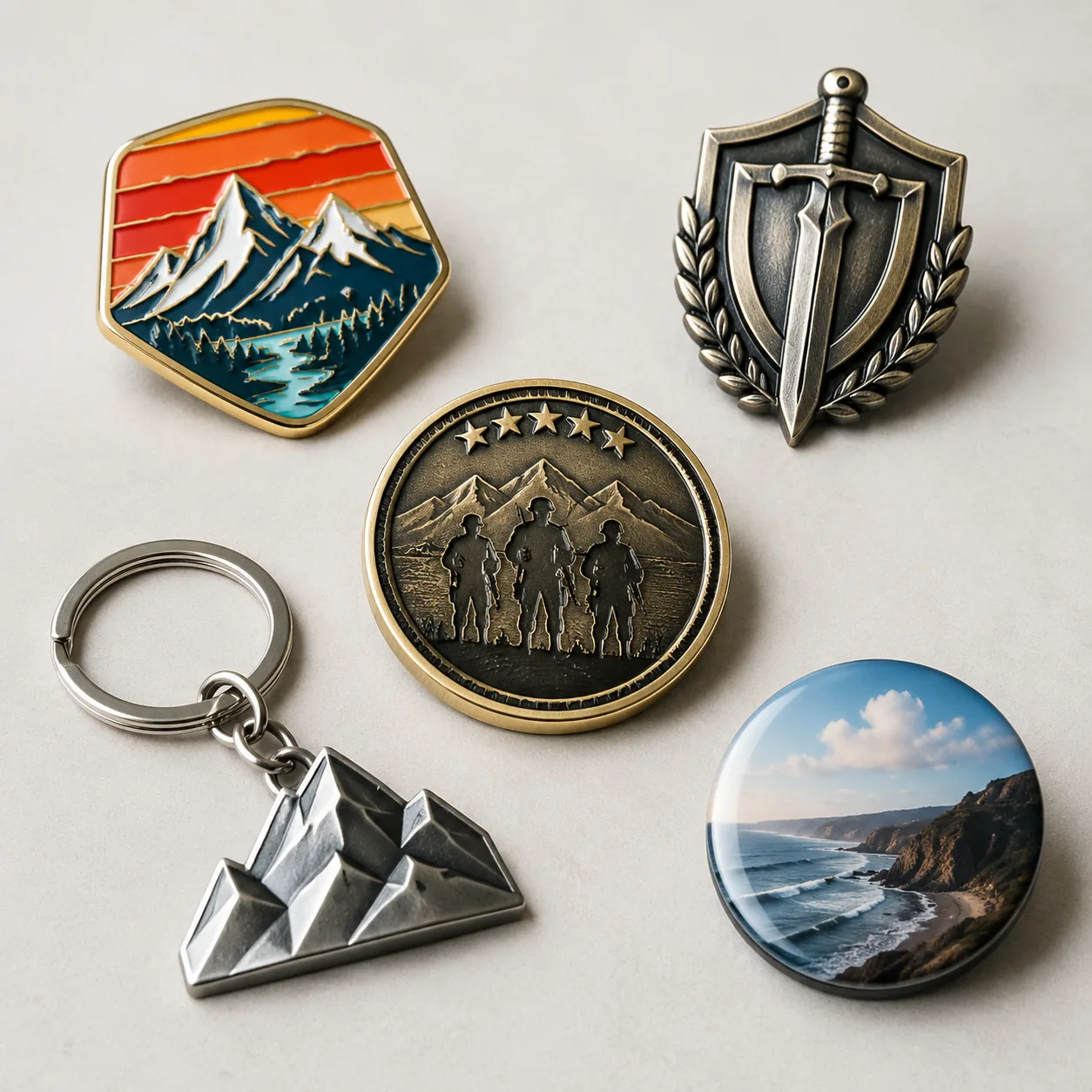
Define the construction before requesting quotes
Most pricing disputes on custom pins start before the first RFQ is answered. Buyers send the same artwork to multiple factories, but each factory quotes a different build. One prices a 32 mm stamped soft enamel pin in iron at 1.2 mm thickness. Another quotes imitation hard enamel in brass at 1.5 mm with polished edges. A third converts the job to CMYK print with epoxy because the art contains gradients, drop shadows, or text under 0.8-1.0 mm cap height. The face may look similar in a mockup, but the die cost, labor content, reject rate, wear life, and freight weight are not comparable.
That mismatch usually costs more than the unit-price gap the buyer was trying to save. If the approved sample has to be rebuilt in a different process, expect new tooling plus another 4-7 calendar days before bulk production restarts. For standard 25-40 mm pins, new dies typically run USD 40-90 for stamped iron or brass, USD 80-150 for zinc alloy die cast, and USD 25-60 for printed pins using a standard stamped base. The practical step is to narrow the project to the right process before RFQ. In this category, overruns are more often caused by choosing the wrong manufacturing method than by weak price negotiation.
Compare the five mainstream pin styles on the same commercial basis
For importers, distributors, and corporate buyers, the fastest way to get usable pricing is to shortlist two viable constructions and quote them on identical terms: same finished size, same quantity tiers, same plating, same backing, same packaging, same Incoterm, and the same use environment. A proper RFQ should state size in millimeters, nominal thickness, base metal, number of spot colors or print colors, plating finish, backing type, packaging, target AQL, and whether the item is for indoor events, daily uniform wear, boxed gifts, or outdoor use.
| Style | Best use case | Typical spec | MOQ | Lead time | FOB price at 1,000 pcs | Primary risk |
|---|---|---|---|---|---|---|
| Soft enamel stamped | Events, fundraising, retail promo | 25-40 mm, iron or brass, 1.2-1.5 mm, 3-6 spot colors | 100 pcs | 10-14 days | USD 0.38-0.82 | Uneven enamel fill, burrs, dirt retention in recessed cells |
| Imitation hard enamel | Corporate awards, alumni, premium merch | 25-38 mm, brass, 1.5-1.8 mm, polished flush face | 100 pcs | 12-16 days | USD 0.58-1.18 | Over-polishing on thin dividers, scratches visible on bright plating |
| Die struck no color | Uniform insignia, service awards, schools | 25-45 mm, brass or iron, 1.5-2.0 mm, antique or satin finish | 100 pcs | 10-14 days | USD 0.42-0.96 | Relief reads flat if depth or finish contrast is weak |
| Printed with epoxy dome | Gradients, mascots, QR codes, tiny text | 20-50 mm, stainless or brass base, 0.8-1.2 mm, CMYK + epoxy | 100 pcs | 8-12 days | USD 0.30-0.76 | Color shift, registration error, epoxy yellowing or edge shrinkage |
| Zinc alloy die cast | 3D shapes, cutouts, bottle openers, spinners | 30-50 mm, zinc alloy, 2.0-3.0 mm, multi-level relief | 100 pcs | 12-18 days | USD 0.72-1.48 | Visible parting lines, heavier weight, higher freight cost |
Use those figures only if the quote basis is truly matched. A 35 mm brass imitation hard enamel pin with two posts, backing card, and rigid gift box is not comparable to a 35 mm iron soft enamel pin with one butterfly clutch in bulk polybag. Ask suppliers to separate tooling, sample charge, unit price, and packaging adders so cost movement is visible.
Match each process to the actual job requirement
Soft enamel remains the default for event giveaways, campus promotions, fundraising, and mid-price retail. A common benchmark is a 30 mm iron pin, 1.2 mm thick, four Pantone spot colors, bright nickel plating, butterfly clutch, and individual polybag. At 1,000 pieces, FOB pricing often lands at USD 0.40-0.55; at 300 pieces, USD 0.58-0.85 is more typical because setup and die charges are spread across fewer units. The recessed color fields are intentional. If the buyer expects a jewelry-flat surface, soft enamel is the wrong specification regardless of price.
Imitation hard enamel is better suited to anniversary pins, executive gifts, alumni programs, and boxed sets where the face finish matters in hand and in photography. The color fill is polished flush to the metal, creating a smoother, harder-looking surface. For a standard 30-35 mm brass pin, reasonable tolerances are plus or minus 0.30 mm on overall size and plus or minus 0.10 mm on thickness. This process becomes risky when metal dividers drop below about 0.25 mm or when the artwork contains many small isolated color islands that can round off during polishing.
Die struck without color is one of the safest choices for conservative programs because it removes color approval, fill-level variation, and most edge contamination from the process. Antique brass, antique silver, matte nickel, and satin gold usually hide handling marks better than mirror-bright finishes. Relief depth should generally be designed at 0.25-0.40 mm on a 32-40 mm face; much shallower than that, the image looks flat at normal viewing distance. This style fits service awards, school badges, membership insignia, and financial or hospitality uniforms where formal appearance matters more than brand-color accuracy.
Printed pins with epoxy are the practical answer when the artwork includes gradients, halftones, mascot illustration, QR codes, or text under roughly 1.0 mm cap height. Printing avoids the minimum line-width limits of metal-separated enamel cells, and standard production can run in 8-12 days after artwork approval. The trade-off is wear life. Epoxy protects the print, but it can yellow slightly under UV exposure, scratch more easily than polished enamel, and shrink back at the perimeter over time. It works well for conferences, campaign merchandise, and short-lifecycle promotions. It is weaker for multi-year recognition programs.
Zinc alloy die cast should move to the top of the list when the part needs deep relief, cut-through windows, irregular outlines, moving elements, bottle opener backs, or sculpted 3D form. Standard thickness is 2.0-3.0 mm, and sizes over 45 mm are common. It is usually the wrong choice for a simple 22-25 mm corporate logo pin where crisp outlines, low weight, and low cost matter more than sculptural depth. On straightforward logo jobs, stamped brass or iron typically gives cleaner lines and lower freight cost.
Build an RFQ that forces apples-to-apples pricing
If each supplier is free to choose any process, quote comparison is unreliable. A better RFQ specifies one baseline construction and asks for pricing on the two most suitable builds plus one lower-cost alternative only if the budget target cannot be met. That method shows whether the supplier understands production trade-offs or is simply chasing the order with the cheapest process available.
A workable RFQ line reads like a control document, not a casual inquiry: 32 mm width, 1.5 mm nominal thickness, stamped brass or zinc alloy die cast as specified, four Pantone spot colors, bright nickel finish, one centered butterfly clutch, individual polybag, optional printed backing card, FOB Shenzhen, AQL 2.5 major / 4.0 minor, indoor daily wear. Then add engineering limits: minimum metal line 0.25 mm, minimum bridge width 1.0 mm, minimum text cap height 1.0 mm, enamel color tolerance against approved Pantone within commercial match standard, and post-location tolerance plus or minus 0.5 mm. Without those figures, sample review turns into a dispute over standards that should have been fixed before price approval.
- Quote quantity tiers at 100, 300, 500, 1,000, and 3,000 pieces so price breaks are visible
- State base metal clearly: iron for economy, brass for finer stamping and cleaner plating, zinc alloy for complex 3D geometry
- Define plating finish precisely: bright gold, bright nickel, antique brass, matte silver, black nickel, or dye black
- Specify packaging in the RFQ: bulk pack, individual polybag, backing card, velvet pouch, or rigid gift box
- Separate tooling charge, pre-production sample charge, and repeat-order tooling waiver into distinct line items
- Set the acceptance level in writing, commonly AQL 2.5 major and 4.0 minor for promo-grade orders
- Request carton quantity, carton dimensions, and gross weight estimate if freight cost or courier limits matter
Inspect pre-production samples with process-specific checkpoints
Sample approval should be process-specific. A generic note such as looks good is too weak to control mass production. On soft enamel, inspect fill depth consistency, clean metal walls, edge grinding, plating coverage around the post weld, and whether any burr catches fabric by touch. For a 30-35 mm pin, post centering should usually stay within plus or minus 0.5 mm. Enamel recession is normal; large low spots, pinholes, exposed base metal, contamination between adjacent color cells, and rough back-side weld marks are not.
On imitation hard enamel, inspect the face under angled light and against a dark background. The surface should feel substantially flat, with no visible wave, low pockets, or polished-through color near fine text. If brand-critical dividers are below 0.25 mm, expect some softening. For premium gift orders, many buyers tighten the control beyond lot sampling and require 100 percent front-face cosmetic screening before packing because polished surfaces show scratches immediately.
For printed epoxy pins, compare color against approved Pantone references or a calibrated print proof, but also inspect registration. Fine text should remain sharp, gradients should transition cleanly, and the dome should sit evenly without crescent-shaped edge voids, trapped dust, heavy pooling, or overflow onto the rim. On zinc alloy die cast parts, check sidewalls, cutout windows, gate cleanup, and parting lines. Mismatch is easier to see once thickness exceeds about 2.5 mm or when the perimeter has tight curves. If the part includes motion, such as a spinner or hinged element, ask for a function video and cycle test evidence before bulk approval.
Lock the production control sheet before releasing deposit
Once the sample is approved, convert it into a production control sheet. Record exact size, finished thickness, base metal, plating, attachment, packaging, approved colors, logo orientation, and any artwork deviations that were accepted during sampling. Typical tolerances for standard custom pins are plus or minus 0.30-0.50 mm on overall size, plus or minus 0.10-0.15 mm on thickness, and plus or minus 0.50 mm on post position. If the pin has dual posts, note center-to-center spacing tolerance as well, typically plus or minus 0.50 mm.
Plating requirements should also be described realistically. Decorative gold-tone, nickel-tone, or silver-tone finish layers are commonly around 0.03-0.05 micron over the normal plating stack. That is adequate for display and light wear, but it is not engineered for constant abrasion against zippers, bag hardware, or workwear. If the item will be worn on denim jackets, backpacks, or uniforms, note that environment clearly. The factory may recommend a thicker base, dual posts, a rubber clutch instead of a butterfly clutch, or an epoxy top coat over soft enamel to reduce snagging and color wear.
Acceptance standards should match the commercial grade. AQL 2.5 major and 4.0 minor is common for promo-grade orders. For recognition pins, executive gifts, or retail boxed sets, buyers often add 100 percent front-face appearance screening before insertion into pouches or gift boxes. That screening adds labor cost, but it is usually cheaper than reworking scratched premium pieces after final packing.
Compare total project risk, not just the lowest quoted unit price
The lowest unit price is often the wrong commercial choice. A printed epoxy badge may save USD 0.08-0.15 per piece versus imitation hard enamel at 1,000 units, but if the program represents membership, certification, or tenure over several years, the lower scratch resistance and long-term yellowing risk can erase that saving quickly. Soft enamel usually gives the best value when the design uses simple spot colors, metal lines of at least 0.25 mm, and text around 1.0 mm cap height or larger. Die struck no color becomes cost-efficient once the buyer removes fill operations and wants a formal look at 500 pieces and above.
| Buyer priority | Usually rank #1 | Usually rank #2 | Usually avoid when |
|---|---|---|---|
| Lowest promo cost | Soft enamel | Printed epoxy | A flat premium face is required |
| Best premium appearance | Imitation hard enamel | Die struck no color | Artwork depends on gradients, photos, or shaded mascots |
| Most formal recognition look | Die struck no color | Imitation hard enamel | Brand color is essential to recognition |
| Best for tiny detail and gradients | Printed epoxy | Imitation hard enamel for simplified art | Long outdoor UV exposure or multi-year wear is expected |
| Best for complex 3D shape | Zinc alloy die cast | Soft enamel on limited raised areas | Weight, postage cost, or low-cost mailing is critical |
Zinc alloy die cast earns its higher cost when a stamped die would create fragile bridges, awkward cutouts, or relief that stamping cannot hold cleanly. Imitation hard enamel earns its premium when face finish, gift presentation, and consistent photography matter more than achieving the lowest piece price. The right choice is the build with the lowest combined risk across tooling changes, sample revisions, cosmetic rejects, freight penalties, and post-distribution complaints.
Plan lead time, packing, and freight around the selected build
Even the correct construction can miss the launch date if production and packing assumptions are loose. For 1,000 standard pins packed in polybags, manufacturing often runs 10-16 calendar days after sample approval, depending on process complexity, plating queue, and packaging requirements. Air freight commonly adds 4-8 days depending on route and customs handling. Gift-box insertion, printed backing-card assembly, barcode labeling, retailer carton marks, and export-carton drop-test requirements can each add 1-3 days if they were not included in the original schedule.
Get packing data before bulk starts, not after the order is finished. A 32 mm pin in a polybag ships densely and keeps freight efficient. The same pin in a foam-insert rigid box can multiply carton volume several times and materially increase landed cost, especially on courier and air shipments billed by volumetric weight. For date-sensitive projects such as conferences, employee anniversaries, or retail launches, add at least seven calendar days of buffer beyond the stated factory finish date. In most custom pin programs, the biggest delays come from slow artwork approval, unclear sample feedback, and freight handoff after packing rather than from the metal process itself.
Have a project? Send your artwork and target quantity and we’ll reply with a detailed quotation within 12 working hours.
Ready to get this made?
Send your sketch, target quantity and ship-date. Detailed quotation in 12 hours.



