Top 5 Custom Pin Plating Finishes for 2026: Buyer Specs That Prevent Tarnish
Why Plating Finish Choice Is a QC Problem, Not Just a Look
You’ve seen it before: a beautiful custom pin arrives, looks perfect on the sample, then after three weeks in a distributor’s warehouse or two days at a trade show, the plating dulls, spots, or turns green. That’s not a defect you can return—it’s a spec failure. In 2026, buyers are demanding plating finishes that hold up to real-world handling, not just lab photos. The finish you choose directly affects tarnish resistance, scratch tolerance, and reorder consistency.
This guide ranks the top five plating finishes for custom enamel pins, coins, and badges based on durability, cost, and aesthetic range. Each finish is rated using buyer criteria: tarnish resistance (accelerated neutral salt spray test per ASTM B117 at 24 hours), scratch hardness (pencil hardness test per ASTM D3363), color stability under UV (ISO 4892-2, 200 hours), and FOB price per unit at a 500-piece MOQ for a 1.5-inch hard enamel pin. No hype, no invented awards—just factory-floor specs that prevent returns.
Evaluation Criteria: What Matters for 2026 Buyers
Before ranking, here are the five criteria every procurement manager should use when comparing plating finishes. These are not marketing claims—they are measurable specs you can write into your RFQ.
- Tarnish resistance: Measured by neutral salt spray (NSS) exposure per ASTM B117. Minimum acceptable: 24 hours without visible corrosion (pitting, spotting, or discoloration). Premium: 48+ hours.
- Scratch hardness: Pencil hardness test per ASTM D3363. Minimum: 2H. Good: 4H. Best: 6H or above (e.g., 6H resists scratching from a 6H pencil lead).
- Color stability: UV resistance per ISO 4892-2. No visible change (Delta E ≤ 2.0) after 200 hours of accelerated UV exposure.
- Consistency across batches: Delta E ≤ 2.0 between production runs, measured with a spectrophotometer (e.g., Konica Minolta CM-2600d).
- FOB price range (USD per unit): At 500-piece MOQ for a 1.5-inch hard enamel pin. Includes plating, polishing, and clear epoxy dome if specified. Lead time in working days from sample approval.
Top 5 Plating Finishes for Custom Pins in 2026
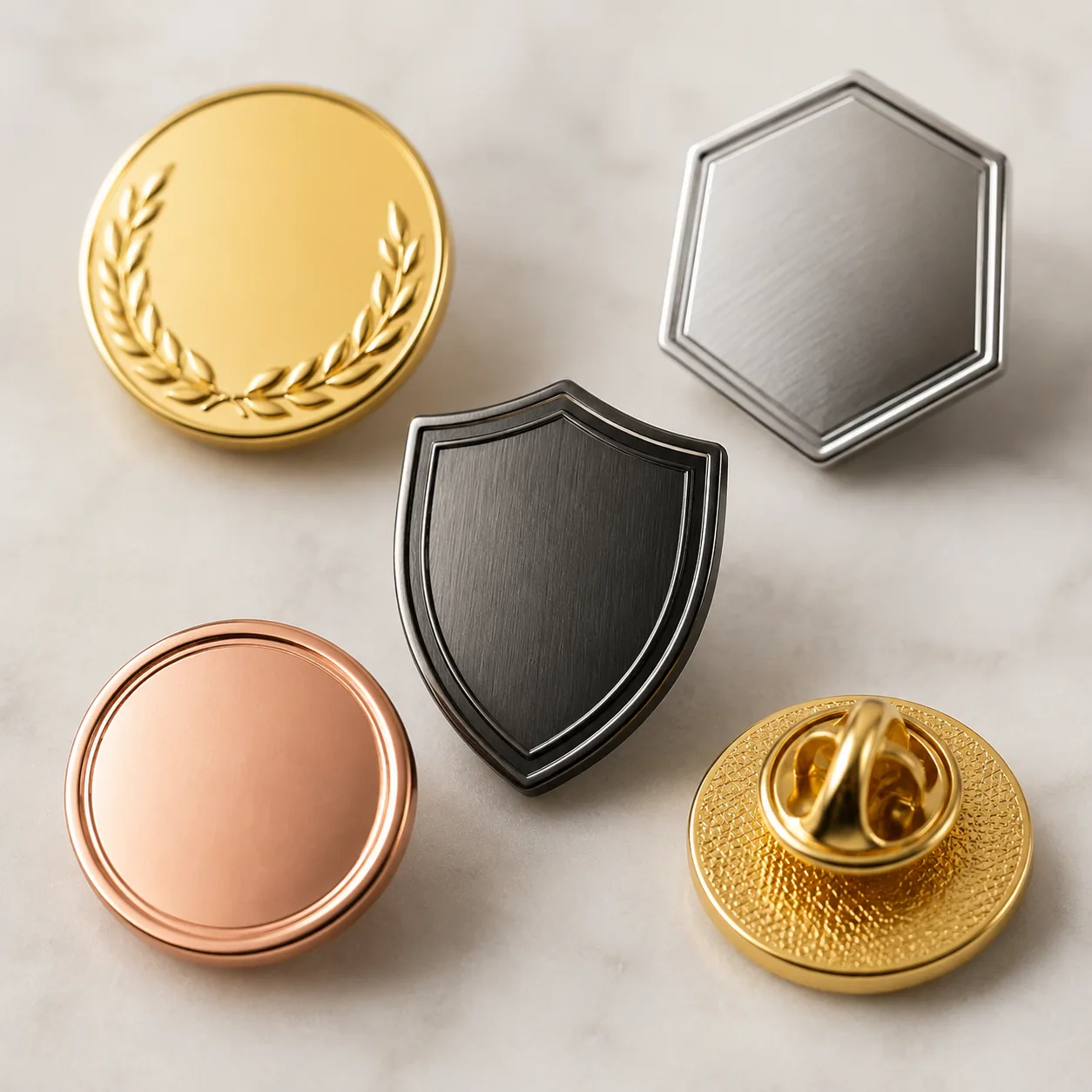
Based on factory production data from ZheCraft’s Yiwu facility and feedback from B2B buyers across promotional, corporate gift, and event verticals, here are the five finishes that deliver the best balance of durability, cost, and aesthetic flexibility.
| Rank | Finish | Tarnish Resistance (NSS 24h) | Scratch Hardness | Color Stability (UV 200h) | FOB Price Range (USD/unit, 500pcs) | Lead Time (Working Days) |
|---|---|---|---|---|---|---|
| 1 | Ruthenium (Dark Gunmetal) | Pass (48h+ premium option; no pitting at 48h) | 6H | Excellent (Delta E < 1.5) | $0.85–$1.20 | 18–22 |
| 2 | Antique Brass (Oxidized) | Pass (24h standard; minor patina shift after 48h) | 4H | Very Good (Delta E < 2.0 with lacquer) | $0.65–$0.95 | 15–20 |
| 3 | Black Nickel (Matte) | Pass (24h standard; requires dome for >24h) | 4H | Good (Delta E < 2.5 without dome) | $0.70–$1.00 | 18–22 |
| 4 | Bright Gold (Electroplated) | Marginal (12–24h; fails at 24h without dome) | 2H | Fair (Delta E > 3.0 without dome) | $0.90–$1.30 | 20–25 |
| 5 | Silver (Rhodium-Plated) | Pass (48h standard; no tarnish at 72h) | 5H | Excellent (Delta E < 1.0) | $1.10–$1.50 | 20–25 |
Note: Bright gold plating often requires a clear epoxy dome (0.5–0.8 mm thickness) to prevent tarnish. Without it, gold is the least durable finish on this list—expect visible tarnish within 2–4 weeks in humid environments (e.g., >60% RH). Rhodium-plated silver offers the best tarnish resistance but at the highest cost. Ruthenium is the 2026 standout for buyers who want a dark, modern look without the maintenance headaches of black nickel.
1. Ruthenium: The 2026 Workhorse for Dark Finishes
Ruthenium is a platinum-group metal that plates onto brass or zinc alloy with a deep gunmetal gray tone (similar to RAL 7021 or Pantone 18-0403 TPX). It is significantly harder than black nickel (6H vs 4H) and passes 48-hour NSS testing without pitting or corrosion. In 2026, it is the go-to finish for corporate gift pins and challenge coins that need to survive shipping, handling, and display without re-plating.
Specs to write into your RFQ: Minimum plating thickness 0.2 microns, with a nickel underplate of 1.0 micron (minimum). Request a salt spray test certificate from the batch (ASTM B117, 48-hour pass). FOB price: $0.85–$1.20 per unit at 500 pieces. Lead time: 18–22 working days including sample approval.
Trade-off: Ruthenium cannot be polished to a mirror shine. It is a matte-to-satin finish only (gloss level 10–30 GU at 60°). If you need high-gloss (e.g., >80 GU), choose rhodium or bright gold with a dome.
2. Antique Brass: Best for Vintage and Themed Lines
Antique brass (also called oxidized brass) is created by applying a chemical patina to bright brass plating, then highlighting the raised areas. The result is a warm, aged look that hides fingerprints and minor scratches. It passes 24-hour NSS testing reliably and holds a 4H pencil hardness.
Specs: Specify a clear lacquer topcoat (0.1–0.2 microns) to lock the patina and prevent further oxidation. Without lacquer, antique brass will continue to darken over time—acceptable for some designs but a risk for color-consistent reorders (Delta E can drift >3.0 over 6 months). FOB price: $0.65–$0.95 per unit. Lead time: 15–20 working days.
Best for: Promotional pins for heritage brands, event badges with a retro theme, and custom coins for military or fraternal orders. Not recommended for outdoor use or high-humidity environments (e.g., >70% RH) without the lacquer spec.
3. Black Nickel: Popular but Requires a Dome
Black nickel is a matte black finish achieved by adding a black dye to the nickel plating bath. It is widely used for modern, minimalist pin designs. However, it is softer than ruthenium (4H) and can show wear on edges after repeated handling. Without a clear epoxy dome, black nickel will begin to tarnish within 3–6 months in normal office conditions (e.g., 40–60% RH, 20–25°C).
Specs: Always pair black nickel with a full epoxy dome (0.5–0.8 mm thickness). The dome protects the plating from moisture and abrasion. Request a tape adhesion test (ASTM D3359, Class 5B) to ensure the dome does not peel. FOB price: $0.70–$1.00 per unit. Lead time: 18–22 working days.
When to skip: If your pin has fine detail or raised text that you want to feel, the dome will smooth over those textures (reducing tactile definition). In that case, choose ruthenium instead.
4. Bright Gold: High Impact, High Maintenance
Bright gold plating is the most visually striking finish—rich, reflective, and associated with premium quality. But it is also the least durable on this list. Pure gold is soft (2H pencil hardness) and porous at plating thicknesses under 0.5 microns. Without a protective layer, it will tarnish within 2–4 weeks in humid environments (e.g., >60% RH).
Specs: Require a clear epoxy dome over the entire pin surface, not just the enamel areas. Specify a minimum gold plating thickness of 0.3 microns with a nickel underplate of 1.5 microns. Accept only 24-hour NSS pass (with dome). FOB price: $0.90–$1.30 per unit. Lead time: 20–25 working days.
Best for: Limited-edition corporate gifts, award pins, and luxury promotional items where the visual impact justifies the extra cost and care. Not for high-volume giveaways or items that will be handled frequently (e.g., >50 touches per day).
5. Rhodium-Plated Silver: The Premium Anti-Tarnish Choice
Rhodium is a platinum-group metal that plates bright white, similar to silver but with far superior tarnish resistance. It passes 48-hour NSS testing (no tarnish at 72h), holds a 5H hardness, and does not require a dome. It is the most expensive finish on this list but eliminates the tarnish complaints that plague silver-plated pins.
Specs: Minimum rhodium thickness 0.1 microns over a 1.0-micron nickel underplate. No dome needed. Request a 48-hour NSS certificate (ASTM B117). FOB price: $1.10–$1.50 per unit. Lead time: 20–25 working days.
When to choose: For high-end challenge coins, luxury brand pins, and any application where the pin must stay bright white for years (e.g., >5 years without visible tarnish). Avoid if your design uses matte or satin finishes—rhodium is naturally bright (gloss level >80 GU at 60°).
How to Write Plating Specs Into Your RFQ (Checklist)
To prevent tarnish and reorder inconsistency, include these five items in every RFQ for plated pins. Copy and paste this checklist into your spec sheet.
- Plating finish name and color reference (e.g., Ruthenium, RAL 7021 or Pantone 18-0403 TPX).
- Minimum plating thickness in microns (e.g., 0.2 microns for ruthenium, 0.3 for gold, 0.1 for rhodium).
- Underplate material and thickness (e.g., nickel, 1.0 micron minimum for ruthenium; 1.5 microns for gold).
- Topcoat or dome specification (e.g., clear epoxy dome 0.5–0.8 mm thickness, or clear lacquer 0.1–0.2 microns).
- Testing requirements: NSS 24-hour pass (ASTM B117), pencil hardness 4H minimum (ASTM D3363), and tape adhesion for domes (ASTM D3359, Class 5B).
What to Do Next: Lock Your Finish Spec Before Sampling
Plating is the single most common cause of rework in custom pin orders—not because factories can’t do it, but because buyers don’t specify the right finish for their use case. Use the table in this guide to select your finish based on durability needs, not just appearance. Then add the checklist specs to your RFQ.
If you are sourcing for a 2026 corporate gift line or a multi-year promotional program, request a pre-production sample with the exact plating finish and test it under your own conditions: rub it with a damp cloth (100 rubs at 500g force), leave it on a desk for two weeks (at 40–60% RH, 20–25°C), and check for color change (Delta E ≤ 2.0). That sample is your golden reference for every reorder.
At ZheCraft, we maintain in-house salt spray and hardness testing for every plating batch. We can provide certificates with each shipment. When you write your RFQ, ask for the specific test results—not just a promise. That’s how you prevent tarnish before it starts.
Have a project? Send your artwork and target quantity and we’ll reply with a detailed quotation within 12 working hours.
Ready to get this made?
Send your sketch, target quantity and ship-date. Detailed quotation in 12 hours.



